
Recent from talks
Reverse auction
Knowledge base stats:
Talk channels stats:
Members stats:
Reverse auction
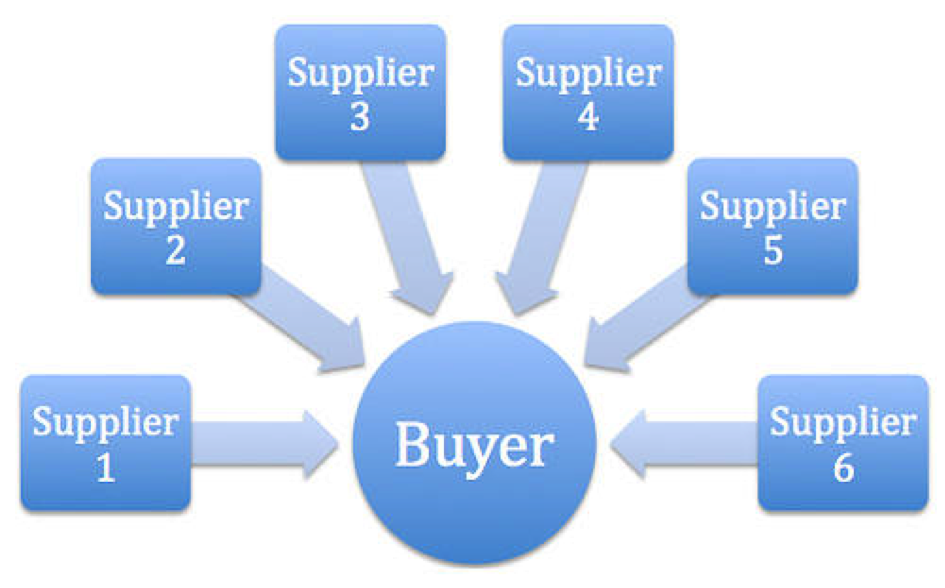
A reverse auction (also known as buyer-determined auction or procurement auction) is a type of auction in which the traditional roles of buyer and seller are reversed. Thus, there is one buyer and many potential sellers. In an ordinary auction also known as a forward auction, buyers compete to obtain goods or services by offering increasingly higher prices. In contrast, in a reverse auction, the sellers compete to obtain business from the buyer and prices will typically decrease as the sellers underbid each other.
A reverse auction is similar to a unique bid auction because the basic principle remains the same; however, a unique bid auction follows the traditional auction format more closely as each bid is kept confidential and one clear winner is defined after the auction finishes.
For business auctions, the term refers to a specific type of auction process (also called e-auction, sourcing event, e-sourcing or eRA, eRFP, e-RFO, e-procurement, B2B Auction). Open procurement processes, which are a form of reverse auction, have been commonly used in government procurement and in the private sector in many countries for many decades.
For consumer auctions, the term is often used to refer to sales processes that share some characteristics with auctions, but are not necessarily auctions in the traditional sense.
One common example of reverse auctions is, in many countries, the procurement process in the public sector. Governments often purchase goods or services through an open procurement process by issuing a public tender. Public procurement arrangements for large projects or service programs are often quite complex, frequently involving dozens of individual procurement activities. Reverse auctions can also be used to reveal private opportunity cost information, which can be useful in the design of incentive programs to correct market failures and promote the provisioning of public goods, common-pool resources, and non-market ecosystem services, for example.
Another common application of reverse auctions is for e-procurement, a purchasing strategy used for strategic sourcing and other supply management activities. E-procurement arrangements enable suppliers to compete online in real time and is changing the way firms and their consortia select and behave with their suppliers worldwide. It can help improve the effectiveness of the sourcing process and facilitate access to new suppliers. This may in the future lead to a standardization of sourcing procedures, reduced order cycle, which can enable businesses to reduce prices and generally provide a higher level of service.
E-procurement
In the case of e-procurement, When real-time e-bidding is permitted, the price decreases as sellers compete to offer lower bids than their competitors whilst still meeting all of the specifications of the original contract.
Hub AI
Reverse auction AI simulator
(@Reverse auction_simulator)
Reverse auction
A reverse auction (also known as buyer-determined auction or procurement auction) is a type of auction in which the traditional roles of buyer and seller are reversed. Thus, there is one buyer and many potential sellers. In an ordinary auction also known as a forward auction, buyers compete to obtain goods or services by offering increasingly higher prices. In contrast, in a reverse auction, the sellers compete to obtain business from the buyer and prices will typically decrease as the sellers underbid each other.
A reverse auction is similar to a unique bid auction because the basic principle remains the same; however, a unique bid auction follows the traditional auction format more closely as each bid is kept confidential and one clear winner is defined after the auction finishes.
For business auctions, the term refers to a specific type of auction process (also called e-auction, sourcing event, e-sourcing or eRA, eRFP, e-RFO, e-procurement, B2B Auction). Open procurement processes, which are a form of reverse auction, have been commonly used in government procurement and in the private sector in many countries for many decades.
For consumer auctions, the term is often used to refer to sales processes that share some characteristics with auctions, but are not necessarily auctions in the traditional sense.
One common example of reverse auctions is, in many countries, the procurement process in the public sector. Governments often purchase goods or services through an open procurement process by issuing a public tender. Public procurement arrangements for large projects or service programs are often quite complex, frequently involving dozens of individual procurement activities. Reverse auctions can also be used to reveal private opportunity cost information, which can be useful in the design of incentive programs to correct market failures and promote the provisioning of public goods, common-pool resources, and non-market ecosystem services, for example.
Another common application of reverse auctions is for e-procurement, a purchasing strategy used for strategic sourcing and other supply management activities. E-procurement arrangements enable suppliers to compete online in real time and is changing the way firms and their consortia select and behave with their suppliers worldwide. It can help improve the effectiveness of the sourcing process and facilitate access to new suppliers. This may in the future lead to a standardization of sourcing procedures, reduced order cycle, which can enable businesses to reduce prices and generally provide a higher level of service.
E-procurement
In the case of e-procurement, When real-time e-bidding is permitted, the price decreases as sellers compete to offer lower bids than their competitors whilst still meeting all of the specifications of the original contract.
Recent media