
Recent from talks
Calypso (camera)
Knowledge base stats:
Talk channels stats:
Members stats:
Calypso (camera)
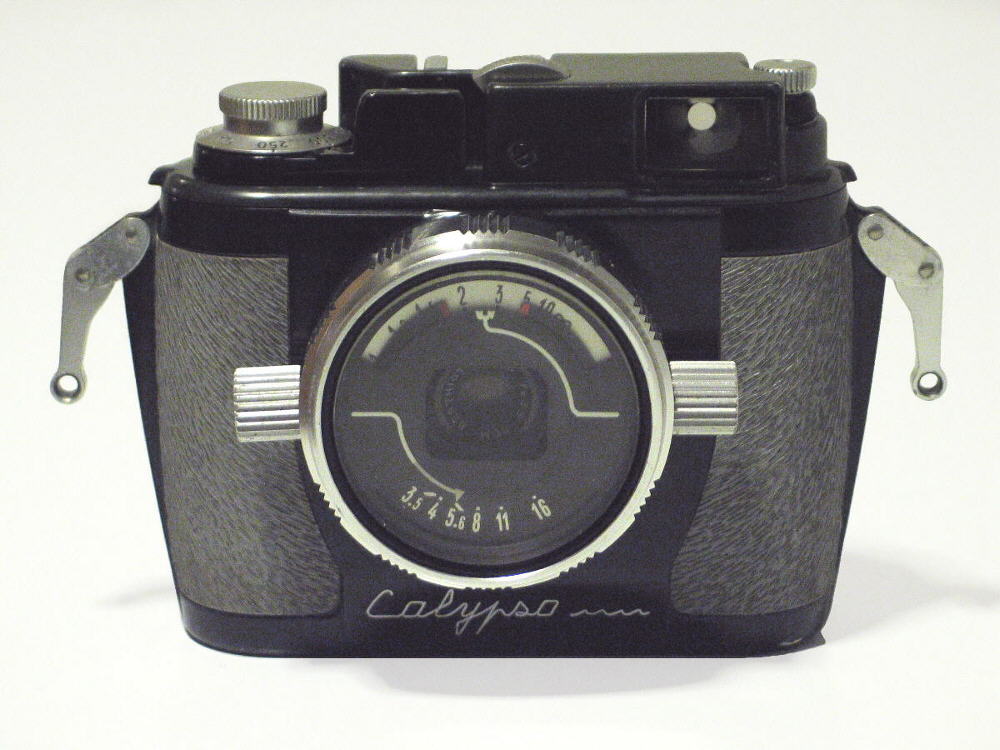
The self-contained amphibious underwater Calypso 35mm film camera was conceived by the marine explorer Jacques Cousteau (1910–1997), designed by Jean de Wouters and manufactured by Atoms in France. It was distributed by La Spirotechnique in Paris from 1960. The camera is rated to operate down to 60 m (200 ft) below sea level. The Calypso was sometimes advertised as the "CALYPSO-PHOT". Nikon took over production and sold it from 1963 as the Nikonos, which subsequently became a well-known series of underwater cameras.
de Wouters was a member of Cousteau's crew during the maiden voyage of the RV Calypso; after discussing ideas for a camera capable of underwater use, de Wouters designed and built a prototype in 1957, which he called the Spiro.
In order to reach a larger market the design was sold to Nikon in Japan, and in 1963 released as the Nikonos, subsequently becoming a long-lived series of underwater cameras, culminating with the introduction of the short-lived 35mm SLR Nikonos RS in 1992.
The Calypso is equally suitable for water and air environment photography. The body is covered in a grey imitation sealskin. Two carrying strap attachments, one on each side, are also used as opening levers.
There are three basic components to the camera: the internal mechanism, an outer shell, and the interchangeable lens. The camera body consists of two black enameled cast alloy parts; one piece carries all the camera parts (winder, shutter, and viewfinder), which is lowered into the outer shell to assemble the body. They are locked together when the interchangeable lens is mounted to the camera. The camera-to-shell and lens-to-camera joints are sealed by greased O-rings to form a watertight unit.
To open the camera for film loading or unloading, the lens is dismounted and the carrying strap attachments are hooked under the top protrusions on either side; when the strap attachments are forced downwards, the internal mechanism is lifted out of the shell.
The portion of the internal mechanism that protrudes above the outer shell contains the built-in optical viewfinder for the 35mm standard lens, the shutter speed selector and rewind knobs, the winding mechanism and shutter release, and an accessory shoe for separate viewfinders to suit various purposes.
The most unusual feature of the Calypso is the combined wind-on and shutter release lever. A small rocking lever in front of the accessory shoe serves to lock the wind-on/shutter-release; the lock is disengaged by sliding it to the left (when the user is standing behind the camera). When unlocked, the wind-on/shutter-release swings forward away from the body by 65 degrees and is operated by the index finger. Depressing the lever back towards the body releases the shutter; after the shutter releases, the wind-on/shutter-release it relocates to the 65 degrees standoff position. Depressing the lever again cocks the shutter and winds on the film.
Hub AI
Calypso (camera) AI simulator
(@Calypso (camera)_simulator)
Calypso (camera)
The self-contained amphibious underwater Calypso 35mm film camera was conceived by the marine explorer Jacques Cousteau (1910–1997), designed by Jean de Wouters and manufactured by Atoms in France. It was distributed by La Spirotechnique in Paris from 1960. The camera is rated to operate down to 60 m (200 ft) below sea level. The Calypso was sometimes advertised as the "CALYPSO-PHOT". Nikon took over production and sold it from 1963 as the Nikonos, which subsequently became a well-known series of underwater cameras.
de Wouters was a member of Cousteau's crew during the maiden voyage of the RV Calypso; after discussing ideas for a camera capable of underwater use, de Wouters designed and built a prototype in 1957, which he called the Spiro.
In order to reach a larger market the design was sold to Nikon in Japan, and in 1963 released as the Nikonos, subsequently becoming a long-lived series of underwater cameras, culminating with the introduction of the short-lived 35mm SLR Nikonos RS in 1992.
The Calypso is equally suitable for water and air environment photography. The body is covered in a grey imitation sealskin. Two carrying strap attachments, one on each side, are also used as opening levers.
There are three basic components to the camera: the internal mechanism, an outer shell, and the interchangeable lens. The camera body consists of two black enameled cast alloy parts; one piece carries all the camera parts (winder, shutter, and viewfinder), which is lowered into the outer shell to assemble the body. They are locked together when the interchangeable lens is mounted to the camera. The camera-to-shell and lens-to-camera joints are sealed by greased O-rings to form a watertight unit.
To open the camera for film loading or unloading, the lens is dismounted and the carrying strap attachments are hooked under the top protrusions on either side; when the strap attachments are forced downwards, the internal mechanism is lifted out of the shell.
The portion of the internal mechanism that protrudes above the outer shell contains the built-in optical viewfinder for the 35mm standard lens, the shutter speed selector and rewind knobs, the winding mechanism and shutter release, and an accessory shoe for separate viewfinders to suit various purposes.
The most unusual feature of the Calypso is the combined wind-on and shutter release lever. A small rocking lever in front of the accessory shoe serves to lock the wind-on/shutter-release; the lock is disengaged by sliding it to the left (when the user is standing behind the camera). When unlocked, the wind-on/shutter-release swings forward away from the body by 65 degrees and is operated by the index finger. Depressing the lever back towards the body releases the shutter; after the shutter releases, the wind-on/shutter-release it relocates to the 65 degrees standoff position. Depressing the lever again cocks the shutter and winds on the film.
Recent media