Hubbry Logo
Camp HaleCamp HaleMain
Open search
Camp Hale
Community hub
Camp Hale
logo
8 pages, 0 posts
0 subscribers
Be the first to start a discussion here.
Camp Hale
Camp Hale
from Wikipedia

Camp Hale Site
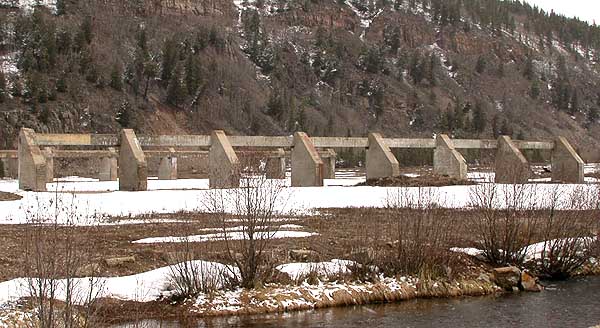
Concrete ruins of the field house
LocationEagle County,
Colorado, U.S.
Nearest cityRed Cliff, Colorado
Coordinates39°26′35″N 106°19′22″W / 39.4430°N 106.3228°W / 39.4430; -106.3228 (Camp Hale)
Built1942; 83 years ago (1942)
ArchitectU.S. Army
NRHP reference No.78003522[1]
Added to NRHP10 April 1992
Camp Hale is located in Colorado
Camp Hale
Camp Hale
Location of Camp Hale

Camp Hale was a U.S. Army training facility in the western United States, constructed in 1942 for what became the 10th Mountain Division. Located in central Colorado between Red Cliff and Leadville in the Eagle River Valley at an elevation of 9,238 feet (2,815 m), it was named for General Irving Hale. Onslow S. Rolfe, who had developed mountain warfare techniques as commander of the 87th Mountain Infantry Regiment, was selected to command Camp Hale.[2]

Soldiers were trained in mountain climbing, Alpine and Nordic skiing, cold-weather survival, and various weapons and ordnance. When it was in full operation, approximately 15,000 soldiers were housed there.

The creation of an elite ski corps was a national effort, with assistance from the National Association of Ski Patrol, local ski clubs, and Hollywood. Enough men were recruited to create three army regiments, which were deployed after training. Camp Hale was decommissioned in November 1945.

On 12 October 2022, President Joe Biden designated Camp Hale and a noncontiguous nearby part of the Tenmile Range as Camp Hale—Continental Divide National Monument.[3][4][5] It comprises 53,804 acres (84 sq mi; 218 km2), which will be managed by the White River National Forest unit of the U.S. Forest Service. Conversion of the site to a monument will not affect any permits held by the neighboring ski resorts and the monument will continue to support a wide range of motorized and non-motorized recreation opportunities.[6][7]

World War II

[edit]

Construction

[edit]

The armed ski corps in the U.S. was based on the ski warfare tactics of the Finnish Army during the Winter War (1939–1940). Early in the effort, 8,000 skiers and outdoorsmen were recruited.[8] The camp was built to accommodate the effort at a cost of $30 million.[9]

The War Department chose the location at 9,200 feet (2,800 m)[10] because the Denver and Rio Grande Western Railroad stopped at Pando rail station and historically the snowfall in the Tennessee Pass area was plentiful. Construction of the camp began in the spring of 1942 and finished seven months later; during that period Highway 24 was moved, a sewage system installed to prevent pollution in the nearby town of Red Cliff, and the meadow drained. Additionally, the nearby town of Leadville to the south, the only source of recreation for the trainees, was persuaded to change its moral character, perceived "to be on a rather low plane."

The camp included mess halls, infirmaries, a ski shop, administrative offices, a movie theater, and stables for livestock.[11] White painted barracks for 15,000 soldiers were built straight lines on the mountain meadow, but when the first trainees of the 87th Regiment of the 10th Light Division, quickly renamed the 10th Mountain Division, arrived in the winter of 1942 only a small portion of barracks were filled. The War Department needed to train more skiers in the elite fighting ski corps and asked the American Ski Patrol Association to contact ski racing clubs, ski schools, and local patrol units, nationwide—each applicant had to supply three letters of recommendation.[9]

Recruitment

[edit]

After 1942 problems in communication caused by the war slowed the recruitment effort. However, that year, Darryl Zanuck released Sun Valley Serenade, starring Sonja Henie and featuring the Glenn Miller Orchestra, and filmed on location in Sun Valley. The movie was a hit and the Hollywood effort helped to interest trainees in the ski corps. Two more wartime movies were made, each filmed at Camp Hale, featuring the white-clad elite troops—Mountain Fighters in 1943 and I Love a Soldier in 1944.[12] The ski corps was featured on national magazine covers and popular radio shows.[8] Although the effort brought in recruits to add the 86th and 85th Regiments for a full division, recruiters realized not enough skiers existed to fill the new regiments; thereafter, efforts were made to bring in rugged outdoorsmen of all types with the slogan that the 10th Mountain Division was made up of "college boys to cowboys".[13] In addition, 200 women from the Women's Army Corps were brought in for administrative support.[14]

Training

[edit]
Lloyd E. Jones observes troops land at Amchitka Island during the Aleutians Campaign, shortly before assuming command of the 10th Light Division at Camp Hale.

By 1943, Camp Hale had as many as 14,000 men in training.[8] Conditions in the camp were harsh: the altitude required acclimation and the shallow valley created polluted inversion layers, as the primary energy source was coal. Recreation (outside of skiing) was non-existent because of the camp's high mountain isolation, which prevented even the USO from visiting, and many of the non-skiing trainees hated skiing.[13] Trainees were taught to ski at Cooper Hill by ski instructors, brought from the ski-areas such as Sun Valley and Waterville Valley.[8] Located three miles (5 km) south of the camp, Cooper Hill had on-site barracks for the instructors and a newly built T-bar lift for the trainees.[15]

Military use of Camp Hale included the 10th Mountain Division, commanded by Lloyd E. Jones, the 38th Regimental Combat Team, the Norwegian-American 99th Infantry Battalion (Separate), and soldiers from Fort Carson conducting mountain and winter warfare training exercises. Trainees were taught skiing, mountain climbing, snow survival skills (such as building snow caves), and winter combat. Also present at Camp Hale was the 620th Engineer General Service Company, a unit composed of suspected unreliable German-Americans or soldiers with suspected pro-National Socialist beliefs.[16]

Camp Hale was active for just three years; it was deactivated in November 1945 and the 10th Mountain Division moved to Texas.[17]

Prisoner of war camp

[edit]

Camp Hale held "about 400 of the most incorrigible members of Field Marshal Erwin Rommel's Afrika Corps".[18] On 15 February 1944, guard Private Dale Maple of the 620th Engineer General Service Unit drove away with German Sergeants Heinrich Kikillus and Erhard Schwichtenberg. They made it to Mexico before being arrested and turned over to U.S. authorities. In an unrelated scandal, in March 1944, five WACs were charged with exchanging notes with the prisoners.[19] Three received sentences of four to six months of confinement.[20] The army used POWs to dismantle most of the structures in 1945.[21]

Late 20th century

[edit]

Many Tibetan resistance fighters were secretly trained at Camp Hale by the CIA. "By February 1963, four groups totaling 135 Tibetans (ten more than originally planned) had arrived at Hale."[22] This was "... the first wave of Tibetans."[23] The site was chosen because of the similarities of the terrain and elevation with the Himalayan Plateau, being heavily mountainous and over 10,000 feet above sea level. The fighters were trained in the use of mortars, explosive, and rifles and instructed in the art of guerilla warfare and subterfuge. The Tibetans nicknamed the camp "Dhumra", meaning "The Garden", due to their enriched hatred of the Chinese occupation of their country. To cover up their newly heightened activity within the camp, the CIA circulated a story in the local press that Camp Hale was to be the site of atomic tests and would be a high security zone going forward. Until the camp was closed in 1964, the entire area was cordoned off and its perimeter patrolled by military police to keep any unwanted eyes away. In all, around 259 Tibetans were trained at Camp Hale, and after it was dismantled, no Tibetans remained in Colorado having all be redeployed into their homeland to fight against the Chinese. From 1958 to 1960, Anthony Poshepny trained various special missions teams, including Tibetan Khambas and Hui Muslims, for operations in China against the communist government.[24]

In 1965, Camp Hale was dismantled and the land was deeded to the U.S. Forest Service. Since 1974, the area has become a youth development training center. An Eagle County non-profit organization, SOS Outreach, has used the site to expose disadvantaged youth to many of the same outdoor challenges experienced by the 10th Mountain Division.[25]

In 1962, Pete Seibert, who was among the soldiers who trained at Camp Hale and then returned to the area after the war, founded the Vail Ski Resort nearby.

In July and August 1985 the valley was the site of the North American Pathfinder camporee with 16,129 attending.[26]

Then and Now

Current status

[edit]

In 2003, the U.S. Army Corps of Engineers began a cleanup effort to remove some of the unexploded ordnance at the site in conjunction with several other government agencies. This effort is still ongoing.

Most of the remnants of Camp Hale are located in the White River National Forest. There are camping grounds where overnight camping is permitted on this former army base. Several informational plaques are located throughout the area. These plaques contain historical information about camp construction, the 99th Infantry Battalion, ski training, rock climbing/alpine training, the motor pool area, CIA training, and camp entertainment.[27]

National Monument

[edit]

In 2019, the Camp Hale site was proposed to be the first National Historic Landscape, under the Colorado Outdoor Recreation & Economy (CORE) Act, which would designate 28,728 acres for preservation.[28] Congressman Joe Neguse hosted Agriculture Secretary Tom Vilsack, Colorado Governor Jared Polis, and U.S. Senators Michael Bennet and John Hickenlooper at Camp Hale on 22 August 2022, in support of the bill.[29] With the bill stalled in Congress,[30][31] on 12 October 2022, President Biden visited the site with the same five leaders and used the Antiquities Act to declare the site a national monument, the 53,804-acre Camp Hale – Continental Divide National Monument.[32] While the designation had support of area mayors and county commissioners and "drew a flurry of praise from political, social and conservation groups", various conservative politicians spoke out in opposition to the new national monument.[33] A survey had found 86% of Coloradans supported national monument protections for Colorado recreation and conservation areas.[34]

The monument includes approximately 28,684 acres in the Camp Hale area and 25,210 acres in the Tenmile area. The Tenmile area was originally proposed in the CORE Act to be recreation management area and wilderness area. The Continental Divide Trail passes through both sections for approximately 20 miles.[35]

See also

[edit]

References

[edit]

Sources

[edit]

Further reading

[edit]
[edit]
Revisions and contributorsEdit on WikipediaRead on Wikipedia
from Grokipedia

Camp Hale was a training facility established in 1942 in the Pando Valley of , at an elevation of approximately 9,250 feet, specifically designed to prepare troops for mountain and winter warfare during .
Construction began in April 1942, and the camp opened for operations on November 16, 1942, serving as the primary base for the , which trained over 13,000 soldiers in rigorous alpine combat, skiing, and mountaineering techniques under harsh high-altitude conditions.
The facility's specialized curriculum, developed in response to the need for troops capable of operating in rugged, snow-covered terrain similar to European battlefields, contributed to the division's effectiveness in campaigns such as the Italian Campaign, where they helped breach fortified mountain positions.
Following the war's end, Camp Hale saw sporadic use until its deactivation in November 1945, after which the site was largely abandoned, though its legacy influenced post-war advancements in and for cold-weather operations.
In October 2022, President designated Camp Hale—along with adjacent areas—as the Camp Hale-Continental Divide to protect its historical, cultural, and ecological value, including remediation of environmental impacts from military activities like explosives training.

Establishment and World War II

Site Selection and Construction

The U.S. Army selected the Pando Valley site in Eagle County, Colorado, for Camp Hale due to its high elevation of approximately 9,200 to 9,250 feet, which provided challenging mountainous terrain and access to peaks exceeding 12,000 feet, ideal for training in alpine and winter warfare conditions similar to those anticipated in Europe. The location also offered substantial annual snowfall averaging 250 inches, enabling realistic ski and cold-weather exercises, while its size supported up to 15,000 troops. Additional factors included reliable water from the Eagle River, proximity to Highway 24 and the Denver & Rio Grande Railroad for logistics, and its position about 100 miles west of Denver near Leadville, balancing isolation for training with accessibility. The choice was informed by evaluations of multiple U.S. sites and drew inspiration from Finnish ski troops' effectiveness against Soviet forces, highlighting the need for specialized mountain units. Construction was authorized in March 1942 following site approval, with work commencing in April 1942 under the civilian firm Pando Constructors. Over 10,000 workers, primarily men exempt from the draft or beyond enlistment age, completed the project in seven months despite high-altitude challenges, manual earth-moving of millions of cubic yards, and a compressed timeline; they were housed in 88 on-site barracks supplemented by 2,800 off-site accommodations. The initial budget of $5 million escalated to approximately $30-31 million, funding over 1,000 structures on 1,457 acres, including 226 barracks, a 676-bed hospital, administration buildings, stables, a veterinary center, field house, parade grounds, recreation facilities, and firing ranges. Engineering efforts involved rechanneling the Eagle River and tributaries for drainage, rerouting Highway 24, and installing infrastructure like the first tested nylon climbing ropes. The camp opened for operations on November 16, 1942, and was named after Brigadier General Irving Hale, a Colorado Spanish-American War veteran and Veterans of Foreign Wars founder.

Recruitment and Training of the 10th Mountain Division

The recruitment of the drew from a targeted effort led by Charles Minot "Minnie" Dole, founder of the National Ski Patrol, who advocated for specialized mountain troops inspired by Finnish ski units and Greek mountain fighters observed in 1941. The National Ski Patrol served as a civilian recruiting arm, processing 12,055 applications between 1941 and 1945 and selecting 7,914 candidates—7,538 enlisted personnel and 376 s—for assignment to mountain units. Recruits were primarily experienced skiers, mountaineers, climbers, and outdoorsmen sourced from ski schools, clubs, and athletic communities across the , marking the first instance of direct civilian into the U.S. ; this yielded a force noted for high intelligence and , with 64% qualifying for or non-commissioned roles based on scores. The 87th Mountain Infantry Regiment, precursor to the division, activated on November 15, 1941, as a test unit for , drawing initial volunteers assessed by the National Ski Patrol. Camp Hale, constructed starting April 1942 in Colorado's Pando Valley at approximately 9,200 feet elevation and operational by November 16, 1942, became the primary site for divisional assembly. The 10th Light Division (Alpine) formally activated on July 15, 1943, under Brigadier General Lloyd E. Jones, incorporating the 87th Regiment and additional personnel from National Ski Patrol volunteers, the 86th Infantry Regiment, and other Army units to reach divisional strength of about 14,000 men. By early 1944, over 2,000 more personnel bolstered the ranks to address shortages, with nearly all Camp Hale occupants assigned to the division except for roughly 100 support troops. Training at Camp Hale emphasized mountain and winter warfare proficiency, incorporating civilian ski coaches and mountaineering experts to teach alpine and Nordic skiing, snowshoeing, rock and ice climbing, and cold-weather survival alongside standard infantry tactics adapted for rugged terrain. Recruits underwent military ski qualification courses, mountaineering school on an artificial glacier for ice axe and crampon use, and weapons handling in snow; field exercises required skiing or snowshoeing with 90-pound packs over 245 miles of trails, simulating extended patrols in extreme conditions. The grueling D-Series maneuvers in , conducted at temperatures down to -35°F, tested divisional readiness but resulted in 1,300 medical evacuations for , , and injuries, highlighting challenges like high-altitude acclimation, equipment limitations, and doctrinal gaps—addressed through innovations such as mule supply trains, improved cold-weather gear, and over 500 tracked vehicles for mobility. Overall, the program trained approximately 20,000 soldiers from 1942 to 1945 under leaders like Onslow S. Rolfe and George P. Hays, forging capabilities absent in prior U.S. Army doctrine.

Combat Contributions and Military Achievements

The , leveraging its specialized training from Camp Hale, entered in the of on February 18, 1945, launching a daring nighttime on Riva Ridge. Troops from the 85th and 87th Mountain Infantry Regiments, equipped with ropes, pitons, and crampons, scaled sheer 1,500-foot cliffs under adverse weather conditions to achieve complete surprise against German defenders from the 4th Parachute Regiment and 1st Fallschirmjäger Division. This operation secured vital high ground that had previously enabled enemy artillery spotting and stalled Allied advances, resulting in the capture of the ridge with minimal initial U.S. losses while inflicting significant German casualties. The success at Riva Ridge facilitated the division's follow-on attack on Mount Belvedere, a heavily fortified massif overlooking the , where fighting commenced on February 19 and culminated in its capture by , 1945. Despite fierce resistance, including counterattacks and minefields, the 10th Mountain Division's pack mules and troops maneuvered supplies and reinforcements across rugged inaccessible to vehicles, enabling the seizure of key objectives like Mount della Spe and Torre Iussi. This breakthrough disrupted German lines along the defenses and opened routes for the broader Allied spring offensive. In the subsequent Po Valley campaign from April 14 to May 2, 1945, the division advanced over 150 miles in rapid motorized and foot pursuits, liberating multiple towns including Levico Terme and cutting off retreating German forces. Elements reached the shores of by late April, destroying bridges and ferries to prevent enemy escape, and captured approximately 3,000 prisoners in the Sulmonte-San Chierlo sector alone on April 18. These actions contributed decisively to the collapse of Axis positions in , hastening the German surrender in the theater on May 2, 1945. Over 114 days of continuous combat, the incurred nearly 5,000 casualties, including 999 —the highest per-day rate of any U.S. Army unit in the European Theater—while accounting for thousands of enemy killed, wounded, or captured. The division's performance validated the efficacy of its Camp Hale-honed tactics in alpine conditions, earning five Medals of Honor for actions such as John D. Johnson’s leadership at Vidiciatico and Clinton J. Budd’s antitank efforts on Mount Belvedere, alongside numerous Distinguished Service Crosses and Silver Stars.

Prisoner of War Operations

During , Camp Hale served as a detention facility for approximately 300 German , primarily captured members of Erwin Rommel's . These prisoners were housed in a secured area featuring barbed wire fences and guard towers, adhering to Geneva Convention standards for treatment, which included adequate food, shelter, and medical care amid the high-altitude Rocky Mountain environment. Official policy prohibited communication between POWs and U.S. soldiers training at the camp, though prisoners were noted for their disciplined marching and singing en route to work details, reflecting military bearing. The POWs performed essential labor supporting camp operations, including general sanitary duties, maintenance tasks, and snow shoveling to facilitate training activities for the . This work contributed to the facility's functionality at elevations around 9,250 feet, where harsh winter conditions demanded constant upkeep. Incidents included the discovery of illicit liquor stills on , 1944, yielding 40-50 gallons from 3-4 operations, indicating attempts at self-sufficiency or morale-boosting among detainees. No verified occurred, underscoring the prisoners' compliance under supervision. Escape attempts highlighted security challenges; on February 15, 1944, U.S. Dale Maple, a suspected Nazi sympathizer from the 620th Service Company, assisted two German POWs in fleeing southward, reaching the Mexican border before recapture. Maple was subsequently court-martialed for his role. Other escapes saw prisoners travel to undetected initially, prompting heightened vigilance, though most detainees remained confined without successful flight. Following the war's end in 1945, POW labor shifted to decommissioning efforts, with prisoners directed to dismantle most of Camp Hale's buildings, salvaging materials for reuse at Camp Carson near Colorado Springs. This systematic breakdown facilitated the site's transition from active military use, reflecting efficient amid .

Postwar Transition and Mid-Century Use

Decommissioning and Initial Civilian Adaptation

Following the conclusion of in 1945, Camp Hale saw limited but continued military utilization, including training programs for the U.S. Army's Mountain and Winter Warfare School and covert operations that trained approximately 170 Tibetan fighters between 1959 and 1964 due to the site's high-altitude conditions simulating Himalayan terrain. Sporadic Army exercises persisted under Forest Service permits into the late , but the facility's primary active military phase had ended with the 10th Mountain Division's redeployment. The U.S. Army formally deactivated in July 1965, with control of the approximately 22,000-acre site returned to the U.S. Forest Service in 1966, integrating it into the . Facilities were either auctioned, transferred to other government entities, or demolished as part of initial demilitarization efforts. Initial civilian adaptation by the Forest Service focused on ecological restoration and public recreation, entailing the burial of concrete foundations, revegetation of scarred landscapes in the Pando Valley, and the establishment of basic to support visitors. Key developments included the Camp Hale Memorial Campground, East Fork Campground, designated picnic areas, and interpretive signage for self-guided tours highlighting the site's . This repurposing transformed the former training ground into an accessible area for , , and educational purposes, while addressing early from wartime activities.

Recreational and Guard Utilization in the Late 20th Century

Following its deactivation by the U.S. Army in 1965, Camp Hale was transferred to the , where it was rehabilitated and opened for public recreational use, emphasizing outdoor activities suited to its high-altitude terrain. Visitors engaged in , snowshoeing, , and operation on designated trails, leveraging the site's rugged Rocky Mountain landscape at elevations between 9,000 and 11,000 feet. These pursuits drew locals and tourists, building on the area's legacy of training, though access was managed to mitigate from increased foot and vehicle traffic. Concurrently, utilization persisted through special-use permits granted by the U.S. Forest Service, allowing periodic training by Army units, including elements focused on mountain and winter warfare exercises. Such activities extended into the 1990s, involving infantry maneuvers, cold-weather acclimation, and tactical drills reminiscent of World War II-era operations, though on a smaller scale than the site's peak wartime capacity of over 15,000 personnel. The 's involvement preserved institutional knowledge of high-altitude operations, with events like field training exercises (FTX) incorporating and in subzero conditions. This dual-use model balanced civilian recreation with limited access, amid growing concerns over site from earlier ordnance and chemical residues.

Environmental Legacy

During training at Camp Hale, the conducted extensive live-fire exercises, including rifle, mortar, and artillery practice across approximately 200,000 acres, resulting in the deposition of (UXO) and discarded training munitions that remain explosive hazards. These include malfunctioning live rounds and inert practice devices, which can detonate upon disturbance, posing risks to recreational users such as hikers and hunters who have encountered them post-war. The U.S. Corps of Engineers' Munitions Response Program (MMRP) has identified and investigated these sites since the under the Formerly Used Defense Sites (FUDS) framework, shrinking contaminated areas through surveys but confirming persistent UXO presence in training ranges like the Tennessee Creek and Fulford areas. Asbestos-containing materials from barracks, firing ranges, and support structures built for acclimation and maneuvers contributed to additional hazards after the camp's decommissioning, when buildings were demolished and scattered without full . In 2012, surface deposits of asbestos were detected in and across about 300 acres, prompting the U.S. Service to close those zones to public access pending remediation by the Army Corps, which involved removal and burial to mitigate and risks. These hazards stemmed directly from infrastructure, as was commonly used in insulation and roofing for the harsh alpine conditions endured by up to 14,000 troops. Other training-induced contaminants include potential petroleum hydrocarbons from vehicle and equipment fuels used in ski troops' maneuvers and cold-weather survival drills, though primary risks center on munitions and due to their acute dangers. Incidents, such as a 1999 hiker discovery of an , underscore the ongoing threats from incomplete post-training recovery efforts. Remediation prioritizes these over less volatile residues, with no widespread evidence of polychlorinated biphenyls (PCBs) directly linked to activities beyond general site closure inventories.

Remediation Efforts and Ongoing Challenges

The U.S. Army Corps of Engineers (USACE) Omaha District has led remediation at Camp Hale under the Department of Defense's Formerly Used Defense Sites (FUDS) program and Military Munitions Response Program (MMRP) since the late 1990s, focusing on identifying and removing (UXO), munitions constituents, and related hazards from World War II-era training. Initial inventory and removal actions occurred in 2001 and 2003, targeting surface munitions such as mortar shells, grenades, and practice mines, with subsequent site-wide investigations completed by 2008 identifying 14 munitions response areas. Remedial investigations began in summer 2011, employing methods like historical records review, geophysical surveys (e.g., ), and on-site detonations to delineate contamination and shrink the impacted area from approximately 226,000 acres to 101,116 acres. Asbestos remediation addressed debris from demolished buildings scattered across about 300 acres, prompting temporary closures by the U.S. Forest Service in 2012; time-critical removal actions cleared portions between 2017 and 2018, with an interim risk management plan implemented for residual public safety. The U.S. Agency (EPA), Department of and Environment (CDPHE), and U.S. Forest Service collaborate on oversight, including public education campaigns like "Recognize, Retreat, Report" for UXO encounters. By fiscal year 2021, the Department of Defense's environmental liability estimate for Camp Hale rose by $87 million to support expanded subsurface munitions removal, as recommended in feasibility studies, with 12 MMRP sites under active response (9 in investigation, 3 completed). Ongoing challenges include the site's immense scale—spanning roughly 200,000 acres at high elevation (around 9,000 feet)—which, combined with short summer work windows and heavy snowfall, limits fieldwork to a few months annually and exposes buried UXO via freeze-thaw cycles. Intense recreational use in the heightens human exposure risks, complicating land-use controls and requiring constant public warnings, while subsurface investigations demand resource-intensive technologies amid rugged terrain. The 2022 designation of permits continued remediation but introduces additional coordination with preservation mandates, potentially delaying actions amid stakeholder consultations for related efforts like Eagle River sediment restoration. Cost uncertainties persist due to evolving scopes, with broader FUDS program backlogs contributing to protracted timelines across similar sites.

National Monument Designation

Designation Process and Protective Measures

President Joe Biden established the Camp Hale–Continental Divide National Monument on October 12, 2022, via presidential proclamation under the Antiquities Act of 1906, marking his first such designation. The proclamation encompassed 53,804 acres within the White River National Forest in Eagle and Summit counties, Colorado, to preserve the site's World War II-era military training grounds, associated cultural resources, and contiguous high-alpine landscapes along the Continental Divide. The designation process originated from bipartisan legislative proposals, including the Colorado Outdoor Recreation and Economy (CORE) Act introduced in 2019 by Senators and , and Representatives and , which sought to protect the area through congressional action but stalled amid broader public lands debates. Efforts gained momentum through advocacy by 10th Mountain Division veterans' descendants, Colorado state officials, outdoor recreation stakeholders, and tribal representatives from the Southern Ute Indian Tribe, emphasizing the site's historical significance to ski troops and its spiritual value to Ute peoples. Biden's executive action followed these consultations, formalized in the on October 19, 2022, without requiring congressional approval. Protective measures under the monument status include withdrawal of lands from new entry for mineral leasing, mining claims, and disposal, while directing the U.S. Forest Service—under the Department of Agriculture—to manage the site for preservation of historic artifacts, remediation of training-related contaminants like and , and sustained multiple-use . Existing activities such as , , , snowmobiling, and off-highway use on designated trails remain permitted, with no immediate overlays imposed, to balance conservation with public access and economic contributions from . The Forest Service is tasked with developing a comprehensive plan, incorporating public input, to address ongoing hazards including restricted zones for -contaminated structures and munitions debris, ensuring long-term ecological restoration alongside interpretive programs for the site's military heritage.

Political Controversies and Executive Overreach Debates

The designation of the Camp Hale–Continental Divide National Monument on October 12, 2022, by President under the of 1906 sparked debates over executive authority, with critics contending that the unilateral action exemplified overreach by circumventing on federal land management. The proclamation withdrew approximately 53,804 acres encompassing the historic Camp Hale training grounds and adjacent landscapes from new , , and certain recreational uses, prompting accusations that such expansive designations—totaling over 112,000 acres when including protective buffers—exceed the Act's original intent for preserving discrete "objects of historic or scientific interest" rather than broad policy-driven land locks. Republican lawmakers, including Colorado Representative Lauren Boebert, decried the move as a "land grab" that prioritized environmentalist agendas over local economic interests, such as active mining claims and off-highway vehicle (OHV) recreation, arguing it imposed federal restrictions without legislative input or consideration of states' rights. Boebert, joined by fellow Colorado Republicans in a September 2022 letter to Biden, opposed executive protection of the site, highlighting potential disruptions to winter sports, grazing, and mineral extraction in Eagle and Summit counties, where the designation overlapped with existing commercial activities like skiing operations at nearby resorts. The BlueRibbon Coalition, representing motorized recreation advocates, similarly criticized the use of the Antiquities Act as an abuse of power, asserting that memorializing a decommissioned military site spanning 2.4 miles of the Continental Divide unnecessarily curtailed public access to trails historically used for snowmobiling and other mechanized pursuits. Tribal stakeholders, notably the Southern Ute Indian Tribe and , expressed strong opposition, issuing statements in March 2023 rebuking the designation for disregarding their treaty rights and cultural consultations, particularly regarding sacred sites and resource access in the affected areas. Broader critiques framed the action within a pattern of presidential overreach, with commentators noting that while the Act has been invoked over 270 times historically, recent large-scale uses by administrations of both parties have fueled calls for reform to require congressional approval, as evidenced by prior rescissions like President Trump's 2017 reductions of Bears Ears and Grand Staircase-Escalante monuments. Proponents, including Democratic Senator , countered that the executive tool was essential for swift preservation amid legislative gridlock, though skeptics viewed the timing—amid Bennet's re-election campaign—as politically motivated rather than purely merit-based. These debates underscored ongoing tensions between conservation imperatives and assertions of , with no subsequent legal challenges overturning the status as of 2025 but persistent Republican advocacy for limitations.

Broader Impact and Assessment

Strategic and Tactical Innovations from Camp Hale

At Camp Hale, established in as the Mountain Training Center, the U.S. Army developed pioneering tactical methods for mountain and winter warfare, including a standardized qualification course requiring soldiers to navigate two miles of varied terrain under load, refined from earlier implementations at Fort Lewis. emphasized empirical testing in high-altitude conditions at 9,200 feet, such as constructing an artificial glacier in 1943 for practice and a Mountain Obstacle Course to evaluate proficiency after phased instruction in , snowshoeing with 90-pound packs, and building snow shelters. These methods, informed by prior expeditions like the 1942 test yielding a 30% casualty rate from inadequate gear, prioritized causal adaptations to extreme cold, with exercises like the March 1944 D-Series simulating sustained operations at -35°F to build resilience against environmental hazards. Equipment innovations tested at Camp Hale included the T-15/M-29 tracked vehicle, with prototypes evaluated in for snow mobility, leading to production of 4,476 units and allocation of 500 to the activated on July 15, . Aerial tramways, prototyped in Aspen in 1942 to haul 400 pounds per load, enabled efficient resupply and in steep terrain, while rations were adjusted empirically—such as increasing sugar to 0.75 pounds daily—based on field data from high-altitude treks. Tactical techniques extended to night climbing with ropes, mule-assisted for rugged ascents, and specialized evacuations adapted for snowy slopes, drawing on civilian expertise from the National Ski Patrol to address prior doctrinal gaps in operations. Strategically, Camp Hale's efforts culminated in the December 1944 publication of Field Manual 70-10, Mountain Operations, the U.S. Army's first dedicated doctrine for such environments, adapting standard infantry tactics to prioritize maneuver, survival, and rapid adaptation in alpine settings. This framework, derived from iterative training under commanders like Lt. Col. Onslow S. Rolfe, influenced postwar capabilities, including the establishment of the Army Mountain Warfare School and integration into cold-weather manuals, enabling operations in diverse terrains from Italy in 1945 to later conflicts. The recruitment of 7,914 skilled volunteers between 1941 and 1945 further embedded civilian mountaineering principles into military practice, fostering a legacy of specialized units.

Economic and Cultural Influences on Colorado

The training at Camp Hale equipped over 14,000 soldiers of the with advanced and skills, which many veterans applied post-war to pioneer 's ski industry. These individuals founded or co-founded key resorts such as Vail (by Pete Seibert and others), Aspen, , Loveland, and others, leveraging their wartime experience in terrain management, lift engineering, and snow handling. By 2025 estimates, 10th Mountain veterans had established, managed, or staffed at least 62 ski areas nationwide, with a substantial concentration in driving the state's emergence as a global hub. This legacy catalyzed economic growth in , as the influx of ski infrastructure attracted and related businesses. Snow sports alone generated $1.7 billion in annual economic activity for in 2015, supporting jobs in , equipment manufacturing, and guiding services rooted in Camp Hale's training methodologies. Veterans' innovations, including improved ski designs and backcountry hut systems via the 10th Mountain Hut Association founded by Fritz Benedict, expanded year-round alpine and diversified revenue streams beyond seasonal . Culturally, Camp Hale embedded military precision and resilience into Colorado's recreational ethos, shifting public perceptions of the Rockies from remote wilderness to accessible adventure grounds. The division's emphasis on physical endurance and environmental adaptation influenced local traditions, evident in annual events like Ski-In Daze honoring the troops' contributions. This heritage also spurred educational programs on history, preserving techniques that informed modern safety and wilderness ethics, while fostering a veteran-led of in Colorado's high-country culture.

Evaluations of Successes, Failures, and Enduring Lessons

The training program at Camp Hale proved highly effective in preparing the 10th Mountain Division for mountain warfare, as evidenced by the division's pivotal role in the Italian Campaign. In February 1945, during Operation Encore, division elements captured Riva Ridge undetected, securing high ground that enabled the U.S. Fifth Army to break through German defenses and advance to the Po River valley; this success, along with the subsequent seizure of Mount Belvedere, directly attributed to skills honed in alpine climbing, skiing, and cold-weather survival at the camp's 9,200-foot elevation. The integration of civilian experts from the National Ski Patrol facilitated recruitment of over 7,900 skilled personnel and the development of specialized equipment, such as fixed-rope systems and aerial tramways, which enhanced tactical mobility in rugged terrain. Despite these achievements, the program faced significant failures stemming from the extreme environmental demands and logistical constraints. A training exercise was aborted after incurring 25% casualties from , exhaustion, and among inexperienced troops, underscoring initial gaps in acclimatization protocols. The grueling D-Series maneuvers in early 1944, involving over 8,600 soldiers at elevations exceeding 13,000 feet, resulted in approximately 1,300 medical evacuations and over 30% hospitalization rates for , highlighting challenges in due to high personnel turnover and resource shortages that left divisions at only 75% strength with limited equipment availability. Enduring lessons from Camp Hale emphasize the critical need for doctrine-specific preparation in complex terrains, where over 35% of global landmass poses unique operational hazards like reduced visibility, restricted maneuverability, and amplified weather effects. Realistic, high-risk exercises in analogous environments build adaptive leaders capable of decentralized operations, as the division's agility in contrasted with failures of untrained units, such as the Indian 4th Division's 1962 defeat due to inadequate gear and positioning. Broader evolved to prioritize peacetime innovation, civilian expertise integration, and standardized manuals like FM 70-10 (1944), informing modern multi-domain operations while underscoring the trade-offs of intensive training, including elevated injury risks that demand refined medical and logistical support.

References

Add your contribution
Related Hubs
User Avatar
No comments yet.