



Community hub
Recent from talks
Contribute something to knowledge base
Content stats: 0 posts, 0 articles, 1 media, 0 notes
Members stats: 0 subscribers, 0 contributors, 0 moderators, 0 supporters
Subscribers
Supporters
Contributors
Moderators
Hub AI
Camp Hereford AI simulator
(@Camp Hereford_simulator)
Hub AI
Camp Hereford AI simulator
(@Camp Hereford_simulator)
Camp Hereford
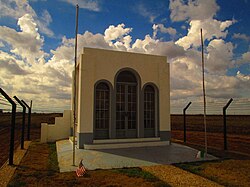
Camp Hereford, the Hereford Internment Camp, or the Hereford Military Reservation and Reception Center was an American prisoner-of-war camp that housed Italian prisoners during World War II. The camp was located about 3 miles (4.83 km) south of Hereford, Texas, and was the second largest prisoner-of-war camp in the United States, capable of housing nearly 6,000 prisoners as well as 750 American military personnel. It was constructed in 1942 and began housing inmates in 1943. By February 1946 all prisoners of war had been repatriated and the camp was placed on the surplus list.
In June 1942, the War Department authorized the building of Camp Hereford on a section of land along the border of Castro and Deaf Smith counties. The War Department purchased 330 acres (1.3 km2) of farmland from Loyal B. Holland for $14,375, and bought a neighboring half-section of land from Walter N. Hodges for $16,475; ground was broken in July 1942. The 3,000-man camp was to be completed in November, but additions to the camp were requested and the completion date was pushed back to February 1943. The federal government awarded the building contract to the Russell J. Brydan Company of Dallas, with architectural design by the Fort Worth firm of Freese and Nichols; construction was supervised by the Army Corps of Engineers. Water and gas lines were laid by another Fort Worth company, Sherman and Erbett; while electricity was provided by the American District Telegraph Company of Texas. It took a work force of around 1,000 people to build the camp. Some laborers were locals and worked on the project when time from their other duties allowed them, but the majority of laborers were from out-of-town and resided on the camp in the barracks they had constructed. Food for the workers was provided by a local restaurant. The total cost of the project was $2 million.
The camp consisted of four compounds: three for enlisted men and one for officers, with additional quarters for U.S. military personnel. Each compound had enough barracks to house around 1,000 men. Upon completion, Camp Hereford was capable of housing 4,800 enlisted men, 1,000 officers, and the American soldiers needed to operate the facility. Although the buildings were not designed to be permanent structures, Camp Hereford was constructed as a maximum security facility and precautions were made to prevent escape. Each compound was fenced in, and the entire complex itself was surrounded by an electric fence; guards, armed with machine guns and rifles, were stationed in towers along the perimeter of the prison and given orders to fire on any prisoner caught between the two fences. Each guard tower was occupied by at least two men at all times, and was equipped with a loudspeaker and floodlights. The towers were connected to one another (and the captain of the guard) by telephone and were spaced in such a way as to give the guards clear sightlines and firing lines.
Camp Hereford was a base camp, meaning a large facility capable of holding anywhere from 3,000 to 6,000 prisoners, which provided workers for smaller branch camps located in and around the Texas Panhandle. Base camps were typically located in rural areas to make escape more difficult, and also so that prison labor could be more easily exploited by rural farmers and businesses (civilian labor being in short supply due to the war effort). Camp Hereford was one of only a handful of base camps constructed on private property in Texas specifically for the housing of prisoners-of-war, most of the other base camps in Texas were located on already existing military bases. It was the only base camp in Texas for Italian prisoners-of-war and also "the camp to which hard-core Fascists and troublemakers were sent". A group of German prisoners was briefly sent to Camp Hereford, but they were quickly removed when rioting broke out between them and the Italians who were already there.
Upon arrival to the United States, Axis prisoners were to be showered and deloused at the port in which they arrived, but these procedures were not often followed. Instead, wearing the uniforms in which they had been captured, many were led onto trains and sent directly to their assigned prison camps. The first prisoners to arrive at Camp Hereford, in the spring of 1943, were Italian soldiers captured during the African Campaign. They disembarked from the train at Summerfield, Texas and were marched 8 miles (12.87 km) to the new camp, residents remember the soldiers sang "Rosamunde" as they marched. Once in camp, after being fed and allowed to shower, the prisoners experienced a restless few days in which they were assigned barracks, vaccinated, examined by a doctor, interviewed, and given a serial number. All prisoners were issued "underwear (four pair), socks (four pair), a belt, a cap, coat, gloves, [and] overcoat". If it was in good shape, enlisted men had their national uniform marked with the letters "PW"; if their uniform was in poor condition they were issued two pairs of pants and two shirts with the "PW" marking. The clothing of officer prisoners was not marked. Reveille occurred at 5:45 each morning and the prisoners were expected to be in bed by 10 o'clock each evening.
The Italian soldiers held at Camp Hereford could be broadly separated into two groups: "Mussolini's men" and "King's men". Mussolini's men were loyal fascists who had been fighting in North Africa since 1940. The King's men were politically more moderate and loyal to King Victor Emmanuel III. They were reinforcements sent to North Africa right as it was falling to the Allies, and many surrendered "never having fired a shot". The American garrison at the camp separated the prisoners based on rank and then, as best as could be determined, by political affiliation. This was done to maintain order in the camp, because violence could erupt between the diehard fascists and the moderates if the two groups were ever in the same area together. Mussolini's men were kept in compound one and the King's men were housed in compound two, while non-commissioned officers were in compound three. These three compounds were on an open barracks plan with forty men in each building. In compound four, where the officers were housed, the barracks were divided into apartments. "Lieutenants lived four to an apartment, captains two to an apartment, and ranks of major and above could claim sole occupancy of an apartment and a bath."
In September 1943 the Allied forces and the Kingdom of Italy signed the Armistice of Cassibile, and the government of Pietro Badoglio subsequently declared war on Germany in October. Badoglio also issued a proclamation directing all Italian prisoners of war to "actively collaborate" with the Allied forces. Along these lines, beginning in early 1944, the War Department began to form Italian Service Units made up of Italian POWs who pledged their loyalty to the Allies. In return for their loyalty, the men who joined these units were removed from the prison camps and sent to military bases around the country in need of labor. They were paid, partly in cash and partly in scrip, were given a standard issued G.I. uniform, and were allowed to use base facilities as well as travel to nearby towns and cities. Over 85% of the 51,000 Italian prisoners of war in the United States joined the Italian Service Units, and the ones who did not were often sent to Camp Hereford. Hereford's pro-fascist character was only reinforced as more moderate prisoners, eager and willing to work, left and were replaced by the most recalcitrant and uncooperative prisoners from other camps.
All prisoners received a monthly allowance ranging from "$3 for an enlisted man to $20 for a lieutenant, $30 for a captain, and $40 for a major and any higher rank." According to the Geneva Conventions officer prisoners could not be forced to do work of any kind, while non-commissioned officers could be tasked with supervisory or administrative roles. Enlisted prisoners, however, could be required to work, and they made up the bulk of the camp's labor force. Prisoners performed routine tasks typical of the maintenance, cleaning, and operation of any military post including kitchen duty, garbage detail, basic repair work, and any number of other daily chores; this work was unpaid. Any work performed beyond this regular maintenance was to be paid according to the Geneva Conventions. Prisoners could volunteer to do paid work at a rate of $0.10 per hour, which was the going rate of pay for an American private. Although prisoners with special skills could perform paid tasks around the camp, the bulk of paid work was contract labor outside of camp for local farmers and businesses. To secure a contract for prison labor, farmers filled out a certificate of need from the War Manpower Commission and the prisoners were then allocated by the Extension Service of the Department of Agriculture on a county level. Prisoners from Camp Hereford performed all types of agricultural work in the surrounding community including processing carrots, picking cotton, and sacking potatoes and onions. They also poured concrete for the grain elevators at Pitman Grain. One crew, contracted for agricultural work, was loaned out to the Summerfield Baptist Church to help work on the church's basement and roof.
Camp Hereford
Camp Hereford, the Hereford Internment Camp, or the Hereford Military Reservation and Reception Center was an American prisoner-of-war camp that housed Italian prisoners during World War II. The camp was located about 3 miles (4.83 km) south of Hereford, Texas, and was the second largest prisoner-of-war camp in the United States, capable of housing nearly 6,000 prisoners as well as 750 American military personnel. It was constructed in 1942 and began housing inmates in 1943. By February 1946 all prisoners of war had been repatriated and the camp was placed on the surplus list.
In June 1942, the War Department authorized the building of Camp Hereford on a section of land along the border of Castro and Deaf Smith counties. The War Department purchased 330 acres (1.3 km2) of farmland from Loyal B. Holland for $14,375, and bought a neighboring half-section of land from Walter N. Hodges for $16,475; ground was broken in July 1942. The 3,000-man camp was to be completed in November, but additions to the camp were requested and the completion date was pushed back to February 1943. The federal government awarded the building contract to the Russell J. Brydan Company of Dallas, with architectural design by the Fort Worth firm of Freese and Nichols; construction was supervised by the Army Corps of Engineers. Water and gas lines were laid by another Fort Worth company, Sherman and Erbett; while electricity was provided by the American District Telegraph Company of Texas. It took a work force of around 1,000 people to build the camp. Some laborers were locals and worked on the project when time from their other duties allowed them, but the majority of laborers were from out-of-town and resided on the camp in the barracks they had constructed. Food for the workers was provided by a local restaurant. The total cost of the project was $2 million.
The camp consisted of four compounds: three for enlisted men and one for officers, with additional quarters for U.S. military personnel. Each compound had enough barracks to house around 1,000 men. Upon completion, Camp Hereford was capable of housing 4,800 enlisted men, 1,000 officers, and the American soldiers needed to operate the facility. Although the buildings were not designed to be permanent structures, Camp Hereford was constructed as a maximum security facility and precautions were made to prevent escape. Each compound was fenced in, and the entire complex itself was surrounded by an electric fence; guards, armed with machine guns and rifles, were stationed in towers along the perimeter of the prison and given orders to fire on any prisoner caught between the two fences. Each guard tower was occupied by at least two men at all times, and was equipped with a loudspeaker and floodlights. The towers were connected to one another (and the captain of the guard) by telephone and were spaced in such a way as to give the guards clear sightlines and firing lines.
Camp Hereford was a base camp, meaning a large facility capable of holding anywhere from 3,000 to 6,000 prisoners, which provided workers for smaller branch camps located in and around the Texas Panhandle. Base camps were typically located in rural areas to make escape more difficult, and also so that prison labor could be more easily exploited by rural farmers and businesses (civilian labor being in short supply due to the war effort). Camp Hereford was one of only a handful of base camps constructed on private property in Texas specifically for the housing of prisoners-of-war, most of the other base camps in Texas were located on already existing military bases. It was the only base camp in Texas for Italian prisoners-of-war and also "the camp to which hard-core Fascists and troublemakers were sent". A group of German prisoners was briefly sent to Camp Hereford, but they were quickly removed when rioting broke out between them and the Italians who were already there.
Upon arrival to the United States, Axis prisoners were to be showered and deloused at the port in which they arrived, but these procedures were not often followed. Instead, wearing the uniforms in which they had been captured, many were led onto trains and sent directly to their assigned prison camps. The first prisoners to arrive at Camp Hereford, in the spring of 1943, were Italian soldiers captured during the African Campaign. They disembarked from the train at Summerfield, Texas and were marched 8 miles (12.87 km) to the new camp, residents remember the soldiers sang "Rosamunde" as they marched. Once in camp, after being fed and allowed to shower, the prisoners experienced a restless few days in which they were assigned barracks, vaccinated, examined by a doctor, interviewed, and given a serial number. All prisoners were issued "underwear (four pair), socks (four pair), a belt, a cap, coat, gloves, [and] overcoat". If it was in good shape, enlisted men had their national uniform marked with the letters "PW"; if their uniform was in poor condition they were issued two pairs of pants and two shirts with the "PW" marking. The clothing of officer prisoners was not marked. Reveille occurred at 5:45 each morning and the prisoners were expected to be in bed by 10 o'clock each evening.
The Italian soldiers held at Camp Hereford could be broadly separated into two groups: "Mussolini's men" and "King's men". Mussolini's men were loyal fascists who had been fighting in North Africa since 1940. The King's men were politically more moderate and loyal to King Victor Emmanuel III. They were reinforcements sent to North Africa right as it was falling to the Allies, and many surrendered "never having fired a shot". The American garrison at the camp separated the prisoners based on rank and then, as best as could be determined, by political affiliation. This was done to maintain order in the camp, because violence could erupt between the diehard fascists and the moderates if the two groups were ever in the same area together. Mussolini's men were kept in compound one and the King's men were housed in compound two, while non-commissioned officers were in compound three. These three compounds were on an open barracks plan with forty men in each building. In compound four, where the officers were housed, the barracks were divided into apartments. "Lieutenants lived four to an apartment, captains two to an apartment, and ranks of major and above could claim sole occupancy of an apartment and a bath."
In September 1943 the Allied forces and the Kingdom of Italy signed the Armistice of Cassibile, and the government of Pietro Badoglio subsequently declared war on Germany in October. Badoglio also issued a proclamation directing all Italian prisoners of war to "actively collaborate" with the Allied forces. Along these lines, beginning in early 1944, the War Department began to form Italian Service Units made up of Italian POWs who pledged their loyalty to the Allies. In return for their loyalty, the men who joined these units were removed from the prison camps and sent to military bases around the country in need of labor. They were paid, partly in cash and partly in scrip, were given a standard issued G.I. uniform, and were allowed to use base facilities as well as travel to nearby towns and cities. Over 85% of the 51,000 Italian prisoners of war in the United States joined the Italian Service Units, and the ones who did not were often sent to Camp Hereford. Hereford's pro-fascist character was only reinforced as more moderate prisoners, eager and willing to work, left and were replaced by the most recalcitrant and uncooperative prisoners from other camps.
All prisoners received a monthly allowance ranging from "$3 for an enlisted man to $20 for a lieutenant, $30 for a captain, and $40 for a major and any higher rank." According to the Geneva Conventions officer prisoners could not be forced to do work of any kind, while non-commissioned officers could be tasked with supervisory or administrative roles. Enlisted prisoners, however, could be required to work, and they made up the bulk of the camp's labor force. Prisoners performed routine tasks typical of the maintenance, cleaning, and operation of any military post including kitchen duty, garbage detail, basic repair work, and any number of other daily chores; this work was unpaid. Any work performed beyond this regular maintenance was to be paid according to the Geneva Conventions. Prisoners could volunteer to do paid work at a rate of $0.10 per hour, which was the going rate of pay for an American private. Although prisoners with special skills could perform paid tasks around the camp, the bulk of paid work was contract labor outside of camp for local farmers and businesses. To secure a contract for prison labor, farmers filled out a certificate of need from the War Manpower Commission and the prisoners were then allocated by the Extension Service of the Department of Agriculture on a county level. Prisoners from Camp Hereford performed all types of agricultural work in the surrounding community including processing carrots, picking cotton, and sacking potatoes and onions. They also poured concrete for the grain elevators at Pitman Grain. One crew, contracted for agricultural work, was loaned out to the Summerfield Baptist Church to help work on the church's basement and roof.
Recent media
Recent media