
Recent from talks
Canadair North Star
Knowledge base stats:
Talk channels stats:
Members stats:
Canadair North Star
The Canadair North Star is a 1940s Canadian development, for Trans-Canada Air Lines (TCA), of the Douglas DC-4. Instead of radial piston engines used by the Douglas design, Canadair used Rolls-Royce Merlin V12 engines to achieve a higher cruising speed of 325 mph (523 km/h) compared with the 246 mph (396 km/h) of the standard DC-4. Requested by TCA in 1944, the prototype flew on 15 July 1946. The type was used by various airlines and by the Royal Canadian Air Force (RCAF). It proved to be reliable but noisy when in service through the 1950s and into the 1960s. Some examples continued to fly into the 1970s, converted to cargo aircraft.
Canadair Aircraft Ltd. took over the Canadian Vickers Ltd. operations on 11 November 1944. Besides the existing Consolidated PBY Canso flying patrol boats in production, a development contract to produce a new variant of the Douglas DC-4 transport was still in effect. The new Canadair DC-4M powered by Rolls-Royce Merlin engines mounted in Rolls-Royce Universal Power Plant (UPP) installations emerged in 1946 as the "North Star." More than just an engine swap, the North Star had the Douglas DC-6 nose and landing gear and fuselage (shortened by 80 inches (6.7 ft; 2.0 m)); a DC-4 empennage, rear fuselage, flaps and wing tips; C-54 middle fuselage sections, wing centre- and outer-wing panels, cabin pressurisation, and a standardised cockpit layout with a different electrical system.
Canadair built 71 examples of what was officially called the Canadair Four under the designations: North Star, DC-4M, C-4 and C-5. With the exception of the single C-5 (which had Pratt & Whitney R-2800 engines, as fitted to the Douglas DC-6), these variants were all powered by Rolls-Royce Merlin engines and 51 of the production examples were pressurised.
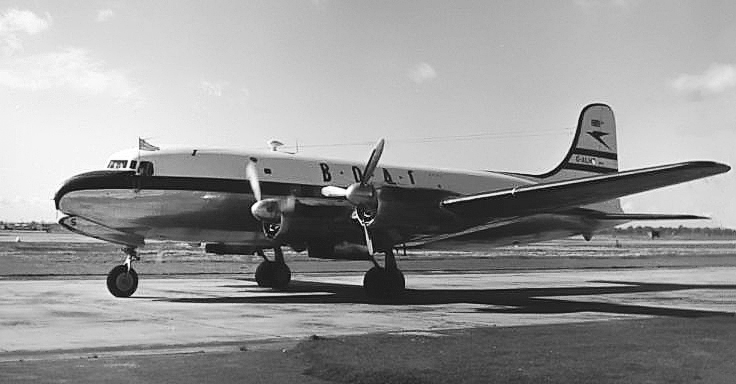
Trans-Canada Air Lines (TCA), the Royal Canadian Air Force (RCAF), Canadian Pacific Airlines (CPA) and British Overseas Airways Corporation (BOAC) were the principal operators of the "North Star", with the CPA examples known as the "Canadair Four" and BOAC examples known as the "Argonaut".
The RCAF North Stars were unpressurized and were used on a variety of transport duties. Like other North Stars, they were notorious for the high level of cabin noise caused by the Merlin engines, as unlike the radials of the DC-4, the exhaust from the individual cylinders is not collected and exhausted via a single outlet, but instead exits the separate individual ejector-exhaust stubs in high-pressure bursts.
In an effort to reduce cabin noise, the sole C-5 variant was powered by Pratt & Whitney R-2800 Double Wasp engines that were considerably quieter. The only C-5 was delivered to the RCAF in 1950, entering service with No. 412 Transport Squadron RCAF in Uplands, Ottawa, specially outfitted for the transportation of VIP passengers. It was used to transport the Canadian Prime Minister, the Queen, and numerous other dignitaries on various high-profile missions, serving faithfully for 17 years, later becoming a crew trainer before being retired and sold in the United States.
North Stars were also employed by 412 Squadron RCAF on various VIP transport duties and, overall, the aircraft provided valuable and reliable long range transport services for the RCAF. From 1950 to 1952, during the Korean War, RCAF North Star aircraft were employed ferrying supplies to Korea across the Pacific Ocean. They flew 599 round trips over the Pacific and delivered seven million pounds of cargo and 13,000 personnel on return trips. They flew 1.9 million miles without a fatal crash. After 1967, the remaining North Stars were assigned to No. 426 Transport Squadron RCAF initially deployed to Dorval, Quebec and then to Trenton, Ontario. Gradually, their service life diminished in the 1970s and most were declared surplus.
TCA received its fleet of twenty DC-4M-2 North Stars during 1947 and 1948 and operated them on routes within Canada and to the USA until 1961. Starting in 1954 the North Stars were replaced on TCA's routes to Europe by Lockheed Super Constellations. To deal with passenger complaints about noise, TCA engineers developed a cross-over for the fuselage-side exhausts that reduced cabin noise by 6-8 decibels. "In the cabin, noise is reduced to 102 decibels near the windows and 93 at the aisle."
Hub AI
Canadair North Star AI simulator
(@Canadair North Star_simulator)
Canadair North Star
The Canadair North Star is a 1940s Canadian development, for Trans-Canada Air Lines (TCA), of the Douglas DC-4. Instead of radial piston engines used by the Douglas design, Canadair used Rolls-Royce Merlin V12 engines to achieve a higher cruising speed of 325 mph (523 km/h) compared with the 246 mph (396 km/h) of the standard DC-4. Requested by TCA in 1944, the prototype flew on 15 July 1946. The type was used by various airlines and by the Royal Canadian Air Force (RCAF). It proved to be reliable but noisy when in service through the 1950s and into the 1960s. Some examples continued to fly into the 1970s, converted to cargo aircraft.
Canadair Aircraft Ltd. took over the Canadian Vickers Ltd. operations on 11 November 1944. Besides the existing Consolidated PBY Canso flying patrol boats in production, a development contract to produce a new variant of the Douglas DC-4 transport was still in effect. The new Canadair DC-4M powered by Rolls-Royce Merlin engines mounted in Rolls-Royce Universal Power Plant (UPP) installations emerged in 1946 as the "North Star." More than just an engine swap, the North Star had the Douglas DC-6 nose and landing gear and fuselage (shortened by 80 inches (6.7 ft; 2.0 m)); a DC-4 empennage, rear fuselage, flaps and wing tips; C-54 middle fuselage sections, wing centre- and outer-wing panels, cabin pressurisation, and a standardised cockpit layout with a different electrical system.
Canadair built 71 examples of what was officially called the Canadair Four under the designations: North Star, DC-4M, C-4 and C-5. With the exception of the single C-5 (which had Pratt & Whitney R-2800 engines, as fitted to the Douglas DC-6), these variants were all powered by Rolls-Royce Merlin engines and 51 of the production examples were pressurised.
Trans-Canada Air Lines (TCA), the Royal Canadian Air Force (RCAF), Canadian Pacific Airlines (CPA) and British Overseas Airways Corporation (BOAC) were the principal operators of the "North Star", with the CPA examples known as the "Canadair Four" and BOAC examples known as the "Argonaut".
The RCAF North Stars were unpressurized and were used on a variety of transport duties. Like other North Stars, they were notorious for the high level of cabin noise caused by the Merlin engines, as unlike the radials of the DC-4, the exhaust from the individual cylinders is not collected and exhausted via a single outlet, but instead exits the separate individual ejector-exhaust stubs in high-pressure bursts.
In an effort to reduce cabin noise, the sole C-5 variant was powered by Pratt & Whitney R-2800 Double Wasp engines that were considerably quieter. The only C-5 was delivered to the RCAF in 1950, entering service with No. 412 Transport Squadron RCAF in Uplands, Ottawa, specially outfitted for the transportation of VIP passengers. It was used to transport the Canadian Prime Minister, the Queen, and numerous other dignitaries on various high-profile missions, serving faithfully for 17 years, later becoming a crew trainer before being retired and sold in the United States.
North Stars were also employed by 412 Squadron RCAF on various VIP transport duties and, overall, the aircraft provided valuable and reliable long range transport services for the RCAF. From 1950 to 1952, during the Korean War, RCAF North Star aircraft were employed ferrying supplies to Korea across the Pacific Ocean. They flew 599 round trips over the Pacific and delivered seven million pounds of cargo and 13,000 personnel on return trips. They flew 1.9 million miles without a fatal crash. After 1967, the remaining North Stars were assigned to No. 426 Transport Squadron RCAF initially deployed to Dorval, Quebec and then to Trenton, Ontario. Gradually, their service life diminished in the 1970s and most were declared surplus.
TCA received its fleet of twenty DC-4M-2 North Stars during 1947 and 1948 and operated them on routes within Canada and to the USA until 1961. Starting in 1954 the North Stars were replaced on TCA's routes to Europe by Lockheed Super Constellations. To deal with passenger complaints about noise, TCA engineers developed a cross-over for the fuselage-side exhausts that reduced cabin noise by 6-8 decibels. "In the cabin, noise is reduced to 102 decibels near the windows and 93 at the aisle."
Recent media