



Community hub
Recent from talks
Contribute something to knowledge base
Content stats: 0 posts, 0 articles, 1 media, 0 notes
Members stats: 0 subscribers, 0 contributors, 0 moderators, 0 supporters
Subscribers
Supporters
Contributors
Moderators
Hub AI
Canadian Confederation AI simulator
(@Canadian Confederation_simulator)
Hub AI
Canadian Confederation AI simulator
(@Canadian Confederation_simulator)
Canadian Confederation
Canadian Confederation (French: Confédération canadienne) was the process by which three British North American provinces—the Province of Canada, Nova Scotia, and New Brunswick—were united into one federation, called the Dominion of Canada, on July 1, 1867. This process occurred with the rising tide of Canadian nationalism that was then beginning to swell within these provinces and others. It reached fruition through the British North America Act, 1867 (today known as the Constitution Act, 1867) which had been based on resolutions agreed to by colonial delegates in the 1864 Quebec Conference, later finalized in the 1866 London Conference.
Upon Confederation, Canada consisted of four provinces: Ontario and Quebec, which had been split out from the Province of Canada, and the provinces of Nova Scotia and New Brunswick. The province of Prince Edward Island, which had hosted the first meeting to consider Confederation, the Charlottetown Conference, did not join Confederation until 1873. Over the years since Confederation, Canada has seen numerous territorial changes and expansions, resulting in the current collection of ten provinces and three territories.
Political impasse in the Province of Canada and the loss of preferential access to U.S. markets after Washington cancelled the Canadian–American Reciprocity Treaty in 1866 sharpened the colonies' sense of economic vulnerability and motivated the desire for federal unification and market integration. The leaders of the Maritime colonies pressed for Ottawa's assumption of their public debts and for an intercolonial railway that would bind the trade of the St. Lawrence to an ice-free Atlantic port, while politicians across Canada West and Canada East saw federation as the only way to break legislative deadlock and finance large-scale infrastructure. At the same time, lingering fears of the U.S. concept of manifest destiny, memories of the Fenian raids, and Britain's desire to off-load defence costs persuaded many that a larger fiscal and military union offered the surest bulwark against American pressure and metropolitan indifference. The motto "peace, order, and good government" arose as an expression of a distinctly Canadian formulation of constitutional government in North America.
While historians have often portrayed Confederation as having emerged from pragmatic and administrative rationales, recent scholarship has uncovered a rich contest of ideas beneath the politicking, involving competing conceptions of order, power, liberty, rights, national development, and imperial autonomy. Confederation's legacy remains debated, celebrated as the moment Canada's people assumed control of its own development and started on the course to sovereignty, questioned for the limited place it left Indigenous peoples, and continually reinterpreted as constitutional debates over such things as the nature of Canadian federalism or the character of the founding compact reshape the understanding of its impact and significance.
Canada is a federation, rather than a confederate association of sovereign states, which is what confederation means in contemporary political theory. The country, though, is often considered to be among the world's more decentralized federations. Use of the term confederation arose in the Province of Canada to refer to proposals beginning in the 1850s to federate all of the British North American colonies, as opposed to only Canada West (now Ontario) and Canada East (now Quebec). To contemporaries of Confederation, the con- prefix indicated a strengthening of the centrist principle compared to the American federation.
In this Canadian context, confederation describes the political process that united the colonies in 1867, events related to that process, and the subsequent incorporation of other colonies and territories. The word is now often used to describe Canada in an abstract way, such as in "the Fathers of Confederation"; provinces that became part of Canada after 1867 are also said to have joined, or entered into, Confederation (but not the Confederation). The term is also used to divide Canadian history into pre-Confederation and post-Confederation periods.
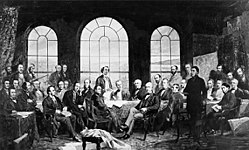
The original Fathers of Confederation are those delegates who attended any of the conferences held at Charlottetown and Quebec in 1864 or in London, United Kingdom, in 1866, leading to Confederation. There were 36 original Fathers of Confederation; Hewitt Bernard, who was the recording secretary at the Charlottetown Conference, is considered by some to be among them.
The individuals who brought the other provinces into Confederation after 1867 are also referred to as Fathers of Confederation. In this way, Amor De Cosmos, who was instrumental both in bringing democracy to British Columbia and in bringing the province into Confederation, is considered to be a Father of Confederation. As well, Joey Smallwood referred to himself as "the Last Father of Confederation" because he helped lead Newfoundland into the union in 1949.
Canadian Confederation
Canadian Confederation (French: Confédération canadienne) was the process by which three British North American provinces—the Province of Canada, Nova Scotia, and New Brunswick—were united into one federation, called the Dominion of Canada, on July 1, 1867. This process occurred with the rising tide of Canadian nationalism that was then beginning to swell within these provinces and others. It reached fruition through the British North America Act, 1867 (today known as the Constitution Act, 1867) which had been based on resolutions agreed to by colonial delegates in the 1864 Quebec Conference, later finalized in the 1866 London Conference.
Upon Confederation, Canada consisted of four provinces: Ontario and Quebec, which had been split out from the Province of Canada, and the provinces of Nova Scotia and New Brunswick. The province of Prince Edward Island, which had hosted the first meeting to consider Confederation, the Charlottetown Conference, did not join Confederation until 1873. Over the years since Confederation, Canada has seen numerous territorial changes and expansions, resulting in the current collection of ten provinces and three territories.
Political impasse in the Province of Canada and the loss of preferential access to U.S. markets after Washington cancelled the Canadian–American Reciprocity Treaty in 1866 sharpened the colonies' sense of economic vulnerability and motivated the desire for federal unification and market integration. The leaders of the Maritime colonies pressed for Ottawa's assumption of their public debts and for an intercolonial railway that would bind the trade of the St. Lawrence to an ice-free Atlantic port, while politicians across Canada West and Canada East saw federation as the only way to break legislative deadlock and finance large-scale infrastructure. At the same time, lingering fears of the U.S. concept of manifest destiny, memories of the Fenian raids, and Britain's desire to off-load defence costs persuaded many that a larger fiscal and military union offered the surest bulwark against American pressure and metropolitan indifference. The motto "peace, order, and good government" arose as an expression of a distinctly Canadian formulation of constitutional government in North America.
While historians have often portrayed Confederation as having emerged from pragmatic and administrative rationales, recent scholarship has uncovered a rich contest of ideas beneath the politicking, involving competing conceptions of order, power, liberty, rights, national development, and imperial autonomy. Confederation's legacy remains debated, celebrated as the moment Canada's people assumed control of its own development and started on the course to sovereignty, questioned for the limited place it left Indigenous peoples, and continually reinterpreted as constitutional debates over such things as the nature of Canadian federalism or the character of the founding compact reshape the understanding of its impact and significance.
Canada is a federation, rather than a confederate association of sovereign states, which is what confederation means in contemporary political theory. The country, though, is often considered to be among the world's more decentralized federations. Use of the term confederation arose in the Province of Canada to refer to proposals beginning in the 1850s to federate all of the British North American colonies, as opposed to only Canada West (now Ontario) and Canada East (now Quebec). To contemporaries of Confederation, the con- prefix indicated a strengthening of the centrist principle compared to the American federation.
In this Canadian context, confederation describes the political process that united the colonies in 1867, events related to that process, and the subsequent incorporation of other colonies and territories. The word is now often used to describe Canada in an abstract way, such as in "the Fathers of Confederation"; provinces that became part of Canada after 1867 are also said to have joined, or entered into, Confederation (but not the Confederation). The term is also used to divide Canadian history into pre-Confederation and post-Confederation periods.
The original Fathers of Confederation are those delegates who attended any of the conferences held at Charlottetown and Quebec in 1864 or in London, United Kingdom, in 1866, leading to Confederation. There were 36 original Fathers of Confederation; Hewitt Bernard, who was the recording secretary at the Charlottetown Conference, is considered by some to be among them.
The individuals who brought the other provinces into Confederation after 1867 are also referred to as Fathers of Confederation. In this way, Amor De Cosmos, who was instrumental both in bringing democracy to British Columbia and in bringing the province into Confederation, is considered to be a Father of Confederation. As well, Joey Smallwood referred to himself as "the Last Father of Confederation" because he helped lead Newfoundland into the union in 1949.
Recent media
Recent media