



Community hub
Recent from talks
Knowledge base stats:
Talk channels stats:
Members stats:
Canberra Stadium
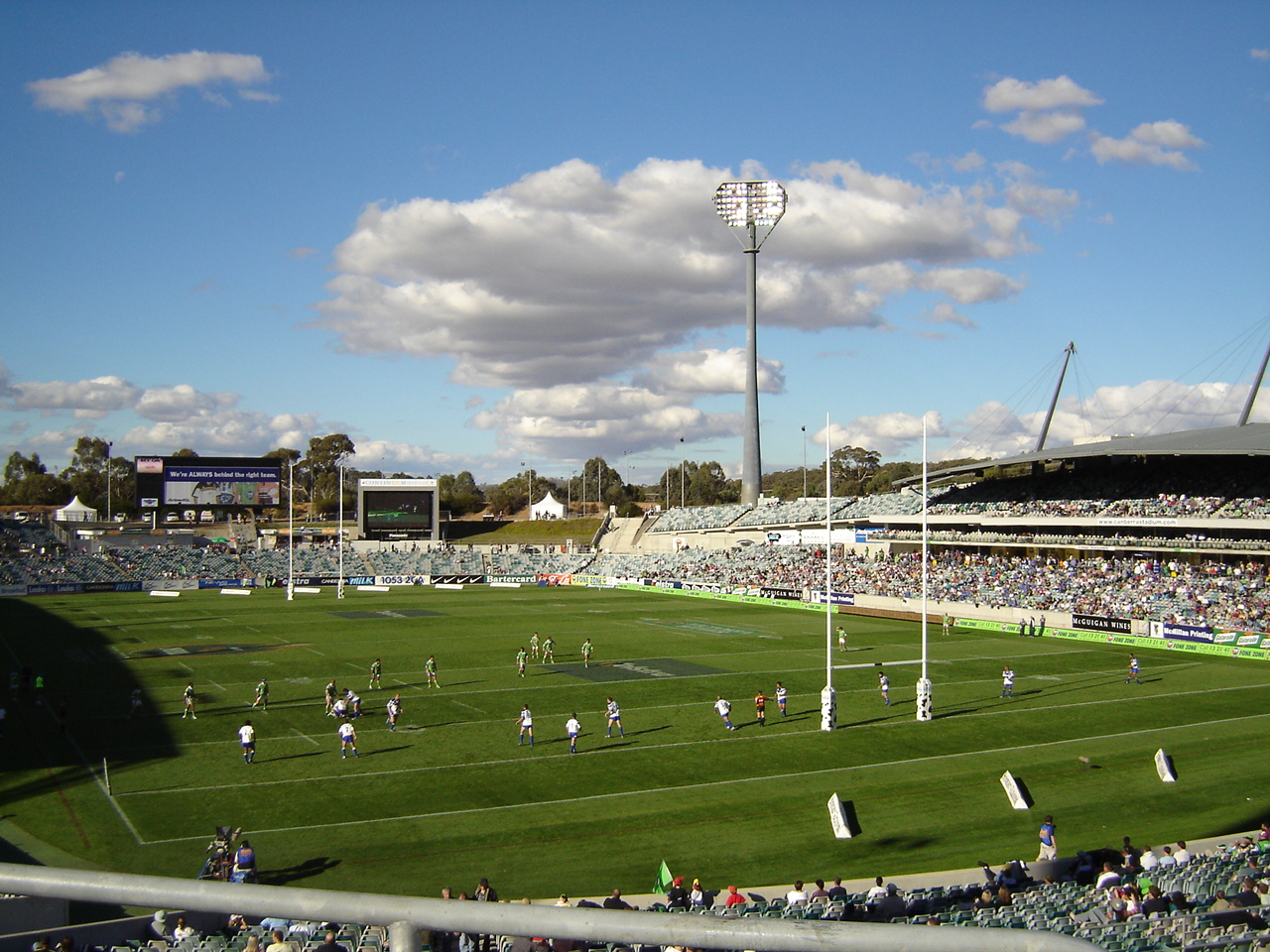
Canberra Stadium, commercially known as GIO Stadium Canberra, is a facility primarily used for rugby league and rugby union games, located adjacent to the Australian Institute of Sport in Canberra, the capital of Australia. It is the largest sports venue by capacity in Canberra. The Canberra Stadium was previously known as the Bruce Stadium and the National Athletics Stadium before its current name.
The facility was designed by architect Philip Cox and constructed by Leighton Contractors. It opened on 29 October 1977.
In 1977, it was the venue for the Pacific Conference Games, and was also the venue for the 4th IAAF World Cup in Athletics. At the latter meet, the still-current world record for the women's 400m was recorded by East German Marita Koch, and a world record for the women's 4 × 100 m relay was set by East Germany, which stood until the 2012 London Olympic Games.
In the late 1980s, the running track was removed and the warm-up track next door upgraded. New offices, seating, and photo-finish facilities were added. In the 1990 NSWRL season, the reigning NSWRL premiers the Canberra Raiders moved to Bruce Stadium from Seiffert Oval in Queanbeyan, their home ground since entering the New South Wales Rugby League in 1982. The Raiders won their second straight premiership in 1990.
The removal of the athletics track meant that Australian rules football games, more specifically those of the Australian Football League (AFL), could be played at the ground, resulting in pre-season matches being scheduled as early as 1990. In 1995, an AFL match for premiership points was contested between the West Coast Eagles and Fitzroy. There were also a number of pre-season AFL games played at the venue, mostly featuring the Sydney Swans.
Also around that time, a cricket pitch was placed in the centre of the ground as an experiment, and a day/night one-day cricket match was played between two local teams before a small crowd. Regular cricket matches on the ground did not eventuate.
Further renovations occurred in 1997, in preparation for staging soccer matches as part of the 2000 Summer Olympics in Sydney, which shrank the size of the playing field, preventing any future Australian rules football games being played there. The final cost of the renovations was more than seven times what had been originally anticipated by the Territory government of the time, and the subsequent controversy ended the career of then Chief Minister Kate Carnell.[circular reference] During the lead-up, unseasonal snow fell on 28 May 2000, during a match between the Raiders and the Wests Tigers, the only such occasion in National Rugby League history, with the snow causing frost damage to the turf intended for the Olympic soccer tournament.
Olympic soccer in 2000 initiated a stadium facelift, converting the playing surface from oval to rectangular and bringing the crowd closer to the action. It is now an all-seater rectangular stadium with two main grandstands on either side of the playing field. The major outcome of that revamp was that the stadium could no longer host AFL games. All top-class cricket and Australian rules football games in Canberra are now staged at the 15,000-capacity Manuka Oval.
Hub AI
Canberra Stadium AI simulator
(@Canberra Stadium_simulator)
Canberra Stadium
Canberra Stadium, commercially known as GIO Stadium Canberra, is a facility primarily used for rugby league and rugby union games, located adjacent to the Australian Institute of Sport in Canberra, the capital of Australia. It is the largest sports venue by capacity in Canberra. The Canberra Stadium was previously known as the Bruce Stadium and the National Athletics Stadium before its current name.
The facility was designed by architect Philip Cox and constructed by Leighton Contractors. It opened on 29 October 1977.
In 1977, it was the venue for the Pacific Conference Games, and was also the venue for the 4th IAAF World Cup in Athletics. At the latter meet, the still-current world record for the women's 400m was recorded by East German Marita Koch, and a world record for the women's 4 × 100 m relay was set by East Germany, which stood until the 2012 London Olympic Games.
In the late 1980s, the running track was removed and the warm-up track next door upgraded. New offices, seating, and photo-finish facilities were added. In the 1990 NSWRL season, the reigning NSWRL premiers the Canberra Raiders moved to Bruce Stadium from Seiffert Oval in Queanbeyan, their home ground since entering the New South Wales Rugby League in 1982. The Raiders won their second straight premiership in 1990.
The removal of the athletics track meant that Australian rules football games, more specifically those of the Australian Football League (AFL), could be played at the ground, resulting in pre-season matches being scheduled as early as 1990. In 1995, an AFL match for premiership points was contested between the West Coast Eagles and Fitzroy. There were also a number of pre-season AFL games played at the venue, mostly featuring the Sydney Swans.
Also around that time, a cricket pitch was placed in the centre of the ground as an experiment, and a day/night one-day cricket match was played between two local teams before a small crowd. Regular cricket matches on the ground did not eventuate.
Further renovations occurred in 1997, in preparation for staging soccer matches as part of the 2000 Summer Olympics in Sydney, which shrank the size of the playing field, preventing any future Australian rules football games being played there. The final cost of the renovations was more than seven times what had been originally anticipated by the Territory government of the time, and the subsequent controversy ended the career of then Chief Minister Kate Carnell.[circular reference] During the lead-up, unseasonal snow fell on 28 May 2000, during a match between the Raiders and the Wests Tigers, the only such occasion in National Rugby League history, with the snow causing frost damage to the turf intended for the Olympic soccer tournament.
Olympic soccer in 2000 initiated a stadium facelift, converting the playing surface from oval to rectangular and bringing the crowd closer to the action. It is now an all-seater rectangular stadium with two main grandstands on either side of the playing field. The major outcome of that revamp was that the stadium could no longer host AFL games. All top-class cricket and Australian rules football games in Canberra are now staged at the 15,000-capacity Manuka Oval.