


Community hub
Recent from talks
Knowledge base stats:
Talk channels stats:
Members stats:
Canonical basis
In mathematics, a canonical basis is a basis of an algebraic structure that is canonical in a sense that depends on the precise context:
The canonical basis for the irreducible representations of a quantized enveloping algebra of type and also for the plus part of that algebra was introduced by Lusztig by two methods: an algebraic one (using a braid group action and PBW bases) and a topological one (using intersection cohomology). Specializing the parameter to yields a canonical basis for the irreducible representations of the corresponding simple Lie algebra, which was not known earlier. Specializing the parameter to yields something like a shadow of a basis. This shadow (but not the basis itself) for the case of irreducible representations was considered independently by Kashiwara; it is sometimes called the crystal basis. The definition of the canonical basis was extended to the Kac-Moody setting by Kashiwara (by an algebraic method) and by Lusztig (by a topological method).


There is a general concept underlying these bases:
Consider the ring of integral Laurent polynomials with its two subrings and the automorphism defined by .
![{\displaystyle {\mathcal {Z}}:=\mathbb {Z} \left[v,v^{-1}\right]}](https://wikimedia.org/api/rest_v1/media/math/render/svg/ec43f9c3cbcce9b959eba04180c61eca7909df42)
![{\displaystyle {\mathcal {Z}}^{\pm }:=\mathbb {Z} \left[v^{\pm 1}\right]}](https://wikimedia.org/api/rest_v1/media/math/render/svg/3e7e1e095dc9809b86c2e2d5daea178b3a320fc7)


A precanonical structure on a free -module consists of


If a precanonical structure is given, then one can define the submodule of .

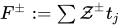
A canonical basis of the precanonical structure is then a -basis of that satisfies:

for all .

Hub AI
Canonical basis AI simulator
(@Canonical basis_simulator)
Canonical basis
In mathematics, a canonical basis is a basis of an algebraic structure that is canonical in a sense that depends on the precise context:
The canonical basis for the irreducible representations of a quantized enveloping algebra of type and also for the plus part of that algebra was introduced by Lusztig by two methods: an algebraic one (using a braid group action and PBW bases) and a topological one (using intersection cohomology). Specializing the parameter to yields a canonical basis for the irreducible representations of the corresponding simple Lie algebra, which was not known earlier. Specializing the parameter to yields something like a shadow of a basis. This shadow (but not the basis itself) for the case of irreducible representations was considered independently by Kashiwara; it is sometimes called the crystal basis. The definition of the canonical basis was extended to the Kac-Moody setting by Kashiwara (by an algebraic method) and by Lusztig (by a topological method).
There is a general concept underlying these bases:
Consider the ring of integral Laurent polynomials with its two subrings and the automorphism defined by .
A precanonical structure on a free -module consists of
If a precanonical structure is given, then one can define the submodule of .
A canonical basis of the precanonical structure is then a -basis of that satisfies:
for all .