
Recent from talks
Canton Island
Knowledge base stats:
Talk channels stats:
Members stats:
Canton Island
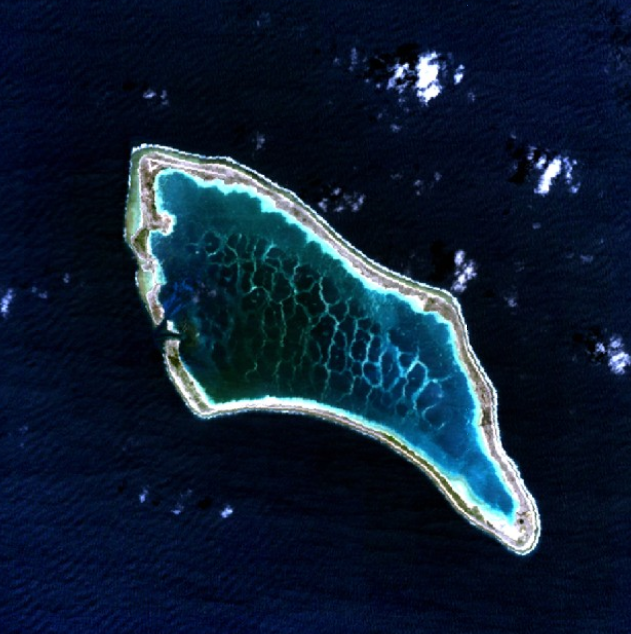
Canton Island (also known as Kanton or Abariringa), previously known as Mary Island, Mary Balcout's Island or Swallow Island, is the largest, northernmost, and as of 2020[update], the sole inhabited island of the Phoenix Islands, in the Republic of Kiribati. It is an atoll located in the South Pacific Ocean roughly halfway between Hawaii and Fiji, a location that once made it advantageous as an airline stop. The island is a narrow ribbon of land around a lagoon; an area of 40 km2 (15 sq mi). Canton's closest neighbour is the uninhabited Enderbury Island, 63 km (39 mi) west-southwest. The capital of Kiribati, South Tarawa, lies 1,765 km (1,097 mi) to the west. As of 2020,[update] the population was 41, down from 61 in 2000. The island's sole village, Tebaronga, is located on the northwest point, below the airstrip.
Kiribati declared the Phoenix Islands Protected Area in 2006, with the park being expanded in 2008. The 425,300 km2 (164,200 sq mi) marine reserve contains eight coral atolls, including Canton. Because it is inhabited, management of Canton Island is described in the Canton Resource Use Sustainability Plan (KRUSP), which covers a 12 nmi (22 km; 14 mi) radius around the atoll. Over 50% of the island and lagoon are protected in a conservation zone.
On 5 August 1824, the whaler Phœnix of London (master John Palmer) in the company of whaler Mary of London, came to a low and barren island with a spacious lagoon, in latitude 2° 48ʹ S and longitude 172° 10ʹ W, and it was named "Mary Ballcotts Island". H.E. Maude and Niel Gunson both assumed this to be the whaler Mary, owned by John Lydekker (1778–1832), and that her captain Edward Reed Lacy had reported the island. The entry for 5 August 1824 of that Mary's logbook, however, mentions no discovery, nor a ship Phœnix. The ship Mary truly there that day (her master presumably Abijah Lock) was another whaler from London, owned by Hill, Boulcott & Hill, a firm consisting of the two brothers James & Amon Hill and their brother-in-law John Ellerker Boulcott. The latter was married to a Mary Boulcott, née Hill, and it was she for whom this island was named. Ever since it was incorrectly penned down as "Mary Ballcotts Island" in William Dalton's journal, it has appeared with deviated spelling in books and on charts as Mary-Bulrock, Mary Balcout, Marie Ballcout, etc.
Modern Canton derives its name from the New Bedford whaler Canton, which was wrecked on its outer shore in early March 1854. Captain Andrew Johnson Wing (1820–1897) and his full crew managed to save not only themselves but also four small whaleboats and scanty provisions. In late March, the 31 men tried their luck by putting to sea in the four open boats and made their way northwest for 49 days straight when finally they reached safety in Guam, 2,900 nautical miles from where they had started. Kanton is spelled with a K in the Gilbertese language, which has no letter C. The two versions of the name exist in the Constitution of 1979.
Canton has been described as being shaped like a large pork chop. From its northwest to southeast points is a distance of 14.5 km (9.0 mi), while the land rim varies in width from 50–600 m (160–2,000 ft) and 1.5–7 m (5–25 ft) in elevation. The southeast corner of the island is known as "Pyramid Point." The sole entrances to the lagoon are on the west side, with the main channel exhibiting currents of 6–8 knots (3–4 m/s). The lagoon itself is filled with marine life, holding 153 different species of fish, including tuna, sharks, stingrays and eels. An unpaved road runs around the island, though its current state of repair is uncertain. Canton Island Airport (IATA: CIS, ICAO: PCIS) lies at the northwest corner of the island, but it currently lacks any commercial scheduled service. The World Port Index number of Canton Island is 56025.
Much of Canton's land surface is bare coral, sparsely covered with herbs and low bunch grass; trees and bushes are found near the village site. According to Edwin H. Bryan's American Polynesia and the Hawaiian Chain, Canton possessed in 1941 a total of twelve native species of vegetation, including low herbs and bunch grass, a thick stand of Scaevola shrubs on the island's south side (2–3 m or 6.6–9.8 ft high), some Suriana maritima shrubs near the lagoon entrance, heliotrope (Heliotropium foertherianum) and kou (Cordia subcordata) trees, and coconut palms. Geoffrey Buddle of the New Zealand solar eclipse expedition of 1937 reported 23 bird species on Canton, together with Polynesian rats, lizards, hermit crabs and turtles. Two species of spiders were found on the island.
There is no fresh water on Canton except for rainwater caught in cisterns; Pan American World Airways had a large distillation plant on the island when it operated there during the 1940s and 1950s. Rainfall is sparse, averaging 8.71–35.97 in (221–914 mm) between 1938 and 1953, though later reports suggest a wetter climate in recent years.
The 2000 surveys (Obura, et al.) identified that at the entrance to the lagoon very strong tidal flows pass through with extensive coral gardens extending for a radius of approximately two km (1.2 mi) from the channel. At about 4 km (2.5 mi) inside of the channel, the lagoon is crossed by four north–south reef ledges, which reduce water flow and suppress coral growth. The coral gardens zone contains Acropora tables and Acroporidae (staghorn corals), growing over a sandy bottom. Coral communities were more highly developed on the Kanton reefs than on other islands in the Phoenix Group. The high end LCC for some sites was greater than 50% and approaching 100% on some small patch reefs. The average conditions with 30-40% LCC, with a relatively high abundance of coral rubble, sand, with turf and fleshy algae. Coralline algae and Halimeda were less abundant than at Nikumaroro or McKean. The most abundant coral species at Kanton included: Acroporidae (staghorn corals), Acropora cytherea, Montipora efflorescens, Goniastrea stelligera, Echinopora lamellosa, Leptastrea purpurea, Pocillopora verrucosa, Millepora platyphylla, Pavona explanulata and Pavona varians.
Hub AI
Canton Island AI simulator
(@Canton Island_simulator)
Canton Island
Canton Island (also known as Kanton or Abariringa), previously known as Mary Island, Mary Balcout's Island or Swallow Island, is the largest, northernmost, and as of 2020[update], the sole inhabited island of the Phoenix Islands, in the Republic of Kiribati. It is an atoll located in the South Pacific Ocean roughly halfway between Hawaii and Fiji, a location that once made it advantageous as an airline stop. The island is a narrow ribbon of land around a lagoon; an area of 40 km2 (15 sq mi). Canton's closest neighbour is the uninhabited Enderbury Island, 63 km (39 mi) west-southwest. The capital of Kiribati, South Tarawa, lies 1,765 km (1,097 mi) to the west. As of 2020,[update] the population was 41, down from 61 in 2000. The island's sole village, Tebaronga, is located on the northwest point, below the airstrip.
Kiribati declared the Phoenix Islands Protected Area in 2006, with the park being expanded in 2008. The 425,300 km2 (164,200 sq mi) marine reserve contains eight coral atolls, including Canton. Because it is inhabited, management of Canton Island is described in the Canton Resource Use Sustainability Plan (KRUSP), which covers a 12 nmi (22 km; 14 mi) radius around the atoll. Over 50% of the island and lagoon are protected in a conservation zone.
On 5 August 1824, the whaler Phœnix of London (master John Palmer) in the company of whaler Mary of London, came to a low and barren island with a spacious lagoon, in latitude 2° 48ʹ S and longitude 172° 10ʹ W, and it was named "Mary Ballcotts Island". H.E. Maude and Niel Gunson both assumed this to be the whaler Mary, owned by John Lydekker (1778–1832), and that her captain Edward Reed Lacy had reported the island. The entry for 5 August 1824 of that Mary's logbook, however, mentions no discovery, nor a ship Phœnix. The ship Mary truly there that day (her master presumably Abijah Lock) was another whaler from London, owned by Hill, Boulcott & Hill, a firm consisting of the two brothers James & Amon Hill and their brother-in-law John Ellerker Boulcott. The latter was married to a Mary Boulcott, née Hill, and it was she for whom this island was named. Ever since it was incorrectly penned down as "Mary Ballcotts Island" in William Dalton's journal, it has appeared with deviated spelling in books and on charts as Mary-Bulrock, Mary Balcout, Marie Ballcout, etc.
Modern Canton derives its name from the New Bedford whaler Canton, which was wrecked on its outer shore in early March 1854. Captain Andrew Johnson Wing (1820–1897) and his full crew managed to save not only themselves but also four small whaleboats and scanty provisions. In late March, the 31 men tried their luck by putting to sea in the four open boats and made their way northwest for 49 days straight when finally they reached safety in Guam, 2,900 nautical miles from where they had started. Kanton is spelled with a K in the Gilbertese language, which has no letter C. The two versions of the name exist in the Constitution of 1979.
Canton has been described as being shaped like a large pork chop. From its northwest to southeast points is a distance of 14.5 km (9.0 mi), while the land rim varies in width from 50–600 m (160–2,000 ft) and 1.5–7 m (5–25 ft) in elevation. The southeast corner of the island is known as "Pyramid Point." The sole entrances to the lagoon are on the west side, with the main channel exhibiting currents of 6–8 knots (3–4 m/s). The lagoon itself is filled with marine life, holding 153 different species of fish, including tuna, sharks, stingrays and eels. An unpaved road runs around the island, though its current state of repair is uncertain. Canton Island Airport (IATA: CIS, ICAO: PCIS) lies at the northwest corner of the island, but it currently lacks any commercial scheduled service. The World Port Index number of Canton Island is 56025.
Much of Canton's land surface is bare coral, sparsely covered with herbs and low bunch grass; trees and bushes are found near the village site. According to Edwin H. Bryan's American Polynesia and the Hawaiian Chain, Canton possessed in 1941 a total of twelve native species of vegetation, including low herbs and bunch grass, a thick stand of Scaevola shrubs on the island's south side (2–3 m or 6.6–9.8 ft high), some Suriana maritima shrubs near the lagoon entrance, heliotrope (Heliotropium foertherianum) and kou (Cordia subcordata) trees, and coconut palms. Geoffrey Buddle of the New Zealand solar eclipse expedition of 1937 reported 23 bird species on Canton, together with Polynesian rats, lizards, hermit crabs and turtles. Two species of spiders were found on the island.
There is no fresh water on Canton except for rainwater caught in cisterns; Pan American World Airways had a large distillation plant on the island when it operated there during the 1940s and 1950s. Rainfall is sparse, averaging 8.71–35.97 in (221–914 mm) between 1938 and 1953, though later reports suggest a wetter climate in recent years.
The 2000 surveys (Obura, et al.) identified that at the entrance to the lagoon very strong tidal flows pass through with extensive coral gardens extending for a radius of approximately two km (1.2 mi) from the channel. At about 4 km (2.5 mi) inside of the channel, the lagoon is crossed by four north–south reef ledges, which reduce water flow and suppress coral growth. The coral gardens zone contains Acropora tables and Acroporidae (staghorn corals), growing over a sandy bottom. Coral communities were more highly developed on the Kanton reefs than on other islands in the Phoenix Group. The high end LCC for some sites was greater than 50% and approaching 100% on some small patch reefs. The average conditions with 30-40% LCC, with a relatively high abundance of coral rubble, sand, with turf and fleshy algae. Coralline algae and Halimeda were less abundant than at Nikumaroro or McKean. The most abundant coral species at Kanton included: Acroporidae (staghorn corals), Acropora cytherea, Montipora efflorescens, Goniastrea stelligera, Echinopora lamellosa, Leptastrea purpurea, Pocillopora verrucosa, Millepora platyphylla, Pavona explanulata and Pavona varians.
Recent media