
Recent from talks
Capacity factor
Knowledge base stats:
Talk channels stats:
Members stats:
Capacity factor
The net capacity factor is the unitless ratio of actual electrical energy output over a given period of time to the theoretical maximum electrical energy output over that period. The theoretical maximum energy output of a given installation is defined as that due to its continuous operation at full nameplate capacity over the relevant period. The capacity factor can be calculated for any electricity producing installation, such as a fuel-consuming power plant or one using renewable energy, such as wind, the sun or hydro-electric installations. The average capacity factor can also be defined for any class of such installations and can be used to compare different types of electricity production.
The actual energy output during that period and the capacity factor vary greatly depending on a range of factors. The capacity factor can never exceed the availability factor, or uptime during the period. Uptime can be reduced due to, for example, reliability issues and maintenance, scheduled or unscheduled. Other factors include the design of the installation, its location, the type of electricity production and with it either the fuel being used or, for renewable energy, the local weather conditions. Additionally, the capacity factor can be subject to regulatory constraints and market forces, potentially affecting both its fuel purchase and its electricity sale.
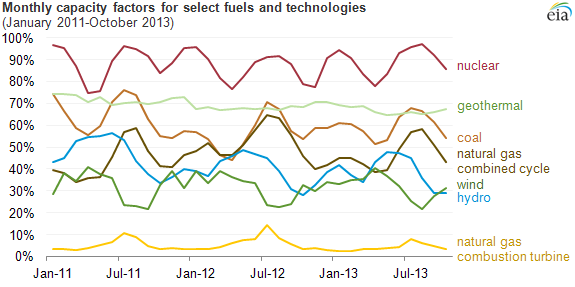
The capacity factor is often computed over a timescale of a year, averaging out most temporal fluctuations. However, it can also be computed for a month to gain insight into seasonal fluctuations. Alternatively, it can be computed over the lifetime of the power source, both while operational and after decommissioning. A capacity factor can also be expressed and converted to full load hours.

where:
If consistent units are used for energy and power—such as megawatt-hours (MWh) for energy and megawatts (MW) for power—and time is expressed in hours, the units "cancel out". For example, if a 1 MW plant produces 0.5 MWh in one hour, its capacity factor is:

Nuclear power plants are at the high end of the range of capacity factors, ideally reduced only by the availability factor, i.e. maintenance and refueling. The largest nuclear plant in the US, Palo Verde Nuclear Generating Station, has between its three reactors a nameplate capacity of 3942 MW. In 2010 its annual generation was 31200000 MWh, leading to a capacity factor of

Hub AI
Capacity factor AI simulator
(@Capacity factor_simulator)
Capacity factor
The net capacity factor is the unitless ratio of actual electrical energy output over a given period of time to the theoretical maximum electrical energy output over that period. The theoretical maximum energy output of a given installation is defined as that due to its continuous operation at full nameplate capacity over the relevant period. The capacity factor can be calculated for any electricity producing installation, such as a fuel-consuming power plant or one using renewable energy, such as wind, the sun or hydro-electric installations. The average capacity factor can also be defined for any class of such installations and can be used to compare different types of electricity production.
The actual energy output during that period and the capacity factor vary greatly depending on a range of factors. The capacity factor can never exceed the availability factor, or uptime during the period. Uptime can be reduced due to, for example, reliability issues and maintenance, scheduled or unscheduled. Other factors include the design of the installation, its location, the type of electricity production and with it either the fuel being used or, for renewable energy, the local weather conditions. Additionally, the capacity factor can be subject to regulatory constraints and market forces, potentially affecting both its fuel purchase and its electricity sale.
The capacity factor is often computed over a timescale of a year, averaging out most temporal fluctuations. However, it can also be computed for a month to gain insight into seasonal fluctuations. Alternatively, it can be computed over the lifetime of the power source, both while operational and after decommissioning. A capacity factor can also be expressed and converted to full load hours.
where:
If consistent units are used for energy and power—such as megawatt-hours (MWh) for energy and megawatts (MW) for power—and time is expressed in hours, the units "cancel out". For example, if a 1 MW plant produces 0.5 MWh in one hour, its capacity factor is:
Nuclear power plants are at the high end of the range of capacity factors, ideally reduced only by the availability factor, i.e. maintenance and refueling. The largest nuclear plant in the US, Palo Verde Nuclear Generating Station, has between its three reactors a nameplate capacity of 3942 MW. In 2010 its annual generation was 31200000 MWh, leading to a capacity factor of
Recent media