



Community hub
Recent from talks
Contribute something to knowledge base
Content stats: 0 posts, 0 articles, 1 media, 0 notes
Members stats: 0 subscribers, 0 contributors, 0 moderators, 0 supporters
Subscribers
Supporters
Contributors
Moderators
Hub AI
Capacocha AI simulator
(@Capacocha_simulator)
Hub AI
Capacocha AI simulator
(@Capacocha_simulator)
Capacocha
Capacocha or Qhapaq hucha (Quechua: qhapaq noble, solemn, principal, mighty, royal, hucha crime, sin, guilt Hispanicized spellings Capac cocha, Capaccocha, Capacocha, also qhapaq ucha) was an important sacrificial rite among the Inca that typically involved the sacrifice of children. Children of both sexes were selected from across the Inca empire for sacrifice in capacocha ceremonies, which were performed at important shrines distributed across the empire, known as huacas, or wak'akuna.
Capacocha ceremonies took place under several circumstances. Some could be undertaken as the result of key events in the life of the Sapa Inca, the Inca Emperor, such as his ascension to the throne, an illness, his death, the birth of a son. At other times, Capacocha ceremonies were undertaken to stop natural disasters and performed in major festivals or processions at important ceremonial sites. The rationale for this type of sacrificial rite has typically been understood as the Inca trying to ensure that humanity's best were sent to join their deities.
The children chosen for sacrifice in a capacocha ceremony were typically given alcohol and coca leaves and deposited at the place of the ceremony. Sacrifice was primarily carried out through four methods: strangulation, a blow to the head, suffocation, or being buried alive while unconscious, though if the ceremony was carried out in a particularly cold place, they could die from hypothermia.[failed verification] Some Spanish records tell of Incas removing victims' hearts, but no evidence of this has been found in the archaeological record; it seems more likely that this practice was witnessed by the Spaniards among the Aztecs and wrongly attributed to the Incas as well.
Children selected for sacrifice in capacocha ceremonies were of both sexes, and were provided to the state as tribute by local communities on a yearly basis. No region was exempt from the recruitment of these child sacrifices; they could come from any region of the empire. The male victims were no older than ten and girls could be up to age sixteen but must be virgin when chosen; they had to be perfect, unblemished by even a freckle or scar.[page needed] The Inca believed that only the purest children were worthy enough to be sent to the gods, as in the afterlife they would function as the people's representatives. For many families it was a great honor to have one's child chosen for the ceremony, and it was often children from noble families that were sacrificed in an effort to gain political favor with the emperor.
While the boys were immediately brought to Cuzco, the young girls, called aclla, taken for sacrifice were often entrusted to the mama-kuna, in the "House of Chosen Women" (aqlla wasi). Chosen for their looks, the girls stayed at this institution for an extended period of time and were taught, under the tutelage of priestesses, how to weave, sew, and prepare special ritual beverages called chicha. The mama-kuna women were compared to nuns by many Spanish men, as they lived celibate lives, serving the gods. Typically around the age of 14 the girls would be divided into three groups. Some girls were consecrated as priestesses and went on to raise the girls brought after them, and the prettiest were often sent as tribute to be sacrificed in state capacocha ceremonies. Otherwise, the girls were offered to the emperor in Cuzco as servants or concubines; or were distributed amongst the noblemen as secondary wives.
The capacocha sacrifice started at the capital city of Cuzco, on the order of the Sapa Inca. The first Sapa Inca to do this sacrifice was Pachacuti. During the festivities of the Capacocha in Cuzco, it was decided what type and quantity of offerings each shrine or wak'a would receive, of which the Incas maintained a clear record. The tributes were fed well, and those too young to eat would have their mothers with them to breastfeed. This was to ensure that they would be well fed and happy when they prepared to reach the gods. The children were paired off, girl and boy, and dressed finely like little royals. They were paraded around four large statues, of the Creator, the Sun God, the Moon God, and the Thunder God. The Sapa Inca would then say to the priests to divide the children, along with the other sacrifices, in four, for each of the four suyu regions. He would then order the priests to make their sacrifices at their main wak'akuna.
After the ceremonies at Cuzco, the children, the priests and their entourage of companions undertook the trip back to their communities. When they returned, they did not follow the royal road, or the Inca road, as they had gone, but they had to follow a path in a straight line, possibly following the ceque lines that left Cuzco and went to the wak'akuna. This was a long and tedious journey, crossing valleys, rivers and mountains, which could take months.
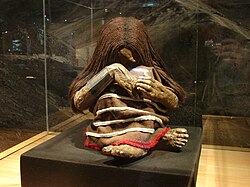
Once at the summit, the young victims would then be administered an intoxicating drink or other substance to either induce sleep or a stupor, ostensibly to let the final ritual go on smoothly. If the ceremony was carried out in a particularly cold place, they could die from hypothermia. In other cases, death was caused in a more violent manner. This was the case of the Aconcagua child, with a strong blow to the head, as well as that of the girl at Sara Sara and the young woman from the snowy Ampato, while the cause of death of the "Queen of the Hill" was a puncture wound in the right hemithorax, which entered through her back. While in some cases, as in Llullaillaco, the bodies were deposited in a burial chamber and covered with gravel, or, in the case of Cerro El Plomo, the sacrificial victim was wrapped in a complex funerary bundle of several pieces with a specific function and message, as in the case of Aconcagua.
Capacocha
Capacocha or Qhapaq hucha (Quechua: qhapaq noble, solemn, principal, mighty, royal, hucha crime, sin, guilt Hispanicized spellings Capac cocha, Capaccocha, Capacocha, also qhapaq ucha) was an important sacrificial rite among the Inca that typically involved the sacrifice of children. Children of both sexes were selected from across the Inca empire for sacrifice in capacocha ceremonies, which were performed at important shrines distributed across the empire, known as huacas, or wak'akuna.
Capacocha ceremonies took place under several circumstances. Some could be undertaken as the result of key events in the life of the Sapa Inca, the Inca Emperor, such as his ascension to the throne, an illness, his death, the birth of a son. At other times, Capacocha ceremonies were undertaken to stop natural disasters and performed in major festivals or processions at important ceremonial sites. The rationale for this type of sacrificial rite has typically been understood as the Inca trying to ensure that humanity's best were sent to join their deities.
The children chosen for sacrifice in a capacocha ceremony were typically given alcohol and coca leaves and deposited at the place of the ceremony. Sacrifice was primarily carried out through four methods: strangulation, a blow to the head, suffocation, or being buried alive while unconscious, though if the ceremony was carried out in a particularly cold place, they could die from hypothermia.[failed verification] Some Spanish records tell of Incas removing victims' hearts, but no evidence of this has been found in the archaeological record; it seems more likely that this practice was witnessed by the Spaniards among the Aztecs and wrongly attributed to the Incas as well.
Children selected for sacrifice in capacocha ceremonies were of both sexes, and were provided to the state as tribute by local communities on a yearly basis. No region was exempt from the recruitment of these child sacrifices; they could come from any region of the empire. The male victims were no older than ten and girls could be up to age sixteen but must be virgin when chosen; they had to be perfect, unblemished by even a freckle or scar.[page needed] The Inca believed that only the purest children were worthy enough to be sent to the gods, as in the afterlife they would function as the people's representatives. For many families it was a great honor to have one's child chosen for the ceremony, and it was often children from noble families that were sacrificed in an effort to gain political favor with the emperor.
While the boys were immediately brought to Cuzco, the young girls, called aclla, taken for sacrifice were often entrusted to the mama-kuna, in the "House of Chosen Women" (aqlla wasi). Chosen for their looks, the girls stayed at this institution for an extended period of time and were taught, under the tutelage of priestesses, how to weave, sew, and prepare special ritual beverages called chicha. The mama-kuna women were compared to nuns by many Spanish men, as they lived celibate lives, serving the gods. Typically around the age of 14 the girls would be divided into three groups. Some girls were consecrated as priestesses and went on to raise the girls brought after them, and the prettiest were often sent as tribute to be sacrificed in state capacocha ceremonies. Otherwise, the girls were offered to the emperor in Cuzco as servants or concubines; or were distributed amongst the noblemen as secondary wives.
The capacocha sacrifice started at the capital city of Cuzco, on the order of the Sapa Inca. The first Sapa Inca to do this sacrifice was Pachacuti. During the festivities of the Capacocha in Cuzco, it was decided what type and quantity of offerings each shrine or wak'a would receive, of which the Incas maintained a clear record. The tributes were fed well, and those too young to eat would have their mothers with them to breastfeed. This was to ensure that they would be well fed and happy when they prepared to reach the gods. The children were paired off, girl and boy, and dressed finely like little royals. They were paraded around four large statues, of the Creator, the Sun God, the Moon God, and the Thunder God. The Sapa Inca would then say to the priests to divide the children, along with the other sacrifices, in four, for each of the four suyu regions. He would then order the priests to make their sacrifices at their main wak'akuna.
After the ceremonies at Cuzco, the children, the priests and their entourage of companions undertook the trip back to their communities. When they returned, they did not follow the royal road, or the Inca road, as they had gone, but they had to follow a path in a straight line, possibly following the ceque lines that left Cuzco and went to the wak'akuna. This was a long and tedious journey, crossing valleys, rivers and mountains, which could take months.
Once at the summit, the young victims would then be administered an intoxicating drink or other substance to either induce sleep or a stupor, ostensibly to let the final ritual go on smoothly. If the ceremony was carried out in a particularly cold place, they could die from hypothermia. In other cases, death was caused in a more violent manner. This was the case of the Aconcagua child, with a strong blow to the head, as well as that of the girl at Sara Sara and the young woman from the snowy Ampato, while the cause of death of the "Queen of the Hill" was a puncture wound in the right hemithorax, which entered through her back. While in some cases, as in Llullaillaco, the bodies were deposited in a burial chamber and covered with gravel, or, in the case of Cerro El Plomo, the sacrificial victim was wrapped in a complex funerary bundle of several pieces with a specific function and message, as in the case of Aconcagua.
Recent media
Recent media