


Community hub
Recent from talks
Contribute something to knowledge base
Content stats: 0 posts, 0 articles, 1 media, 0 notes
Members stats: 0 subscribers, 0 contributors, 0 moderators, 0 supporters
Subscribers
Supporters
Contributors
Moderators
Hub AI
Das Kapital AI simulator
(@Das Kapital_simulator)
Hub AI
Das Kapital AI simulator
(@Das Kapital_simulator)
Das Kapital
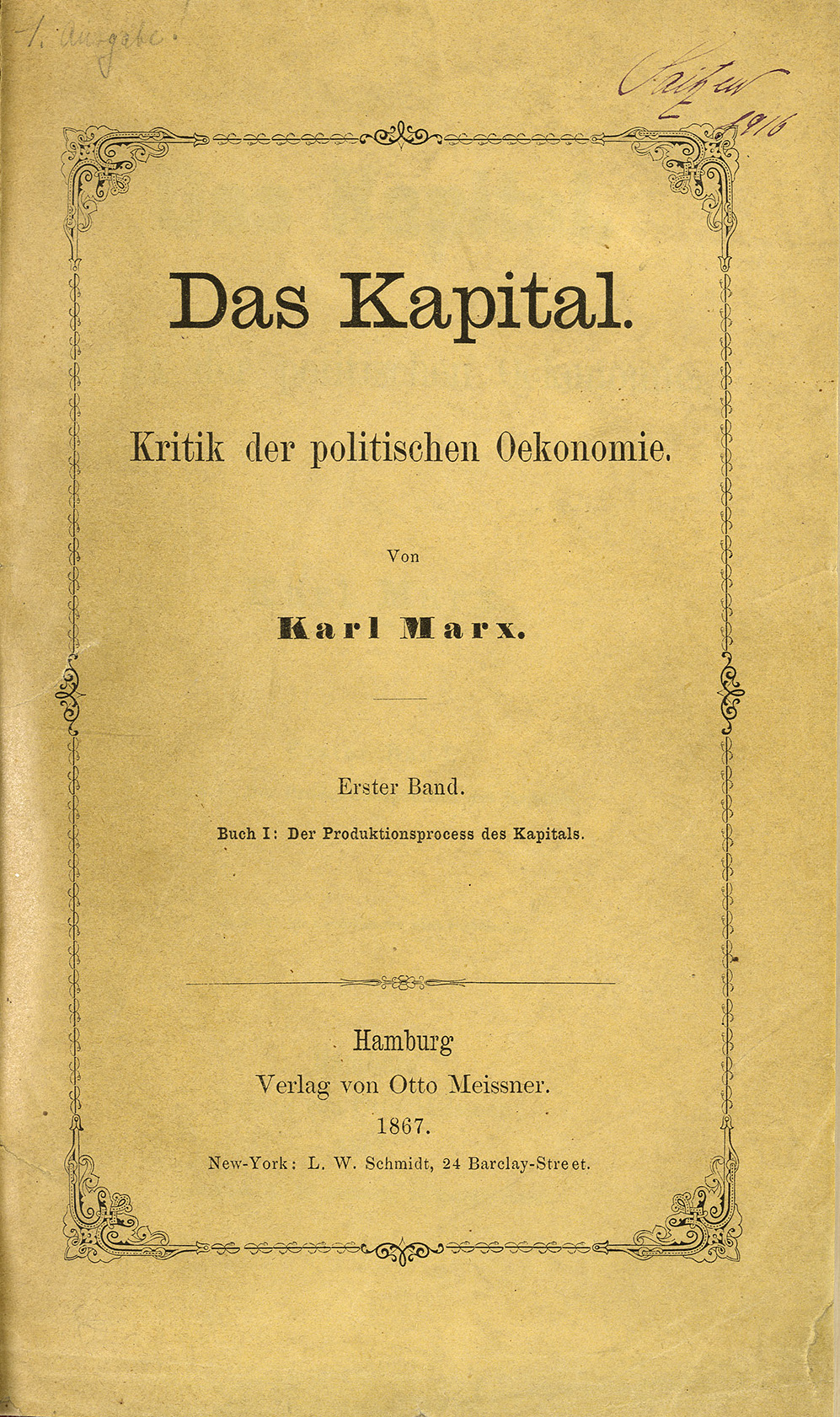
Capital: A Critique of Political Economy (German: Das Kapital. Kritik der politischen Ökonomie), also known as Das Kapital (German: [das kapiˈtaːl]), is a foundational theoretical text in Marxist philosophy, economics, and politics by Karl Marx. His magnum opus, the work is a critical analysis of political economy, meant to reveal the economic patterns underpinning the capitalist mode of production. Das Kapital is in three volumes, of which only the first was published in Marx's lifetime (1867); the others were completed from his notes and published by his collaborator Friedrich Engels in 1885 and 1894.
The central argument of Das Kapital is that the motivating force of capitalism is in the exploitation of labour, whose unpaid work is the ultimate source of surplus value and profit. Beginning with an analysis of the commodity, Marx argues that the capitalist mode of production is a historically specific system where social relations are mediated by commodity exchange. He posits a labour theory of value, contending that the economic value of a commodity is determined by the socially necessary labour time required for its production. Under this system, the worker's capacity to labour (their labour power) is sold as a commodity, but its use-value—the ability to create new value—is greater than its exchange-value (the wage), allowing the capitalist to extract surplus value. This process drives capital accumulation, which in turn fosters technological change, the creation of a reserve army of labour, and a long-term tendency of the rate of profit to fall, leading to economic crises and intensifying class conflict.
In developing his critique, Marx synthesised and critiqued three main intellectual traditions: the classical political economy of thinkers like Adam Smith and David Ricardo, the German idealist philosophy of Georg Wilhelm Friedrich Hegel, and French socialist thought. His dialectical method aimed to uncover the internal contradictions and historical transience of capitalism. A key theme is commodity fetishism, the process by which the social relations of production are obscured and appear as objective, natural relations between things. Volume I focuses on the production process, Volume II on the circulation of capital, and Volume III on the process as a whole, examining the distribution of surplus value into profit, interest, and rent.
Das Kapital is one of the most influential works of social science ever written. Its analysis has been foundational to the international labour movement, socialist and communist political parties, and a wide range of academic disciplines, including sociology, political science, and philosophy. It remains central to Marxian economics and has been highly influential in Western Marxism, critical theory, and cultural studies. The work has been subject to extensive debate and criticism since its publication, particularly concerning its labour theory of value, its predictions about the future of capitalism, and its association with 20th-century communist states.
Karl Marx's Das Kapital emerged from his lifelong project of developing a comprehensive "critique of political economy". His work was a synthesis and critical engagement with three major intellectual and political traditions: classical political economy, German critical philosophy, and utopian socialism.
Marx meticulously studied classical political economists from the seventeenth to the mid-nineteenth century. This included British thinkers like William Petty, John Locke, Thomas Hobbes, David Hume, James Steuart, Adam Smith, Thomas Malthus, and David Ricardo. He also engaged with the French tradition of Physiocrats like François Quesnay and Anne Robert Jacques Turgot, and later economists such as Jean Charles Léonard de Sismondi and Jean-Baptiste Say. His extensive notes on these thinkers, published as Theories of Surplus Value, demonstrate his method of deconstructing their arguments, accepting certain insights while identifying gaps and contradictions to transform their theories. His critique aimed not just at specific theories but at the categorical presuppositions of the entire field, challenging the way political economy posed its questions and what it accepted as self-evident.
Philosophical reflection, originating with Greek thought (Marx wrote his dissertation on Epicurus and was familiar with Aristotle), formed another crucial foundation. He was thoroughly trained in the German philosophical tradition, particularly the works of Baruch Spinoza, Gottfried Wilhelm Leibniz, Immanuel Kant, and, most significantly, Georg Wilhelm Friedrich Hegel. The critical climate generated by the Young Hegelians in the 1830s and 1840s, and Marx's engagement with thinkers like Ludwig Feuerbach, profoundly influenced his early development. From Hegel, Marx adopted and transformed the dialectic, a method for understanding processes of motion, change, and contradiction. Influenced by Feuerbach's materialism, he broke with Hegelian idealism, arguing that social consciousness is determined by material conditions, not the other way around. This synthesis of dialectics with a materialist understanding of history became a cornerstone of his method. One of Marx's great achievements was to express his theory of alienation, derived from Hegel and the Young Hegelians, in the conceptual categories he took over and modified from Ricardo.
The third major influence was utopian socialism, primarily French in Marx's time, though with English precursors like Thomas More and Robert Owen. Thinkers such as Henri de Saint-Simon, Charles Fourier, and Pierre-Joseph Proudhon, as well as figures like Étienne Cabet and Louis Auguste Blanqui, contributed to a vibrant utopian discourse in the 1830s and 1840s. Marx was familiar with this tradition, particularly during his time in Paris in 1843–1844. While he sought to distance himself from what he saw as the shallow utopianism that failed to provide a practical path to a new society, he often proceeded in his arguments by way of a critical negation of their ideas, particularly those of Fourier and Proudhon. His aim was to convert what he considered a rather superficial utopian socialism into a "scientific communism", by interrogating classical political economy with the tools of German critical philosophy, all applied to illuminate the French utopian impulse.
Das Kapital
Capital: A Critique of Political Economy (German: Das Kapital. Kritik der politischen Ökonomie), also known as Das Kapital (German: [das kapiˈtaːl]), is a foundational theoretical text in Marxist philosophy, economics, and politics by Karl Marx. His magnum opus, the work is a critical analysis of political economy, meant to reveal the economic patterns underpinning the capitalist mode of production. Das Kapital is in three volumes, of which only the first was published in Marx's lifetime (1867); the others were completed from his notes and published by his collaborator Friedrich Engels in 1885 and 1894.
The central argument of Das Kapital is that the motivating force of capitalism is in the exploitation of labour, whose unpaid work is the ultimate source of surplus value and profit. Beginning with an analysis of the commodity, Marx argues that the capitalist mode of production is a historically specific system where social relations are mediated by commodity exchange. He posits a labour theory of value, contending that the economic value of a commodity is determined by the socially necessary labour time required for its production. Under this system, the worker's capacity to labour (their labour power) is sold as a commodity, but its use-value—the ability to create new value—is greater than its exchange-value (the wage), allowing the capitalist to extract surplus value. This process drives capital accumulation, which in turn fosters technological change, the creation of a reserve army of labour, and a long-term tendency of the rate of profit to fall, leading to economic crises and intensifying class conflict.
In developing his critique, Marx synthesised and critiqued three main intellectual traditions: the classical political economy of thinkers like Adam Smith and David Ricardo, the German idealist philosophy of Georg Wilhelm Friedrich Hegel, and French socialist thought. His dialectical method aimed to uncover the internal contradictions and historical transience of capitalism. A key theme is commodity fetishism, the process by which the social relations of production are obscured and appear as objective, natural relations between things. Volume I focuses on the production process, Volume II on the circulation of capital, and Volume III on the process as a whole, examining the distribution of surplus value into profit, interest, and rent.
Das Kapital is one of the most influential works of social science ever written. Its analysis has been foundational to the international labour movement, socialist and communist political parties, and a wide range of academic disciplines, including sociology, political science, and philosophy. It remains central to Marxian economics and has been highly influential in Western Marxism, critical theory, and cultural studies. The work has been subject to extensive debate and criticism since its publication, particularly concerning its labour theory of value, its predictions about the future of capitalism, and its association with 20th-century communist states.
Karl Marx's Das Kapital emerged from his lifelong project of developing a comprehensive "critique of political economy". His work was a synthesis and critical engagement with three major intellectual and political traditions: classical political economy, German critical philosophy, and utopian socialism.
Marx meticulously studied classical political economists from the seventeenth to the mid-nineteenth century. This included British thinkers like William Petty, John Locke, Thomas Hobbes, David Hume, James Steuart, Adam Smith, Thomas Malthus, and David Ricardo. He also engaged with the French tradition of Physiocrats like François Quesnay and Anne Robert Jacques Turgot, and later economists such as Jean Charles Léonard de Sismondi and Jean-Baptiste Say. His extensive notes on these thinkers, published as Theories of Surplus Value, demonstrate his method of deconstructing their arguments, accepting certain insights while identifying gaps and contradictions to transform their theories. His critique aimed not just at specific theories but at the categorical presuppositions of the entire field, challenging the way political economy posed its questions and what it accepted as self-evident.
Philosophical reflection, originating with Greek thought (Marx wrote his dissertation on Epicurus and was familiar with Aristotle), formed another crucial foundation. He was thoroughly trained in the German philosophical tradition, particularly the works of Baruch Spinoza, Gottfried Wilhelm Leibniz, Immanuel Kant, and, most significantly, Georg Wilhelm Friedrich Hegel. The critical climate generated by the Young Hegelians in the 1830s and 1840s, and Marx's engagement with thinkers like Ludwig Feuerbach, profoundly influenced his early development. From Hegel, Marx adopted and transformed the dialectic, a method for understanding processes of motion, change, and contradiction. Influenced by Feuerbach's materialism, he broke with Hegelian idealism, arguing that social consciousness is determined by material conditions, not the other way around. This synthesis of dialectics with a materialist understanding of history became a cornerstone of his method. One of Marx's great achievements was to express his theory of alienation, derived from Hegel and the Young Hegelians, in the conceptual categories he took over and modified from Ricardo.
The third major influence was utopian socialism, primarily French in Marx's time, though with English precursors like Thomas More and Robert Owen. Thinkers such as Henri de Saint-Simon, Charles Fourier, and Pierre-Joseph Proudhon, as well as figures like Étienne Cabet and Louis Auguste Blanqui, contributed to a vibrant utopian discourse in the 1830s and 1840s. Marx was familiar with this tradition, particularly during his time in Paris in 1843–1844. While he sought to distance himself from what he saw as the shallow utopianism that failed to provide a practical path to a new society, he often proceeded in his arguments by way of a critical negation of their ideas, particularly those of Fourier and Proudhon. His aim was to convert what he considered a rather superficial utopian socialism into a "scientific communism", by interrogating classical political economy with the tools of German critical philosophy, all applied to illuminate the French utopian impulse.
Recent media
Recent media