Recent from talks
Legacy and Works
Personal Life and Relationships
Later Life and Death
Early Life and Education
Career and Major Works
Main milestones
Nothing was collected or created yet.
Aristotle
View on Wikipedia
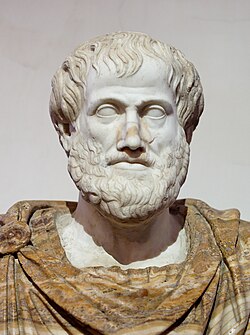
Aristotle[A] (Attic Greek: Ἀριστοτέλης, romanized: Aristotélēs;[B] 384–322 BC) was an ancient Greek philosopher and polymath. His writings cover a broad range of subjects spanning the natural sciences, philosophy, linguistics, economics, politics, psychology, and the arts. As the founder of the Peripatetic school of philosophy in the Lyceum in Athens, he began the wider Aristotelian tradition that followed, which set the groundwork for the development of modern science.
Key Information
Little is known about Aristotle's life. He was born in the city of Stagira in northern Greece during the Classical period. His father, Nicomachus, died when Aristotle was a child, and he was brought up by a guardian. At around eighteen years old, he joined Plato's Academy in Athens and remained there until the age of thirty seven (c. 347 BC). Shortly after Plato died, Aristotle left Athens and, at the request of Philip II of Macedon, tutored his son Alexander the Great beginning in 343 BC. He established a library in the Lyceum, which helped him to produce many of his hundreds of books on papyrus scrolls.
Though Aristotle wrote many treatises and dialogues for publication, only around a third of his original output has survived, none of it intended for publication. Aristotle provided a complex synthesis of the various philosophies existing prior to him. His teachings and methods of inquiry have had a significant impact across the world, and remain a subject of contemporary philosophical discussion.
Aristotle's views profoundly shaped medieval scholarship. The influence of his physical science extended from late antiquity and the Early Middle Ages into the Renaissance, and was not replaced systematically until the Enlightenment and theories such as classical mechanics were developed. He influenced Judeo-Islamic philosophies during the Middle Ages, as well as Christian theology, especially the Neoplatonism of the Early Church and the scholastic tradition of the Catholic Church.
Aristotle was revered among medieval Muslim scholars as "The First Teacher", and among medieval Christians like Thomas Aquinas as simply "The Philosopher", while the poet Dante called him "the master of those who know". He has been referred to as the first scientist. His works contain the earliest known systematic study of logic, and were studied by medieval scholars such as Peter Abelard and Jean Buridan. His influence on logic continued well into the 19th century. In addition, his ethics, although always influential, has gained renewed interest with the modern advent of virtue ethics.
Life
[edit]In general, the details of Aristotle's life are not well-established. The biographies written in ancient times are often speculative and historians only agree on a few salient points.[C] Aristotle was born in 384 BC[D] in Stagira, Chalcidice,[2] about 55 km (34 miles) east of modern-day Thessaloniki.[3][4] He was the son of Nicomachus, the personal physician of King Amyntas of Macedon,[5] and Phaestis, a woman with origins from Chalcis, Euboea.[6] Nicomachus was said to have belonged to the medical guild of Asclepiadae and was likely responsible for Aristotle's early interest in biology and medicine.[7] Ancient tradition held that Aristotle's family descended from the legendary physician Asclepius and his son Machaon.[8] Both of Aristotle's parents died when he was still at a young age and Proxenus of Atarneus became his guardian.[9] Although little information about Aristotle's childhood has survived, he probably spent some time in the Macedonian capital, making his first connections with the Macedonian monarchy.[10]

At the age of seventeen or eighteen, Aristotle moved to Athens to continue his education at Plato's Academy.[11] He became distinguished as a researcher and lecturer, earning for himself the nickname "mind of the school" by his tutor Plato.[12] In Athens, he probably experienced the Eleusinian Mysteries as he wrote when describing the sights one viewed at the Mysteries, "to experience is to learn" (παθεĩν μαθεĩν).[13] Aristotle remained in Athens for nearly twenty years before leaving in 348/47 BC after Plato's death.[14] The traditional story about his departure records that he was disappointed with the academy's direction after control passed to Plato's nephew Speusippus, although it is possible that the anti-Macedonian sentiments in Athens could have also influenced his decision.[15][16] Aristotle left with Xenocrates to Assos in Asia Minor, where he was invited by his former fellow student Hermias of Atarneus; he stayed there for a few years, leaving around the time of Hermias' death.[E] While at Assos, Aristotle and his colleague Theophrastus did extensive research in botany and marine biology, which they later continued at the near-by island of Lesbos.[17] During this time, Aristotle married Pythias, Hermias's adoptive daughter and niece, and had a daughter whom they also named Pythias.[18]

In 343/42 BC, Aristotle was invited to Pella by Philip II of Macedon to become the tutor to his thirteen-year-old son Alexander;[19] a choice perhaps influenced by the relationship of Aristotle's family with the Macedonian dynasty.[20] Aristotle taught Alexander at the private school of Mieza, in the gardens of the Nymphs, the royal estate near Pella.[21] Alexander's education probably included a number of subjects, such as ethics and politics,[22] as well as standard literary texts, like Euripides and Homer.[23] It is likely that during Aristotle's time in the Macedonian court, other prominent nobles, like Ptolemy and Cassander, would have occasionally attended his lectures.[24] Aristotle encouraged Alexander toward eastern conquest, and his own attitude towards Persia was strongly ethnocentric. In one famous example, he counsels Alexander to be "a leader to the Greeks and a despot to the barbarians".[25] Alexander's education under the guardianship of Aristotle likely lasted for only a few years, as at around the age of sixteen he returned to Pella and was appointed regent of Macedon by his father Philip.[26] During this time, Aristotle gifted Alexander an annotated copy of the Iliad, which is said to have become one of Alexander's most prized possessions.[27] Scholars speculate that two of Aristotle's now lost works, On kingship and On behalf of the Colonies, were composed by the philosopher for the young prince.[28] Aristotle returned to Athens for the second and final time a year after Philip II's assassination in 336 BC.[29]
As a metic, Aristotle could not own property in Athens and thus rented a building known as the Lyceum (named after the sacred grove of Apollo Lykeios), in which he established his own school.[30] The building included a gymnasium and a colonnade (peripatos), from which the school acquired the name Peripatetic.[31] Aristotle conducted courses and research at the school for the next twelve years. He often lectured small groups of distinguished students and, along with some of them, such as Theophrastus, Eudemus, and Aristoxenus, Aristotle built a large library which included manuscripts, maps, and museum objects.[32] While in Athens, his wife Pythias died and Aristotle became involved with Herpyllis of Stagira. They had a son whom Aristotle named after his father, Nicomachus.[33] This period in Athens, between 335 and 323 BC, is when Aristotle is believed to have composed many of his philosophical works.[34] He wrote many dialogues, of which only fragments have survived. Those works that have survived are in treatise form and were not, for the most part, intended for widespread publication; they are generally thought to be lecture aids for his students. His most important treatises include Physics, Metaphysics, Nicomachean Ethics, Politics, On the Soul and Poetics. Aristotle studied and made significant contributions to "logic, metaphysics, mathematics, physics, biology, botany, ethics, politics, agriculture, medicine, dance, and theatre."[35]

While Alexander deeply admired Aristotle, near the end of his life, the two men became estranged having diverging opinions over issues, like the optimal administration of city-states, the treatment of conquered populations, such as the Persians, and philosophical questions, like the definition of braveness.[36] A widespread speculation in antiquity suggested that Aristotle played a role in Alexander's death, but the only evidence of this is an unlikely claim made some six years after the death.[37] Following Alexander's death, anti-Macedonian sentiment in Athens was rekindled. In 322 BC, Demophilus and Eurymedon the Hierophant reportedly denounced Aristotle for impiety,[38] prompting him to flee to his mother's family estate in Chalcis, Euboea, at which occasion he was said to have stated "I will not allow the Athenians to sin twice against philosophy"[39] – a reference to Athens's trial and execution of Socrates.[15] He died in Chalcis, Euboea[40][41] of natural causes later that same year, having named his student Antipater as his chief executor and left a will in which he asked to be buried next to his wife.[42] Aristotle left his works to Theophrastus, his successor as the head of the Lyceum, who in turn passed them down to Neleus of Scepsis in Asia Minor. There, the papers remained hidden for protection until they were purchased by the collector Apellicon. In the meantime, many copies of Aristotle's major works had already begun to circulate and be used in the Lyceum of Athens, Alexandria, and later in Rome.[43]
Theoretical philosophy
[edit]Logic
[edit]With the Prior Analytics, Aristotle is credited with the earliest systematic study of logic,[44] and his conception of it was the dominant form of Western logic until 19th-century advances in mathematical logic.[45] Kant stated in the Critique of Pure Reason that with Aristotle, logic reached its completion.[46]
Organon
[edit]
Most of Aristotle's work is probably not in its original form, because it was most likely edited by students and later lecturers. The logical works of Aristotle were compiled into a set of six books called the Organon around 40 BC by Andronicus of Rhodes or others among his followers.[49] The books are:
The order of the books (or the teachings from which they are composed) is not certain, but this list was derived from analysis of Aristotle's writings. It goes from the basics, the analysis of simple terms in the Categories, the analysis of propositions and their elementary relations in On Interpretation, to the study of more complex forms, namely, syllogisms and demonstration (in the Analytics)[50][51] and dialectics (in the Topics and Sophistical Refutations). The first three treatises form the core of the logical theory stricto sensu: the grammar of the language of logic and the correct rules of reasoning. The Rhetoric is not conventionally included, but it states that it relies on the Topics.[52]
Syllogism
[edit]| In words | In terms[G] |
In equations[H] |
|---|---|---|
| All men are mortal. All Greeks are men. ∴ All Greeks are mortal. |
M a P S a M S a P |
What is today called Aristotelian logic with its types of syllogism (methods of logical argument),[53] Aristotle himself would have labelled "analytics". The term "logic" he reserved to mean dialectics.[55][56]
Demonstration
[edit]Aristotle's Posterior Analytics contains his account of demonstration, or demonstrative knowledge, what would today be considered the study of epistemology rather than logic, but which for Aristotle is deeply connected with his account of syllogism.[52] For Aristotle, knowledge is that which is necessarily the case, along with the study of causes.[52]
Metaphysics
[edit]The word "metaphysics" comes from the title of a collection of works by Aristotle bearing that title. However, Aristotle did not use that term himself, which is due to a later compiler, but instead called it "first philosophy" or theology.[57] He distinguished this as "the study of being qua being" which, as opposed to other studies of being, such as mathematics and natural science, studies that which is eternal, unchanging, and immaterial.[57] He wrote in his Metaphysics (1026a16):
If there were no other independent things besides the composite natural ones, the study of nature would be the primary kind of knowledge; but if there is some motionless independent thing, the knowledge of this precedes it and is first philosophy, and it is universal in just this way, because it is first. And it belongs to this sort of philosophy to study being as being, both what it is and what belongs to it just by virtue of being.[58]
Substance
[edit]Aristotle examines the concepts of substance (ousia) and essence (to ti ên einai, "the what it was to be") in his Metaphysics (Book VII), and he concludes that a particular substance is a combination of both matter and form, a philosophical theory called hylomorphism. In Book VIII, he distinguishes the matter of the substance as the substratum, or the stuff of which it is composed. For example, the matter of a house is the bricks, stones, timbers, etc., or whatever constitutes the potential house, while the form of the substance is the actual house, namely 'covering for bodies and chattels' or any other differentia that let us define something as a house. The formula that gives the components is the account of the matter, and the formula that gives the differentia is the account of the form.[59][57]
Moderate realism
[edit]
Like his teacher Plato, Aristotle's philosophy aims at the universal. Aristotle's ontology has the universal (katholou) exist in a lesser sense than particulars (kath' hekaston), things in the world, whereas for Plato the universal is a realer, separately existing form which particular things merely imitate. For Aristotle, universals still exist, but are only encountered when "instantiated" in a particular substance.[57]
In addition, Aristotle disagreed with Plato about the location of universals. Where Plato spoke of the forms as existing separately from the things that participate in them, Aristotle maintained that universals are multiply located. So, according to Aristotle, the form of apple exists within each apple, rather than in the world of the forms.[57][60]
Potentiality and actuality
[edit]Concerning the nature of change (kinesis) and its causes, as he outlines in his Physics and On Generation and Corruption (319b–320a), he distinguishes coming-to-be (genesis, also translated as 'generation') from:
- growth and diminution, which is change in quantity;
- locomotion, which is change in space; and
- alteration, which is change in quality.

Coming-to-be is a change where the substrate of the thing that has undergone the change has itself changed. In that particular change he introduces the concept of potentiality (dynamis) and actuality (entelecheia) in association with the matter and the form. Referring to potentiality, this is what a thing is capable of doing or being acted upon if the conditions are right and it is not prevented by something else. For example, the seed of a plant in the soil is potentially (dynamei) a plant, and if it is not prevented by something, it will become a plant. Potentially, beings can either 'act' (poiein) or 'be acted upon' (paschein), which can be either innate or learned. For example, the eyes possess the potentiality of sight (innate – being acted upon), while the capability of playing the flute can be possessed by learning (exercise – acting). Actuality is the fulfilment of the end of the potentiality. Because the end (telos) is the principle of every change, and potentiality exists for the sake of the end, actuality, accordingly, is the end. Referring then to the previous example, it can be said that an actuality is when a plant does one of the activities that plants do.[57]
For that for the sake of which (to hou heneka) a thing is, is its principle, and the becoming is for the sake of the end; and the actuality is the end, and it is for the sake of this that the potentiality is acquired. For animals do not see in order that they may have sight, but they have sight that they may see.[61]
In summary, the matter used to make a house has potentiality to be a house and both the activity of building and the form of the final house are actualities, which is also a final cause or end. Then Aristotle proceeds and concludes that the actuality is prior to potentiality in formula, in time and in substantiality. With this definition of the particular substance (i.e., matter and form), Aristotle tries to solve the problem of the unity of the beings, for example, "what is it that makes a man one"? Since, according to Plato there are two Ideas: animal and biped, how then is man a unity? However, according to Aristotle, the potential being (matter) and the actual one (form) are one and the same.[57][62]
Natural philosophy
[edit]Aristotle's "natural philosophy" spans a wide range of natural phenomena including those now covered by physics, biology and other natural sciences.[63] In Aristotle's terminology, "natural philosophy" is a branch of philosophy examining the phenomena of the natural world, and includes fields that would be regarded today as physics, biology and other natural sciences. Aristotle's work encompassed virtually all facets of intellectual inquiry. Aristotle makes philosophy in the broad sense coextensive with reasoning, which he also would describe as "science". However, his use of the term science carries a different meaning than that covered by the term "scientific method". For Aristotle, "all science (dianoia) is either practical, poetical or theoretical" (Metaphysics 1025b25). His practical science includes ethics and politics; his poetical science means the study of fine arts including poetry; his theoretical science covers physics, mathematics and metaphysics.[63]
Physics
[edit]
Five elements
[edit]In his On Generation and Corruption, Aristotle related each of the four elements proposed earlier by Empedocles, earth, water, air, and fire, to two of the four sensible qualities, hot, cold, wet, and dry. In the Empedoclean scheme, all matter was made of the four elements, in differing proportions. Aristotle's scheme added the heavenly aether, the divine substance of the heavenly spheres, stars and planets.[64]
| Element | Hot/Cold | Wet/Dry | Motion | Modern state of matter |
|---|---|---|---|---|
| Earth | Cold | Dry | Down | Solid |
| Water | Cold | Wet | Down | Liquid |
| Air | Hot | Wet | Up | Gas |
| Fire | Hot | Dry | Up | Plasma |
| Aether | (divine substance) |
None | Circular (in heavens) |
Vacuum |
Motion
[edit]Aristotle describes two kinds of motion: "violent" or "unnatural motion", such as that of a thrown stone, in the Physics (254b10), and "natural motion", such as of a falling object, in On the Heavens (300a20). In violent motion, as soon as the agent stops causing it, the motion stops also: in other words, the natural state of an object is to be at rest,[65][I] since Aristotle does not address friction.[66] With this understanding, it can be observed that, as Aristotle stated, heavy objects (on the ground, say) require more force to make them move; and objects pushed with greater force move faster.[67][J] This would imply the equation[67]
- ,
incorrect in modern physics.[67]
Natural motion depends on the element concerned: the aether naturally moves in a circle around the heavens,[K] while the 4 Empedoclean elements move vertically up (like fire, as is observed) or down (like earth) towards their natural resting places.[68][66][L]

In the Physics (215a25), Aristotle effectively states a quantitative law, that the speed, v, of a falling body is proportional (say, with constant c) to its weight, W, and inversely proportional to the density,[M] ρ, of the fluid in which it is falling:[68][66]
Aristotle implies that in a vacuum the speed of fall would become infinite, and concludes from this apparent absurdity that a vacuum is not possible.[68][66] Opinions have varied on whether Aristotle intended to state quantitative laws. Henri Carteron held the "extreme view"[66] that Aristotle's concept of force was basically qualitative,[69] but other authors reject this.[66]
Archimedes corrected Aristotle's theory that bodies move towards their natural resting places; metal boats can float if they displace enough water; floating depends in Archimedes' scheme on the mass and volume of the object, not, as Aristotle thought, its elementary composition.[68]
Aristotle's writings on motion remained influential until the early modern period. John Philoponus (in late antiquity) and Galileo (in the early modern period) are said to have shown by experiment that Aristotle's claim that a heavier object falls faster than a lighter object is incorrect.[63] A contrary opinion is given by Carlo Rovelli, who argues that Aristotle's physics of motion is correct within its domain of validity, that of objects in the Earth's gravitational field immersed in a fluid such as air. In this system, heavy bodies in steady fall indeed travel faster than light ones (whether friction is ignored, or not[68]), and they do fall more slowly in a denser medium.[67][N]
Isaac Newton's "forced" motion corresponds to Aristotle's "violent" motion with its external agent, but Aristotle's assumption that the agent's effect stops immediately it stops acting (e.g., the ball leaves the thrower's hand) has awkward consequences: he has to suppose that surrounding fluid helps to push the ball along to make it continue to rise even though the hand is no longer acting on it, resulting in the Medieval theory of impetus.[68]
Four causes
[edit]
Aristotle distinguished between four different "causes"(Ancient Greek: αἰτία, aitia) or explanations for why an object exists or changes:[71][72]
- The material cause describes the material out of which something is composed. Thus the material cause of a wooden table is the wood it is made of.[71]
- The formal cause is its form, i.e., the arrangement of that matter, the design of the table independent of the specific material it is made of.[71]
- The efficient cause is "the primary source", the modern definition of "cause" as either the agent or agency of particular events or states of affairs. In the case of two dominoes, when the first is knocked over it causes the second to fall.[71] In the case of an animal, this agency is a combination of how it develops from the egg, and how its body functions.[73]
- The final cause (telos) is its purpose, the reason why it exists or is done, or function that something is supposed to serve.[71] In the case of living things, it implies adaptation to a particular way of life.[73]
Optics
[edit]Aristotle was aware of Pythagorean optics.[74] He used optics in his Meteorology, treating it as a science.[75] He viewed optics as stating the laws of sight, thus combining what is now treated as physics and biology.[76] The process of seeing involved the movement of a visible form from the thing seen through the air (or other medium) to the eye, where the form comes to rest. Aristotle does not analyse the nature of this movement; he does not anticipate geometrical optics.[77]
Chance and spontaneity
[edit]According to Aristotle, spontaneity and chance are causes of some things, distinguishable from other types of cause such as simple necessity. Chance as an incidental cause lies in the realm of accidental things, "from what is spontaneous". There is also more a specific kind of chance, which Aristotle names "luck", that only applies to people's moral choices.[78][79]
Astronomy
[edit]In astronomy, Aristotle refuted Democritus's claim that the Milky Way was made up of "those stars which are shaded by the earth from the sun's rays," pointing out partly correctly that if "the size of the sun is greater than that of the earth and the distance of the stars from the earth many times greater than that of the sun, then... the sun shines on all the stars and the earth screens none of them."[80] He also wrote descriptions of comets, including the Great Comet of 371 BC.[81]
Geology and natural sciences
[edit]
Aristotle was one of the first people to record any geological observations. He stated that geological change was too slow to be observed in one person's lifetime.[82][83] The geologist Charles Lyell noted that Aristotle described such change, including "lakes that had dried up" and "deserts that had become watered by rivers", giving as examples the growth of the Nile delta since the time of Homer, and "the upheaving of one of the Aeolian islands, previous to a volcanic eruption."[84]
Meteorologica lends its name to the modern study of meteorology, but its modern usage diverges from the content of Aristotle's ancient treatise on meteors. The ancient Greeks did use the term for a range of atmospheric phenomena, but also for earthquakes and volcanic eruptions. Aristotle proposed that the cause of earthquakes was a gas or vapour (anathymiaseis) that was trapped inside the earth and trying to escape, following other Greek authors Anaxagoras, Empedocles and Democritus.[85]
Aristotle also made many observations about the hydrologic cycle. For example, he made some of the earliest observations about desalination: he observed early – and correctly – that when seawater is heated, freshwater evaporates and that the oceans are then replenished by the cycle of rainfall and river runoff ("I have proved by experiment that salt water evaporated forms fresh and the vapour does not when it condenses condense into sea water again.")[86]
Biology
[edit]
Empirical research
[edit]Aristotle was the first person to study biology systematically,[87] and biology forms a large part of his writings. He spent two years observing and describing the zoology of Lesbos and the surrounding seas, including in particular the Pyrrha lagoon in the centre of Lesbos.[88][89] His data in History of Animals, Generation of Animals, Movement of Animals, and Parts of Animals are from his own observations,[90] statements by knowledgeable people such as beekeepers and fishermen, and accounts by travellers.[91] His apparent emphasis on animals rather than plants is a historical accident: his works on botany have been lost, but two books on plants by his pupil Theophrastus have survived.[92]
Aristotle reports on sea life from observation on Lesbos and the catches of fishermen. He describes the catfish, electric ray, and frogfish, as well as cephalopods such as the octopus and paper nautilus. His description of the hectocotyl arm of cephalopods, used in sexual reproduction, was widely disbelieved until the 19th century.[93] He gives accurate descriptions of the four-chambered stomachs of ruminants,[94] and of the ovoviviparous embryological development of the hound shark.[95]
He notes that an animal's structure is well matched to function so the heron has a long neck, long legs, and a sharp spear-like beak, whereas ducks have short legs and webbed feet.[96] Darwin, too, noted such differences, but unlike Aristotle used the data to come to the theory of evolution.[97] Aristotle's writings can seem to imply evolution, but Aristotle saw mutations or hybridizations as rare accidents, distinct from natural causes. He was thus critical of Empedocles's theory of a "survival of the fittest" origin of living things and their organs, and ridiculed the idea that accidents could lead to orderly results.[98] In modern terms, he nowhere says that different species can have a common ancestor, that one kind can change into another, or that kinds can become extinct.[99]
Scientific style
[edit]
Aristotle did not do experiments in the modern sense.[100] He made observations, or at most investigative procedures like dissection.[101] In Generation of Animals, he opens a fertilized hen's egg to see the embryo's heart beating inside.[102][103]
Instead, he systematically gathered data, discovering patterns common to whole groups of animals, and inferring possible causal explanations from these.[104][105] This style is common in modern biology when large amounts of data become available in a new field, such as genomics. This sets out testable hypotheses and constructs a narrative explanation of what is observed. In this sense, Aristotle's biology is scientific.[104]
From his data, Aristotle inferred rules relating the life-history features of live-bearing tetrapods (terrestrial placental mammals) that he studied. He correctly predicted that brood size decreases with body mass; that lifespan increases with gestation period and with body mass; and that fecundity decreases with lifespan.[106]
Classification of living things
[edit]
Aristotle distinguished about 500 animal species,[108][109] arranging them in a nonreligious graded scale of perfection, with man at the top. The highest gave live birth to hot and wet creatures, the lowest laid cold, dry mineral-like eggs.[110][111] He grouped what a zoologist would call vertebrates as "animals with blood", and invertebrates as "animals without blood". Those with blood were divided into live-bearing (mammals), and egg-laying (birds, reptiles, fish). Those without blood were insects, crustacea and hard-shelled molluscs. He recognised that animals did not exactly fit onto a scale, and noted exceptions, such as that sharks had a placenta. To a biologist, the explanation is convergent evolution.[112] Philosophers of science have concluded that Aristotle was not interested in taxonomy,[113][114] but zoologists think otherwise.[115][116][117]
| Group | Examples (given by Aristotle) |
Blood | Legs | Souls (Rational, Sensitive, Vegetative) |
Qualities (Hot–Cold, Wet–Dry) |
|---|---|---|---|---|---|
| Man | Man | with blood | 2 legs | R, S, V | Hot, Wet |
| Live-bearing tetrapods | Cat, hare | with blood | 4 legs | S, V | Hot, Wet |
| Cetaceans | Dolphin, whale | with blood | none | S, V | Hot, Wet |
| Birds | Bee-eater, nightjar | with blood | 2 legs | S, V | Hot, Wet, except Dry eggs |
| Egg-laying tetrapods | Chameleon, crocodile | with blood | 4 legs | S, V | Cold, Wet except scales, eggs |
| Snakes | Water snake, Ottoman viper | with blood | none | S, V | Cold, Wet except scales, eggs |
| Egg-laying fishes | Sea bass, parrotfish | with blood | none | S, V | Cold, Wet, including eggs |
| (Among the egg-laying fishes): placental selachians |
Shark, skate | with blood | none | S, V | Cold, Wet, but placenta like tetrapods |
| Crustaceans | Shrimp, crab | without | many legs | S, V | Cold, Wet except shell |
| Cephalopods | Squid, octopus | without | tentacles | S, V | Cold, Wet |
| Hard-shelled animals | Cockle, trumpet snail | without | none | S, V | Cold, Dry (mineral shell) |
| Larva-bearing insects | Ant, cicada | without | 6 legs | S, V | Cold, Dry |
| Spontaneously generating | Sponges, worms | without | none | S, V | Cold, Wet or Dry, from earth |
| Plants | Fig | without | none | V | Cold, Dry |
| Minerals | Iron | without | none | none | Cold, Dry |
Psychology
[edit]Soul
[edit]
Aristotle's psychology, in his treatise On the Soul (peri psychēs), posits three kinds of soul (psyches): the vegetative, sensitive, and rational. Humans have all three. The vegetative soul is concerned with growth and nourishment. The sensitive soul experiences sensations and movement. The uniquely human, rational soul receives forms of things and compares them using the nous (intellect) and logos (reason).[118]
For Aristotle, the soul is the form of a living being. Because all beings are composites of form and matter, the form of living beings is that which endows them with what is specific to living beings, e.g., the ability to initiate movement.[119] In contrast to earlier philosophers, but in accordance with the Egyptians, he placed the rational soul in the heart.[120] Aristotle distinguished sensation and thought, unlike previous philosophers except for Alcmaeon.[121]
In On the Soul, Aristotle criticizes Plato's theory of the soul and develops his own in response. Firstly he criticises Plato's Timaeus which holds the soul takes up space and can come into physical contact with bodies.[122] 20th-century scholarship held that Aristotle had here misinterpreted Plato.[123] Aristotle also argued that Plato's view of reincarnation entails that a soul and its body can be mis-matched; in principle, Aristotle alleges, any soul can go with any body, according to Plato's theory.[124]
Memory
[edit]According to Aristotle in On the Soul, memory is the ability to hold a perceived experience in the mind and to distinguish between the internal "appearance" and a past occurrence.[125] A memory is a mental picture (phantasm) that can be recovered. An impression is left on a semi-fluid bodily organ that undergoes changes in order to make a memory. A memory occurs when stimuli such as sights or sounds are so complex that the nervous system cannot receive them all at once. These changes are the same as those involved in sensation, 'common sense', and thinking.[126][127]
Aristotle uses the term 'memory' for the actual retaining of an experience in the impression that develops from sensation, and for the intellectual anxiety that comes with the impression because it is formed at a particular time and processing specific contents. Memory is of the past, prediction is of the future, and sensation is of the present. Retrieval of impressions cannot be performed suddenly. A transitional channel is needed and located in past experiences, both for previous experience and present experience.[128]
Because Aristotle believed people perceive all kinds of sense perceptions as impressions, people continually weave together new impressions of experiences. To search for impressions, people search memory itself.[129] Within memory, if an experience is offered instead of a specific memory, that person will reject this experience until they find what they are looking for. Recollection occurs when a retrieved experience naturally follows another. If the chain of "images" is needed, one memory stimulates the next. When people recall experiences, they stimulate certain previous experiences until they reach the one that is needed.[130] Recollection is thus the self-directed activity of retrieving information stored in a memory impression.[131] Only humans can remember impressions of intellectual activity, such as numbers and words. Animals that have perception of time can retrieve memories of their past observations. Remembering involves only perception of the things remembered and of the time passed.[132]

Aristotle believed the chain of thought that achieves recollection of impressions was connected systematically in relationships such as similarity, contrast, and contiguity, described in his laws of association. Aristotle believed that past experiences are hidden within the mind. A force operates to awaken the hidden material to bring up the actual experience. Association is the power innate in a mental state, which operates upon the unexpressed remains of former experiences, allowing them to be recalled.[133][134]
Dreams
[edit]Aristotle describes sleep in On Sleep and Wakefulness.[135] It is a result of overuse of the senses[136] or of digestion,[137] and is vital to the body.[136] While a person is asleep, the critical activities, which include thinking, sensing, recalling and remembering, do not function. Since a person cannot sense during sleep, they cannot have desire. However, the senses work during sleep,[136] albeit differently.[135]
Dreams do not involve sensing a stimulus. Sensation is involved, but in an altered manner.[136] Aristotle explains that when a person stares at a moving stimulus such as the waves in a body of water, and then looks away, the next thing they look at appears to have a wavelike motion. When a person perceives a stimulus and it is no longer the focus of their attention, it leaves an impression.[135] When the body is awake, a person constantly encounters new stimuli and so the impressions of previous stimuli are ignored.[136] However, during sleep the impressions made throughout the day are noticed, free of distractions.[135] So, dreams result from these lasting impressions. Since impressions are all that are left, dreams do not resemble waking experience.[138] During sleep, a person is in an altered state of mind, like a person who is overtaken by strong feelings. For example, a person who has a strong infatuation with someone may begin to think they see that person everywhere. Since a person sleeping is in a suggestible state and unable to make judgements, they become easily deceived by what appears in their dreams, like the infatuated person.[135] This leads them to believe the dream is real, even when the dreams are absurd.[135] In De Anima iii 3, Aristotle ascribes the ability to create, to store, and to recall images to the faculty of imagination, phantasia.[119]
One component of Aristotle's theory disagrees with previously held beliefs. He claimed that dreams are not foretelling and not sent by a divine being. Aristotle reasoned that instances in which dreams resemble future events are simply coincidences.[139] Any sensory experience perceived while a person is asleep, such as actually hearing a door close, does not qualify as part of a dream. Images of dreams must be a result of lasting impressions of waking sensory experiences.[138]
Practical philosophy
[edit]Aristotle's practical philosophy covers areas such as ethics, politics, economics, and rhetoric.[63]
| Too little | Virtuous mean | Too much |
|---|---|---|
| Humbleness | High-mindedness | Vainglory |
| Lack of purpose | Right ambition | Over-ambition |
| Spiritlessness | Good temper | Irascibility |
| Rudeness | Civility | Obsequiousness |
| Cowardice | Courage | Rashness |
| Insensibility | Self-control | Intemperance |
| Sarcasm | Sincerity | Boastfulness |
| Boorishness | Wit | Buffoonery |
| Callousness | Just resentment | Spitefulness |
| Pettiness | Generosity | Vulgarity |
| Meanness | Liberality | Wastefulness |
Ethics
[edit]Aristotle was a virtue ethicist who considered ethics to be a practical rather than theoretical study, i.e., one aimed at becoming good and doing good rather than knowing for its own sake. He wrote several treatises on ethics, most notably including the Nicomachean Ethics.[140]
Aristotle taught that virtue has to do with the proper function (ergon) of a thing. An eye is only a good eye in so much as it can see because the proper function of an eye is sight. Aristotle reasoned that humans must have a function specific to humans, and that this function must be an activity of the psuchē (soul) in accordance with reason (logos). Aristotle identified such an optimum activity (the virtuous mean, between the accompanying vices of excess or deficiency[35]) of the soul as the aim of all human deliberate action, eudaimonia, generally translated as "happiness" or sometimes "well-being". To have the potential of ever being happy in this way necessarily requires a good character (ēthikē aretē), often translated as moral or ethical virtue or excellence.[141]
Aristotle taught that to achieve a virtuous and potentially happy character requires a first stage of having the fortune to be habituated, not deliberately, but by teachers, and experience, leading to a later stage in which one consciously chooses to do the best things, becoming the phronimos or virtuous man. When the best people come to live life this way their practical wisdom (phronesis) and their intellect (nous) can develop with each other towards the highest possible human virtue, the wisdom of an accomplished theoretical or speculative thinker, or in other words, a philosopher.[142]
Politics
[edit]In addition to his works on ethics, which address the individual, Aristotle addressed the city in his work titled Politics. Aristotle considered the city to be a natural community. Moreover, he considered the city to be prior in importance to the family, which in turn is prior to the individual, "for the whole must of necessity be prior to the part".[143] He famously stated that "man is by nature a political animal" and argued that humanity's defining factor among others in the animal kingdom is its rationality.[144] Aristotle conceived of politics as being like an organism rather than like a machine, and as a collection of parts, none of which can exist without the others. Aristotle's conception of the city is organic, and he is considered one of the first to conceive of the city in this manner.[145]

The common modern understanding of a political community as a modern state is quite different from Aristotle's understanding. Although he was aware of the existence and potential of larger empires, the natural community according to Aristotle was the city (polis) which functions as a political "community" or "partnership" (koinōnia). The aim of the city is not just to avoid injustice or for economic stability, but rather to allow at least some citizens the possibility to live a good life, and to perform beautiful acts: "The political partnership must be regarded, therefore, as being for the sake of noble actions, not for the sake of living together." This is distinguished from modern approaches, beginning with social contract theory, according to which individuals leave the state of nature because of "fear of violent death" or its "inconveniences".[O]
In Protrepticus, the character 'Aristotle' states:[146]
For we all agree that the most excellent man should rule, i.e., the supreme by nature, and that the law rules and alone is authoritative; but the law is a kind of intelligence, i.e., a discourse based on intelligence. And again, what standard do we have, what criterion of good things, that is more precise than the intelligent man? For all that this man will choose, if the choice is based on his knowledge, are good things and their contraries are bad. And since everybody chooses most of all what conforms to their own proper dispositions (a just man choosing to live justly, a man with bravery to live bravely, likewise a self-controlled man to live with self-control), it is clear that the intelligent man will choose most of all to be intelligent; for this is the function of that capacity. Hence it's evident that, according to the most authoritative judgment, intelligence is supreme among goods.[146]
As Plato's disciple Aristotle was rather critical concerning democracy and, following the outline of certain ideas from Plato's Statesman, he developed a coherent theory of integrating various forms of power into a so-called mixed state:
It is ... constitutional to take ... from oligarchy that offices are to be elected, and from democracy that this is not to be on a property-qualification. This then is the mode of the mixture; and the mark of a good mixture of democracy and oligarchy is when it is possible to speak of the same constitution as a democracy and as an oligarchy.
— Aristotle. Politics, Book 4, 1294b.10–18
Economics
[edit]Aristotle made substantial contributions to economic thought, especially to thought in the Middle Ages. In Politics, Aristotle addresses the city, property, and trade. His response to criticisms of private property, in Lionel Robbins's view, anticipated later proponents of private property among philosophers and economists, as it related to the overall utility of social arrangements. Aristotle believed that although communal arrangements may seem beneficial to society, and that although private property is often blamed for social strife, such evils in fact come from human nature. In Politics, Aristotle offers one of the earliest accounts of the origin of money.[147] Money came into use because people became dependent on one another, importing what they needed and exporting the surplus. For the sake of convenience, people then agreed to deal in something that is intrinsically useful and easily applicable, such as iron or silver.[148]
Aristotle's discussions on retail and interest was a major influence on economic thought in the Middle Ages. He had a low opinion of retail, believing that contrary to using money to procure things one needs in managing the household, retail trade seeks to make a profit. It thus uses goods as a means to an end, rather than as an end unto itself. He believed that retail trade was in this way unnatural. Similarly, Aristotle considered making a profit through interest unnatural, as it makes a gain out of the money itself, and not from its use.[148]
Aristotle gave a summary of the function of money that was perhaps remarkably precocious for his time. He wrote that because it is impossible to determine the value of every good through a count of the number of other goods it is worth, the necessity arises of a single universal standard of measurement. Money thus allows for the association of different goods and makes them "commensurable". He goes on to state that money is also useful for future exchange, making it a sort of security. That is, "if we do not want a thing now, we shall be able to get it when we do want it".[148]
Rhetoric
[edit]| Part of a series on |
| Rhetoric |
|---|
Aristotle's Rhetoric proposes that a speaker can use three basic kinds of appeals to persuade his audience: ethos (an appeal to the speaker's character), pathos (an appeal to the audience's emotion), and logos (an appeal to logical reasoning).[149] He also categorizes rhetoric into three genres: epideictic (ceremonial speeches dealing with praise or blame), forensic (judicial speeches over guilt or innocence), and deliberative (speeches calling on an audience to decide on an issue).[150] Aristotle also outlines two kinds of rhetorical proofs: enthymeme (proof by syllogism) and paradeigma (proof by example).[151]
Poetics
[edit]Aristotle writes in his Poetics that epic poetry, tragedy, comedy, dithyrambic poetry, painting, sculpture, music, and dance are all fundamentally acts of mimesis ("imitation"), each varying in imitation by medium, object, and manner.[152][153] He applies the term mimesis both as a property of a work of art and also as the product of the artist's intention[152] and contends that the audience's realisation of the mimesis is vital to understanding the work itself.[152] Aristotle states that mimesis is a natural instinct of humanity that separates humans from animals[152][154] and that all human artistry "follows the pattern of nature".[152] Because of this, Aristotle believed that each of the mimetic arts possesses what Stephen Halliwell calls "highly structured procedures for the achievement of their purposes."[155] For example, music imitates with the media of rhythm and harmony, whereas dance imitates with rhythm alone, and poetry with language. The forms also differ in their object of imitation. Comedy, for instance, is a dramatic imitation of men worse than average; whereas tragedy imitates men slightly better than average. Lastly, the forms differ in their manner of imitation – through narrative or character, through change or no change, and through drama or no drama.[156]

While it is believed that Aristotle's Poetics originally comprised two books – one on comedy and one on tragedy – only the portion that focuses on tragedy has survived. Aristotle taught that tragedy is composed of six elements: plot-structure, character, style, thought, spectacle, and lyric poetry.[158] The characters in a tragedy are merely a means of driving the story; and the plot, not the characters, is the chief focus of tragedy. Tragedy is the imitation of action arousing pity and fear, and is meant to effect the catharsis of those same emotions. Aristotle concludes Poetics with a discussion on which, if either, is superior: epic or tragic mimesis. He suggests that because tragedy possesses all the attributes of an epic, possibly possesses additional attributes such as spectacle and music, is more unified, and achieves the aim of its mimesis in shorter scope, it can be considered superior to epic.[159] Aristotle was a keen systematic collector of riddles, folklore, and proverbs; he and his school had a special interest in the riddles of the Delphic Oracle and studied the fables of Aesop.[160]
Legacy
[edit]
More than 2300 years after his death, Aristotle remains one of the most influential people who ever lived.[161][162][163] He contributed to almost every field of human knowledge then in existence, and was the founder of many new fields. According to the philosopher Bryan Magee, "it is doubtful whether any human being has ever known as much as he did".[164] Aristotle has been regarded as the first scientist.[165][166]
Aristotle was the founder of term logic, pioneered the study of zoology, and benefited future scientists and philosophers through his contributions to the scientific method.[40][167][168] Taneli Kukkonen, observes that his achievement in founding two sciences is unmatched, and his reach in influencing "every branch of intellectual enterprise" including Western ethical and political theory, theology, rhetoric, and literary analysis is equally long. As a result, Kukkonen argues, any analysis of reality today "will almost certainly carry Aristotelian overtones ... evidence of an exceptionally forceful mind."[168] Jonathan Barnes wrote that "an account of Aristotle's intellectual afterlife would be little less than a history of European thought".[169]
Aristotle has been called the father of logic, biology, political science, zoology, embryology, natural law, scientific method, rhetoric, psychology, realism, criticism, individualism, teleology, and meteorology.[171]
The scholar Taneli Kukkonen writes that "in the best 20th-century scholarship Aristotle comes alive as a thinker wrestling with the full weight of the Greek philosophical tradition."[168] What follows is an overview of the transmission and influence of his texts and ideas into the modern era.[172][173]
Ancient
[edit]Hellenistic period
[edit]
The immediate influence of Aristotle's work was felt as the Lyceum grew into the Peripatetic school. Aristotle's students included Aristoxenus, Dicaearchus, Demetrius of Phalerum, Eudemos of Rhodes, Harpalus, Hephaestion, Mnason of Phocis, Nicomachus, and Theophrastus.[174]
Aristotle's pupil and successor, Theophrastus, wrote the History of Plants, a pioneering work in botany. Some of his technical terms remain in use, such as carpel from carpos, fruit, and pericarp, from pericarpion, seed chamber.[175] Theophrastus was much less concerned with formal causes than Aristotle was, instead pragmatically describing how plants functioned.[176][177]
Under the Ptolemies, the first medical teacher at Alexandria, Herophilus of Chalcedon, corrected Aristotle, placing intelligence in the brain, and connected the nervous system to motion and sensation. Herophilus also distinguished between veins and arteries, noting that the latter pulse while the former do not.[178]
Early Roman empire
[edit]In antiquity, Aristotle's writings were divisible into two groups; the "exoteric" works, intended for the public, and the "esoteric" treatises, for use within the Lyceum school.[179][180] However, all of the works of Aristotle that have survived from antiquity through medieval manuscript transmission are the technical philosophical treatises from within Aristotle's school,[181] which were compiled in the 1st century BC by Andronicus of Rhodes out of a series of smaller, separate works into the more cohesive, larger works as they are known today.[182][183]
The primary way that ancient philosophers in the Roman empire engaged with Aristotle's technical work was via philosophical commentary; interpretation and explication of the text of Aristotle along with their own synthesis and views on the topics discussed by Aristotle. The peripatetic commentary tradition began with Boethus of Sidon in the 1st century BC and reached its peak at the end of the 2nd century AD with Alexander of Aphrodisias, who was appointed to the official Imperial chair of Aristotelian philosophy established by Marcus Aurelius, many of whose commentaries still survive.[184]
Late antiquity
[edit]In the 3rd century, Neoplatonism emerged as the dominant philosophical school. The Neoplatonists saw all subsequent philosophical systems after Plato, including Aristotle's, as developments on Plato's philosophy, and sought to explain how Plato and Aristotle were in agreement, even on subjects where they appeared to disagree, and included Aristotle's logical and physical works in their school curriculum as introductory works that needed to be mastered before the study of Plato himself. This study program began with the Categories, which the Neoplatonist philosopher Porphyry of Tyre wrote an introduction to, called Isagoge, which went on to influence subsequent philosophy in late antiquity and the medieval period. Later Neoplatonists in Athens and Alexandria including Syrianus, Ammonius Hermiae, Olympiodorus the Younger and Simplicius of Cilicia wrote further commentaries on Aristotle from a Platonist perspective which are still extant, with Simplicius compiling many of the lost works of his predecessors into massive commentaries that survey the entire Neoplatonic tradition.[184]
With the rise of Christianity and closure of the pagan schools by the order of Justinian in 529,[185] the study of Aristotle and other philosophers in the remainder of the Byzantine period was primarily from a Christian perspective. The first Byzantine Christians to comment extensively on Aristotle were Philoponus, who was a student of Ammonius, and Elias and David, students of Olympiodorus, along with Stephen of Alexandria in the early seventh century, who brought the study of Plato and Aristotle from Alexandria to Constantinople.[186] John Philoponus stands out for having attempted a fundamental critique of Aristotle's views on the eternity of the world, movement, and other elements of Aristotelian thought.[187] Philoponus questioned Aristotle's teaching of physics, noting its flaws and introducing the theory of impetus to explain his observations.[188]
Medieval
[edit]Medieval Byzantine empire
[edit]After a hiatus of several centuries, formal commentary by Eustratius and Michael of Ephesus reappeared in the late eleventh and early twelfth centuries, apparently sponsored by Anna Comnena.[189] Byzantine philosophers also filled in the gaps in the commentaries that had survived down to their time; Alexander of Aphrodisias' commentary on the Metaphysics, of which only the first five books survived, was completed by Michael of Ephesus, who also wrote a commentary on the Sophistical Refutations, the only work of the Organon not to have a commentary, and Michael of Ephesus and Eustratius compiled a number of fragmentary commentaries on the Nicomachean Ethics which they supplemented with their own interpretations. Michael of Ephesus also wrote commentaries on the works of Aristotle's animal biology and the Politics, completing the series of commentaries on Aristotle's extant works.[190]
Medieval Islamic world
[edit]
Aristotle's works also underwent a revival in the Abbasid Caliphate.[192] Translated into Arabic, Aristotle's logic, ethics, and natural philosophy inspired early Islamic scholars.[193] Aristotle is considered the most influential figure in the history of Arabic philosophy and was revered in early Islamic theology.[194] Most surviving works of Aristotle,[195] as well as some of the original Greek commentaries, were translated into Arabic and studied by Muslim philosophers, scientists, and scholars. Through commentaries and critical engagements, figures like Al-Kindi,[196] Al-Farabi, Ibn Sina (Avicenna), and Averroes[197] breathed new life into Aristotle's ideas. They harmonized his logic with Islamic theology, employed his scientific methodology to explore the natural world, and reinterpreted his ethics within the framework of Islamic morality. Islamic thinkers embraced Aristotle's rigorous methods while challenging his conclusions where they diverged from their religious beliefs,[198] which later influenced Thomas Aquinas and other Western Christian scholastic philosophers. Medieval Muslim scholars described Aristotle as the "First Teacher".[195] The title was later used by Western philosophers (as in Dante's poem) who were influenced by the tradition of Islamic philosophy.[199]
Medieval Judaism
[edit]Moses Maimonides (considered to be the foremost intellectual figure of medieval Judaism)[200] adopted Aristotelianism from the Islamic scholars and based his Guide for the Perplexed on it and that became the basis of Jewish scholastic philosophy. Maimonides also considered Aristotle to be the greatest philosopher that ever lived, and styled him as the "chief of the philosophers".[201][202][203] Also, in his letter to Samuel ibn Tibbon, Maimonides observes that there is no need for Samuel to study the writings of philosophers who preceded Aristotle because the works of the latter are "sufficient by themselves and [superior] to all that were written before them. His intellect, Aristotle's is the extreme limit of human intellect, apart from him upon whom the divine emanation has flowed forth to such an extent that they reach the level of prophecy, there being no level higher".[204]
Medieval Western Europe
[edit]
With the loss of the study of ancient Greek in the early medieval Latin West, Aristotle was practically unknown there from c. CE 600 to c. 1100 except through the Latin translation of the Organon made by Boethius. In the twelfth and thirteenth centuries, interest in Aristotle revived and Latin Christians had translations made, both from Arabic translations, such as those by Gerard of Cremona,[205] and from the original Greek, such as those by James of Venice[206] and William of Moerbeke.[207]
After the scholastic Thomas Aquinas wrote his Summa Theologica, working from Moerbeke's translations and calling Aristotle "The Philosopher",[208] the demand for Aristotle's writings grew, and the Greek manuscripts returned to the West, stimulating a revival of Aristotelianism in Europe that continued into the Renaissance.[209] These thinkers blended Aristotelian philosophy with Christianity, bringing the thought of Ancient Greece into the Middle Ages. Scholars such as Boethius, Peter Abelard, and John Buridan worked on Aristotelian logic.[53]
According to scholar Roger Theodore Lafferty, Dante built up the philosophy of the Comedy on a foundation of Aristotle, just as the scholastics used Aristotle as the basis for their thinking. Dante knew Aristotle directly from Latin translations of his works and indirectly through quotations in the works of Albert Magnus.[210] Dante acknowledges Aristotle's influence explicitly in the poem, when Virgil justifies the Inferno's structure by citing the Nicomachean Ethics.[211] Dante refers to him as "he / Who is acknowledged Master of those who know".[212][213]
Modern era
[edit]Early Modern science
[edit]
In the early modern period, scientists such as William Harvey in England and Galileo Galilei in Italy reacted against the theories of Aristotle and other classical era thinkers like Galen, establishing new theories based to some degree on observation and experiment. Harvey demonstrated the circulation of the blood, establishing that the heart functioned as a pump rather than being the seat of the soul and the controller of the body's heat, as Aristotle thought.[214] Galileo used more doubtful arguments to displace Aristotle's physics, proposing that bodies all fall at the same speed whatever their weight.[215]
18th and 19th-century science
[edit]The English mathematician George Boole fully accepted Aristotle's logic, but decided "to go under, over, and beyond" it with his system of algebraic logic in his 1854 book The Laws of Thought. This gives logic a mathematical foundation with equations, enables it to solve equations as well as check validity, and allows it to handle a wider class of problems by expanding propositions of any number of terms, not just two.[216]
Charles Darwin regarded Aristotle as the most important contributor to the subject of biology. In an 1882 letter he wrote that "Linnaeus and Cuvier have been my two gods, though in very different ways, but they were mere schoolboys to old Aristotle".[217][218] Also, in later editions of the book "On the Origin of Species', Darwin traced evolutionary ideas as far back as Aristotle;[219] the text he cites is a summary by Aristotle of the ideas of the earlier Greek philosopher Empedocles.[220]
Present science
[edit]The philosopher Bertrand Russell claims that "almost every serious intellectual advance has had to begin with an attack on some Aristotelian doctrine". Russell calls Aristotle's ethics "repulsive", and labelled his logic "as definitely antiquated as Ptolemaic astronomy". Russell states that these errors make it difficult to do historical justice to Aristotle, until one remembers what an advance he made upon all of his predecessors.[172]
The Dutch historian of science Eduard Jan Dijksterhuis writes that Aristotle and his predecessors showed the difficulty of science by "proceed[ing] so readily to frame a theory of such a general character" on limited evidence from their senses.[221] In 1985, the biologist Peter Medawar could still state in "pure seventeenth century"[222] tones that Aristotle had assembled "a strange and generally speaking rather tiresome farrago of hearsay, imperfect observation, wishful thinking and credulity amounting to downright gullibility".[222][223]
Zoologists have frequently mocked Aristotle for errors and unverified secondhand reports. However, modern observation has confirmed several of his more surprising claims.[224][225][226] Aristotle's work remains largely unknown to modern scientists, though zoologists sometimes mention him as the father of biology[170] or in particular of marine biology.[227] Practising zoologists are unlikely to adhere to Aristotle's chain of being, but its influence is still perceptible in the use of the terms "lower" and "upper" to designate taxa such as groups of plants.[228] The evolutionary biologist Armand Marie Leroi has reconstructed Aristotle's biology,[229] while Niko Tinbergen's four questions, based on Aristotle's four causes, are used to analyse animal behaviour; they examine function, phylogeny, mechanism, and ontogeny.[230][231] The concept of homology began with Aristotle;[232] the evolutionary developmental biologist Lewis I. Held commented that he would be interested in the concept of deep homology.[233] In systematics too, recent studies suggest that Aristotle made important contributions in taxonomy and biological nomenclature.[234][235][236]
Depictions in art
[edit]Paintings
[edit]Aristotle has been depicted by major artists including Lucas Cranach the Elder,[237] Justus van Gent, Raphael, Paolo Veronese, Jusepe de Ribera,[238] Rembrandt,[239] and Francesco Hayez over the centuries. Among the best-known depictions is Raphael's fresco The School of Athens, in the Vatican's Apostolic Palace, where the figures of Plato and Aristotle are central to the image, at the architectural vanishing point, reflecting their importance.[240] Rembrandt's Aristotle with a Bust of Homer, too, is a celebrated work, showing the knowing philosopher and the blind Homer from an earlier age: as the art critic Jonathan Jones writes, "this painting will remain one of the greatest and most mysterious in the world, ensnaring us in its musty, glowing, pitch-black, terrible knowledge of time."[241][242]
-
Aristotle, mosaic from a Roman villa in Cologne
-
Nuremberg Chronicle anachronistically shows Aristotle in a medieval scholar's clothing. Ink and watercolour on paper, 1493
-
Aristotle by Justus van Gent. Oil on panel, c. 1476
-
Phyllis and Aristotle by Lucas Cranach the Elder. Oil on panel, 1530
-
Aristotle by Paolo Veronese. Oil on canvas, 1560s
-
Aristotle by Jusepe de Ribera. Oil on canvas, 1637
-
Aristotle by Johann Jakob Dorner the Elder. Oil on canvas, 1813
-
Aristotle by Francesco Hayez. Oil on canvas, 1811
-
By Charles Laplante "That most enduring of romantic images, Aristotle tutoring the future conqueror Alexander".[168] 1866
Sculptures
[edit]-
Roman copy of 1st or 2nd century from original bronze by Lysippos. Louvre Museum
-
Roman copy of 117–138 AD of Greek original. Palermo Regional Archeology Museum
-
Relief of Aristotle and Plato by Luca della Robbia, Florence Cathedral, 1437–1439
-
Stone statue in niche, Gladstone's Library, Hawarden, Wales, 1899
-
Bronze statue, University of Freiburg, Germany, 1915
Eponyms
[edit]The Aristotle Mountains in Antarctica are named after Aristotle. He was the first person known to conjecture, in his book Meteorology, the existence of a landmass in the southern high-latitude region, which he called Antarctica.[243] Aristoteles is a crater on the Moon bearing the classical form of Aristotle's name.[244] (6123) Aristoteles, an asteroid in the main asteroid belt, also bears the classical form of his name.[245]
See also
[edit]Notes
[edit]- ^ /ˈærɪstɒtəl/ ⓘ ARR-ih-stot-əl[1]
- ^ pronounced [aristotélɛːs]
- ^ See Shields 2012, pp. 3–16. Blits 1999, p. 58 writes that most information about Aristotle's life derives from Diogenes Laertius' Lives and Opinions of Eminent Philosophers, which in turn borrows material from earlier, now mostly lost, sources. Düring 1957 covers ancient biographies of Aristotle.
- ^ That these dates (the first half of the Olympiad year 384/383 BC, and in 322 shortly before the death of Demosthenes) are correct was shown by August Boeckh (Kleine Schriften VI 195); for further discussion, see Felix Jacoby on FGrHist 244 F 38. Ingemar Düring, Aristotle in the Ancient Biographical Tradition, Göteborg, 1957, p. 253
- ^ Nussbaum & Osborne 2014, p. 73 write that Hermias died in 345 BC; Hazel 2013, p. 37 places Hermias' death in 342 BC, the same year as Aristotle's trip back to Macedon, while Nawotka 2009, p. 40 mentions that Hermias got arrested in 341 BC.
- ^ This type of syllogism, with all three terms in 'a', is known by the traditional (medieval) mnemonic Barbara.[53]
- ^ M is the Middle (here, Men), S is the Subject (Greeks), P is the Predicate (mortal).[53]
- ^ The first equation can be read as 'It is not true that there exists an x such that x is a man and that x is not mortal.'[54]
- ^ Rhett Allain notes that Newton's First Law is "essentially a direct reply to Aristotle, that the natural state is not to change motion.[65]
- ^ Leonard Susskind comments that Aristotle had clearly never gone ice skating or he would have seen that it takes force to stop an object.[67]
- ^ For heavenly bodies like the Sun, Moon, and stars, the observed motions are "to a very good approximation" circular around the Earth's centre, (for example, the apparent rotation of the sky because of the rotation of the Earth, and the rotation of the moon around the Earth) as Aristotle stated.[68]
- ^ Drabkin quotes numerous passages from Physics and On the Heavens (De Caelo) which state Aristotle's laws of motion.[66]
- ^ Drabkin agrees that density is treated quantitatively in this passage, but without a sharp definition of density as weight per unit volume.[66]
- ^ Philoponus and Galileo correctly objected that for the transient phase (still increasing in speed) with heavy objects falling a short distance, the law does not apply: Galileo used balls on a short incline to show this. Rovelli notes that "Two heavy balls with the same shape and different weight do fall at different speeds from an aeroplane, confirming Aristotle's theory, not Galileo's."[68]
- ^ For a different reading of social and economic processes in the Nicomachean Ethics and Politics see Polanyi, Karl (1957) "Aristotle Discovers the Economy" in Primitive, Archaic and Modern Economies: Essays of Karl Polanyi ed. G. Dalton, Boston 1971, 78–115.
- ^ Compare the medieval tale of Phyllis and Aristotle above.
References
[edit]- ^ Collins English Dictionary.
- ^ Anagnostopoulos 2013, p. 3; Shields 2012, p. 3; Blits 1999, p. 58; Aristotle (Greek philosopher)
- ^ McLeisch 1999, p. 5; Hazel 2013, p. 36
- ^ Aristoteles-Park in Stagira.
- ^ Ogden 2024, p. 32; Anagnostopoulos 2013, p. 3; Shields 2012, p. 5; Nussbaum & Osborne 2014, p. 73; Hazel 2013, p. 36; Nawotka 2009, p. 40
- ^ Anagnostopoulos 2013, pp. 4; Shields 2012, p. 5; Hazel 2013, pp. 36–37; Reeve & Miller 2015, p. 250
- ^ Anagnostopoulos 2013, pp. 4–5; Shields 2012, p. 5; Nussbaum & Osborne 2014, p. 73; Lloyd, Brunschwig & Pellegrin 2000, p. 554
- ^ Lloyd, Brunschwig & Pellegrin 2000, pp. 554–555; Hall 2018, p. 40
- ^ Hall 2018, p. 14; Anagnostopoulos 2013, p. 4; Shields 2012, p. 5
- ^ Anagnostopoulos 2013, p. 4; Hazel 2013, p. 37; Shields 2012, p. 5
- ^ Nussbaum & Osborne 2014, p. 73; Blits 1999, p. 58
- ^ Hazel 2013, p. 37.
- ^ Evans 2006, p. 18.
- ^ Nussbaum & Osborne 2014, p. 73; Hazel 2013, p. 37
- ^ a b Nussbaum & Osborne 2014, p. 73.
- ^ Aristotle 1984, pp. Introduction.
- ^ Shields 2012, p. 6; Nussbaum & Osborne 2014, p. 73; Hazel 2013, p. 37
- ^ Shields 2012, p. 6.
- ^ Wu 2022, p. 71; Worthington 2014b, pp. 69–70; Nussbaum & Osborne 2014, p. 73; Shields 2012, pp. 6–7; Nawotka 2009, p. 39; Green 1991, p. 54
- ^ Ogden 2024, p. 32; Shields 2012, p. 5; Nawotka 2009, pp. 39–40; Lloyd, Brunschwig & Pellegrin 2000, p. 555
- ^ Ogden 2024, p. 32; Worthington 2014a, p. 34; Shields 2012, p. 7; Nawotka 2009, p. 39
- ^ Wu 2022, p. 71; Nawotka 2009, p. 40
- ^ Hornblower 2002, p. 91; Hazel 2013, p. 37
- ^ Worthington 2014a, pp. 34–35; Nawotka 2009, pp. 41–42; Green 1991, pp. 58–59
- ^ Green 1991, pp. 58–59; Worthington 2014b, p. 96
- ^ Worthington 2014b, p. 97; Hazel 2013, p. 37
- ^ Ogden 2024, p. 32; Worthington 2014b, pp. 97, 186; Nawotka 2009, p. 40
- ^ Ogden 2024, p. 32; Hazel 2013, p. 37 provides the alternative translations On Monarchy and Colonists
- ^ Shields 2012, p. 7.
- ^ Nussbaum & Osborne 2014, p. 73; Hazel 2013, p. 37; Shields 2012, p. 7
- ^ Nussbaum & Osborne 2014, p. 73; Hazel 2013, p. 37
- ^ Shields 2012, p. 7; Nussbaum & Osborne 2014, p. 73; Hazel 2013, p. 37
- ^ Shields 2012, p. 7; Hazel 2013, p. 37
- ^ Shields 2012, p. 7; Russell 1972
- ^ a b c Humphreys 2009.
- ^ Wu 2022, pp. 72–74.
- ^ Green 1991, p. 460.
- ^ Filonik 2013, pp. 72–73.
- ^ Jones 1980, p. 216; Gigon 2017, p. 41; Düring 1957, p. T44a-e
- ^ a b Aristotle (Greek philosopher).
- ^ Britton, Bianca (27 May 2016). "Is this Aristotle's tomb?". CNN. Retrieved 21 January 2023.
- ^ Haase 1992, p. 3862.
- ^ Hazel 2013, p. 38; Nussbaum & Osborne 2014, p. 73
- ^ Degnan 1994, pp. 81–89.
- ^ Corcoran 2009, pp. 1–20.
- ^ Kant 1787, pp. Preface.
- ^ School of Athens.
- ^ Stewart 2019.
- ^ Pickover 2009, p. 52.
- ^ Prior Analytics, pp. 24b18–20.
- ^ Bobzien 2015.
- ^ a b c Smith 2017.
- ^ a b c d Lagerlund 2016.
- ^ Predicate Logic.
- ^ Evans, John David Gemmill (1977). Aristotle's concept of dialectic. Cambridge University Press. pp. 86–87.
- ^ Duncombe, Matthew; Dutilh Novaes, Catarina (2 January 2016). "Dialectic and logic in Aristotle and his tradition" (PDF). History and Philosophy of Logic. 37 (1): 1–8. doi:10.1080/01445340.2015.1086624. ISSN 0144-5340.
- ^ a b c d e f g Cohen 2000.
- ^ Aristotle 1999, p. 111.
- ^ Metaphysics, pp. VIII 1043a 10–30.
- ^ Lloyd 1968, pp. 43–47.
- ^ Metaphysics, p. IX 1050a 5–10.
- ^ Metaphysics, p. VIII 1045a–b.
- ^ a b c d Wildberg 2016.
- ^ a b Lloyd 1968, pp. 133–139, 166–169.
- ^ a b Allain 2016.
- ^ a b c d e f g h i Drabkin 1938, pp. 60–84.
- ^ a b c d e Susskind 2011.
- ^ a b c d e f g h i Rovelli 2015, pp. 23–40.
- ^ Carteron 1923, pp. 1–32 and passim.
- ^ Leroi 2015, pp. 88–90.
- ^ a b c d e Lloyd 1996, pp. 96–100, 106–107.
- ^ Hankinson 1998, p. 159.
- ^ a b Leroi 2015, pp. 91–92, 369–373.
- ^ Burnyeat, Myles F. "Archytas and optics". Science in Context 18.1 (2005): pp. 35-53.
- ^ Berryman, Sylvia (2012). "'It Makes No Difference': Optics and Natural Philosophy in Late Antiquity". Apeiron. 45 (3). doi:10.1515/apeiron-2012-0001.
- ^ Cantor, Geoffrey N. "Physical optics". Companion to the History of Modern Science. Routledge, 2006. pp. 627–638.
- ^ Matthen, Mohan. "Is the eye like what it sees? A critique of Aristotle on sensing by assimilation". Vivarium 57.3-4 (2019): pp. 268–292.
- ^ Physics, p. 2.6.
- ^ Miller 1973, pp. 204–213.
- ^ Meteorology, p. 1. 8.
- ^ Meteorology.
- ^ Moore 1956, p. 13.
- ^ Meteorology, p. Book 1, Part 14.
- ^ Lyell 1832, p. 17.
- ^ Udias, Agustin; Buforn, Elisa (2018). Principles of Seismology. Cambridge University Press. p. 1.
- ^ Aristotle (1952). Meteorologica, Chapter II. Translated by Lee, H. D. P. (Loeb Classical Library ed.). Cambridge, Massachusetts: Harvard University Press. p. 156. Retrieved 22 January 2021.
- ^ Leroi 2015, p. 7.
- ^ Leroi 2015, p. 14.
- ^ Thompson 1910, p. Prefatory Note.
- ^ "Darwin's Ghosts, By Rebecca Stott". The Independent (UK). 2 June 2012. Retrieved 19 June 2012.
- ^ Leroi 2015, pp. 196, 248.
- ^ Day 2013, pp. 5805–5816.
- ^ Leroi 2015, pp. 66–74, 137.
- ^ Leroi 2015, pp. 118–119.
- ^ Leroi 2015, p. 73.
- ^ Leroi 2015, pp. 135–136.
- ^ Leroi 2015, p. 206.
- ^ Sedley 2007, p. 189.
- ^ Leroi 2015, p. 273.
- ^ Taylor 1922, p. 42.
- ^ Leroi 2015, pp. 361–365.
- ^ Leroi 2011.
- ^ Leroi 2015, pp. 197–200.
- ^ a b Leroi 2015, pp. 365–368.
- ^ Taylor 1922, p. 49.
- ^ Leroi 2015, p. 408.
- ^ Leroi 2015, pp. 72–74.
- ^ Bergstrom & Dugatkin 2012, p. 35.
- ^ Rhodes 1974, p. 7.
- ^ Mayr 1982, pp. 201–202.
- ^ Lovejoy 1976.
- ^ Leroi 2015, pp. 111–119.
- ^ Lennox, James G. (2001). Aristotle's Philosophy of Biology: Studies in the Origins of Life Science. Cambridge: Cambridge University Press. p. 346. ISBN 0-521-65976-0.
- ^ Sandford, Stella (3 December 2019). "From Aristotle to Contemporary Biological Classification: What Kind of Category is "Sex"?". Redescriptions: Political Thought, Conceptual History and Feminist Theory. 22 (1): 4–17. doi:10.33134/rds.314. ISSN 2308-0914. S2CID 210140121.
- ^ Voultsiadou, Eleni; Gerovasileiou, Vasilis; Vandepitte, Leen; Ganias, Kostas; Arvanitidis, Christos (2017). "Aristotle's scientific contributions to the classification, nomenclature and distribution of marine organisms". Mediterranean Marine Science. 18 (3): 468–478. doi:10.12681/mms.13874. ISSN 1791-6763.
- ^ von Lieven, Alexander Fürst; Humar, Marcel (2008). "A Cladistic Analysis of Aristotle's Animal Groups in the "Historia animalium"". History and Philosophy of the Life Sciences. 30 (2): 227–262. ISSN 0391-9714. JSTOR 23334371. PMID 19203017.
- ^ Laurin, Michel (3 August 2023). The Advent of PhyloCode: The Continuing Evolution of Biological Nomenclature (section 1.1.3). Boca Raton, Fl: CRC Press. pp. xv + 209. ISBN 978-1-00-091257-9.
- ^ Leroi 2015, pp. 156–163.
- ^ a b Shields 2016.
- ^ Mason 1979, p. 45.
- ^ Guthrie 2010, p. 348.
- ^ On the Soul, I.3 406b26-407a10.
- ^ For instance, Ross, William D. ed. 1961. Aristotle: De Anima. Oxford: Oxford University Press, page 189.
- ^ On the Soul, I.3 407b14–27.
- ^ Bloch 2007, p. 12.
- ^ Bloch 2007, p. 61.
- ^ Carruthers 2007, p. 16.
- ^ Bloch 2007, p. 25.
- ^ Warren 1921, p. 30.
- ^ Warren 1921, p. 25.
- ^ Carruthers 2007, p. 19.
- ^ Warren 1921, p. 296.
- ^ Warren 1921, p. 259.
- ^ Sorabji 2006, p. 54.
- ^ a b c d e f Holowchak 1996, pp. 405–423.
- ^ a b c d e Shute 1941, pp. 115–118.
- ^ Holowchak 1996, pp. 405–23.
- ^ a b Modrak 2009, pp. 169–181.
- ^ Webb 1990, pp. 174–184.
- ^ Kraut 2001.
- ^ Nicomachean Ethics Book I. See for example chapter 7.
- ^ Nicomachean Ethics, Book VI.
- ^ Politics, pp. 1253a19–124.
- ^ Aristotle 2009, pp. 320–321.
- ^ Ebenstein & Ebenstein 2002, p. 59.
- ^ a b Hutchinson & Johnson 2015, p. 22.
- ^ Robbins 2000, pp. 20–24.
- ^ a b c Aristotle 1948, pp. 16–28.
- ^ Garver 1994, pp. 109–110.
- ^ Rorty 1996, pp. 3–7.
- ^ Grimaldi 1998, p. 71.
- ^ a b c d e Halliwell 2002, pp. 152–159.
- ^ Poetics, p. I 1447a.
- ^ Poetics, p. IV.
- ^ Halliwell 2002, pp. 152–59.
- ^ Poetics, p. III.
- ^ Kaufmann 1968, pp. 56–60.
- ^ Poetics, p. VI.
- ^ Poetics, p. XXVI.
- ^ Aesop 1998, pp. Introduction, xi–xii.
- ^ Leroi 2015, p. 8.
- ^ Aristotle's Influence 2018.
- ^ Garner., Dwight (14 March 2014). "Who's More Famous Than Jesus?". The New York Times. Archived from the original on 1 April 2021.
- ^ Magee 2010, p. 34.
- ^ Kullmann, Wolfgang (1991). "Aristotle as a Natural Scientist". Acta Classica. 34: 137–150. ISSN 0065-1141. JSTOR 24591937.
- ^ Lo Presti, Roberto (21 August 2014). "History of science: The first scientist". Nature. 512 (7514): 250–251. Bibcode:2014Natur.512..250L. doi:10.1038/512250a. ISSN 0028-0836.
- ^ Durant 2006, p. 92.
- ^ a b c d Kukkonen 2010, pp. 70–77.
- ^ Barnes 1982, p. 86.
- ^ a b Leroi 2015, p. 352.
- ^ * "the father of logic": Wentzel Van Huyssteen, Encyclopedia of Science and Religion: A–I, p. 27
- "the father of biology": S. C. Datt, S. B. Srivastava, Science and society, p. 93.[170]
- "the father of political science": N. Jayapalan, Aristotle, p. 12, Jonathan Wolff, Lectures on the History of Moral and Political Philosophy, p. 48.
- the "father of zoology": Josef Rudolf Winkler, A Book of Beetles, p. 12
- "the father of embryology": D. R. Khanna, Text Book Of Embryology, p. 2
- "the father of natural law": Shellens, Max Solomon (1959). "Aristotle on Natural Law". Natural Law Forum. 4 (1): 72–100. doi:10.1093/ajj/4.1.72. ISSN 0065-8995.
- "the father of scientific method": Shuttleworth, Martyn. "History of the Scientific Method". Explorable., Riccardo Pozzo (2004) The impact of Aristotelianism on modern philosophy. CUA Press. p. 41. ISBN 0-8132-1347-9
- "the father of psychology": Margot Esther Borden, Psychology in the Light of the East, p. 4
- "the father of realism": Russell L. Hamm, Philosophy and Education: Alternatives in Theory and Practice, p. 58
- "the father of criticism": Nagendra Prasad, Personal Bias in Literary Criticism: Johnson, Matthew Arnold, T. S. Eliot, p. 70. Lord Henry Home Kames, Elements of Criticism, p. 237.
- "the father of meteorology":"What is meteorology?". Meteorological Office."94.05.01: Meteorology". Archived from the original on 21 July 2016. Retrieved 16 June 2015.
- "the father of individualism": Allan Gotthelf, Gregory Salmieri, A Companion to Ayn Rand, p. 325.
- "the father of teleology": Malcolm Owen Slavin, Daniel H. Kriegman, The Adaptive Design of the Human Psyche: Psychoanalysis, Evolutionary Biology, and the Therapeutic Process, p. 292.
- ^ a b Russell 1972, Chapter 19 "Aristotle's Metaphysics".
- ^ Wilkins 2009, p. 15.
- ^ Ostwald & Lynch 1982, pp. 623–624.
- ^ Hooker 1831, p. 219.
- ^ Mayr 1982, pp. 90–91.
- ^ Mason 1979, p. 46.
- ^ Mason 1979, p. 56.
- ^ Barnes 1995, p. 12.
- ^ House 1956, p. 35.
- ^ Barnes 1995, p. 9.
- ^ Anagnostopoulos 2013, p. 16.
- ^ Barnes 1995, pp. 10–15.
- ^ a b Falcon 2021.
- ^ Ahbel-Rappe 2010, p. 424 (note 17), Notes to Pages 4-7.
- ^ Sorabji 1990.
- ^ Sorabji 1990, pp. 233–724.
- ^ Lindberg 1992, p. 162.
- ^ Sorabji 1990, pp. 20–21, 28–29, 393–406, 407–408.
- ^ Ierodiakonou 2008.
- ^ Contadini, Anna (1 January 2012). A World of Beasts: A Thirteenth-Century Illustrated Arabic Book on Animals (the Kitāb Na't al-Ḥayawān) in the Ibn Bakhtīshū' Tradition. Brill. p. 75. doi:10.1163/9789004222656_005.
- ^ Gutas, Dimitri (1998). The Graeco-Arabic Translation Movement in Baghdad and Early 'Abbasaid Society (1stglish ed.). Harvard University Press. ISBN 978-0-415-06133-9.
- ^ Admin (13 February 2017). "The Reception of Aristotelian Science in Early Islam: A Historical Account". Interdisciplinary Humanities Center UCSB. Retrieved 27 January 2024.
- ^ Alwishah, Ahmed; Hayes, Josh (2015). Aristotle and the Arabic Tradition. Cambridge University Press. p. 1. ISBN 978-1-107-10173-9.
- ^ a b Kennedy-Day 1998.
- ^ Staley 1989.
- ^ Averroes 1953, p. III, 2, 43.
- ^ Fakhry, Majid (1987). A History of Islamic Philosophy (2nd ed.). Columbia University Press. ISBN 978-0-231-05533-8.
- ^ Nasr 1996, pp. 59–60.
- ^ "Moses Maimonides". Britannica. 26 March 2023.
- ^ Levi ben Gershom, The Wars of the Lord: Book one, Immortality of the soul, p. 35.
- ^ Leon Simon, Aspects Of The Hebrew Genius: A Volume Of Essays On Jewish Literature And Thought (1910), p. 127.
- ^ Herbert A. Davidson, Herbert A. |q (Herbert Alan) Davidson, Professor of Hebrew Emeritus Herbert Davidson, Moses Maimonides: The Man and His Works, p. 98.
- ^ Menachem Kellner, Maimonides on Judaism and the Jewish People, p. 77.
- ^ Hasse 2014.
- ^ "Medieval Chronology" (PDF). bc.edu. Archived from the original (PDF) on 17 September 2006. Retrieved 8 March 2007.
- ^ "Aristutalis" in Encyclopedia of Islam 2nd. ed. Brill, Leiden, Vol. 1 p. 631.
- ^ Aquinas 2013.
- ^ Kuhn 2018.
- ^ Lafferty, Roger. "The Philosophy of Dante", p. 4
- ^ Inferno, Canto XI, lines 70–115, Mandelbaum translation.
- ^ Inferno, Canto IV, lines 115-16 trans., 131 original, Robert Pinksky translation (1994); note to line, p.384
- ^ Kukkonen 2010, p. 74.
- ^ Aird 2011, pp. 118–29.
- ^ Machamer 2017.
- ^ Boole 2003.
- ^ Wilkins, John (2009). Species: a history of the idea. Berkeley: University of California Press. p. 15. ISBN 978-0-520-27139-5. OCLC 314379168.
- ^ Pasipoularides, Ares (2010). The heart's vortex: intracardiac blood flow phenomena. Shelton, Connecticut: People's Medical Publishing House. p. 118. ISBN 978-1-60795-033-2. OCLC 680621287.
- ^ Darwin 1872, p. xiii
- ^ Aristotle. "Physics". translated by Hardie, R. P. and Gayle, R. K. and hosted by MIT's Internet Classics Archive. Retrieved 23 April 2009.
- ^ Dijksterhuis 1969, p. 72.
- ^ a b Leroi 2015, p. 353.
- ^ Medawar & Medawar 1984, p. 28.
- ^ Ogilvie, Brian W. (2010). "Zoology". In Grafton, Anthony; Most, Glenn W.; Settis, Salvatore (eds.). The Classical Tradition. Harvard University Press. pp. 1000–1001. ISBN 978-0-674-07227-5.
- ^ Forbes, Peter (2009). Dazzled and Deceived: Mimicry and Camouflage. Yale University Press. pp. 236–239. ISBN 978-0-300-12539-9.
- ^ Leroi 2015, pp. 137–138.
- ^ "A History of the Study of Marine Biology". MarineBio Conservation Society. Retrieved 19 November 2016.
- ^ Rigato, Emanuele; Minelli, Alessandro (28 June 2013). "The great chain of being is still here". Evolution: Education and Outreach. 6 (18) 18: 1–6. doi:10.1186/1936-6434-6-18. ISSN 1936-6434.
- ^ Leroi 2015.
- ^ MacDougall-Shackleton 2011, pp. 2076–2085.
- ^ Hladký & Havlíček 2013.
- ^ Panchen, A. L. (1999). "Homology—History of a Concept". Novartis Foundation Symposium 222 – Homology. Novartis Foundation Symposia. Vol. 222. pp. 5–18, discussion 18–23. doi:10.1002/9780470515655.ch2. ISBN 978-0-470-51565-5. PMID 10332750.
- ^ Held, Lewis I. (February 2017). Deep Homology?: Uncanny Similarities of Humans and Flies Uncovered by Evo-Devo. Cambridge University Press. p. viii. ISBN 978-1-316-60121-1.
- ^ Voultsiadou, Eleni; Vafidis, Dimitris (1 January 2007). "Marine invertebrate diversity in Aristotle's zoology". Contributions to Zoology. 76 (2): 103–120. doi:10.1163/18759866-07602004. ISSN 1875-9866. S2CID 55152069.
- ^ Ganias, Kostas; Mezarli, Charikleia; Voultsiadou, Eleni (November 2017). "Aristotle as an ichthyologist: Exploring Aegean fish diversity 2,400 years ago". Fish and Fisheries. 18 (6): 1038–1055. Bibcode:2017FiFi...18.1038G. doi:10.1111/faf.12223. ISSN 1467-2960.
- ^ Laurin, Michel; Humar, Marcel (2022). "Phylogenetic signal in characters from Aristotle's History of Animals". Comptes Rendus Palevol (in French). 21 (1): 1–16. doi:10.5852/cr-palevol2022v21a1. S2CID 245863171.
- ^ Lucas Cranach the Elder.
- ^ Lee & Robinson 2005.
- ^ Aristotle with Bust 2002.
- ^ Phelan 2002.
- ^ Held 1969.
- ^ Jones 2002.
- ^ Aristotle Mountains.
- ^ Aristoteles.
- ^ "IAU Minor Planet Center". minorplanetcenter.net. Retrieved 1 July 2024.
Sources
[edit]- Damascius' Problems and Solutions Concerning First Principles (in English and Ancient Greek). Translated by Ahbel-Rappe, Sara. New York: Oxford University Press, Inc. 2010. ISBN 978-0195150292.
- Aesop (1998). The Complete Fables By Aesop. Translated by Temple, Olivia; Temple, Robert. Penguin Classics. ISBN 978-0-14-044649-4.
- Aird, W. C. (2011). "Discovery of the cardiovascular system: from Galen to William Harvey". Journal of Thrombosis and Haemostasis. 9: 118–129. doi:10.1111/j.1538-7836.2011.04312.x. PMID 21781247. S2CID 12092592.
- Allain, Rhett (21 March 2016). "I'm So Totally Over Newton's Laws of Motion". Wired. Retrieved 11 May 2018.
- Anagnostopoulos, Georgios (2013). A Companion to Aristotle. Wiley. ISBN 978-1-118-59243-4.
- Aquinas, Thomas (2013). Summa Theologica. e-artnow. ISBN 978-80-7484-292-4.
- Aristoteles (31 January 2019) [1831]. Bekker, Immanuel (ed.). "Aristotelis Opera edidit Academia Regia Borussica Aristoteles graece". apud Georgium Reimerum. Retrieved 31 January 2019 – via Internet Archive.
- "Aristoteles". Gazetteer of Planetary Nomenclature. United States Geological Survey. Retrieved 19 March 2018.
- "Aristoteles-Park in Stagira". Dimos Aristoteli. Archived from the original on 10 August 2022. Retrieved 20 March 2018.
- "Aristotle (Greek philosopher)". Encyclopædia Britannica. Britannica Online Encyclopedia. Archived from the original on 22 April 2009. Retrieved 26 April 2009.
- Aristotle. "Metaphysics". classics.mit.edu. The Internet Classics Archive. Retrieved 30 January 2019.
- Aristotle. "Meteorology". classics.mit.edu. The Internet Classics Archive. Retrieved 30 January 2019.
- Aristotle. "Nicomachean Ethics". classics.mit.edu. The Internet Classics Archive.
- Aristotle. "On the Soul". classics.mit.edu. The Internet Classics Archive. Retrieved 30 January 2019.
- Aristotle. "Physics". classics.mit.edu. The Internet Classics Archive. Retrieved 31 January 2019.
- Aristotle. "Poetics". classics.mit.edu. The Internet Classics Archive. Retrieved 30 January 2019.
- Aristotle. "Politics". classics.mit.edu. The Internet Classics Archive. Retrieved 30 January 2019.
- Aristotle. "Prior Analytics". classics.mit.edu. The Internet Classics Archive.
- Aristotle. "Rhetoric". Translated by Roberts, W. Rhys. Archived from the original on 13 February 2015.
- "Aristotle Mountains". SCAR Composite Antarctic Gazetteer. Programma Nazionale di Ricerche in Antartide. Department of the Environment and Energy, Australian Antarctic Division, Australian Government. Retrieved 1 March 2018.
- Aristotle (1948). Monroe, Arthur E. (ed.). Politics-Ethics, In Early Economic Thought: Selections from Economic Literature Prior to Adam Smith. Harvard University Press.
- Aristotle (1984). Lord, Carnes (ed.). The Politics. University of Chicago Press. ISBN 978-0-226-92184-6.
- Aristotle (2009) [1995]. Politics. Translated by Ernest Barker and revised with introduction and notes by R. F. Stalley (1st ed.). Oxford University Press. ISBN 978-0-19-953873-7.
- Aristotle (1999). Aristotle's Metaphysics. Translated by Sachs, Joe. Green Lion Press.
- "Aristotle definition and meaning". www.collinsdictionary.com. Collins English Dictionary.
- "Aristotle with a Bust of Homer, Rembrandt (1653)". The Guardian. 27 July 2002. Retrieved 23 March 2018.
- Averroes (1953). Crawford, F. Stuart (ed.). Commentarium Magnum in Aristotelis De Anima Libros. Mediaeval Academy of America. OCLC 611422373.
- Barnes, Jonathan (1982). Aristotle: A Very Short Introduction. Oxford University Press. ISBN 978-0-19-285408-7.
- Barnes, Jonathan (1995). "Life and Work". The Cambridge Companion to Aristotle. Cambridge University Press. ISBN 978-0-521-42294-9.
- Barnes, Jonathan; Griffin, Miriam Tamara (1999). Philosophia Togata: Plato and Aristotle at Rome. II. Clarendon Press. ISBN 978-0-19-815222-4.
- Bergstrom, Carl T.; Dugatkin, Lee Alan (2012). Evolution. Norton. ISBN 978-0-393-92592-0.
- Blits, Kathleen C. (15 April 1999). "Aristotle: Form, function, and comparative anatomy". The Anatomical Record. 257 (2): 58–63. doi:10.1002/(SICI)1097-0185(19990415)257:2<58::AID-AR6>3.0.CO;2-I. PMID 10321433.
- Bloch, David (2007). Aristotle on Memory and Recollection. Brill. ISBN 978-90-04-16046-0.
- Bobzien, Susanne (2015). "Ancient Logic". In Zalta, Edward N. (ed.). The Stanford Encyclopedia of Philosophy. Metaphysics Research Lab, Stanford University – via Stanford Encyclopedia of Philosophy.
- Boole, George (2003) [1854]. The Laws of Thought. Prometheus Books. ISBN 978-1-59102-089-9.
- Carruthers, Mary (2007). The Book of Memory: A Study of Memory in Medieval Culture. Cambridge University Press. ISBN 978-0-521-42973-3.
- Carteron, Henri (1923). Notion de Force dans le Systeme d'Aristote (in French). J. Vrin.
- Cicero, Marcus Tullius (1874). "Book II, chapter XXXVIII, § 119". In Reid, James S. (ed.). The Academica of Cicero 106–43 BC. Macmillan.
- Cohen, S. Marc (8 October 2000). "Aristotle's Metaphysics". Stanford Encyclopedia of Philosophy (Winter 2016 ed.). Retrieved 14 November 2018.
- Corcoran, John (2009). "Aristotle's Demonstrative Logic". History and Philosophy of Logic. 30: 1–20. CiteSeerX 10.1.1.650.463. doi:10.1080/01445340802228362. S2CID 8514675.
- Darwin, Charles (1872). The Origin of Species by Means of Natural Selection, or the Preservation of Favoured Races in the Struggle for Life (6th ed.). London: John Murray. Retrieved 9 January 2009.
- Day, J. (2013). "Botany meets archaeology: people and plants in the past". Journal of Experimental Botany. 64 (18): 5805–5816. doi:10.1093/jxb/ert068. PMID 23669575.
- Degnan, Michael (1994). "Recent Work in Aristotle's Logic". Philosophical Books. 35 (2 (April 1994)): 81–89. doi:10.1111/j.1468-0149.1994.tb02858.x.
- Dijksterhuis, Eduard Jan (1969). The Mechanization of the World Picture. Translated by C. Dikshoorn. Princeton University Press.
- Drabkin, Israel E. (1938). "Notes on the Laws of Motion in Aristotle". The American Journal of Philology. 59 (1): 60–84. doi:10.2307/290584. JSTOR 90584.
- Durant, Will (2006) [1926]. The Story of Philosophy. Simon & Schuster. ISBN 978-0-671-73916-4.
- Düring, Ingemar (1957). Aristotle in the Ancient Biographical Tradition. By Ingemar Düring. Almqvist & Wiksell in Komm.
- Ebenstein, Alan; Ebenstein, William (2002). Introduction to Political Thinkers. Wadsworth Group.
- Evans, Nancy (2006). "Diotima and Demeter as Mystagogues in Plato's Symposium". Hypatia. 21 (2): 1–27. doi:10.1111/j.1527-2001.2006.tb01091.x. ISSN 1527-2001. S2CID 143750010.
- Zalta, Edward N., ed. (2021). "Commentators on Aristotle". Stanford Encyclopedia of Philosophy.
- Filonik, Jakub (2013). "Athenian impiety trials: a reappraisal". Dike. 16 (16): 72–73. doi:10.13130/1128-8221/4290.
- Garver, Eugene (1994). Aristotle's Rhetoric: An Art of Character. University of Chicago Press. ISBN 978-0-226-28425-5.
- Gigon, Olof (2017) [1965]. Vita Aristotelis Marciana. Walter de Gruyter. ISBN 978-3-11-082017-1.
- Green, Peter (1991). Alexander of Macedon. University of California Press. ISBN 978-0-520-27586-7.
- Grimaldi, William M. A. (1998). "Studies in the Philosophy of Aristotle's Rhetoric". In Enos, Richard Leo; Agnew, Lois Peters (eds.). Landmark Essays on Aristotelian Rhetoric. Vol. 14. Lawrence Erlbaum Associates. p. 71. ISBN 978-1-880393-32-1.
- Guthrie, W. (2010). A History of Greek Philosophy Vol. 1. Cambridge University Press. ISBN 978-0-521-29420-1.
- Haase, Wolfgang (1992). Philosophie, Wissenschaften, Technik. Philosophie (Doxographica [Forts. ]) (in German). Walter de Gruyter. ISBN 978-3-11-013699-9.
- Hall, Edith (2018). Aristotle's Way: How Ancient Wisdom Can Change Your Life. The Bodley Head. ISBN 978-1-84792-407-0.
- Halliwell, Stephen (2002). "Inside and Outside the Work of Art". The Aesthetics of Mimesis: Ancient Texts and Modern Problems. Princeton University Press. pp. 152–59. ISBN 978-0-691-09258-4.
- Hankinson, R. J. (1998). Cause and Explanation in Ancient Greek Thought. Oxford University Press. doi:10.1093/0199246564.001.0001. ISBN 978-0-19-823745-7.
- Hasse, Dag Nikolaus (2014). "Influence of Arabic and Islamic Philosophy on the Latin West". In Zalta, Edward N. (ed.). Stanford Encyclopedia of Philosophy.
- Hazel, John (2013) [1999]. Who's Who in the Greek World. Taylor & Francis. ISBN 978-1-134-80223-4.
- Held, Julius (1969). Rembrandt's Aristotle and Other Rembrandt Studies. Princeton University Press. ISBN 978-0-691-03862-9.
- Hladký, V.; Havlíček, J. (2013). "Was Tinbergen an Aristotelian? Comparison of Tinbergen's Four Whys and Aristotle's Four Causes" (PDF). Human Ethology Bulletin. 28 (4): 3–11.
- Holowchak, Mark (1996). "Aristotle on Dreaming: What Goes on in Sleep when the 'Big Fire' goes out". Ancient Philosophy. 16 (2): 405–423. doi:10.5840/ancientphil199616244.
- Hooker, William Jackson (1831). The British Flora: Comprising the Phaenogamous, Or Flowering Plants, and the Ferns. Longman. OCLC 17317293.
- House, Humphry (1956). Aristotle's Poetics. Rupert Hart-Davis.
- Hornblower, Simon (2002). The Greek World, 479–323 BC. Routledge. ISBN 0-415-16326-9.
- Humphreys, Justin (2009). "Aristotle (384–322 B.C.E.)". In Fieser, James; Dowden, Bradley (eds.). Internet Encyclopedia of Philosophy. ISSN 2161-0002. OCLC 37741658.
- Hutchinson, D. S.; Johnson, Monte Ransome (2015). "Exhortation to Philosophy" (PDF). Protrepticus. p. 22.
- Zalta, Edward N., ed. (2008). "Byzantine Philosophy". Stanford Encyclopedia of Philosophy.
- Irwin, Terence; Fine, Gail, eds. (1996). Aristotle: Introductory Readings. Hackett Pub. ISBN 978-0-87220-339-6.
- Jones, Jonathan (27 July 2002). "Aristotle with a Bust of Homer, Rembrandt (1653)". The Guardian. Retrieved 23 March 2018.
- Jones, W. T. (1980). The Classical Mind: A History of Western Philosophy. Harcourt Brace Jovanovich. ISBN 978-0-15-538312-8.
- Kant, Immanuel (1787). Critique of Pure Reason (Second ed.). OCLC 2323615.
- Kaufmann, Walter Arnold (1968). Tragedy and Philosophy. Princeton University Press. ISBN 978-0-691-02005-1.
- Kennedy-Day, Kiki (1998). "Aristotelianism in Islamic philosophy". Routledge Encyclopedia of Philosophy. Taylor and Francis. doi:10.4324/9780415249126-H002-1. ISBN 978-0-415-25069-6.
- Kraut, Richard (1 May 2001). "Aristotle's Ethics". Stanford Encyclopedia of Philosophy. Retrieved 19 March 2018.
- Kuhn, Heinrich (2018). "Aristotelianism in the Renaissance". In Zalta, Edward N. (ed.). Stanford Encyclopedia of Philosophy.
- Kukkonen, Taneli (2010). Grafton, Anthony; et al. (eds.). The classical tradition. Belknap Press of Harvard University Press. ISBN 978-0-674-03572-0.
- Lagerlund, Henrik (2016). "Medieval Theories of the Syllogism". In Zalta, Edward N. (ed.). Stanford Encyclopedia of Philosophy.
- Lee, Ellen Wardwell; Robinson, Anne (2005). Indianapolis Museum of Art: Highlights of the Collection. Indianapolis Museum of Art. ISBN 978-0-936260-77-8.
- Leroi, Armand Marie (3 May 2011). "Aristotle's Lagoon: Embryo Inside a Chicken's Egg". BBC. Retrieved 17 November 2016.
- Leroi, Armand Marie (2015). The Lagoon: How Aristotle Invented Science. Bloomsbury. ISBN 978-1-4088-3622-4.
- Lindberg, David (1992). The Beginnings of Western Science. University of Chicago Press. ISBN 978-0-226-48205-7.
- Lloyd, G. E. R. (1968). "Aristotle: The Growth and Structure of His Thought". The critic of Plato. Cambridge University Press. ISBN 978-0-521-09456-6.
- Lloyd, G. E. R. (1996). "Adversaries and Authorities: Investigations into ancient Greek and Chinese science". Causes and Correlations. Cambridge University Press. ISBN 978-0-521-55695-8.
- Lloyd, E. R. G.; Brunschwig, Jacques; Pellegrin, Pierre (2000). Greek Thought, A Guide to Classical Knowledge. Harvard University Press. ISBN 978-0-674-00261-6.
- Lovejoy, Arthur O. (1976). The Great Chain of Being: A Study of the History of an Idea. Harvard University Press. ISBN 978-0-674-36153-9.
- "Lucas Cranach the Elder| Phyllis and Aristotle". Sotheby's. 2008. Retrieved 23 March 2018.
- Lyell, Charles (1832). Principles of Geology. J. Murray, 1832. OCLC 609586345.
- MacDougall-Shackleton, Scott A. (27 July 2011). "The levels of analysis revisited". Philosophical Transactions of the Royal Society B: Biological Sciences. 366 (1574): 2076–2085. doi:10.1098/rstb.2010.0363. PMC 3130367. PMID 21690126.
- Machamer, Peter (2017). "Galileo Galilei". In Zalta, Edward N. (ed.). Stanford Encyclopedia of Philosophy.
- Magee, Bryan (2010). The Story of Philosophy. Dorling Kindersley. ISBN 978-0-241-24126-4.
- Mason, Stephen F. (1979). A History of the Sciences. Collier Books. ISBN 978-0-02-093400-4. OCLC 924760574.
- Mayr, Ernst (1982). The Growth of Biological Thought. Belknap Press. ISBN 978-0-674-36446-2.
- Mayr, Ernst (1985). The Growth of Biological Thought. Harvard University Press. ISBN 978-0-674-36446-2.
- McLeisch, Kenneth Cole (1999). Aristotle: The Great Philosophers. Routledge. ISBN 978-0-415-92392-7.
- Medawar, Peter B.; Medawar, J. S. (1984). Aristotle to Zoos: a philosophical dictionary of biology. Oxford University Press. ISBN 978-0-19-283043-2.
- Miller, Willard M. (1973). "Aristotle on Necessity, Chance, and Spontaneity". New Scholasticism. 47 (2): 204–213. doi:10.5840/newscholas197347237.
- Modrak, Deborah (2009). "Dreams and Method in Aristotle". Skepsis: A Journal for Philosophy and Interdisciplinary Research. 20: 169–181.
- Moore, Ruth (1956). The Earth We Live On. Alfred A. Knopf. OCLC 1024467091.
- Nasr, Seyyed Hossein (1996). The Islamic Intellectual Tradition in Persia. Curzon Press. ISBN 978-0-7007-0314-2.
- Nawotka, Krzysztof (2009). Alexander the Great. Cambridge Scholars Publishing. ISBN 978-1-4438-1811-7.
- Nussbaum, Martha C.; Osborne, Catherine (2014). "Aristotle". In Hornblower, Simon; Spawforth, Antony; Eidinow, Esther (eds.). The Oxford Companion to Classical Civilization (2nd ed.). Oxford University Press. ISBN 978-0-19-954556-8.
- Ogden, Daniel (2024). The Cambridge Companion to Alexander the Great. Cambridge University Press. ISBN 978-1-108-84099-6.
- Ostwald, M.; Lynch, J. (1982). "The Growth of Schools & the Advance of Knowledge". In Lewis, D. M.; Boardman, John; Hornblower, Simon; et al. (eds.). The Cambridge Ancient History Volume 6: The Fourth Century BCE. Cambridge University Press.
- Phelan, Joseph (September 2002). "The Philosopher as Hero: Raphael's The School of Athens". ArtCyclopedia. Retrieved 23 March 2018.
- Pickover, Clifford A. (2009). The Math Book: From Pythagoras to the 57th Dimension, 250 Milestones in the History of Mathematics. Sterling. ISBN 978-1-4027-5796-9.
- "Plutarch – Life of Alexander (Part 1 of 7)". penelope.uchicago.edu. Loeb Classical Library. 1919. Retrieved 31 January 2019.
- "Predicate Logic" (PDF). University of Texas. Archived (PDF) from the original on 29 March 2018. Retrieved 29 March 2018.
- Reeve, C. D. C.; Miller, Patrick L. (2015) [2006]. Introductory Readings in Ancient Greek and Roman Philosophy. Hackett. ISBN 978-1-62466-354-3.
- Rhodes, Frank Harold Trevor (1974). Evolution. Golden Press. ISBN 978-0-307-64360-5.
- Robbins, Lionel (2000). Medema, Steven G.; Samuels, Warren J. (eds.). A History of Economic Thought: The LSE Lectures. Princeton University Press.
- Rorty, Amélie Oksenberg (1996). "Structuring Rhetoric". In Rorty, Amélie Oksenberg (ed.). Essays on Aristotle's Rhetoric. University of California Press. ISBN 978-0-520-20227-6.
- Rovelli, Carlo (2015). "Aristotle's Physics: A Physicist's Look". Journal of the American Philosophical Association. 1 (1): 23–40. arXiv:1312.4057. doi:10.1017/apa.2014.11. S2CID 44193681.
- Russell, Bertrand (1972). A history of western philosophy. Simon and Schuster. ISBN 978-0-671-31400-2.
- Sedley, David (2007). Creationism and Its Critics in Antiquity. University of California Press. ISBN 978-0-520-25364-3.
- Shields, Christopher (2012). The Oxford Handbook of Aristotle. Oxford University Press. ISBN 978-0-19-518748-9.
- Shields, Christopher (2016). "Aristotle's Psychology". In Zalta, Edward N. (ed.). Stanford Encyclopedia of Philosophy (Winter 2016 ed.).
- Shute, Clarence (1941). The Psychology of Aristotle: An Analysis of the Living Being. Columbia University Press. OCLC 936606202.
- Smith, Robin (2017). "Aristotle's Logic". In Zalta, Edward N. (ed.). Stanford Encyclopedia of Philosophy.
- Sorabji, R. (2006). Aristotle on Memory (2nd ed.). Chicago: University of Chicago Press. p. 54.
And this is exactly why we hunt for the successor, starting in our thoughts from the present or from something else, and from something similar, or opposite, or neighbouring. By this means recollection occurs...
- Sorabji, Richard (1990). Aristotle Transformed. Duckworth. ISBN 978-0-7156-2254-4.
- Staley, Kevin (1989). "Al-Kindi on Creation: Aristotle's Challenge to Islam". Journal of the History of Ideas. 50 (3): 355–370. doi:10.2307/2709566. JSTOR 2709566.
- Susskind, Leonard (3 October 2011). "Classical Mechanics, Lectures 2, 3". The Theoretical Minimum. Retrieved 11 May 2018.
- Taylor, Henry Osborn (1922). "Chapter 3: Aristotle's Biology". Greek Biology and Medicine. Archived from the original on 27 March 2006. Retrieved 3 January 2017.
- "The School of Athens by Raphael". Visual Arts Cork. Retrieved 22 March 2018.
- Stewart, Jessica (2019). "The Story Behind Raphael's Masterpiece 'The School of Athens'". My Modern Met. Retrieved 29 March 2019.
Plato's gesture toward the sky is thought to indicate his Theory of Forms. ... Conversely, Aristotle's hand is a visual representation of his belief that knowledge comes from experience. Empiricism, as it is known, theorizes that humans must have concrete evidence to support their ideas
- Thompson, D'Arcy (1910). Ross, W. D.; Smith, J. A. (eds.). Historia animalium – The works of Aristotle translated into English. Clarendon Press. OCLC 39273217. Archived from the original on 9 August 2019. Retrieved 19 March 2018.
- Warren, Howard C. (1921). A History of the Association of Psychology. C. Scribner's sons. ISBN 978-0-598-91975-5.
{{cite book}}: CS1 maint: ignored ISBN errors (link) - Webb, Wilse (1990). Dreamtime and dreamwork: Decoding the language of the night. Jeremy P. Tarcher. ISBN 978-0-87477-594-5.
- "When libraries were on a roll". The Telegraph. 19 May 2001. Archived from the original on 10 January 2022. Retrieved 29 June 2017.
- Wildberg (2016). "John Philoponus". In Zalta, Edward N. (ed.). Stanford Encyclopedia of Philosophy.
- Worthington, Ian (2014a) [2004]. Alexander the Great: Man and God. Routledge. ISBN 978-1-317-86644-2.
- Worthington, Ian (2014b). By the Spear: Philip II, Alexander the Great, and the Rise and Fall of the Macedonian Empire. Oxford University Press. ISBN 978-0-19-992986-3.
- Wu, Yuchen (2022). "The Relationship Between Aristotle and Alexander the Great". Proceedings of the 2021 International Conference on Public Art and Human Development (ICPAHD 2021). Proceedings of the 2021 International Conference on Public Art and Human Development ( ICPAHD 2021). Vol. 638. Paris, France: Atlantis Press. doi:10.2991/assehr.k.220110.015. ISBN 978-94-6239-523-7. ISSN 2352-5398.
- Zalta, Edward N. (ed.). "Aristotle's Influence". Stanford Encyclopedia of Philosophy (Spring 2018 ed.).
Further reading
[edit]The secondary literature on Aristotle is vast. The following is only a small selection.
- Ackrill, J. L. (1997). Essays on Plato and Aristotle, Oxford University Press.
- Ackrill, J. L. (1981). Aristotle the Philosopher. Oxford University Press.
- Adler, Mortimer J. (1978). Aristotle for Everybody. Macmillan.
- Ammonius (1991). Cohen, S. Marc; Matthews, Gareth B. (eds.). On Aristotle's Categories. Cornell University Press. ISBN 978-0-8014-2688-9.
- Aristotle (1908–1952). The Works of Aristotle Translated into English Under the Editorship of W. D. Ross, 12 vols. Clarendon Press. These translations are available in several places online; see External links.
- Bakalis, Nikolaos. (2005). Handbook of Greek Philosophy: From Thales to the Stoics Analysis and Fragments, Trafford Publishing, ISBN 978-1-4120-4843-9.
- Bocheński, I. M. (1951). Ancient Formal Logic. North-Holland.
- Bolotin, David (1998). An Approach to Aristotle's Physics: With Particular Attention to the Role of His Manner of Writing. Albany: SUNY Press. A contribution to our understanding of how to read Aristotle's scientific works.
- Burnyeat, Myles F. et al. (1979). Notes on Book Zeta of Aristotle's Metaphysics. Oxford: Sub-faculty of Philosophy.
- Cantor, Norman F.; Klein, Peter L., eds. (1969). Ancient Thought: Plato and Aristotle. Monuments of Western Thought. Vol. 1. Blaisdell.
- Chappell, V. (1973). "Aristotle's Conception of Matter". Journal of Philosophy. 70 (19): 679–696. doi:10.2307/2025076. JSTOR 2025076.
- Code, Alan (1995). Potentiality in Aristotle's Science and Metaphysics, Pacific Philosophical Quarterly 76.
- Cohen, S. Marc; Reeve, C. D. C. (21 November 2020). "Aristotle's Metaphysics". Stanford Encyclopedia of Philosophy (Winter 2020 ed.).
- Ferguson, John (1972). Aristotle. Twayne Publishers. ISBN 978-0-8057-2064-8.
- De Groot, Jean (2014). Aristotle's Empiricism: Experience and Mechanics in the 4th century BC, Parmenides Publishing, ISBN 978-1-930972-83-4.
- Frede, Michael (1987). Essays in Ancient Philosophy. Minneapolis: University of Minnesota Press.
- Fuller, B. A. G. (1923). Aristotle. History of Greek Philosophy. Vol. 3. Cape.
- Gendlin, Eugene T. (2012). Line by Line Commentary on Aristotle's De Anima Archived 27 March 2017 at the Wayback Machine, Volume 1: Books I & II; Volume 2: Book III. The Focusing Institute.
- Gill, Mary Louise (1989). Aristotle on Substance: The Paradox of Unity. Princeton University Press.
- Guthrie, W. K. C. (1981). A History of Greek Philosophy. Vol. 6. Cambridge University Press.
- Halper, Edward C. (2009). One and Many in Aristotle's Metaphysics, Volume 1: Books Alpha – Delta. Parmenides Publishing. ISBN 978-1-930972-21-6.
- Halper, Edward C. (2005). One and Many in Aristotle's Metaphysics, Volume 2: The Central Books. Parmenides Publishing. ISBN 978-1-930972-05-6.
- Irwin, Terence H. (1988). Aristotle's First Principles (PDF). Oxford: Clarendon Press. ISBN 0-19-824290-5.
- Jaeger, Werner (1948). Robinson, Richard (ed.). Aristotle: Fundamentals of the History of His Development (2nd ed.). Clarendon Press.
- Jori, Alberto (2003). Aristotele, Bruno Mondadori (Prize 2003 of the "International Academy of the History of Science"), ISBN 978-88-424-9737-0.
- Kiernan, Thomas P., ed. (1962). Aristotle Dictionary. Philosophical Library.
- Knight, Kelvin (2007). Aristotelian Philosophy: Ethics and Politics from Aristotle to MacIntyre, Polity Press.
- Lewis, Frank A. (1991). Substance and Predication in Aristotle. Cambridge University Press.
- Lord, Carnes (1984). Introduction to The Politics, by Aristotle. Chicago University Press.
- Loux, Michael J. (1991). Primary Ousia: An Essay on Aristotle's Metaphysics Ζ and Η. Ithaca, NY: Cornell University Press.
- Maso, Stefano (Ed.), Natali, Carlo (Ed.), Seel, Gerhard (Ed.) (2012) Reading Aristotle: Physics VII. 3: What is Alteration? Proceedings of the International ESAP-HYELE Conference, Parmenides Publishing. ISBN 978-1-930972-73-5.
- McKeon, Richard (1973). Introduction to Aristotle (2nd ed.). University of Chicago Press.
- Owen, G. E. L. (1965c). "The Platonism of Aristotle". Proceedings of the British Academy. 50: 125–150. [Reprinted in J. Barnes, M. Schofield, and R. R. K. Sorabji, eds.(1975). Articles on Aristotle Vol 1. Science. London: Duckworth 14–34.]
- Pangle, Lorraine Smith (2002). Aristotle and the Philosophy of Friendship. doi:10.1017/CBO9780511498282. ISBN 978-0-511-49828-2.
- Plato (1979). Allen, Harold Joseph; Wilbur, James B. (eds.). The Worlds of Plato and Aristotle. Prometheus Books.
- Roreitner, Robert (2025). Aristotle on the Nature and Causes of Perception. Cambridge University Press. ISBN 9781009533829.
- Rose, Lynn E. (1968). Aristotle's Syllogistic. Charles C. Thomas.
- Ross, David (1995). Aristotle (6th ed.). Routledge.
- Scaltsas, T. (1994). Substances and Universals in Aristotle's Metaphysics. Cornell University Press.
- Strauss, Leo (1964). "On Aristotle's Politics", in The City and Man, Rand McNally.
- Swanson, Judith (1992). The Public and the Private in Aristotle's Political Philosophy. Cornell University Press. ISBN 978-0-8014-2319-2.
- Veatch, Henry B. (1974). Aristotle: A Contemporary Appreciation. Indiana University Press.
- Woods, M. J. (1991b). "Universals and Particular Forms in Aristotle's Metaphysics". Aristotle and the Later Tradition. Oxford Studies in Ancient Philosophy. Vol. Suppl. pp. 41–56.
External links
[edit]- Aristotle at PhilPapers
- 2553 Aristotle at the Indiana Philosophy Ontology Project
- At the Internet Encyclopedia of Philosophy:
- At the Internet Classics Archive
- From the Stanford Encyclopedia of Philosophy:
- Turner, William (1907). . Catholic Encyclopedia. Vol. 1.
Laërtius, Diogenes. . Lives of the Eminent Philosophers. Vol. 1:5. Translated by Hicks, Robert Drew (Two volume ed.). Loeb Classical Library.
- Collections of works
- Works by Aristotle in eBook form at Standard Ebooks
- At Massachusetts Institute of Technology
- Works by Aristotle at Project Gutenberg
- Works by or about Aristotle at the Internet Archive
- Works by Aristotle at LibriVox (public domain audiobooks)

- Works by Aristotle at the Biodiversity Heritage Library
- Works by Aristotle at Open Library
- Perseus Project at Tufts University (in English and Greek)
- At the University of Adelaide
- P. Remacle (in Greek and French)
- The 11-volume 1837 Bekker edition of Aristotle's Works in Greek (PDF Archived 24 November 2022 at the Wayback Machine · DJVU)
Aristotle
View on GrokipediaBiography
Early Life and Education
Aristotle was born in 384 BCE in Stagira, a town on the Chalcidic peninsula in northern Greece.[8] His father, Nicomachus, worked as a physician in the court of Amyntas III, king of Macedon, which positioned the family within Macedonian elite circles.[8] His mother, Phaestias, originated from Chalcis on the island of Euboea.[8] Both parents died when Aristotle was young, leaving him orphaned; he was then raised by Proxenus of Atarneus, a relative who served as his guardian and later facilitated Aristotle's marriage to Pythias, the adoptive daughter or niece of Hermias, the ruler of Atarneus.[8] Details of Aristotle's early upbringing remain sparse, with primary ancient accounts deriving from later biographers like Diogenes Laertius, whose reliability is tempered by the distance from events and potential hagiographic tendencies. Nicomachus's medical role likely provided Aristotle incidental exposure to dissection and observation of natural phenomena, fostering an early interest in biology, though no formal schooling is recorded prior to his relocation.[9] At around age seventeen, in 367 BCE, Aristotle moved to Athens and joined Plato's Academy, the leading philosophical institution of the era, where he remained as a student and researcher for approximately twenty years until Plato's death in 347 BCE.[9] This period marked his systematic education in dialectic, metaphysics, and mathematics under Plato's guidance, though Aristotle's later works reveal divergences from Platonic idealism toward empirical investigation.[10]Academy Period and Influences
In 367 BC, at the age of seventeen, Aristotle arrived in Athens and enrolled as a student at Plato's Academy, the philosophical school founded around 387 BC near the grove of Akademos.[11][8] He remained there continuously for approximately twenty years, until Plato's death in 347 BC, during which time he progressed from pupil to a respected lecturer and participant in the institution's intellectual activities.[11][1] This extended residency immersed Aristotle in the Academy's rigorous curriculum, which emphasized dialectical inquiry, mathematics, and metaphysical speculation, fostering his early development as a systematic thinker.[12] Plato exerted the dominant influence on Aristotle during this phase, shaping his foundational approaches to logic, ethics, and ontology through exposure to the theory of Forms, Socratic elenchus, and idealist epistemology.[10] Aristotle's initial writings, such as lost dialogues echoing Platonic style, reflect this imprint, though he increasingly diverged by prioritizing empirical observation over abstract idealism—evident in his later critiques of Forms as insufficient for explaining particular substances.[10][1] Interactions with fellow Academics, including Speusippus (Plato's nephew and successor) and Xenocrates, likely refined Aristotle's dialectical skills through debates on mathematics and the independence of abstract objects from the physical world.[9] The Academy's environment also exposed Aristotle to broader Presocratic traditions via Plato's synthesis, reinforcing causal explanations in natural philosophy while highlighting tensions between rational deduction and sensory data that Aristotle would resolve through his hylomorphic framework.[10] Despite these influences, Aristotle's medical heritage from his father Nicomachus—a physician to Macedonian kings—predisposed him toward biological empiricism, which contrasted with the Academy's mathematical focus and foreshadowed his independent pursuits post-347 BC.[8] Upon Plato's death, Aristotle declined to vie for leadership, which passed to Speusippus, and departed Athens amid reported philosophical disagreements.[11]Tutorship and Lyceum Founding
In 343 BC, Philip II of Macedon invited Aristotle to Pella, the Macedonian capital, to tutor his son Alexander, then aged 13.[13][10] The arrangement lasted approximately two to three years, during which instruction occurred partly at Mieza, a site featuring a nymphaeum and shrine dedicated to the nymphs, serving as an educational retreat for royal youth.[14][15] Aristotle's curriculum emphasized ethics, politics, literature including Homer, and natural philosophy, aiming to cultivate virtue and practical wisdom in the future king.[13] The tutorship concluded around 340 BC as Alexander assumed military responsibilities under Philip, including campaigns against Illyria and Thrace.[10] Aristotle remained in Macedonia until after Philip's victory at Chaeronea in 338 BC, which secured Macedonian hegemony over Greece.[13] Following Philip's assassination in 336 BC and Alexander's ascension, Aristotle returned to Athens in 335 BC, coinciding with Alexander's suppression of the Theban revolt.[10][3] Upon his return, Aristotle established his school, the Lyceum, in a public gymnasium and grove sacred to Apollo Lyceius near Athens.[16] Unlike Plato's Academy, which focused on mathematical dialogues, the Lyceum emphasized empirical research, systematic lectures, and collections of data on biology, politics, and constitutions from various city-states.[10] Students, known as Peripatetics due to Aristotle's habit of teaching while walking the covered walkways (peripatoi), engaged in both esoteric advanced studies and exoteric public discourses.[16] The institution thrived under Aristotle's direction until anti-Macedonian sentiment forced his departure in 323 BC following Alexander's death.[10]Death and Posthumous Fate
Following the death of Alexander the Great in 323 BC, rising anti-Macedonian hostility in Athens prompted Aristotle to withdraw to Chalcis on the island of Euboea, where he owned a family estate inherited from his mother, to evade a potential trial for impiety akin to that faced by Socrates.[17] He died there the following year, in 322 BC, at approximately age 62, reportedly of natural causes including a stomach ailment, though ancient accounts vary and include unsubstantiated claims of poisoning by wolfsbane. In his will, Aristotle appointed his pupil Antipater as chief executor over his affairs, with instructions for the care of his family, including his adopted son Nicanor and wards; Theophrastus was designated as a potential guardian for the children and received provisions reflecting his close role.[18] He specified burial alongside his deceased wife Pythias in Chalcis, where she had been interred years earlier, and ancient sources confirm his entombment occurred there, despite later unverified traditions suggesting relocation of his remains to Stagira or the Lyceum gardens.[19] Upon Aristotle's death, Theophrastus, his longtime colleague and successor by designation, assumed leadership of the Lyceum, maintaining its research and instructional activities for 36 years and expanding its library with Aristotle's manuscripts, which ensured the preservation and transmission of his corpus.[20] The school thrived under Peripatetic successors, sustaining Aristotelian empiricism and inquiry amid Hellenistic shifts, though it later declined following the deaths of Theophrastus and Strato of Lampsacus.[21]Major Works and Corpus
Surviving Treatises and Structure
The surviving treatises attributed to Aristotle number approximately thirty-one, forming the Corpus Aristotelicum and consisting mainly of lecture notes, research outlines, and compilations prepared for instruction at the Lyceum rather than for broad publication.[10] These works exhibit a technical, aphoristic style marked by abrupt transitions and unresolved inquiries, reflecting their origin as tools for ongoing philosophical and scientific inquiry among students and associates.[10] In contrast to the polished, dialogue-based exoteric writings—most of which perished after Aristotle's death—these esoteric treatises prioritize systematic analysis over rhetorical flourish.[9] The structure of the corpus derives from the editorial efforts of Andronicus of Rhodes around 60–40 BCE, who compiled and arranged manuscripts from earlier Peripatetic collections, establishing the categorical framework that persists in contemporary editions such as Immanuel Bekker's 1831–1843 Greek text.[22] Andronicus prefixed the logical writings as preparatory (the Organon), followed by treatises grouped under Aristotle's tripartite division of knowledge: theoretical sciences (pursued for understanding, e.g., physics and metaphysics), practical sciences (addressing human action and governance), and productive sciences (concerning craftsmanship and persuasion).[10] This organization underscores Aristotle's view of philosophy as an interconnected system, with logic as the instrument for all inquiry.[9] Key surviving treatises include:- Organon (logical works): Categories (on substance and predication); On Interpretation (on propositions and truth); Prior Analytics (on syllogistic deduction); Posterior Analytics (on scientific demonstration); Topics (on dialectical reasoning); Sophistical Refutations (on fallacies).[10][9]
- Theoretical sciences: Physics (on change and nature); On the Heavens (on celestial motion); On Generation and Corruption (on elemental transformation); Meteorology (on atmospheric phenomena); Metaphysics (on being qua being); On the Soul (on vital principles); biological texts such as History of Animals (empirical descriptions), Parts of Animals (functional anatomy), and Generation of Animals (reproductive processes); Parva Naturalia (short treatises on sensation, memory, and sleep).[10][9]
- Practical sciences: Nicomachean Ethics (on virtue and eudaimonia); Eudemian Ethics (alternative ethical lectures); Magna Moralia (summary ethics, authenticity debated); Politics (on constitutions and justice); Athenian Constitution (empirical polity analysis, preserved separately).[10][9]
- Productive sciences: Rhetoric (on persuasive discourse); Poetics (on tragedy and imitation, with a lost companion on comedy).[10][9]
Lost Works and Reconstructions
Aristotle's literary output included a vast array of works, the majority of which are now lost, with estimates from ancient catalogues suggesting over 150 titles spanning roughly 400 books or rolls.[22] The surviving corpus primarily consists of lecture notes and treatises intended for internal use at the Lyceum, whereas the lost works were largely "exoteric" compositions, such as polished dialogues aimed at a broader audience, similar in style to Plato's writings.[22] These losses occurred gradually, with many works circulating in antiquity but failing to be systematically copied during the medieval period, leading to their disappearance by the early Middle Ages.[22] Key lost works include dialogues like the Protrepticus (an exhortation to philosophy), the Eudemus (on the immortality of the soul), and On Philosophy (three books exploring metaphysical themes), as catalogued by Diogenes Laertius in the third century CE.[23] Other notable titles encompass On Justice (four books), On Poets (three books), Gryllus (a rhetorical treatise), and extensive writings on Homer, politics, and natural phenomena, with fragments preserved in later authors like Cicero, Plutarch, and Simplicius.[24] These fragments, compiled by Valentin Rose in the 19th century as part of Bekker's edition (volume 5), provide glimpses into content but often lack context, complicating attribution; for instance, a recently identified fragment from the Eudemus appears in Tertullian's De Anima, discussing soul migration.[25] Reconstructions of lost works rely on collating fragments, cross-references in ancient commentaries, and stylistic analysis, though such efforts remain speculative and debated among scholars.[26] The Protrepticus, for example, has been reconstructed multiple times, with Ingemar Düring's 1950 edition drawing on Iamblichus and other Neoplatonists to portray it as an early persuasive dialogue urging the pursuit of philosophy over material pursuits.[27] More recent projects, such as the FragArist initiative funded by the European Research Council (2023–2028), aim to systematically reassemble lost dialogues by reevaluating sources and digital philology, shifting focus from surviving treatises to Aristotle's public-facing output.[28] Werner Jaeger's earlier 20th-century studies also influenced reconstructions by positing evolutionary development in Aristotle's thought, though critics argue these impose modern interpretive frameworks on fragmentary evidence.[29] Despite these advances, full recoveries remain improbable without new manuscript discoveries, as ancient transmission favored doctrinal treatises over rhetorical dialogues.[26]Method of Composition and Transmission
Aristotle's surviving treatises were composed primarily as teaching materials for his students at the Lyceum, consisting of lecture notes, outlines, and drafts rather than polished dialogues intended for broad publication, unlike many of Plato's works.[9] These texts exhibit a condensed, aphoristic style with specialized terminology, reflecting iterative revisions during oral instruction and internal school use, often lacking introductory explanations or rhetorical flourishes.[9] Early in his career, Aristotle produced exoteric works in dialogue form for public audiences, but most of these perished, leaving the esoteric corpus of systematic treatises as the primary extant body.[30] Following Aristotle's death in 322 BCE, his library and unpublished writings passed to his successor Theophrastus, who maintained and expanded the collection at the Lyceum.[30] Upon Theophrastus's death around 287 BCE, the corpus was bequeathed to Neleus of Scepsis, a Peripatetic scholar, whose heirs concealed the manuscripts in a cellar near Scepsis to evade confiscation by the Attalid kings building the Library of Pergamum, resulting in damage from moisture and insects that affected textual integrity.[31] The deteriorated volumes were later acquired by Apellicon of Teos circa 100 BCE, who restored them imperfectly, introducing conjectural emendations.[32] In 86 BCE, the Roman general Sulla seized Athens and transported Apellicon's library to Rome, where the grammarian Tyrannion accessed and copied the texts.[30] Andronicus of Rhodes, as head of the Peripatetic school in the late 1st century BCE (circa 60–40 BCE), collated these copies, organized the works thematically, and produced the first systematic edition, resolving duplicates and establishing the canonical arrangement that underlies modern corpora.[33] This edition facilitated transmission through Hellenistic, Roman, Byzantine, and medieval channels, including Arabic intermediaries, despite ongoing scribal errors and interpolations in later manuscripts.[32]Philosophical Methodology
Epistemology and First Principles
Aristotle's epistemology, as outlined in the Posterior Analytics, posits that genuine scientific knowledge (episteme) consists of demonstrative understanding of necessary truths, derived from premises that capture the causes or reasons why phenomena occur.[34] This knowledge applies universally and holds of necessity, distinguishing it from mere opinion (doxa) or empirical familiarity (empeiria), which lack explanatory depth.[34] Demonstrations proceed deductively via syllogisms, but their starting points—first principles (archai)—cannot themselves be demonstrated, as they are immediate and self-evident.[35] These archai include axioms such as the principle of non-contradiction and basic definitions grasped intuitively by nous, an intellectual faculty that apprehends truths directly without mediation by discursive reason.[35] Aristotle argues that nous recognizes the indemonstrable foundations of knowledge, such as that equals added to equals yield equals, through a non-inferential insight informed by prior experience.[36] Unlike Plato's recollection of innate Forms, Aristotle maintains that such principles emerge from sensory engagement with particulars, rejecting purely a priori origins for knowledge.[34] The process begins with sense perception, which yields impressions of individuals, progressing through memory and repeated experience to form universal concepts via induction (epagogê).[37] In Posterior Analytics II.19, Aristotle describes epagogê as drawing the mind from particulars to the universal, enabling nous to seize the archai that underpin demonstration.[38] This ascent from sensory data to causal understanding underscores Aristotle's commitment to knowledge rooted in the observable world, where universals inhere in substances rather than existing separately.[34] Thus, epistemology integrates empiricism with rational intuition, ensuring sciences like geometry or biology rest on empirically informed yet necessarily true foundations.[39]Empiricism versus Rationalism
Aristotle rejected the rationalist doctrine of innate knowledge advocated by Plato, who theorized that learning involves recollecting pre-existing ideas from the soul's prior existence. In Posterior Analytics II.19, Aristotle argues that innate possession of first principles would imply infants possess the most precise knowledge, yet observation shows they lack such capacity, acquiring understanding gradually through sensory input rather than immediate rational intuition.[34][40] This critique underscores Aristotle's empiricist foundation, where the intellect begins as a blank potentiality, actualized by external experiences.[34] Knowledge acquisition proceeds from sense perception, which registers particulars, to memory forming impressions of repeated encounters, culminating in empeiria (experience) that recognizes causal patterns.[34] From this empirical base, induction abstracts universals, enabling the intellect (nous) to grasp first principles intuitively, after which deductive syllogisms demonstrate scientific truths in works like Physics and Metaphysics. Aristotle thus synthesizes empiricism's reliance on observation—evident in his biological dissections yielding over 500 species descriptions—with rationalism's deductive rigor, but subordinates reason to empirical verification, avoiding pure a priori speculation.[41] This balanced methodology influenced later empiricists like Locke, who echoed the tabula rasa notion, while differing from strict rationalists by insisting universals inhere in observed substances, not separate realms.[42] Aristotle's emphasis on empirical methodology is verifiable in his Lyceum research program, which prioritized systematic collection of data on natural phenomena, constitutions, and customs, yielding treatises grounded in evidence rather than deduction alone.[34]Dialectic and Scientific Demonstration
Aristotle delineates dialectic as a method of argumentation in the Topics, utilizing syllogisms drawn from endoxa—reputable opinions that appear plausible to the many, the wise, or experts, without requiring their absolute truth.[43] These premises enable dialectical reasoning to address probable matters, facilitate refutation of inconsistencies, and explore definitions through question-and-answer exchanges between interlocutors. The dialectician assumes no truth in the premises but leverages them to test positions, making the method suitable for philosophical training, rhetorical preparation, and preliminary inquiry into ethical or metaphysical questions where first principles remain undetermined.[44] Scientific demonstration, conversely, constitutes apodeictic syllogism as expounded in the Posterior Analytics, demanding premises that are true, necessary, and derived from prior knowledge closer to first principles, such as axioms or definitions inherent to a genus. This form yields episteme, or scientific understanding, by revealing essential causes and explaining why a conclusion holds universally and eternally, as in geometric proofs where effects follow deductively from indemonstrable primaries.[36] Demonstration excludes contingency, requiring the knower to possess prior acquaintance with the premises' truth, thus distinguishing it from mere opinion or dialectical probability.[45] While dialectic yields no certain knowledge, Aristotle positions it as instrumental to scientific progress, serving to collect and scrutinize endoxa for potential principles, resolve apparent contradictions, and refine definitions applicable in demonstrative sciences.[46] In works like the Nicomachean Ethics, he employs dialectical review of reputable views to approach ethical truths, bridging exploratory argument toward the rigor of demonstration without conflating the two.[47] This interplay underscores Aristotle's view that dialectic clears conceptual ground, preventing premature demonstration on flawed foundations, though it cannot supplant the necessity of true premises for genuine science.[48]Logic and Formal Reasoning
Syllogism and Deductive Validity
Aristotle defines a syllogism as "a discourse in which, certain things being supposed, something different from those supposed results of necessity because of their being so," as stated in Prior Analytics I.1 (24b18-20).[39] This formulation establishes syllogism as the core of deductive reasoning, where the conclusion follows necessarily from the premises without introducing external elements.[37] Aristotle's analysis in the Prior Analytics focuses primarily on categorical syllogisms, involving propositions about classes of things expressed through subject-predicate relations.[49] In the first figure, the middle term serves as the subject of the major premise and predicate of the minor premise, enabling direct deduction of the major-minor relation in the conclusion; valid moods include Barbara (universal affirmative premises yielding universal affirmative conclusion), Celarent (universal negative), Darii (universal affirmative major with particular affirmative minor yielding particular affirmative), and Ferio (universal negative major with particular negative minor yielding particular negative).[39] The second figure positions the middle term as predicate in both premises, supporting contradictory conclusions such as in Cesare and Camestres (universal negatives) or Festino and Baroco (particular negatives).[50] The third figure places the middle term as subject in both, allowing particular conclusions in moods like Darapti, Disamis, Datisi, Felapton, Bocardo, and Ferison.[39] Aristotle demonstrates the validity of these 14 moods by reduction to basic forms, showing that invalid combinations fail to produce necessity due to issues like undistributed middles or illicit minors/majors.[37] Deductive validity in Aristotelian terms requires that the premises imply the conclusion through the relations of terms, preserving truth: if premises are true, the conclusion must be true.[49] Unlike modern propositional logic, Aristotle's system emphasizes term connections over connectives, yet it captures essential deductive structures, as evidenced by his proof that all deductions reduce to syllogistic form.[39] He distinguishes perfect syllogisms (self-evident, like first-figure universals) from imperfect ones reducible via conversion or ecthesis, ensuring systematic completeness for categorical inferences.[50] This framework laid the groundwork for formal logic, influencing reasoning until the 19th-century developments in symbolic logic.[37]Categories and Predication
In Aristotle's Categories, the titular categories constitute the basic framework for classifying predicates, representing the irreducible ways in which terms can signify entities or attributes in propositions. These categories delineate the highest kinds of predication, ensuring that every non-composite expression—beyond simple names or verbs—falls into one of ten distinct heads: substance, quantity, quality, relation, place, time, position, state, action, or affection.[51][52] Substance stands as primary, encompassing individual beings like "this man" or "this horse," while secondary substances include universals such as species (e.g., "man") or genera (e.g., "animal"). The remaining categories cover accidents: quantity (e.g., "two cubits long"), quality (e.g., "white"), relation (e.g., "double"), place (e.g., "in the marketplace"), time (e.g., "yesterday"), position (e.g., "is-lying"), state (e.g., "armed"), action (e.g., "cutting"), and affection (e.g., "being cut").[39] This scheme, derived from linguistic analysis of how terms function in assertions, underpins Aristotle's ontology by limiting predication to these modes, preventing infinite regress in classification and grounding logical discourse in concrete referential structures.[52] Predication, as treated in the Categories, involves asserting a predicate either of a subject or in a subject, a distinction that clarifies how universals and particulars relate. A predicate is said of a subject when it applies universally, as "animal" is said of both "man" and "ox," sharing the same definition across instances (synonymous predication).[51][39] Conversely, a predicate is in a subject when it inheres without being predicated of it, such as "musical" in "this man," where the attribute belongs to the individual but is not essential to its kind.[53] Aristotle contrasts this with homonymous predication, where terms share a name but differ in account (e.g., "bank" as river edge or money repository), warning against equivocation that could undermine valid inference.[51] Paronymous terms, derived by inflection (e.g., "grammar" from "grammatical"), further refine predication by linking nouns and adjectives without full synonymy.[52] These modes ensure predicates align with subjects without blending categories, as mixing (e.g., predicating a quality as a substance) yields nonsensical assertions like "man is white" without qualification. The categories and predication doctrine interlock to form a tool for dialectical and scientific inquiry, where substances serve as ultimate subjects incapable of inhering in others, while accidents depend on them for existence. Primary substances, as particular composites, anchor predication, enabling attributes to be asserted coherently within their categorical bounds.[52] This framework, though not exhaustively ontological in the Categories, anticipates fuller treatments in the Metaphysics, emphasizing empirical discernment of how terms denote real distinctions rather than mere linguistic conventions.[39]The Organon and Its Components
The Organon denotes the corpus of Aristotle's logical writings, comprising six treatises assembled posthumously by his successors in the Lyceum around the late 4th century BCE, serving as an instrumental toolkit (organon) for systematic reasoning and inquiry.[54] These works establish the principles of deduction, predication, and argumentation, influencing subsequent philosophy from Hellenistic times through the Middle Ages.[55] Aristotle did not title the collection himself; the designation emerged from Andronicus of Rhodes' edition circa 40 BCE, grouping texts focused on terms, propositions, syllogisms, demonstration, dialectic, and refutation of errors.[56] The first treatise, Categories, delineates the fundamental ways predicates can be asserted of subjects, enumerating ten irreducible categories: substance (primary beings like individuals), quantity, quality, relatives, place, time, position, state, action, and affection. Substances are ontologically prior, as they exist independently and underpin predications in other categories, enabling Aristotle to analyze linguistic and metaphysical structure without reducing all to relations.[57] On Interpretation (De Interpretatione) examines simple propositions formed by nouns and verbs, defining affirmation as the assertion of connection (e.g., "S is P") and negation as disconnection, while addressing truth, falsity, and modalities like necessity or possibility.[58] Chapters 6–9 explore oppositional relations, including the square of opposition where universal affirmatives contradict particular negatives, laying groundwork for evaluating propositional consistency and future contingents, such as the debated sea-battle example implying limited determinism.[59] The Prior Analytics formalizes syllogistic deduction, defining a syllogism as a discourse where, given premises, a distinct conclusion necessarily follows, analyzing 256 possible moods across three figures (e.g., first figure: major premise universal, minor particular, yielding Barbara: all M are P, all S are M, thus all S are P).[60] Book I codifies valid forms through conversion and reduction, emphasizing categorical propositions (universal/particular, affirmative/negative), while Book II extends to modal syllogisms and induction, providing a complete theory of non-contradictory inference without quantification of the predicate.[61] The Posterior Analytics distinguishes scientific knowledge (epistēmē) from mere opinion, requiring demonstration via syllogisms from true, primary, indemonstrable premises more known than the conclusion, such as axioms or definitions capturing essences.[62] It outlines the regress problem's solution through circular demonstration of principles and linear proofs of theorems, insisting demonstrations reveal causes and necessities, as in geometry where theorems derive from self-evident postulates.[36] The Topics instructs in dialectical argumentation from generally accepted opinions (endoxa), equipping debaters to defend theses or refute opponents via topoi (commonplaces) like genus-species relations, opposites, or consequences, across eight books spanning probable syllogisms and question-response formats.[43] Dialectic probes first principles indirectly, contrasting with apodeictic science, and aids in scrutinizing reputations of views held by the wise.[63] Concluding the Organon, Sophistical Refutations catalogs thirteen fallacies sophists exploit in apparent refutations, classifying them as linguistic (e.g., equivocation on homonyms, composition treating parts as whole) or non-linguistic (e.g., accident ignoring context, secundum quid generalizing qualified statements), with remedies via precise term-fixing or premise scrutiny.[64] Aristotle attributes their prevalence to verbal ambiguities or ignorance of refutation's essence—disproving an opposite—marking the first systematic fallacy taxonomy.[65]Metaphysics and Ontology
Substance, Form, and Matter
In Aristotle's ontology, substance (ousia) denotes the primary entities that underlie and explain the existence of all other things, serving as the fundamental subjects of predication and change. Unlike accidents or qualities, which inhere in substances, substances exist independently and are not said of a subject. Aristotle identifies primary substances as particular individuals, such as "this human" or "this horse," which are concrete composites capable of independent existence.[66] These primary substances are hylomorphic compounds, integrating matter (hylē) and form (eidos or morphē), a doctrine termed hylomorphism. Matter functions as the potential substrate that persists through qualitative changes, lacking determinate structure on its own, while form provides the actuality, essence, and organizational principle that actualizes the matter into a specific kind of thing.[67] Aristotle develops this framework across his Physics and Metaphysics. In Physics Book I, he posits matter as the underlying continuum that remains identical amid alteration, exemplified by the bronze in a statue or the flesh and bones in an animal, which supply the potentiality for form's realization. Form, conversely, is the what-it-is-to-be (to ti ēn einai), the definitional essence specifying the substance's nature and function, as the shape of the statue or the soul in a living body. The composite of matter and form constitutes the substance, where neither component exists separately in the primary sense for perishable things; form individuates the matter without being separable in most cases.[67] In Metaphysics Book Zeta (VII), Aristotle refines substance as primarily the form, arguing that the essence (to ti esti)—identical with form—explains why the matter constitutes a unity rather than a mere aggregate. While matter contributes to the compound's existence as a particular, it is dependent and posterior; form alone captures the substantial unity and causal priority, as "the form is the cause of the matter's being a this-something." For instance, the form of "circle" defines the substance beyond its material substrate like wood or bronze. Aristotle rejects pure materialism, as matter alone cannot account for specificity or teleological order, and Platonic idealism, as forms abstracted from matter fail to explain concrete individuals.[66][68] This hylomorphic analysis resolves Parmenidean puzzles of change by treating generation and corruption as the imposition or loss of form on suitable matter, preserving the continuity of substance.[67] Hylomorphism extends to natural kinds, where form incorporates teleological causation, directing matter toward its end (telos), as in an acorn's form guiding growth into an oak. Prime matter, the most indeterminate substrate, underlies elemental changes but is theoretical, never observed isolately. Critics note tensions, such as whether forms are universals or particulars, but Aristotle maintains forms as immanent principles within substances, avoiding both nominalism and extreme realism.[68] This framework underpins his rejection of atomism, emphasizing continuous matter informed by substantial forms for explanatory adequacy in physics and biology.[67]Actuality, Potentiality, and Teleology
In Aristotle's metaphysics, the distinction between potentiality (dynamis) and actuality (energeia or entelecheia) provides the foundation for understanding substance, change, and being. Potentiality denotes the capacity or inherent possibility within a thing to realize a certain state or function, such as an acorn's capacity to develop into an oak tree, while actuality is the fulfillment or complete realization of that capacity, as in the mature tree exhibiting its full form and function.[68] This framework resolves the tension between permanence and change by positing that substances possess both potentialities rooted in their matter and actualities derived from their form, with change occurring as a potential is actualized by an actualizer.[68] Aristotle emphasizes in Metaphysics Theta that actuality is prior to potentiality in the order of substance, for the actual substance (e.g., a builder) precedes and enables the realization of potentials (e.g., constructing a house), ensuring that being is not merely possible but dynamically realized.[68] Teleology permeates this distinction, as Aristotle conceives of natural processes as directed toward an end or purpose (telos), where the actualization of potentiality aligns with the thing's inherent goal. In Physics II.8, he asserts that "nature does nothing in vain" and that parts of organisms and natural motions exist for the sake of an end, such as teeth developing for biting rather than incidentally.[9] This final causality integrates with potentiality and actuality: a thing's potential is oriented toward its telos, the state of complete actuality that defines its essence, as seen in biological development where embryos progress through stages toward mature function.[69] Unlike mechanistic views, Aristotle's teleology posits intrinsic purposiveness in nature, where efficient causes (e.g., parental generation) serve the final cause, avoiding randomness by linking potential realization to normative ends.[9] The primacy of actuality underscores teleological hierarchy in ontology, culminating in pure actuality—the unmoved mover—as the ultimate end of all motion and change, eternally actual without potentiality, drawing the cosmos toward perfection.[68] This structure implies that incomplete actualities (e.g., humans with unrealized potentials) are ordered toward fuller being, reflecting a causal realism where purposes are not imposed externally but emerge from the natures of things themselves.[68] Empirical observation supports this, as Aristotle's dissections revealed organs suited to functions, reinforcing that teleology explains why things are as they are, beyond mere material composition.[9]Causality and the Unmoved Mover
Aristotle developed a theory of causality encompassing four distinct explanatory principles, articulated primarily in Physics Book II, to account for why things come to be and exist as they do. These include the material cause, which identifies the substrate or matter composing the entity; the formal cause, specifying its defining essence or structure; the efficient cause, denoting the primary agent or source initiating the change; and the final cause, representing the purpose, end, or telos toward which the process is directed.[70] This framework rejects reduction to a single causal type, insisting that complete understanding requires all four, as they address different aspects of explanation without redundancy.[71] In Physics Book VIII, Aristotle applies causal reasoning to motion, arguing that eternal cosmic motion precludes an infinite regress of moved movers, necessitating an unmoved mover as the ultimate efficient cause that initiates all change without itself undergoing alteration.[72] This entity sustains perpetual circular motion of celestial bodies through its unchanging nature, avoiding the paradoxes of infinite chains by being purely actual, devoid of potentiality or matter.[72] Extending this in Metaphysics Book Lambda (XII), Aristotle identifies the unmoved mover as a divine substance, eternal and immaterial, functioning primarily as a final cause: the object of desire and thought that draws the universe toward actuality, akin to how lovers are moved by the beloved without physical contact.[73] According to Aristotle in Metaphysics (Book VI, Chapter 1), theology constitutes one of the three theoretical sciences—alongside physics and mathematics—which pursue knowledge of causes and principles for its own sake. Theology, as the study of being qua being, specifically investigates eternal, immovable, and separate substances, such as the divine, establishing it as the highest and primary science concerned with the first principles of being.[74] Comprising pure nous (intellect), it engages in self-contemplation—"thought thinking itself"—as the highest activity, with its eternity implying at least one such mover, though Aristotle posits multiple (up to 55) corresponding to celestial spheres, unified under a supreme principle.[75] This causal primacy underscores actuality over potentiality, positioning the unmoved mover as the foundational ousia (substance) exempt from generation or corruption.[72]Physics and Cosmology
Four Causes and Natural Motion
In Physics Book II, Aristotle identifies four causes as essential for explaining why things come to be and undergo change: the material, formal, efficient, and final causes.[76] The material cause refers to "that out of which a thing comes to be and which persists," such as the bronze composing a statue.[76] The formal cause is "the form or the archetype, i.e., the statement of the essence," defining the structure or essence that makes a thing what it is, like the shape of the statue.[76] The efficient cause denotes "the primary source of the change or coming to rest," exemplified by the sculptor who shapes the bronze or the father who begets a child.[76] The final cause is understood "in the sense of end or 'that for the sake of which' a thing is done," such as the purpose of health prompting exercise.[76] These causes provide a comprehensive explanatory framework for natural and artificial objects alike, integrating composition, structure, agency, and purpose.[76] Aristotle applies them particularly to natural bodies, which possess an internal principle of motion and rest, distinguishing them from artifacts reliant on external movers. In this context, natural motion arises from the inherent tendencies of elemental bodies toward their proper places, as detailed in Physics Books IV and VIII.[77][78] Natural motion is the self-directed locomotion of bodies according to their natures, without need for continuous external force, toward their natural places determined by relative heaviness or lightness.[78] Heavy elements like earth and water naturally move downward to the center of the cosmos, while light elements like fire and air move upward to the periphery.[78] This motion is explained through the four causes: the material cause as the elemental composition conferring heaviness or lightness; the formal cause as the essence defining the body's natural tendency; the efficient cause as the internal nature initiating the movement; and the final cause as the attainment of the proper place, fulfilling the body's telos.[76][78] Deviations from natural motion, such as throwing fire downward, constitute violent motion requiring external agency.[78] Aristotle's theory posits that rest in the natural place realizes the potentiality inherent in the body's form, ceasing motion unless impeded, thus linking causality directly to observed tendencies in unaltered elemental behavior.[78] This framework contrasts with later inertial concepts by emphasizing teleological directionality rooted in qualitative essences rather than quantitative forces.[78]Elements, Place, and Change
Aristotle identified four elemental bodies—earth, water, air, and fire—as the fundamental constituents of sublunary matter, each defined by a specific pairing of the contraries hot/cold and dry/wet. Fire possesses the qualities hot and dry; air, hot and wet; water, cold and wet; and earth, cold and dry.[79] [80] These qualities explain the observable behaviors and transformations of bodies, with elements capable of interconversion through the alteration of one quality at a time, such as water turning to air via the loss of coldness (heating) while preserving wetness.[79] Each element has a natural place within the spherical cosmos, toward which it tends to move when displaced, embodying Aristotle's principle that nature acts for an end. Earth, the heaviest and coldest, seeks the universe's center; water surrounds it as the next layer; air lies above water; and fire occupies the outermost sublunary sphere, aspiring upward due to its lightness and heat.[81] [82] This hierarchical arrangement aligns with the elements' relative weights and qualities, where downward motion characterizes heavy elements (earth and water) and upward motion the light ones (air and fire), restoring them to rest in their proper positions.[69] Change, or kinesis, in Aristotle's framework includes locomotion to natural place and qualitative alteration between elements, both driven by the actualization of potentialities inherent in matter. Locomotion restores elemental order without altering intrinsic qualities, whereas qualitative change modifies a single contrary—e.g., drying wet earth to produce dry earth-like material—facilitating elemental succession without void or leaping discontinuities.[69] [79] These processes underscore Aristotle's rejection of atomism, favoring continuous transformation grounded in observable contraries rather than indivisible particles.[69]Astronomy and Geocentric Model
Aristotle developed a cosmological framework in his treatise On the Heavens (De Caelo), composed around 350 BCE, positing a finite, spherical universe with the Earth as a stationary sphere at its center.[83] The Earth's centrality derived from its composition of the heavier terrestrial elements—earth and water—which naturally seek the universe's lowest point, the center, due to their intrinsic tendency toward rectilinear motion downward.[84] Lighter elements like air and fire move upward to their natural places beneath the celestial realm, while the spherical shape of the Earth was inferred from observations such as the circular shadow cast during lunar eclipses and the varying visibility of stars by latitude.[85] Beyond the terrestrial sphere lay the celestial region, composed of a fifth element, aether, which naturally undergoes eternal, uniform circular motion around the Earth's center.[86] Aristotle adapted and physically justified earlier geometric models, such as Eudoxus's system of concentric homocentric spheres (developed circa 370 BCE), assigning multiple spheres—ultimately 55 in Aristotle's refined version—to account for the observed motions of the seven celestial bodies (Moon, Sun, Mercury, Venus, Mars, Jupiter, Saturn) and the fixed stars without invoking eccentrics or epicycles.[87] [88] Each planet required nested spheres to produce retrograde loops and varying speeds, with the outermost sphere of fixed stars rotating daily to explain the apparent diurnal motion of all bodies.[89] This geocentric arrangement rejected the possibility of void space, as all bodies occupy contiguous positions in a plenum, enabling efficient causation through direct contact between spheres.[90] Celestial motions were eternal and perfect, driven not by mechanical forces but by the spheres' inherent desire to emulate the divine unmoved movers—immaterial intelligences that initiate motion as final causes without themselves moving.[91] Aristotle dismissed heliocentric or alternative placements for the Earth, arguing that a moving Earth would produce undetectable stellar parallax and contradict sensory evidence of stability, while heavier bodies like projectiles return to Earth only because of the medium's resistance, not inherent levity.[92] The universe's overall eternity and immutability in the celestial realm contrasted with sublunary change, underscoring a hierarchical cosmos where perfection increases with distance from the center.[93]Biological and Empirical Sciences
Classification and Empirical Observation
Aristotle developed a system of animal classification rooted in systematic empirical observation, dividing organisms primarily into those with blood (enaima, encompassing vertebrates such as mammals, birds, reptiles, amphibians, and fish) and those without (anaima, including invertebrates like insects, crustaceans, and cephalopods).[94][95] This binary served as a foundational criterion, with further differentiations based on modes of locomotion—such as walking quadrupeds, flying birds, and swimming fish—reproductive strategies (viviparous versus oviparous), and anatomical features like the presence of lungs or scales.[95] Unlike later hierarchical schemes, Aristotle's approach emphasized continuous scales of complexity through differentiae in parts, habits, and behaviors, avoiding rigid taxa in favor of descriptive groupings informed by observed variations.[96] His empirical method prioritized direct sensory data over speculation, involving extensive dissections (anatomai) of over 35 species, particularly marine animals during his studies on Lesbos around 343 BCE, and observations of living specimens' behaviors, habitats, and developmental stages.[96][3] In works like History of Animals, he cataloged details on approximately 500 species of birds, mammals, and fish, drawing from personal autopsies, reports from fishermen and hunters, and comparative analyses to identify uniform parts (e.g., flesh, bone) versus non-uniform organs (e.g., heart, liver).[95] Notable accuracies include descriptions of the cuttlefish's reproductive arm and octopus locomotion via jet propulsion, derived from dissections revealing internal structures like the ink sac and siphon, which he contrasted with squid.[95] Aristotle advocated a two-stage process: first compiling factual histories through repeated observations to ensure reliability, then seeking explanatory causes, correcting errors in predecessors like Anaxagoras on bird reproduction via verified dissections of chick embryos showing sequential organ formation over 20–21 days.[96][3] This proto-scientific rigor, combining fieldwork, vivisection, and secondary accounts, yielded insights into ecological traits, such as migratory patterns in cranes and seasonal breeding in fish, though limited by available technology and regional fauna.[97] His classifications thus reflected causal realism in linking observable traits to functional necessities, influencing later taxonomy despite inaccuracies like underestimating insect diversity.[96]Teleology in Living Organisms
Aristotle posits that living organisms exhibit teleology through their inherent striving toward ends determined by their form or soul, with natural processes directed by final causes rather than mere chance or necessity. In his biological works, particularly On the Parts of Animals and On the Generation of Animals, he argues that the structure and function of organic parts serve specific purposes essential to the organism's life activities, such as nutrition, sensation, and reproduction.[96][95] Central to this view is the principle that "nature does nothing in vain," meaning that no feature of an organism exists without contributing to its overall good or the fulfillment of its potentialities. For instance, in On the Parts of Animals, Aristotle examines why certain animals have teeth suited to their diet—sharp for carnivores to tear flesh, broad and flat for herbivores to grind plants—explaining these as adaptations for the sake of efficient nourishment, not accidental variations.[98][95] Similarly, the lungs and windpipe are structured for respiration to cool the heart's heat, preventing overheating during vital functions, with the design reflecting purposeful efficiency akin to tools crafted by art.[96] This teleological framework extends to reproduction and development, where the final cause ensures the perpetuation of the species' form across generations. In On the Generation of Animals, Aristotle describes embryonic development, such as the heart forming first in bird eggs to initiate pneuma production and orchestrate further growth, as guided toward the mature organism's essence rather than arising from preformed parts.[95] Plants, possessing only a nutritive soul, pursue the telos of growth and reproduction to maintain their kind, while animals add locomotion and perception, enabling pursuit of ends like sustenance and avoidance of harm.[96][98] Aristotle distinguishes this intrinsic teleology from mechanical explanations by invoking conditional necessity: materials and processes are as they are because they must be to achieve the organism's end, as in the bile's role not as waste but as aiding digestion when suited to the body's needs.[96] Thus, biological inquiry prioritizes final and formal causes to comprehend why organisms are structured for self-preservation and flourishing, integrating empirical observation with purposive reasoning.[95]Psychology of the Soul and Sensation
In De Anima, Aristotle defines the soul (psychē) as the form and actuality of a natural body capable of life, serving as the organizing principle that enables vital functions without being separable from the body in most cases.[99] The soul is not a distinct substance but the entelechy—the realized potential—of organic matter, distinguishing living from non-living entities through capacities like self-nourishment and reproduction.[100] This hylomorphic view integrates soul and body, rejecting Platonic dualism where soul pre-exists independently.[9] Aristotle delineates three primary faculties of the soul, hierarchically arranged: the nutritive (threptikon), sensitive (aisthetikon), and rational (dianoētikon).[101] The nutritive faculty, present in all living things including plants, governs ingestion, growth, and reproduction, maintaining the organism's material composition.[102] Animals possess the sensitive faculty in addition, enabling perception of external objects, appetite, and locomotion, while humans uniquely add the rational faculty for abstract thought and deliberation.[101] These faculties are not discrete souls but integrated powers, with higher ones encompassing lower ones—e.g., human souls include nutritive and sensitive capacities.[101] Sensation arises as the actualization of the sensitive faculty by the presence of a sensible object, without the sense organ acquiring the object's matter, only its form.[103] Each particular sense apprehends a proper sensible: sight detects color via transparent media like air or water; hearing perceives sound through percussed air; smell involves odorants in air or water; taste discerns flavors in direct contact; touch senses qualities like hot, cold, wet, and dry.[104] The sense organ undergoes qualitative change, becoming assimilated to the object's quality—e.g., the eye's transparent medium takes on color form—thus avoiding material transfer.[103] Beyond particular senses, Aristotle posits a koinē aisthēsis (common sense) that perceives koinai aisthētoi (common sensibles) such as motion, rest, number, shape, and magnitude, which no single sense exclusively detects.[105] This is not a sixth sense but a unified perceptual capacity integrating inputs from the particular senses, enabling awareness of perceptual unity—e.g., seeing that a sighted object is white and simultaneously hearing its sound as the same entity.[105] Incidental perception occurs when senses judge attributes beyond their proper objects, like sight discerning shape via motion contrasts.[104] Sensation requires media for transmission, with actual sensation being a motion terminating in the soul, distinct from thought.[102]Ethics and Moral Philosophy
Eudaimonia and Virtue as Habit
In the Nicomachean Ethics, Aristotle posits eudaimonia—often rendered as flourishing or the highest human good—as the ultimate telos of deliberate human action, a complete and self-sufficient end that encompasses well-being across a lifetime rather than fleeting pleasure or external goods alone. He argues that eudaimonia is realized through the ergon (characteristic function) of the human soul, which is rational activity in accordance with aretē (virtue), distinguishing humans from other beings by their capacity for reasoned choice and purposeful conduct. Unlike honor or wealth, which depend on contingencies and serve as means to other ends, eudaimonia aligns with the contemplative and practical exercises of virtue, requiring a stable character shaped over time. Moral virtues, essential to achieving eudaimonia, are dispositions (hexeis) formed not by nature alone but through habitual practice, whereby repeated actions under proper guidance instill stable patterns of choice toward the mean between excess and deficiency. Aristotle emphasizes that "virtues arise in us neither by nature nor against nature, but we are by nature able to receive them, and are perfected by habit," likening the process to skill acquisition: one becomes just by performing just acts, temperate by temperate ones, provided these are done with the right motivation and knowledge. [106] This habituation transforms potential capacities into second nature, enabling consistent ethical action without internal conflict, as initial compulsion yields to delight in the virtuous. Intellectual virtues, such as phronēsis (practical wisdom), complement moral habits by providing the deliberative insight needed to discern the mean in particular circumstances, bridging general principles with situational judgment.[107] Yet Aristotle warns that mere habit without reason risks mechanical repetition, underscoring the necessity of education and law to guide youth toward virtuous dispositions before full rational maturity. Thus, eudaimonia emerges not as a static state but as sustained activity of a habituated soul, where virtues enable the rational pursuit of excellence amid life's variability.The Doctrine of the Mean
In Aristotle's Nicomachean Ethics, particularly Book II, the Doctrine of the Mean identifies moral virtue as an intermediate state (mesotēs) between the vices of excess and deficiency in regard to feelings and actions.[107] This mean is not a fixed arithmetic average but a qualitative disposition determined by rational deliberation, varying according to the person, situation, and context—what is excessive for one individual or circumstance may be deficient for another.[108] Virtue thus requires hitting the "right amount" relative to practical wisdom (phronēsis), which discerns the appropriate response amid pleasures and pains.[109] Aristotle illustrates the doctrine through specific virtues of character, each flanked by corresponding vices:| Virtue | Excess | Deficiency |
|---|---|---|
| Courage | Rashness | Cowardice |
| Temperance | Self-indulgence | Insensibility |
| Liberality | Prodigality | Stinginess |
| Magnificence | Vulgarity | Niggardliness |
| Magnanimity | Vanity | Pusillanimity |
| Friendliness | Obsequiousness | Cantankerousness |
| Truthfulness | Boastfulness | Mock-modesty |
| Wit | Buffoonery | Boorishness |
| Justice | (Integrated across) | (Integrated across) |