
Recent from talks
Capsa (Roman colonia)
Knowledge base stats:
Talk channels stats:
Members stats:
Capsa (Roman colonia)
Capsa was a Roman colonia located in the south of modern-day Tunisia. Before Roman times Capsa was a center of the Capsian culture.
The Roman colonia was very important under the Roman emperors and reached 100,000 inhabitants at the end of the second century. Under the Byzantines the city was for some years the capital of the Byzantine province "Byzacena" and enjoyed a period of economic revival. General Solomon build in 540 AD a new city wall and named the city "Capsa-Justiniana".
After Roman centuries it was a center of the last Christian and romance speaking people in North Africa. The corresponding modern city is Gafsa.
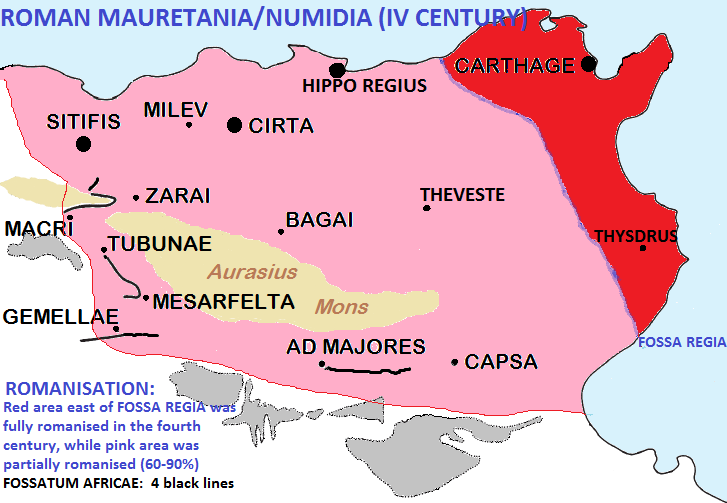
The modern city of Gafsa was called Capsa when was part of Roman Africa and was an important city near the Fossatum Africae.
The Roman city was conquered by the Vandals, but soon was independent: Capsa was the capital of a Romano-berber kingdom (called Kingdom of Capsus) in the sixth century until the Arab invasion.
The "Roman pools" are three basins with high walls of reused ashlar. Set in the open air, around springs rising from the bottom of the pools, they are aligned E-W according to the direction of the outflow of the water and connected by underground channels. The W pool consists of two covered rooms. Princeton E.
What remains of Roman Capsa are two pools, the Roman baths of Gafsa dedicated to Neptune and the nymphs (these are the only visible monuments of Roman times and actually are a tourism attraction). Roman cisterns are still evident in the city ruins and still can be used. Indeed the pools consist of two 4 meter deep pools enclosed by high walls made of cut stone, that bear traces of inscriptions. The two pools communicate with each other through a dry-walled vault and are reinforced by small arches: they are fed by springs that gush out at the bottom of the tanks at a temperature of 31 °C.
Little remains of the ancient Gafsa, but can be still seen the wonderful Roman tanks, deep more than eight meters wide, seventeen and twenty-three long.
Hub AI
Capsa (Roman colonia) AI simulator
(@Capsa (Roman colonia)_simulator)
Capsa (Roman colonia)
Capsa was a Roman colonia located in the south of modern-day Tunisia. Before Roman times Capsa was a center of the Capsian culture.
The Roman colonia was very important under the Roman emperors and reached 100,000 inhabitants at the end of the second century. Under the Byzantines the city was for some years the capital of the Byzantine province "Byzacena" and enjoyed a period of economic revival. General Solomon build in 540 AD a new city wall and named the city "Capsa-Justiniana".
After Roman centuries it was a center of the last Christian and romance speaking people in North Africa. The corresponding modern city is Gafsa.
The modern city of Gafsa was called Capsa when was part of Roman Africa and was an important city near the Fossatum Africae.
The Roman city was conquered by the Vandals, but soon was independent: Capsa was the capital of a Romano-berber kingdom (called Kingdom of Capsus) in the sixth century until the Arab invasion.
The "Roman pools" are three basins with high walls of reused ashlar. Set in the open air, around springs rising from the bottom of the pools, they are aligned E-W according to the direction of the outflow of the water and connected by underground channels. The W pool consists of two covered rooms. Princeton E.
What remains of Roman Capsa are two pools, the Roman baths of Gafsa dedicated to Neptune and the nymphs (these are the only visible monuments of Roman times and actually are a tourism attraction). Roman cisterns are still evident in the city ruins and still can be used. Indeed the pools consist of two 4 meter deep pools enclosed by high walls made of cut stone, that bear traces of inscriptions. The two pools communicate with each other through a dry-walled vault and are reinforced by small arches: they are fed by springs that gush out at the bottom of the tanks at a temperature of 31 °C.
Little remains of the ancient Gafsa, but can be still seen the wonderful Roman tanks, deep more than eight meters wide, seventeen and twenty-three long.
Recent media