



Community hub
Recent from talks
Knowledge base stats:
Talk channels stats:
Members stats:
Capsizing
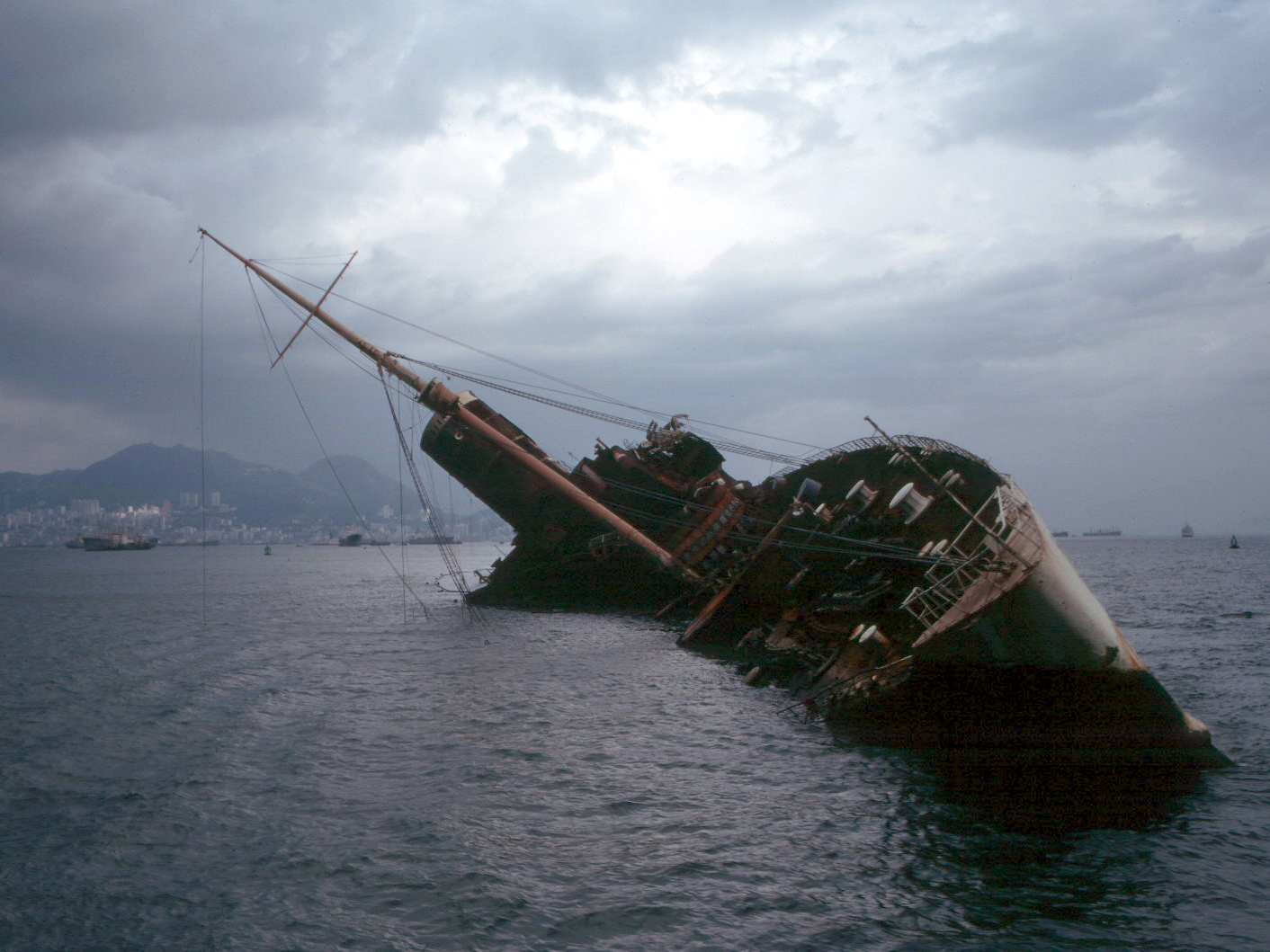
Capsizing or keeling over occurs when a boat or ship is rolled on its side or further by wave action, instability or wind force beyond the angle of positive static stability or it is upside down in the water. The act of recovering a vessel from a capsize is called righting. Capsize may result from broaching, knockdown, loss of stability due to cargo shifting or flooding, or in high speed boats, from turning too fast.
If a capsized vessel has enough flotation to prevent sinking, it may recover on its own in changing conditions or through mechanical work if it is not stable while inverted. Vessels of this design are called self-righting.
In dinghy sailing, a practical distinction can be made between being knocked down (to 90 degrees; on its beam-ends, figuratively) which is called a capsize, and being inverted, which is called being turtled. Small dinghies frequently capsize in the normal course of use and can usually be recovered by the crew. Some types of dinghy are occasionally deliberately capsized, as capsizing and righting the vessel again can be the fastest means of draining water from the boat.[citation needed]
Capsizing (but not necessarily turtling) is an inherent part of dinghy sailing. Many have described it as "not a question of 'if' but a question of 'when'." For those who do not want the experience, a keelboat monohull has physics on its side. But even yachts can capsize and turtle in extraordinary conditions, so design considerations are important. Such events can overcome skill and experience; boats need to be appropriate for foreseeable conditions.
A capsized kayak may be righted with a roll or eskimo rescue. As long as the kayaker knows how to react, the water is not too shallow, and the location is not close to dangers that require evasive action by the kayaker – which cannot be taken while capsized – capsizing itself is usually not considered dangerous. In whitewater kayaking, capsizing occurs frequently and is accepted as an ordinary part of the sport.[citation needed] Kayak rolling, in which paddlers intentionally capsize and right themselves (in synchrony, as many times as possible in a given interval, or in as many different ways as possible) is also a competitive sport, especially in Greenland.[citation needed]
Sailing vessels' "capsize ratio" is commonly published as a guideline for zones of safe operation — less than 2.0 means as a rule-of-thumb suitability for offshore navigation. However its crude nature of displacement divided by a vessel's beam (breadth) (albeit with a constant multiplied to provide an average assessment), means thorough assessment of ship stability, immersibility and buoyancy involves other factors to address the relevant risks posed by waves, tides, weather and occurrences such as damage and collision.[citation needed][clarification needed]
In a storm, even large vessels may be rolled by being hit broadside by a large wave or swell or "pitch poled" stem over stern in extreme waves. This is normally catastrophic for larger ships, and smaller yachts can be dismasted (i.e., lose their masts and rigging) due to the drag as the boat is forced to roll over.
A ship that sustains a hole or crack ('is holed') may capsize. This is the working of torpedo and naval mine warfare. In 2012 the very large cruise ship Costa Concordia was holed and lost her propulsion by striking a charted rock, and drifted further where she partially sank just outside the harbor entrance, coming to rest with her starboard side submerged and resting on the seafloor with approximately two-thirds of her structure above the sea. This was not a capsize as her bottom was only partly exposed; rather this was a partial sinking. Fixing a hole is called plugging.
Hub AI
Capsizing AI simulator
(@Capsizing_simulator)
Capsizing
Capsizing or keeling over occurs when a boat or ship is rolled on its side or further by wave action, instability or wind force beyond the angle of positive static stability or it is upside down in the water. The act of recovering a vessel from a capsize is called righting. Capsize may result from broaching, knockdown, loss of stability due to cargo shifting or flooding, or in high speed boats, from turning too fast.
If a capsized vessel has enough flotation to prevent sinking, it may recover on its own in changing conditions or through mechanical work if it is not stable while inverted. Vessels of this design are called self-righting.
In dinghy sailing, a practical distinction can be made between being knocked down (to 90 degrees; on its beam-ends, figuratively) which is called a capsize, and being inverted, which is called being turtled. Small dinghies frequently capsize in the normal course of use and can usually be recovered by the crew. Some types of dinghy are occasionally deliberately capsized, as capsizing and righting the vessel again can be the fastest means of draining water from the boat.[citation needed]
Capsizing (but not necessarily turtling) is an inherent part of dinghy sailing. Many have described it as "not a question of 'if' but a question of 'when'." For those who do not want the experience, a keelboat monohull has physics on its side. But even yachts can capsize and turtle in extraordinary conditions, so design considerations are important. Such events can overcome skill and experience; boats need to be appropriate for foreseeable conditions.
A capsized kayak may be righted with a roll or eskimo rescue. As long as the kayaker knows how to react, the water is not too shallow, and the location is not close to dangers that require evasive action by the kayaker – which cannot be taken while capsized – capsizing itself is usually not considered dangerous. In whitewater kayaking, capsizing occurs frequently and is accepted as an ordinary part of the sport.[citation needed] Kayak rolling, in which paddlers intentionally capsize and right themselves (in synchrony, as many times as possible in a given interval, or in as many different ways as possible) is also a competitive sport, especially in Greenland.[citation needed]
Sailing vessels' "capsize ratio" is commonly published as a guideline for zones of safe operation — less than 2.0 means as a rule-of-thumb suitability for offshore navigation. However its crude nature of displacement divided by a vessel's beam (breadth) (albeit with a constant multiplied to provide an average assessment), means thorough assessment of ship stability, immersibility and buoyancy involves other factors to address the relevant risks posed by waves, tides, weather and occurrences such as damage and collision.[citation needed][clarification needed]
In a storm, even large vessels may be rolled by being hit broadside by a large wave or swell or "pitch poled" stem over stern in extreme waves. This is normally catastrophic for larger ships, and smaller yachts can be dismasted (i.e., lose their masts and rigging) due to the drag as the boat is forced to roll over.
A ship that sustains a hole or crack ('is holed') may capsize. This is the working of torpedo and naval mine warfare. In 2012 the very large cruise ship Costa Concordia was holed and lost her propulsion by striking a charted rock, and drifted further where she partially sank just outside the harbor entrance, coming to rest with her starboard side submerged and resting on the seafloor with approximately two-thirds of her structure above the sea. This was not a capsize as her bottom was only partly exposed; rather this was a partial sinking. Fixing a hole is called plugging.