



Community hub
Capsizing
View on Wikipedia
Capsizing or keeling over occurs when a boat or ship is rolled on its side or further by wave action, instability or wind force beyond the angle of positive static stability or it is upside down in the water. The act of recovering a vessel from a capsize is called righting. Capsize may result from broaching, knockdown, loss of stability due to cargo shifting or flooding, or in high speed boats, from turning too fast.
If a capsized vessel has enough flotation to prevent sinking, it may recover on its own in changing conditions or through mechanical work if it is not stable while inverted. Vessels of this design are called self-righting.
Small vessels
[edit]
In dinghy sailing, a practical distinction can be made between being knocked down (to 90 degrees; on its beam-ends, figuratively) which is called a capsize, and being inverted, which is called being turtled. Small dinghies frequently capsize in the normal course of use and can usually be recovered by the crew. Some types of dinghy are occasionally deliberately capsized, as capsizing and righting the vessel again can be the fastest means of draining water from the boat.[citation needed]
Capsizing (but not necessarily turtling) is an inherent part of dinghy sailing. Many have described it as "not a question of 'if' but a question of 'when'."[1] For those who do not want the experience, a keelboat monohull has physics on its side.[1][2] But even yachts can capsize and turtle in extraordinary conditions, so design considerations are important.[2] Such events can overcome skill and experience; boats need to be appropriate for foreseeable conditions.[3]

A capsized kayak may be righted with a roll or eskimo rescue. As long as the kayaker knows how to react, the water is not too shallow, and the location is not close to dangers that require evasive action by the kayaker – which cannot be taken while capsized – capsizing itself is usually not considered dangerous. In whitewater kayaking, capsizing occurs frequently and is accepted as an ordinary part of the sport.[citation needed] Kayak rolling, in which paddlers intentionally capsize and right themselves (in synchrony, as many times as possible in a given interval, or in as many different ways as possible) is also a competitive sport, especially in Greenland.[citation needed]
Sailing vessels' "capsize ratio" is commonly published as a guideline for zones of safe operation — less than 2.0 means as a rule-of-thumb suitability for offshore navigation. However its crude nature of displacement divided by a vessel's beam (breadth) (albeit with a constant multiplied to provide an average assessment), means thorough assessment of ship stability, immersibility and buoyancy involves other factors to address the relevant risks posed by waves, tides, weather and occurrences such as damage and collision.[citation needed][clarification needed]
Large vessels
[edit]In a storm, even large vessels may be rolled by being hit broadside by a large wave or swell or "pitch poled" stem over stern in extreme waves. This is normally catastrophic for larger ships, and smaller yachts can be dismasted (i.e., lose their masts and rigging) due to the drag as the boat is forced to roll over.
A ship that sustains a hole or crack ('is holed') may capsize.[4] This is the working of torpedo and naval mine warfare. In 2012 the very large cruise ship Costa Concordia was holed and lost her propulsion by striking a charted rock, and drifted further where she partially sank just outside the harbor entrance, coming to rest with her starboard side submerged and resting on the seafloor with approximately two-thirds of her structure above the sea. This was not a capsize as her bottom was only partly exposed; rather this was a partial sinking. Fixing a hole is called plugging.

Otherwise a vessel in largely upright position which capsizes has suffered too much water to enter in places normally above the waterline, and which may be caused by poor manoeuvering, overloading (see Plimsoll Line) or poor weather. As for holes, bailing may be carried out – removal of water aboard such as with a bilge pump, self or hand bailer, buckets or de-watering pumps. At the stage of sinking where its buoyancy is deemed critical, the ship is unlikely to upright nor able to right itself such that stability and safety will be compromised even if the vessel is righted – a decision is made to abandon ship and any ultimate salvage may entail firm grounding and re-buoyancy pumps. Among ship types, a roll-on-roll-off (RORO or ro-ro) ship is more prone to capsizing as it has large open car decks near the waterline. If the watertight car-deck doors fail through damage or mismanagement (as in the partial sinking of MS Herald of Free Enterprise where the doors were accidentally left open, and as in one of the largest peacetime maritime disasters when MS Estonia sank off of the Archipelago Sea in Finland), water entering the car-deck is subject to the free surface effect and may cause a capsize. As a RORO ferry rolls, vehicles can break free and slide down if not firmly secured, adversely altering the ship's centre of gravity, accelerating the roll, and possibly turning an otherwise recoverable roll into a capsize.
Competition
[edit]
In competitive yacht racing, a capsized boat has certain special rights as it cannot maneuver. A boat is deemed capsized when the mast is touching the water; when it is fully inverted, it is said to have turned turtle or turtled.[5] Good racers can often recover from a capsize with minimal loss of time.
The capsize can result from extreme broaching, especially if the keel has insufficient leverage to tilt the vessel upright.
Some rescue lifeboats, for example the RNLI's Severn class, are designed to be self-righting if capsized, but most other motorboats are not.[citation needed]
Training
[edit]

Intermediate sailors are encouraged to capsize their dinghies in a safe location with supervision at least once to become acquainted with their boat's floating properties and the capsize process. The boat is then righted, bailed out, and the sails reset, so that in the event of an uncontrolled capsize, the boat and its occupants are familiar with the procedure and may recover.
Most small monohull sailboats can normally be righted by standing or pulling down on the centreboard, daggerboard (or bilgeboard in a scow) to lift the mast clear of the water. Depending on the design of the hull, the boat's righting moment will normally take effect once the mast is around 30 degrees from horizontal and help pull the boat vertical. Righting a catamaran that is lying on its side involves using a righting line fed over the upper hull. The crew stands on the lower hull and pulls back on the righting line. In small catamarans such as the Hobie 16 it is imperative that at least one crew member assumes this task as soon as possible as there is a chance that the boat will turtle and then become extremely difficult to recover without assistance.[6] Some monohulls and catamarans use a small flotation device mounted at the tip of the mast or mainsail to ensure that the craft cannot assume an inverted position, or at least that a fully inverted position is not stable (i.e. it would come to a position where the mast is lying on the surface of the water, which would be preferable to fully inverted).
In both cases, having a crew member lift the end of the mast out of the water may help speed the process, as the greatest challenge of righting a capsized boat is shedding the weight of the water from the sails. A helpful step, where possible (on a loose footed sail), is to disconnect the clew of the sail from the boom, which prevents the sail from scooping up water as the sail lifts out of the water. The bow of the capsized vessel should be pointed towards the wind so that when the sail starts to lift out of the water the wind can catch underneath the sail and help right the boat.
Care is taken not to let the boat swing all the way over and capsize on the other side, frequently with the crew on the bottom. This is more likely if the boat is not pointed into the wind.
Prevention
[edit]There is a wide range of technology that can be installed or strategically placed to prevent or deter a boat or ship from capsizing. The various technologies rely on inflating airbags also known as lift bags which increasing the vessel's buoyancy with the water. There are many steps a crew can take to reduce the chance of capsizing, such as distributing the weight evenly and taking care during windy weather.[7]
Yachts
[edit]Capsizing in yachts can occur when water is able to infiltrate the hull and decrease the vessels water and buoyancy leading to capsizing. Yachts can be deployed with a flotation system which is a series of strategically placed lift bags within the interior of the hull increasing the vessel's buoyancy and filling void space where water can collect, providing valuable time to remove the water, fix damage or evacuate.[8]
Large ships
[edit]When larger ships such as cargo ships and tankers capsize or sink not only is recovery not possible but great environment damage can occur from spillage of cargo.[9] Larger ships are being equipped with Surfacing System for Ship Recovery which is an inflatable device that is installed in the ballast water tank or within the hull of the vessel and can be deployed within seconds of an accident to stabilize the vessel and give more time for rescue and evacuation.[10]
Self-righting
[edit]-
 A crane capsizes a small coast guard vessel to test its righting ability
 -
 A larger self-righting vessel's stability test. Note large deckhouse, which is almost the only part submerged when fully inverted.
 -

-
 The Lizzie Porter is a Peake-class lifeboat, an early design of self-righting boat. Note the high, rounded buoyancy tanks at her bow and stern, and low sides amidships.

_20080627_Kentertest_diff.gif)


A vessel may be designated as "self-righting" if it is designed to be able to capsize then return to upright without intervention (with or without crew on board). The angle of vanishing stability, the angle of heel at which a vessel becomes unstable and does not bob back upright, does not exist; a self-righting boat will return to upright from any position, including completely upside-down. A self-righting vessel must be positively buoyant when swamped. There are three methods of making a vessel self-right: careful distribution of stationary weight and buoyancy, inflatable airbags, and movable ballast.[11]
A basic tool for calculating a vessel's stability is a static stability diagram, which plots the angle of heel on the horizontal axis and the righting lever (GZ) on the vertical axis. (see metacentric height for details). If the static stability curve never crosses the x-axis, the boat is not stable upside-down. This is not sufficient to build a boat with good stability at sea, as it neglects the effects of wind, waves, and human occupants, but it is a simple, powerful way to analyze the stability of a vessel.[11] See also primary stability and secondary stability.
Self-righting through distribution of weight and buoyancy requires the weight low-down, and the buoyancy high up. It is often accomplished with a self-sealing superstructure, such as the large deckhouses on modern rescue boats.[11]
Most small craft intended as lifeboats with rigid (rather than inflatable) hulls designed since about the middle of the twentieth century are self-righting.[citation needed]
Small radio-controlled boats may also self-right. This is particularly useful for racing.[12]
Notable capsizings
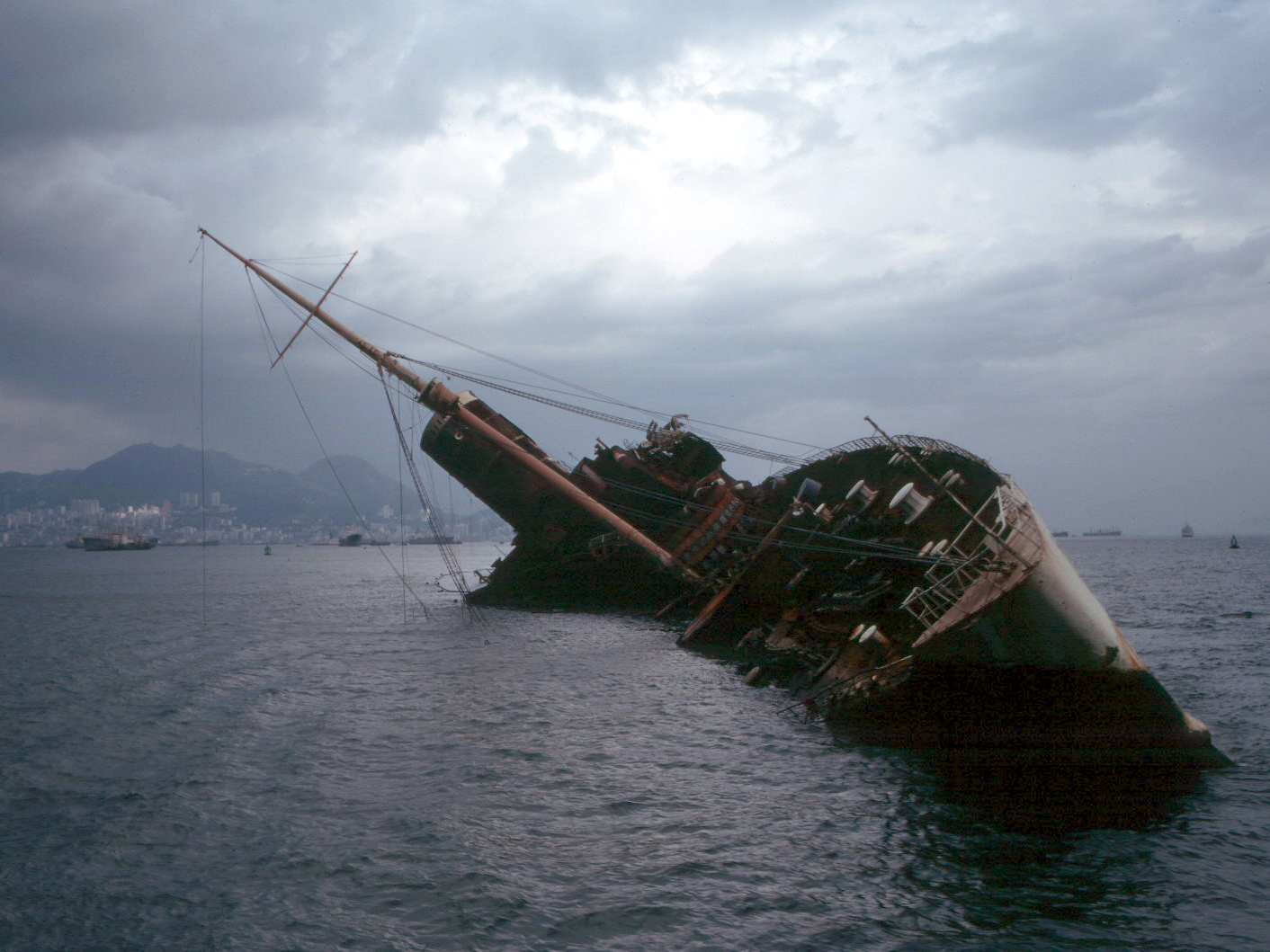
[edit].jpg)

- Mary Rose, 19 July 1545, capsized and sank, English carrack, 380 dead.
- Vasa, 10 August 1628, Swedish warship, maiden voyage, 30–50 dead.
- Codseeker, 9 May 1877, Canadian fishing schooner, maiden voyage, 4 dead, 2 trapped in hull rescued three days later.
- RMS Empress of Ireland, 19 May 1914, capsized and sank in the Saint Lawrence River after colliding with the Norwegian collier Storstad, 1,012 dead.
- HMS Monmouth, 1 November 1914, British armoured cruiser sunk with all hands at the Battle of Coronel, 734 dead.
- SMS Blücher, 24 January 1915, German armoured cruiser, sunk at the Battle of Dogger Bank (1915), 770 dead.
- SS Eastland, 24 July 1915, excursion boat, 844 dead, greatest loss of life on the Great Lakes.
- SMS Szent István, 10 June 1918, Austro-Hungarian capital warship, torpedoed, 89 dead.
- Scuttling of the German fleet at Scapa Flow, 21 June 1919, several German battleships and battlecruisers scuttled.
- HMS Royal Oak, 14 October 1939, torpedoed and sunk by German U-boat U-47, 835 dead.
- German battleship Bismarck, 27 May 1941, sunk after sinking HMS Hood, over 2000 casualties.
- HMS Barham, on the 25th of November, 1941, torpedoed four times by German U-boat U-331, rolled over to port within 4 minutes before exploding, 862 dead.
- USS Oklahoma, 7 December 1941, U.S. battleship torpedoed at Pearl Harbor, 429 missing or killed.
- HMS Repulse, 10 December 1941, attacked and sunk by Japanese aircraft, 517 dead.
- HMS Prince of Wales, 10 December 1941, attacked and sunk by enemy Japanese aircraft, 328 dead.
- USS Lafayette (AP-53), formerly SS Normandie, 9 February 1942, at dock while being converted to a troopship, one casualty.
- Japanese aircraft carrier Ryūjō, 24 August 1942, sunk by American air attacks, 120 casualties.
- Japanese battleship Kirishima, 15 November 1942, 212 casualties.
- German battleship Scharnhorst, 26 December 1943, sunk during the Battle of the North Cape, 1,932 dead.
- Japanese battleship Musashi, 24 October 1944, sunk during the Battle of Sibuyan Sea, 1,023 casualties.
- Japanese battleship Fusō, 25 October 1944, sunk during the Battle of Surigao Strait, approximately 1890 casualties.
- Japanese battleship Yamashiro, 25 October 1944, sunk during the Battle of Surigao Strait, 1,626 casualties.
- German battleship Tirpitz, 12 November 1944, sunk by Royal Air Force bombers, over 1,000 casualties.
- Japanese aircraft carrier Shinano, 29 November 1944, sunk by American submarine USS Archerfish (SS-311), 1,435 casualties.
- Japanese battleship Yamato, 7 April 1945, 2,475 dead.
- Soviet battleship Novorossiysk, 29 October 1955, 608 dead.
- SS Andrea Doria, 25 July 1956, killing 46 passengers at the area of the impact with the MS Stockholm.
- HMS Coventry, 25 May 1982, killing 19 sailors, sunk by three 1000 lb bombs dropped from Argentine A-4 Skyhawks.
- MS Herald of Free Enterprise, 6 March 1987, bow door left open, killing 193 passengers.
- MS Jan Heweliusz, 14 January 1993, leaving 54 people dead.
- MS Estonia, 28 September 1994, killing 852 passengers.
- MS Express Samina, 26 September 2000, 82 dead.
- MV Le Joola, 26 September 2002, Senegalese ferry, at least 1,863 dead.
- MV Rocknes, 19 January 2004, Dutch rock discharge vessel, capsized south of Bergen, Norway, killing 18 of 30 crew.[13]
- MS al-Salam Boccaccio 98, 3 February 2006, resulting in an estimated 1,020 dead.
- MV Demas Victory, 30 June 2009, which sails to offshore oil and gas platforms capsized off the coast of Qatari capital city of Doha.[14]
- Costa Concordia, 13 January 2012, ran aground off the island of Giglio, western Italy, with about 4,200 aboard, all except 32 saved.
- Sewol, 16 April 2014, approximately three kilometres off Gwanmae Island, South Jeolla Province, South Korea, with over 450 people on board, 304 dead, 172 survivors.
- Dongfang Zhi Xing, 1 June 2015, large vessel capsized and sank cruising the Yangtze River in Jianli, Hubei: thunderstorm downburst with high winds, with 442 dead and 12 survivors.
- MV Sinar Bangun, 18 June 2018, at Lake Toba, North Sumatra, Indonesia, 3 known dead and 164 presumed so; 23 known survivors. Overloaded and improper three-deck use/design caused high uprighting moment (centre of gravity).
- MV Phoenix, 5 July 2018, hit fellow tourist boat MV Serenita; both capsized and sank in a sudden storm near Phuket, Thailand. Double-decker: 41 dead and 15 missing, 49 survivors; smaller boat carried 42 passengers, all saved.
- MV Nyerere, 20 September 2018, ferry shuttling people and cargo on Lake Victoria, Tanzania due to pilot distraction when docking, a sharp turn and overloading. 227 known dead, passenger log lost, tens survived.
- MV Golden Ray, 8 September 2019, automobile carrier in St Simons Sound off the US state of Georgia, improperly ballasted and heeled over during sharp turn. All 23 crewmembers and the harbor pilot were rescued.
- Orient Queen, 5 August 2020, at Beirut as a result of nearby 4 August ammonium nitrate explosion.
- Wonder Sea, 19 July 2025, tourist boat capsized and sank during high winds at Hạ Long Bay, Vietnam. 39 dead and 10 survivors.
See also
[edit]
- Glossary of nautical terms (disambiguation)
- keeling over
- Limit of positive stability
- Seakeeping, also called Seaworthiness
- Seamanship
- Turtling (sailing) – a full capsize in which the mast and sail are fully submerged.
References
[edit]- ^ a b "Will I capsize?". Discover Boating. Retrieved 22 November 2013.
- ^ a b Dashew, Steve (8 January 2012). "Evaluating Stability and Capsize Risks for Yachts". Retrieved 22 November 2013.
- ^ Keilman, John (30 October 2011). "Report: Boat in deadly accident unfit for Mackinac race — Craft that capsized called too unstable for long competition in area prone to severe weather". Chicago Tribune. Retrieved 22 November 2013.
- ^ The Telegraph: The EU ignored years of expert warnings on cruise ship safety. Discussion of stability when large modern ships are holed
- ^ Rousmaniere, John. "Tests of Sailor Retrieval, Capsize Recovery and Entrapment". US Sailing. Archived from the original (PDF) on 3 December 2013. Retrieved 19 November 2013.
- ^ "Fusion Capsize Manual" (PDF). F-15 dinghy. Archived from the original (PDF) on 2 December 2013. Retrieved 18 November 2013.
- ^ "Boatkeep | Free resources for boat owners". boatkeep.com. Archived from the original on 2022-06-11. Retrieved 2022-05-24.
- ^ "Underwater Lift Bags & Yacht Floatation". www.turtlepac.com. Retrieved 13 January 2017.
- ^ "SuSy - Surfacing System for Ship Recovery". www.su-sy.eu. Archived from the original on 19 April 2017. Retrieved 31 January 2017.
- ^ Munoz, Gabriella. "New Airbags Will Save Ships From Sinking". ScienceAlert. Archived from the original on 6 January 2018. Retrieved 31 January 2017.
- ^ a b c Akyıldız, Hakan; Şimşek, Cemre (2016). "Self-righting boat design" (PDF). GiDB-DERGi (6): 41–54. Archived from the original (PDF) on 23 September 2019. Retrieved 21 June 2019.
- ^ "Best Self Righting RC Boat: Top Picks for 2019". Radio-controlled hobby review. 21 September 2018. Archived from the original on 21 June 2019. Retrieved 21 June 2019.
- ^ Blueprint for Disaster. Season 2. Episode 3.
- ^ Schreck, Adam (1 July 2009). "Up to 30 feared dead after ship capsizes off Qatar capital Doha in rough Persian Gulf waters". Washington Examiner. Associated Press. Retrieved 2 July 2009.[permanent dead link]
External links
[edit]

- Capsize formula for displacement sailboats
- Hallett, Peter (1 August 2013). "E-SCOW capsizing after duel with Kiwi 35 Racing sailboat" (video). Bellingham Bay: YouTube. Archived from the original on 2021-12-22. Retrieved 7 December 2013.
- "Hobie Bob Installation" (video). YouTube. Archived from the original on 2021-12-22. Retrieved 21 November 2013.
- "How to Right a Capsized and Turtled Flying Scot Sailboat" (video). YouTube. Retrieved 19 November 2013.[dead YouTube link]
- Lebigot, Sebastien. "Righting a capsized catamaran (Hobie Cat speed)" (video). YouTube. Archived from the original on 2021-12-22. Retrieved 19 November 2013.


Capsizing
View on GrokipediaFundamentals
Definition and Mechanisms
Capsizing refers to the overturning of a boat or ship onto its side or completely inverting, occurring when the vessel heels beyond its angle of positive stability, potentially leading to a loss of upright orientation or sinking.[1] This occurs when the vessel's equilibrium is disrupted such that restoring forces can no longer counteract the heeling moment, leading to a loss of upright orientation.[4] The primary mechanisms of capsizing involve external or internal forces that alter the relative positions of the center of gravity (CG) and the center of buoyancy (CB). Sudden weight shifts, such as cargo or passenger movement, can elevate the CG, reducing the vessel's righting moment.[4] Wave action may impose dynamic loads that shift the CB unfavorably, while wind forces on the superstructure create heeling moments that, if excessive, cause the CG to effectively rise above the CB, initiating uncontrolled rolling.[5] In these scenarios, the misalignment generates a capsizing torque rather than a restoring one.[6] A key distinction exists between heeling and capsizing: heeling is a temporary transverse tilt induced by forces like wind or waves, from which the vessel naturally recovers due to its inherent stability, whereas capsizing represents a permanent state of overturn where recovery is not possible without external intervention.[7] Stability in vessels is broadly categorized into static and dynamic types; static stability describes the initial resistance to small inclinations based on the equilibrium between CG and CB, while dynamic stability assesses the vessel's capacity to absorb energy from transient disturbances before reaching a capsizing threshold.[8] Measures like metacentric height provide a quantitative indicator of this static resistance.[4]Physics and Stability Concepts
The stability of a vessel relies fundamentally on the balance between gravitational and buoyant forces, as governed by Archimedes' principle. This principle states that the upward buoyant force exerted on a body immersed in a fluid equals the weight of the fluid displaced by the body.[9] For a floating vessel, the buoyant force acts vertically upward through the center of buoyancy (B), the centroid of the displaced fluid volume, and precisely balances the vessel's weight, which acts downward through the center of gravity (G).[9] The fraction of the vessel submerged is determined by the ratio of its average density to the fluid's density, ensuring equilibrium in calm conditions.[9] Capsizing occurs when this equilibrium is lost, typically through a sudden reduction in positive stability. A key measure of initial transverse stability is the metacentric height (GM), defined as the distance between the center of gravity (G) and the metacenter (M), the point where the buoyant force acts after a small heel.[10] The formula is derived from hydrostatic principles for small heel angles (less than 10°), where the center of buoyancy shifts laterally, creating a righting moment:Here, KB is the vertical distance from the keel to the center of buoyancy, calculated by integrating the hull's submerged volume; BM is the transverse metacentric radius, given by $ BM = I_T / \nabla_s $, where $ I_T $ is the second moment of the waterplane area about the longitudinal axis and $ \nabla_s $ is the submerged displacement volume; and KG is the vertical distance from the keel to the center of gravity, determined from weight distributions.[10] Factors affecting GM include hull beam (which increases $ I_T $ and thus BM, as it scales with the cube of half-beam), displacement (affecting $ \nabla_s $ and BM inversely), and the vertical position of G (higher KG reduces GM).[10] Positive GM indicates stability, as the metacenter lies above G, producing a righting couple. The righting moment (RM), which resists heeling and prevents capsizing, is the torque generated by the offset between the lines of action of weight and buoyancy.[11] For small angles of heel, it is approximated by:
where $ \Delta $ is the vessel's displacement (total weight), and $ \theta $ is the heel angle.[11] This moment quantifies the vessel's restoring capability, with larger values indicating greater resistance to capsize; as heel increases, RM peaks before potentially vanishing if stability is overcome.[11] Under dynamic conditions, such as in waves, stability involves interactions between the vessel's natural roll period and wave characteristics. The natural roll period is the time for one complete oscillation when disturbed, influenced by GM and displacement.[12] Capsizing risks escalate when the wave encounter period synchronizes with the vessel's roll period, amplifying motions through resonance, particularly in following or quartering seas where transverse stability is marginal.[12] Synchronous rolling occurs when these periods align (encounter period ≈ roll period), leading to excessive amplitudes.[12] Parametric rolling arises from periodic stability variations between wave crests (reduced stability) and troughs (increased stability), with resonance at ratios like 1:1 or 1:0.5 (encounter period to roll period), potentially causing violent rolls even in moderate seas.[12] Free surface effects further compromise stability when liquids in partially filled tanks slosh during motion, effectively raising the center of gravity and reducing GM.[13] This sloshing creates a virtual shift in G, as the liquid's moment of inertia allows it to lag behind the vessel's roll, diminishing the righting moment and lengthening the roll period.[13] The reduction, known as the free surface correction (FSC), is calculated as $ FSC = (i \times d_i) / (\nabla \times d_o) $, where $ i $ is the tank's moment of inertia, $ d_i $ is liquid density, $ \nabla $ is displacement volume, and $ d_o $ is water density; the fluid GM is then solid GM minus FSC.[13] This effect is more pronounced in wider, longer tanks and can critically lower stability, increasing capsize vulnerability.[13]
Small Craft Capsizing
Causes and Risk Factors
Capsizing in small craft, such as boats, canoes, and personal watercraft, often results from a combination of environmental forces, human actions, and inherent design limitations that compromise the vessel's stability.[14] Environmental factors play a significant role in overwhelming the limited stability of small hulls. High winds, rogue waves, and strong currents can generate forces that exceed the craft's ability to maintain equilibrium, particularly in open water or near shorelines. Contributing factors in recreational boating, such as the force of waves or wakes (122 incidents), often lead to sudden rolls or swamping in lightweight vessels. Hazardous waters, including rough seas or swift currents (172 incidents, with 53 associated deaths), amplify the impact on small, low-freeboard designs.[14][14] Human errors frequently exacerbate these risks through poor operational decisions. Improper weight distribution or overloading shifts the center of gravity, reducing stability and increasing the likelihood of tipping during maneuvers. Factors in recreational boating, such as operator inexperience (436 incidents), often involve failure to anticipate wave actions or execute controlled turns, while inattention (551 incidents) and improper lookout (464 incidents) are common contributors. In recreational kayaking, for example, inexperienced paddlers attempting maneuvers in surf zones may cause the craft to broach—turning broadside to waves—resulting in capsize due to loss of directional control.[14][14][15] Design-related risks stem from features that prioritize portability or speed over robustness in small craft. Narrow beam-to-length ratios provide form stability through hull shape but limit initial resistance to rolling, making vessels more susceptible to capsizing in moderate conditions; wider beams enhance this stability but may reduce efficiency. Insufficient ballast in lightweight designs, such as many canoes and kayaks, fails to lower the center of gravity adequately, relying instead on dynamic balance from the operator. The metacentric height, a key measure of initial stability, can become critically low in such configurations, heightening capsize risk when external forces act.[16][16][17] Statistical data underscores these patterns in recreational settings. In 2024, the U.S. Coast Guard reported 202 capsizing incidents among small craft, resulting in 111 deaths—primarily drownings—and 106 injuries, with open motorboats involved in 47% of cases, personal watercraft in 19%, kayaks in 16%, and canoes in 4.5%. Capsizing rates in recreational kayaking are notably high during surf entry or exit, where broaching accounts for a substantial portion of incidents due to wave-induced turns, contributing to 14 kayak-related deaths that year.[14][14][14]Recovery Techniques
Recovery techniques for small craft capsizing prioritize immediate survival actions to minimize risk in cold water or remote locations, where hypothermia and exhaustion can quickly become threats. The primary survival priorities include staying with the vessel as it provides flotation and visibility for rescuers, wearing a personal flotation device (PFD) at all times to maintain buoyancy without expending energy swimming, and signaling for help using a whistle, mirror, or dye marker if available.[18][19] These steps are essential following events like sudden weight shifts from crew movement or wind gusts that lead to capsize.[20] For manual righting of capsized dinghies or small sailboats, crew members must first ensure all are accounted for and free from entanglement under the hull before attempting recovery. In a double-handed dinghy, the standard scoop method involves one crew member swimming to the centerboard (if equipped) on the lower (windward) side of the capsized boat, grasping it firmly near the base, and pulling downward with body weight while leaning back to apply leverage, which begins to rotate the hull upright. Simultaneously, the second crew member swims under the boat from the leeward side to the emerging windward side, positioning themselves to "scoop" into the cockpit as the boat rights, using the daggerboard trunk or toe straps for support to avoid falling back into the water.[19] If no centerboard is present, the boom or a paddle can serve as leverage: the crew positions on the lower gunwale, pulls the boom downward perpendicular to the hull, and coordinates a coordinated heave to flip the boat.[21] Once upright, crew should right themselves inside the boat, bail excess water using buckets or handheld bilge pumps to restore stability, and resume sailing or await assistance. For solo dinghies, the process is similar but requires the sailor to secure the mainsheet and jib sheets first to prevent further complications, then use body weight alone on the centerboard or boom, often taking longer and benefiting from masthead buoyancy aids to prevent full inversion.[22] In group sailboat flips, such as in larger small craft like training keelboats or multi-crew dinghies, recovery emphasizes coordinated crew positioning to distribute weight effectively. Heavier crew members should position on the centerboard or lower hull to maximize leverage, pulling in unison while lighter members prepare to board from the opposite side, reducing the risk of re-capsizing during the flip.[22] Harnesses clipped to the boat or jacklines allow crew to stay attached during the process, preventing separation in choppy conditions. For assisted recovery, inflatable righting bags attached to the mast base can be deployed to provide additional buoyancy, aiding the crew in rotating the hull without full manual effort.[23] For solo canoe re-entry after capsize in deep water, the paddler first rights the canoe by flipping it over to drain initial water, then uses the paddle as a fulcrum placed across the gunwales to lever the hull and empty more water by rocking or pulling from the side.[24] Positioning beside the center of the canoe, the paddler grasps the near gunwale and far gunwale alternately, pulling the body over the side in a controlled roll to re-enter while keeping weight low to avoid tipping; a paddle float attached to one end can stabilize the craft like an outrigger during this maneuver.[25] In contrast, group canoe recovery involves all paddlers swimming to one side, righting the canoe together, and re-entering sequentially from the stern using a "fireman's lift" technique where each assists the next by steadying the gunwale. Post-re-entry, bailing with a sponge or pump restores freeboard, and signaling remains critical if the group is separated from shore. Tools like waterproof bailers or throw bags not only aid water removal but also serve for self-rescue if multiple craft are involved.[26]Survival and emergency response after capsizing
If a vessel capsizes but remains afloat (common for small open boats with built-in flotation), the priority is survival until rescue arrives.- Remain calm and conserve energy to prevent exhaustion and rapid heat loss, especially in cold water.
- Conduct a headcount to ensure all persons are accounted for and stay together as a group.
- Ensure everyone dons or secures a personal flotation device (PFD/life jacket) immediately; assist others if needed.
- Stay with the boat unless it is drifting toward immediate danger (e.g., rocks, dam, fire, or rapids). A capsized vessel is larger and more visible to rescuers than individuals in the water, and it provides flotation support.
- If possible, climb onto the overturned hull to get more of the body out of the water, reducing heat loss.
- For small boats, attempt to right the vessel (flip it upright) and bail out water if conditions allow, then reboard carefully while keeping weight low and centered.
- Signal for help using available devices: VHF radio on Channel 16 with MAYDAY call, whistle, mirror, flares, arm waving, or waterproof phone to call emergency services.
- In cold water, follow the 1-10-1 rule: expect 1 minute to control gasping/breathing after immersion, 10 minutes of meaningful movement before cold incapacitation, and up to 1 hour before unconsciousness from hypothermia. Huddle with others (arms around each other) to conserve heat, minimize movement, and protect the head and neck.