
Recent from talks
Car phone
Knowledge base stats:
Talk channels stats:
Members stats:
Car phone
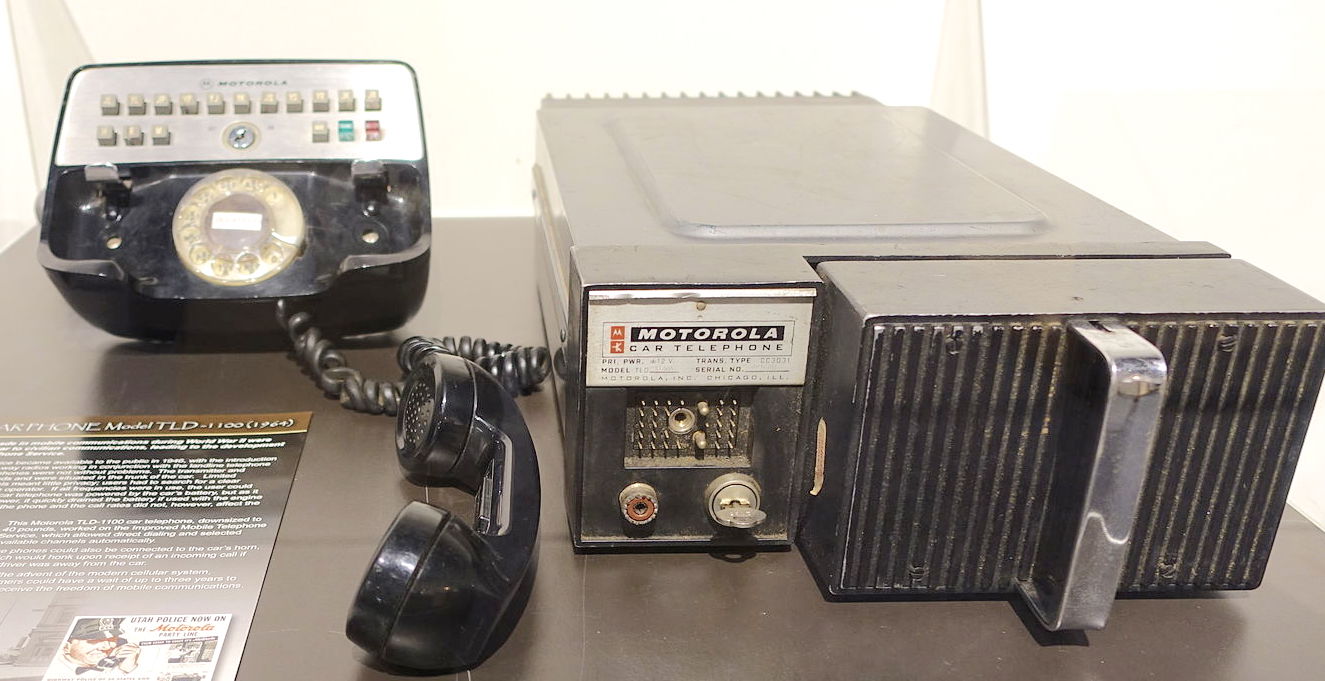
A car phone is a mobile radio telephone specifically designed for and fitted into an automobile. This service originated with the Bell System and was first used in St. Louis, Missouri, on June 17, 1946.
The original equipment weighed 80 pounds (36 kg), and there were initially only three channels for all the users in the metropolitan area (other sources claim six channels).
On October 2, 1946, Motorola communications equipment carried the first calls on Illinois Bell Telephone Company's new car radiotelephone service in Chicago. Due to the small number of radio frequencies available, the service quickly reached capacity.
In 1964 AT&T introduced the Improved Mobile Telephone Service (IMTS). More licenses were added, bringing the total to 32 channels across three bands (See IMTS frequencies). This service was used at least into the 1980s in large portions of North America.
In 1968, almost 22 years after the initial network, the US government started to consider reserving spectrum for land mobile radio communication, to be used by private persons. The FCC initiated proceedings which resulted in the reservation of 75 MHz of spectrum in 1970. During the 1970s the FCC changed its mind a few times, such as in 1974 when it reduced the spectrum to 40 MHz.
On May 4, 1981 the FCC released the rules for providing commercial cellular service. Over the next few years the FCC received hundreds of applications for 90 markets. The first cellular system went live on October 13, 1983 in the Chicago market. It served only hard-wired, non-portable units in vehicles. Over 5,000 subscribers signed up by early 1984.
In Finland, car phone service was first available in 1971 on the zero generation ARP (Autoradiopuhelin, or Car Radiophone) service. This was succeeded in 1982 by the 1G system NMT (Nordic Mobile Telephone), used across Scandinavia and in other often remote areas.
Sweden started relatively early with plans for mobile telephony service trials at the end of the 1940s. At the end of the 1950s, a trial system was built, using two channels, providing service for five mobile stations. In 1956, two commercial systems were brought online, each equipped with four channels. There were 125 subscribers by the end of the 1960s, when the network was shut down.
Hub AI
Car phone AI simulator
(@Car phone_simulator)
Car phone
A car phone is a mobile radio telephone specifically designed for and fitted into an automobile. This service originated with the Bell System and was first used in St. Louis, Missouri, on June 17, 1946.
The original equipment weighed 80 pounds (36 kg), and there were initially only three channels for all the users in the metropolitan area (other sources claim six channels).
On October 2, 1946, Motorola communications equipment carried the first calls on Illinois Bell Telephone Company's new car radiotelephone service in Chicago. Due to the small number of radio frequencies available, the service quickly reached capacity.
In 1964 AT&T introduced the Improved Mobile Telephone Service (IMTS). More licenses were added, bringing the total to 32 channels across three bands (See IMTS frequencies). This service was used at least into the 1980s in large portions of North America.
In 1968, almost 22 years after the initial network, the US government started to consider reserving spectrum for land mobile radio communication, to be used by private persons. The FCC initiated proceedings which resulted in the reservation of 75 MHz of spectrum in 1970. During the 1970s the FCC changed its mind a few times, such as in 1974 when it reduced the spectrum to 40 MHz.
On May 4, 1981 the FCC released the rules for providing commercial cellular service. Over the next few years the FCC received hundreds of applications for 90 markets. The first cellular system went live on October 13, 1983 in the Chicago market. It served only hard-wired, non-portable units in vehicles. Over 5,000 subscribers signed up by early 1984.
In Finland, car phone service was first available in 1971 on the zero generation ARP (Autoradiopuhelin, or Car Radiophone) service. This was succeeded in 1982 by the 1G system NMT (Nordic Mobile Telephone), used across Scandinavia and in other often remote areas.
Sweden started relatively early with plans for mobile telephony service trials at the end of the 1940s. At the end of the 1950s, a trial system was built, using two channels, providing service for five mobile stations. In 1956, two commercial systems were brought online, each equipped with four channels. There were 125 subscribers by the end of the 1960s, when the network was shut down.
Recent media