


Community hub
Recent from talks
Contribute something
Nothing was collected or created yet.
Punched card input/output
View on Wikipedia

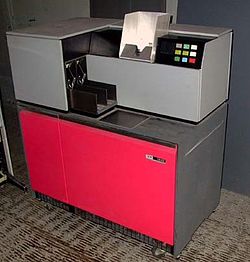
A computer punched card reader or just computer card reader is a computer input device used to read computer programs in either source or executable form and data from punched cards. A computer card punch is a computer output device that punches holes in cards. Sometimes computer punch card readers were combined with computer card punches and, later, other devices to form multifunction machines.
History
[edit]Many early computers, such as the ENIAC, and the IBM NORC, provided for punched card input/output.[1] Card readers and punches, either connected to computers or in off-line card to/from magnetic tape configurations, were ubiquitous through the mid-1970s.
Punched cards had been in use since the 1890s; their technology was mature and reliable. Card readers and punches developed for punched card machines were readily adaptable for computer use.[2] Businesses were familiar with storing data on punched cards and keypunch machines were widely employed. Punched cards were a better fit for some computer applications than other 1950s technologies, such as magnetic tape, because individual cards could easily be updated without having to access a computer. Also file drawers of punched cards served as a low-density offline storage medium for data.
Operation
[edit]The standard measure of speed is cards per minute, abbreviated CPM: The number of cards which can be read or punched in one minute. Card reader models vary from 150 to around 2,000 CPM.[3][4] At 1200 CPM, i.e. 20 cards per second, this translates to 1,600 characters per second (CPS), assuming all 80 columns of each card encode information.
Early computer card readers were based on electromechanical unit record equipment and used mechanical brushes that make an electrical contact for a hole, and no contact if there was no hole. Later readers used photoelectric sensors to detect the presence or absence of a hole. Timing within each read cycle relates the resulting signals to the corresponding position on the card. Early readers read cards in parallel, row by row, following unit record practice (hence the orientation of the rectangular holes). Later, card readers that read cards serially, column by column became more common.
Card punches necessarily run more slowly to allow for the mechanical action of punching, up to around 300 CPM or 400 characters per second.[5]
Some card devices offer the ability to interpret, or print a line on the card displaying the data that is punched. Typically this slows down the punch operation. Many punches would read the card just punched and compare its actual contents to the original data punched, to protect against punch errors. Some devices allowed data to be read from a card and additional information to be punched into the same card.
Readers and punches include a hopper for input cards and one or more stacker bins to collect cards read or punched. A function called stacker select allows the controlling computer to choose which stacker a card just read or punched will be placed into.
Card readers/punches
[edit]Control Data Corporation
[edit]- CDC 405 — CDC 6000 series card reader, 1200 or 1600 cards per minute (CPM)[6]: 2–1
- CDC 415 — CDC 6000 series card punch, 250 cards per minute[6]: 4–1
Documation
[edit]Documation Inc., of Melbourne, Florida, made card readers for minicomputers in the 1970s:
- M-200 card reader, 300 cards/minute[7] also sold by DEC as the CR-11 card reader for the PDP-11[8]
- M-600 card reader, 600 cards/minute, also sold by HP as 2892A and 2893A [9]
- M-1000-L card reader 1,000 cards/minute[10]
Their card readers have been used in elections,[11] including the 2000 "chads" election in Florida.[12]
IBM
[edit]- IBM 711 card reader computer peripheral used in the vacuum tube era, 150 or 250 CPM
- IBM 2501 card reader, 600 or 1000 CPM
- IBM 1402 high speed reader/punch introduced with the IBM 1401, 800 CPM
- IBM 1442 reader/punch introduced with the lower-cost IBM 1440, read 80-400 CPM, punch 91-355 CPM
- IBM 2540 reader/punch derived from the 1402 that was introduced with System 360
- IBM 2560 Multi-Function Card Machine (MFCM), first introduced for the IBM System/360 Model 20, could also collate, sort and print/interpret.[13]
- IBM 3505 reader and its companion 3525 reader/printer/punch that was introduced for the System/370 in 1971, read 1200 CPM, punch 300 CPM
Binary format
[edit]

For some computer applications, binary formats were used, where each hole represented a single binary digit (or "bit"), every column (or row) is treated as a simple bitfield, and every combination of holes is permitted. For example, the IBM 711 card reader used with the 704/709/7090/7094 series scientific computers treated every row as two 36-bit words, ignoring 8 columns. (The specific 72 columns used were selectable using a plugboard control panel, which is almost always wired to select columns 1–72.) Sometimes the ignored columns (usually 73–80) were used to contain a sequence number for each card, so the card deck could be sorted to the correct order in case it was dropped.
An alternative format, used by the IBM 704's IBM 714 native card reader, is referred to as Column Binary or Chinese Binary, and used 3 columns for each 36-bit word.[14] Later computers, such as the IBM 1130 or System/360, used every column. The IBM 1401's card reader could be used in Column Binary mode, which stored two characters in every column, or one 36-bit word in three columns when used as input device for other computers. However, most of the older card punches were not intended to punch more than 3 holes in a column. The multipunch key is used to produce binary cards, or other characters not on the keypunch keyboard.[15]
As a prank, in binary mode, cards could be punched where every possible punch position had a hole. Such "lace cards" lacked structural strength, and would frequently buckle and jam inside the machine.[16]
See also
[edit]- Plugboard discusses how early card readers worked in some detail
- Computer programming in the punched card era
- List of IBM products#Punched card and paper tape equipment
References
[edit]- ^ Stern, Nancy (1981). From ENIAC to UNIVAC: An Appraisal of the Eckert-Mauchly Computers. Digital Press. p. 50. ISBN 0-932376-14-2.
- ^ The IBM 711 Punched Card Reader's card-feeding mechanism was similar to the IBM 402's card-feeding mechanism
- ^ Roy, Gautam (2007). Computer Studies for Engineering Students. Mumbai, IN: Allied Publishers Limited. p. 10. ISBN 9788184242119. Retrieved July 28, 2016.
- ^ IBM 711 at IBM archive
- ^ IBM Corporation (1971). IBM 3505 Card Reader and IBM 3525 Card Punch Subsystem. Retrieved July 28, 2016.
- ^ a b Control Data Corporation (1967). PUNCHED CARD EQUIPMENT TRAINING MANUAL (PDF). Retrieved May 9, 2021.
- ^ Documation M-200 Card Reader Manual, 1972
- ^ Documation M-200 photo
- ^ "2892A Card Reader". HP Museum. Retrieved 2017-09-11.
- ^ Documation M1000L Card Reader Archived 2012-07-21 at archive.today
- ^ (2006 elections, Arizona) "Certified Voting Equipment Before 2006 - Arizona Secretary of State" (PDF).
- ^ "Dimpled and Pregnant Chad are not votes".
- ^ C. E. Spurrier (1966). "The IBM 2560 multi-function card machine". Proceedings of the April 26-28, 1966, Spring joint computer conference on XX - AFIPS '66 (Spring). pp. 315–321. doi:10.1145/1464182.1464221. ISBN 9781450378925. S2CID 24960497.
- ^ Thelen, Ed. "Chinese Binary". Retrieved 12 December 2013.
- ^ IBM (1955). IBM Operator's Guide, 22-8484-3 1955 Type 24 Card Punch. IBM.
- ^ Raymond, Eric S. (1991). The New Hacker's Dictionary. Cambridge, MA: MIT Press. p. 219.
Punched card equipment
[edit]-
 An IBM 650 computer, introduced in 1953, came with the IBM 533 Card Reader/Punch, right. At many IBM 650 installations, punched cards and address 8000 on the console were the only input and output medium.
 -
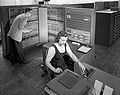 IBM 711 card reader on an IBM 704 computer at NASA in 1957
 -
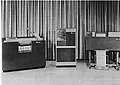 The popular IBM 1401, introduced in 1959 featured a fast card reader/punch, the IBM 1402, left
 -
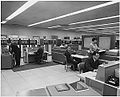 IBM 711 card readers, far left and foreground, attached to dual IBM 7090s at NASA Mission Control in 1962.
 -
 An IBM 2540 Card Reader Punch at the University of Michigan computer center in 1968
 -
 Punched card reader/punch on an IBM System/360 Model 20
 -
 IBM System/3, announced in 1969 introduced a new, smaller punched card and a combined reader/punch/sorter, right
 -
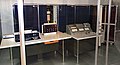 IBM 7070 with IBM 7501 Console Card Reader, right, based in the IBM 026 keypunch
 -
 Documation M-600 card reader


.jpg)


Punched card input/output
View on GrokipediaPunched card input/output is a data interchange method utilized in early electromechanical tabulating machines and digital computers, wherein information is encoded by selectively punching rectangular or circular holes into stiff paper cards according to predefined columnar formats, with input achieved via mechanical or electrical reading of these holes and output via punching new holes or interpreting reader signals for printing or further processing.[1][2]
Invented by Herman Hollerith in the 1880s for the U.S. Census Bureau, the system enabled rapid tabulation of demographic data by electrically detecting hole positions in cards passed over mercury contacts or brushes, processing up to 7,000 cards per day per operator—over ten times faster than manual methods—and laying the groundwork for the data processing industry that evolved into modern computing.[2][3]
IBM standardized the 80-column rectangular-hole card in 1928, which supported 80 characters per card through a 12-row by 80-column grid encoding decimal digits, zones, and later alphanumeric data, becoming the dominant format for business and scientific applications through the mid-20th century.[1]
Cards were typically created on keypunch devices like the IBM 029 and fed into high-speed readers—such as those on the IBM 1401 or System/360—capable of 800 to 1,600 cards per minute, while output punches replicated this process to generate result decks for archiving, sorting, or reprinting via interpreters.[4][5]
Though reliable for batch processing in environments like payroll and inventory control, punched cards' limitations in density, manual preparation errors, and handling bulk decks contributed to their decline by the 1970s, replaced by more efficient media amid the shift to interactive systems.[6][1]
Historical Development
Precursors and Invention
The concept of using punched cards for machine control originated with Joseph Marie Jacquard, who in 1801 demonstrated a loom in Lyon, France, that employed chains of punched cards to automate the weaving of complex silk patterns by unskilled workers.[7] These cards, linked together and advanced sequentially, directed the lifting of specific warp threads via hooks and needles, enabling programmable pattern reproduction without manual reconfiguration.[8] This mechanical system marked the first practical application of punched cards as a medium for instructing automated machinery, influencing later computational designs despite initial resistance from French weavers who smashed early models fearing job loss.[7] Charles Babbage drew on Jacquard's mechanism in the 1830s when designing his proposed Analytical Engine, a mechanical general-purpose computer intended to perform arbitrary arithmetic operations under program control.[9] Babbage envisioned punched cards serving dual roles: operation cards to specify computational instructions and variable cards for numerical input data, with the cards feeding into a "store" for data retention and a "mill" for processing, anticipating modern input-output separation.[10] Although the Analytical Engine was never constructed due to funding and engineering challenges, Babbage's detailed plans, including blueprints for card-reading mechanisms, established punched cards as a theoretical input medium for programmable computation.[9] The adaptation of punched cards for data processing input and output was invented by Herman Hollerith in the late 1880s to address delays in manual tabulation of the U.S. Census.[11] Hollerith, inspired by railroad punch tickets and Jacquard's system, developed electrically actuated tabulating machines that read demographic data encoded as holes in 3.25-by-6.5-inch paper cards via spring-loaded pins completing circuits to increment counters.[1] His system, patented in 1889 as an "art of compiling statistics," processed the 1890 Census's 62 million cards using 43 tabulators, completing population counts in weeks rather than years, under budget by $5 million relative to the 1880 Census.[12] This marked the transition of punched cards from pattern control to scalable data input/output for statistical aggregation, laying the foundation for electromechanical data processing.[2]Integration into Data Processing
Herman Hollerith's electric tabulating system marked the initial integration of punched cards into systematic data processing, designed specifically to accelerate the compilation of U.S. Census statistics. Developed in the late 1880s, the system encoded demographic data—such as age, occupation, and nationality—onto 80-column paper cards via holes punched in designated positions, allowing electrically operated tabulators to read and aggregate information through spring-loaded pins completing circuits.[11] This approach replaced labor-intensive manual sorting and tabulation used in the 1880 Census, which required over seven years to process, with mechanized operations that tallied population figures in approximately six months for the 1890 Census.[13] The system's efficiency saved the Census Bureau an estimated $5 million compared to manual projections and completed the work months ahead of schedule, demonstrating punched cards' viability for large-scale data handling.[14] Post-census, the technology expanded into unit record data processing equipment, comprising keypunches for data entry, sorters for arranging cards by hole positions, and tabulators for printing summaries, forming the core of early 20th-century business information systems. Hollerith established the Tabulating Machine Company in 1896 to commercialize these machines, which were adopted by railroads for freight accounting, insurance firms for policy tracking, and governments for vital statistics by the early 1900s.[12][15] Punched cards served as both input medium and portable data storage, enabling sequential processing workflows where cards were punched from source documents, sorted by criteria like date or amount, and fed into tabulators to generate reports—processes that scaled to handle millions of records for payroll, inventory, and billing without electronic computation.[16] This unit record methodology, refined through iterations like the 1920s IBM sorters capable of 12,000 cards per hour, standardized data processing in enterprises until the 1950s, bridging mechanical tabulation to electronic computing by providing a reliable, verifiable format for batch operations.[17][16] The integration fostered causal advancements in data fidelity and auditability, as cards retained immutable records of transactions, reducing errors from manual transcription; however, it also imposed limitations like fixed field sizes and sequential access, which later influenced early computer input designs. By 1911, Hollerith's firm merged into the Computing-Tabulating-Recording Company (later IBM), institutionalizing punched card systems across industries and processing billions of cards annually by the 1930s for applications from social security enrollment to wartime logistics.[18][14] This era established punched cards as the dominant input/output paradigm for non-real-time data processing, predating magnetic media and underscoring their role in transitioning from artisanal record-keeping to industrialized information management.[15]Expansion in Electronic Computing Era
The transition to electronic computing in the late 1940s and 1950s markedly expanded the use of punched cards as a standardized input/output medium for batch processing. Early electronic computers, building on electromechanical tabulating systems, adopted punched cards for their reliability, portability, and compatibility with existing data processing infrastructure. The UNIVAC I, delivered to the U.S. Census Bureau in 1951, employed 90-column punched cards developed by Remington Rand for program and data input, integrating them with magnetic tape for secondary storage.[19] Similarly, IBM's 701 Defense Calculator, shipped starting in 1953, utilized punched card readers to feed programs and datasets into its electronic circuitry, marking a shift from manual wiring to card-based job submission.[1] The IBM 650 Magnetic Drum Data-Processing Machine, announced in 1953 and with over 2,000 units installed by the early 1960s, exemplified this expansion by relying primarily on the IBM 533 card reader/punch unit, capable of reading up to 200 cards per minute and punching at 100 cards per minute.[20] [21] In many installations, punched cards served as the sole input/output mechanism, enabling daily batch operations where sales or transaction data logged on cards were processed overnight. This model facilitated widespread adoption in business and scientific computing, with cards holding approximately 80 bytes each in IBM's rectangular-hole format, allowing decks of thousands of cards to represent complex programs or datasets.[1] The IBM 1401, introduced in 1959, further accelerated punched card proliferation, with the integrated IBM 1402 reader/punch processing up to 800 cards per minute for reading and 450 for punching. Over 10,000 systems were deployed, predominantly for commercial data processing, where punched cards remained central despite emerging magnetic tape alternatives, due to their role in verifying and archiving transaction records.[22] [23] Booting and program loading often involved specialized card decks, with a bootstrap card initiating reads from subsequent cards into core memory.[24] By the mid-1960s, systems like the IBM System/360 continued supporting high-speed card peripherals, such as the IBM 2540 reader/punch at 1,000 cards per minute, though usage began declining as online terminals and tapes gained traction. This era saw annual production of billions of cards by IBM, underpinning the data processing demands of expanding industries.[1]Technical Operation
Card Structure and Encoding Schemes
![Front view of a blue IBM punched card showing rectangular holes in an 80-column format][float-right]../assets/Blue-punch-card-front-horiz.png The standard punched card used in data processing from the 1930s onward measured 7 3/8 inches (187 mm) in length by 3 1/4 inches (83 mm) in width, with a thickness of 0.007 inches (0.18 mm), constructed from stiff card stock to withstand mechanical handling.[25][26] These dimensions allowed for 80 vertical columns spaced 0.3125 inches (7.94 mm) apart center-to-center, each column featuring 12 possible punch positions arranged in rows spaced 0.25 inches (6.35 mm) apart.[25] Holes were rectangular, typically 0.125 inches (3.175 mm) high and 0.070 inches (1.78 mm) wide for the 80-column format, enabling denser packing compared to earlier round-hole designs.[25] Encoding schemes on these cards primarily followed the Hollerith code, developed by Herman Hollerith and standardized by IBM, where each column encoded one character through the presence or absence of punches in the 12 rows.[27] Numeric data used a single punch in one of the 10 digit rows (0-9), with row 0 at the top of the numeric section and rows 1-9 below; alphabetic characters combined a zone punch in one of the three upper rows—12 (Y), 11 (X), or 0—with a numeric punch, such as row 12 + row 1 for 'A'.[5] Special characters and symbols employed unique combinations, including multiple punches per column, supporting up to 51 printable characters in early implementations, later expanded.[27] Variations included the earlier 45-column format with round holes 0.035 inches (0.89 mm) in diameter, used until the late 1920s for lower density, and specialized cards like 96-column formats with smaller round holes for higher capacity in certain systems.[28] By 1969, the American National Standard Hollerith Punched Card Code extended support to 128 characters, aligning with USASCII by defining punch patterns for all positions, including control codes via specific row combinations.[29] These schemes ensured reliable mechanical and optical reading, with error detection aided by consistent hole positioning and card corner cuts for orientation.[30]Input Reading Mechanisms
![IBM 1442 card read-punch][float-right] Early punched card readers employed electromechanical sensing mechanisms, utilizing spring-loaded pins or wire brushes that extended through holes in the card to contact mercury-filled cups positioned beneath, thereby completing an electrical circuit to detect the presence of a punch. This approach, developed by Herman Hollerith for his 1890 U.S. Census tabulating machines, enabled the interpretation of hole positions according to predefined codes such as the Hollerith code with 12 rows per card column.[14][2] In operation, cards advanced via mechanical feed rollers past a fixed sensing station, where pins for each row probed the card, generating electrical pulses for punched positions; the mercury ensured reliable conduction despite slight card misalignment or wear.[31] These mechanical systems persisted into the 1950s, as seen in devices like the IBM 533 card read-punch unit integrated with the IBM 650 computer introduced in 1953, which maintained the pin-and-mercury contact method for reading at speeds up to 250 cards per minute. However, limitations including contact wear, mercury evaporation risks, and slower cycle times due to mechanical inertia prompted a shift to non-contact methods.[32] Photoelectric sensing emerged in the late 1950s as a more durable and higher-speed alternative, employing a light source—typically incandescent lamps—to illuminate the card as it traversed between the source and an array of photodetectors aligned with each punch position in a column. Light transmitted through a hole activated the corresponding photodiode or vacuum photocell, converting photons to an electrical signal that signified a punched bit.[33] The IBM 1442 card read-punch, released in 1962 for the IBM 1440 system, exemplified this technology with 12 photo sensors per column, reading 80-column cards serially from left to right during a controlled feed cycle.[34] In photoelectric readers, precise timing synchronized card motion—driven by rubber rollers and registration pins—with sensor sampling, often involving dual passes per card for verification: an initial read to capture data in binary-coded decimal (BCD) format and a subsequent compare cycle to detect read errors, enhancing accuracy in batch processing environments. This mechanism supported rates exceeding 300 cards per minute in models like the IBM 1402 for the 1401 system, reducing mechanical complexity while minimizing false readings from dust or edge damage.[34][33]Output Punching and Verification
Output punching in punched card systems referred to the process by which electronic computers generated perforated cards containing processed data or results, serving as a primary output medium before widespread adoption of magnetic tapes and printers. Data from the computer's internal storage was serialized and sent to the punch unit, where electromechanical actuators, typically solenoids linked to punch knives, selectively perforated holes in predefined rows and columns of the card to represent binary or Hollerith-encoded characters. This method allowed for tangible, transportable records suitable for archiving, further processing, or manual review.[1] Verification of output-punched cards aimed to detect mechanical errors such as incomplete punches, extra holes, or misalignments that could arise from wear, dust, or feed issues in the punching apparatus. A standard technique integrated a reading station immediately following the punching station in the device, enabling read-after-punch checking: the newly perforated card passed under sensing brushes or brushes that detected hole positions electrically, with the interpreted data compared bitwise or character-wise to the original output buffer. Discrepancies activated error indicators, halting operations or flagging the faulty card for rejection. This approach, documented in mid-20th-century data processing error protection practices, enhanced reliability in batch-oriented computing environments.[35] In systems without built-in read-back, verification could involve offline duplication or interpretation, where punched cards were fed into a reproducer or interpreter to generate printed listings for manual comparison against expected outputs, though this was less efficient for high-volume operations. Computer-controlled punches, such as those attached to IBM mainframes, often supported programmed verification cycles to automate error detection, minimizing human intervention while maintaining data fidelity essential for applications like accounting and scientific computation.[36]Hardware Systems
Major Manufacturers and Innovations
International Business Machines (IBM) dominated the market for punched card input/output equipment, evolving from Herman Hollerith's original designs through the Tabulating Machine Company, which merged into the Computing-Tabulating-Recording Company in 1911 and rebranded as IBM in 1924.[1] Early innovations included the IBM Type 001 numeric key punch in 1901, the first keyboard-operated device that doubled punching speed over manual pantographic methods at approximately 700 cards per day.[37] The IBM 011 electric key punch, introduced in 1923, incorporated relays and coils to minimize physical effort, supporting 80-column cards after 1928.[37] Duplication capability arrived with the IBM 012 in 1925, followed by the motor-driven IBM 016 in 1929, achieving 100-200 cards per hour via automatic feeding and ejecting.[37] For reading and sorting, IBM advanced electromechanical sensing with the rectangular-holed 80-column card in 1928, doubling data density and requiring proprietary compatibility, alongside the Type 80 horizontal sorter in 1925 that processed cards at speeds enabling widespread adoption by 1943 with over 10,200 units deployed.[16] In the electronic computing era, IBM integrated high-speed devices like the 2540 Card Read Punch in 1965 for System/360, offering separate feeds with reading at 1000 cards per minute and punching at 300 cards per minute using photoelectric sensing for reliability.[38] Competitors introduced alternatives to challenge IBM's standards. Remington Rand, acquiring Powers Accounting Machine Company in 1927, developed 90-column cards in 1930 with circular holes and multi-hole coding to bypass IBM's 80-column patent, supporting mechanical sensing in devices like the Model 3 Card Punch for both 45- and 90-column formats. Groupe Bull in France pioneered electrical hole reading and produced advanced sorters in the 1930s, noted for superior performance in electromechanical systems. These innovations fostered competition but IBM's ecosystem prevailed in data processing integration.Interfaces and Compatibility Standards
The physical characteristics of punched cards, including dimensions, material thickness, and hole positions, were governed by standards such as ANSI X3.11-1969 for general-purpose cards, ensuring mechanical compatibility with readers, punches, and sorters from multiple manufacturers.[39] The dominant format featured 80 columns spaced at 0.187 inches center-to-center, with rectangular holes measuring approximately 0.125 by 0.070 inches, positioned in 12 rows per column, as formalized in ANSI X3.21-1967 for rectangular holes in twelve-row punched cards.[40] This layout originated from IBM's 1928 design and persisted as a de facto industry standard into the 1970s, facilitating interchangeability despite attempts by competitors like Remington Rand to introduce denser formats such as 90-column round-hole cards, which proved less compatible with IBM-dominated ecosystems.[41][1] Data encoding on punched cards relied on the Hollerith code, a 12-row binary-decimal scheme where each column's punch combination represented one character, initially supporting a limited alphanumeric set but extended for broader use.[27] ANSI X3.26-1970 standardized Hollerith representations for the 128 characters of ASCII, specifying 256 possible hole patterns to accommodate control codes and extended symbols while maintaining backward compatibility with legacy equipment.[29] This code's zone-digit structure—using rows 0-9 for numeric values and rows 11-12 for zones—minimized ambiguity in mechanical reading and enabled reliable data transfer across tabulating machines and early computers, though variants like EBCDIC emerged in IBM System/360 for binary compatibility with electronic processing.[42] International efforts, such as ISO 6586:1980, adapted these for 7-bit and 8-bit coded character sets, but adoption remained limited outside U.S. markets due to IBM's influence.[43] Electrical interfaces for card readers employed contact brushes sliding over conductive backing plates, completing circuits through holes to generate binary signals for each column's state, typically at speeds up to 1,000 cards per minute in devices like the IBM 2540.[16][5] Punches used electromechanical solenoids activated by input signals to drive cutting dies, with verification circuits often re-reading cards post-punching to detect errors via redundant sensing.[44] For computer integration, readers and punches connected via standardized I/O channels, as in the IBM System/360 family, where a common interface protocol—using tag lines for device selection, data lines for byte transfer, and control signals for status—ensured compatibility across models and peripherals without custom cabling.[45] This channel architecture supported burst-mode data transfer, with card readers presenting serialized column data as 12-bit words or packed into bytes, reducing wiring complexity and enabling plug-compatible replacements from vendors like Memorex.[46] Compatibility across systems hinged on adherence to these physical, encoding, and interface standards, with IBM's 80-column format achieving near-universal adoption by the 1960s, allowing data decks prepared on keypunches to process seamlessly on diverse hardware from tabulators to mainframes.[5] Deviations, such as non-standard hole shapes or column counts, required adapters or translation, underscoring the causal role of IBM's market dominance in enforcing de facto standards over formal ones.[1] By the late 1960s, ANSI and ISO efforts aimed to broaden interoperability, but practical limitations in electrical signaling—such as voltage levels (typically 48V DC for brushes) and timing synchronization—often confined full compatibility to within vendor families.[40]Performance Characteristics
Punched card input/output systems exhibited performance characteristics primarily determined by mechanical feed rates, with reading speeds typically outpacing punching operations. Early models like the IBM 711, used in vacuum-tube era computers, achieved read speeds of 150 to 250 cards per minute (CPM). By the late 1950s, the IBM 1402, integral to systems such as the IBM 1401, reached read speeds of up to 800 CPM for high-performance models, while punching at 250 CPM.[47][48] Advancements in the 1960s, exemplified by the IBM 2540 for System/360, elevated read capabilities to 1,000 CPM and punch rates to 300 CPM, reflecting improvements in brush-sensing technology and card transport mechanisms.[5]| Model | Read Speed (CPM) | Punch Speed (CPM) | Associated System |
|---|---|---|---|
| IBM 711 | 150-250 | N/A | IBM 704/709 |
| IBM 1402 (high-speed) | 800 | 250 | IBM 1401 |
| IBM 2540 | 1,000 | 300 | IBM System/360 |
| IBM 2501 | 600-1,000 | N/A | IBM System/360 |
Applications and Societal Impact
Tabulation and Batch Processing
Punched cards originated in tabulation systems for aggregating statistical data, where electromechanical machines read holes punched into cards to detect electrical conductivity and tally categories such as population demographics. Herman Hollerith developed this approach for the 1890 United States Census, processing data on approximately 60 million cards through tabulators, sorters, and punches in a multistage workflow that separated data entry from analysis.[2] This innovation completed the rough population count in six weeks, far faster than the nearly ten years required for manual tabulation of the 1880 census.[51] Hollerith's system, patented in 1889, extended to vital statistics and manufacturing inventories, enabling automated summarization that reduced human error in large-scale data aggregation.[41] In business applications, tabulation evolved into unit record accounting, where punched cards encoded transactional data for sorting by criteria like date or account number before tabulation on printers or accounting machines. By 1937, IBM produced 5 to 10 million cards daily to support payroll, inventory, and billing processes for enterprises and government agencies, including the Social Security Administration's issuance of checks starting in 1935.[1] These systems processed batches of cards offline, with operators using sorters to reorder decks and tabulators to generate reports, forming the basis for standardized data flows in commercial operations.[52] With the advent of electronic computers, punched cards adapted to batch processing, where decks containing both program instructions and input data were fed sequentially into readers for non-interactive execution. Early systems like the IBM 650 (1953) and IBM 1401 (1959) relied on card readers such as the IBM 533 and 1402, which scanned up to 1,000 cards per minute, loading jobs into memory for processing payroll, scientific calculations, or utility billing without real-time user intervention.[1] Over 10,000 IBM 1401 units were installed by the mid-1960s, consolidating prior tabulating functions into programmable batch workflows that handled alphanumeric data in 80-column format, outputting results to printers or new card decks.[24] This paradigm prioritized throughput for high-volume tasks, with job control cards delineating batch boundaries, though it incurred delays from card preparation and verification.[53] Batch processing with punched cards thus scaled computational power for industrial adoption, underpinning economic efficiencies in data-intensive sectors until magnetic media supplanted cards in the 1970s.Program Loading and Debugging
Punched cards facilitated program loading in early computers by serving as portable, sequential storage for machine instructions and data, read directly into core memory via dedicated card readers. In systems like the IBM 650, introduced in 1953, programs were loaded using the IBM 533 Card Reader/Punch, often starting from address 8000 on the console, with cards representing binary or decimal-encoded instructions. Bootstrap procedures, sometimes hardcoded or initiated via console switches, read initial loader cards to assemble the full program deck into memory, enabling execution in batch mode without magnetic storage.[1][54] The IBM 1401, released in 1959, exemplified this process through its reader control mechanism: pressing the "Load" button transferred the first card's contents into memory addresses 1-80, setting a word mark at address 1 to denote instruction boundaries; subsequent cards employed self-modifying code to clear memory blocks, load program segments into columns 1-29, and position up to six word marks per card for variable-length instructions. The final loader card orchestrated a jump to the program's entry point, typically around address 333, after verifying sequence numbers in columns 72-75 to maintain deck integrity. This card-by-card accumulation supported programs up to the machine's 8K-character core limit, with errors in punching or ordering necessitating manual deck reconstruction.[24] Debugging relied on non-interactive techniques due to batch processing constraints, where programs output diagnostic traces, variable dumps, or error listings to printers or auxiliary card punches for offline analysis. Programmers inserted conditional print or punch statements into source decks—punched via keypunch machines like the IBM 026—then recompiled and resubmitted for iterative testing; for example, in FORTRAN or assembly code, commenting out lines via special card columns (e.g., column 1 as 'C') allowed selective activation of debug code without repunching entire decks. Core dumps, punched in row-binary format on cards, preserved memory states post-crash for manual disassembly, though queue times for job submission often extended cycles to hours or days, emphasizing careful pre-submission verification.[55][56]Economic and Industrial Adoption
Punched card systems saw significant economic adoption in the early 20th century, enabling businesses to mechanize large-scale data processing tasks that were previously manual and labor-intensive. By the 1930s, industries such as chemicals, motor vehicles, and electrical machinery expanded their use of punched card equipment for accounting and inventory management, capitalizing on the technology's ability to handle growing volumes of transactional data efficiently.[57] Commercial applications predated 1900, including sales analysis in department stores and cost accounting in steel production, where punched cards facilitated rapid sorting and tabulation.[36] In manufacturing, punched cards were integral to payroll processing, labor distribution, and inventory control, allowing firms to track stock levels and reorder points automatically through tabulating machines.[36] [58] For instance, chain stores implemented punched card-based inventory systems that integrated accounting, billing, and stock reconciliation, reducing manual errors and processing time.[58] One accounting application demonstrated reductions from 12 working days to four in certain procedures and from 11 to four days in cost department tasks, yielding substantial labor savings.[59] IBM dominated the punched card market, with sales comprising approximately 20% of its revenue and 30% of profits by the mid-1950s, reflecting widespread industrial reliance on the technology for data storage and processing.[1] This period marked peak adoption, as punched cards underpinned batch processing in sectors like banking, insurance, and government administration until the late 1970s, when magnetic tape and direct computer input began displacing them.[1] [60] The technology's economic viability stemmed from its standardization and scalability, processing millions of cards for applications such as the U.S. Social Security Administration's data handling in the 1930s.[1]Advantages, Limitations, and Criticisms
Reliability and Standardization Benefits
Punched cards demonstrated superior reliability compared to contemporary alternatives like paper tape, owing to their construction from durable, stiff cardboard that withstood repeated manual handling, sorting, and mechanical reading without significant data degradation. Holes punched into the cards remained stable over extended storage, resisting contamination from dust or minor physical damage that could obscure or alter data on more fragile media. This durability contributed to their longevity in data processing applications from the late 19th century through the mid-20th century.[1][61][62] The medium's design also supported built-in error mitigation, as cards could be visually inspected, manually edited by filling or repunching holes, and verified through duplicate punching or interpreter devices that printed readable interpretations alongside the holes. Electrical or optical reading methods minimized wear during input/output operations, unlike tape systems susceptible to stretching or tearing, ensuring consistent machine interpretability across multiple passes. These features reduced transcription errors in batch processing, where a single deck of cards might be read thousands of times without loss of fidelity.[63][1] Standardization profoundly amplified these reliability gains by establishing uniform formats that promoted equipment compatibility and scalable production. IBM's adoption of the 80-column rectangular-hole card in 1928, building on Herman Hollerith's original 24-inch square design from 1880, doubled data density while maintaining backward compatibility with earlier tabulators, fostering a de facto industry standard. The associated Hollerith code limited punch combinations to avoid overlapping holes in a column, preventing mechanical jams and encoding errors during high-speed sorting at rates up to 2,000 cards per minute by the 1930s.[1][5][41] This uniformity enabled interoperability across manufacturers, such as Remington Rand and Univac, reducing customization costs and accelerating adoption in large-scale operations like the U.S. Census and Social Security administration, where standardized cards streamlined data exchange and minimized format-induced discrepancies. Economies of scale in card manufacturing further lowered per-unit costs, while the fixed format enforced disciplined data entry, curbing variability in human-prepared inputs. By the 1950s, these standards underpinned IBM's dominance in data processing, accounting for 20% of revenue with 30% profit margins.[1][64]Inefficiencies and Error Sources
Punched card systems suffered from inherent inefficiencies in data handling and processing speed, primarily due to their reliance on mechanical and manual operations. Input via keypunching was labor-intensive, with operators typically producing cards at rates of around 40-80 characters per minute, necessitating dedicated keypunch rooms and personnel that increased operational costs and turnaround times for batch jobs.[1] This batch-oriented workflow meant programmers and users often waited hours or days for error detection, as cards had to be physically transported to a central computing facility, submitted in decks, and processed sequentially without interactive feedback.[5] Such delays compounded inefficiencies, particularly in iterative tasks like program debugging, where a single logical error could invalidate an entire deck of hundreds of cards, requiring full resubmission.[65] Error sources were manifold, stemming from both human and mechanical factors. Keypunching errors, such as misplaced holes or skipped columns, occurred frequently due to the unforgiving nature of the process; a mistake in one column often required repunching the entire card from the beginning, as partial corrections were impractical without specialized duplication features on advanced machines like the IBM 029.[5] Verification passes using duplicate punches could mitigate but not eliminate these issues, with manual keystroking inherently prone to transcription inaccuracies estimated to affect up to several percent of entries in unverified decks.[66] Physical mishandling led to further problems, including lost or misordered cards, which compromised file integrity since cards lacked standardized serial numbering to facilitate reassembly after errors or discards.[67] During reading, mechanical failures like card jams were common, often triggered by feed misalignments or worn components in devices such as the IBM 1402, halting operations and requiring manual intervention.[44] A particularly notorious error source was "chad"—the small rectangular paper remnants from punching—which could hang from cards or accumulate in readers, causing intermittent jams or misreads in photoelectric or brush-contact sensors.[68] Early IBM readers from the mid-20th century were especially susceptible, with hinged chad pieces interfering with hole detection and leading to read stops or data corruption if not regularly cleared.[68] Full chad boxes in punches or readers also triggered undetected halts until overflow caused mechanical strain, exacerbating downtime in high-volume environments.[69] Environmental factors, including dust adhesion to punched holes or humidity-induced card warping, further amplified read errors, underscoring the fragility of punched cards as a medium compared to more robust successors.[66]Comparative Analysis with Successor Technologies
Punched card input/output was progressively replaced by magnetic tape drives in the early 1950s, which provided vastly superior data density and sequential processing efficiency for bulk data handling. A standard 80-column IBM punched card held approximately 80 bytes of data, requiring stacks of thousands for substantial programs or datasets, whereas an IBM 726 tape reel from 1952 stored about 2 million digits—equivalent to over 20,000 cards—on a compact medium that avoided the bulk and handling vulnerabilities of card decks.[1] [70] Magnetic tape's rewritability eliminated the need for repunching cards to correct errors, and its transfer rates, such as 7,200 characters per second in the 1951 UNIVAC UNISERVO drive, outpaced card readers like the IBM 1402's maximum of 800 cards per minute (roughly 1,067 bytes per second).[71] [72] However, tape retained sequential access limitations, necessitating full rewinds for non-linear retrieval, which still constrained applications compared to punched cards' modular editability via physical deck rearrangement.[1] The advent of random-access disk storage marked a further advancement over both punched cards and tape, enabling direct retrieval without sequential scanning. IBM's 305 RAMAC system, shipped in 1956, offered 5 million characters (about 3.75 to 5 MB) across 50 platters, equivalent to roughly 62,500 punched cards, with average access times of around 1 second versus the minutes needed to manually locate and feed specific cards or tape segments.[73] [74] This capability alleviated I/O bottlenecks in early computing, supporting real-time accounting and data processing that punched cards' batch-oriented, human-dependent workflow could not sustain at scale.[70] Disks also reduced error sources from card jams or misfeeds, though early units like RAMAC were bulky and expensive, limiting adoption until refinements in the 1960s, such as the IBM 1311's 2 million-character removable packs.[70] By the late 1960s and 1970s, interactive terminals and direct keyboard entry supplanted punched cards entirely for program loading and data input, shifting from offline batch modes to online, real-time interaction. Systems like the 1970 Datapoint 2200 and IBM 3740 data entry stations bypassed physical media, allowing immediate verification and correction without keypunching or deck assembly, which had imposed delays of hours or days in punched card workflows.[75] This evolution prioritized speed and human-computer dialogue over the permanence and verifiability of punched cards, though the latter's immunity to magnetic degradation preserved its niche for long-term archival until digital emulation.[1]| Technology | Example Capacity | Access Type | Key Performance Metric |
|---|---|---|---|
| Punched Cards | 80 bytes per card (IBM standard) | Sequential | 800 cards/min read (IBM 1402, 1959) |
| Magnetic Tape | 2 million digits per reel (IBM 726, 1952) | Sequential | 7,200 chars/sec transfer (UNISERVO, 1951) |
| Disk Storage | 5 million chars (RAMAC, 1956) | Random | ~1 sec average access |