



Community hub
Recent from talks
Contribute something to knowledge base
Content stats: 0 posts, 0 articles, 1 media, 0 notes
Members stats: 0 subscribers, 0 contributors, 0 moderators, 0 supporters
Subscribers
Supporters
Contributors
Moderators
Hub AI
Carl Brashear AI simulator
(@Carl Brashear_simulator)
Hub AI
Carl Brashear AI simulator
(@Carl Brashear_simulator)
Carl Brashear
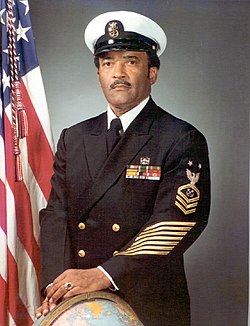
Carl Maxie Brashear (19 January 1931 – 25 July 2006) was an American sailor who served in the United States Navy as a Master Diver. He was among the first African-Americans to obtain that qualification, doing so in 1970 despite the amputation of his lower left leg in 1966. The 2000 film Men of Honor was based on his life.
Brashear was born on 19 January 1931, in Tonieville, LaRue County, Kentucky, the sixth of 16 children to sharecroppers McDonald and Gonzella Brashear. In 1935, the family settled on a farm in Sonora, Kentucky. Brashear attended Sonora Grade School from 1937 to 1946.
Brashear enlisted in the United States Navy on 25 February 1948, four months before the military was desegregated by President Harry S. Truman. He graduated from the United States Navy Diving & Salvage School in 1954, becoming the first African-American to attend and graduate from the Diving & Salvage School and one of the first African-American United States Navy Divers.
While attending diving school in Bayonne, New Jersey, Brashear faced hostility and racism. He found notes on his bunk saying, "We're going to drown you today, nigger!" and "We don't want any nigger divers." Brashear received encouragement to finish from Boatswain's Mate First Class Harry M. Rutherford, and graduated 16 out of 17.
Brashear first worked as a diver retrieving approximately 16,000 rounds of ammunition that fell off a barge which had broken in half and sunk. On his first tour of shore duty in Quonset Point, Rhode Island, his duties included the salvaging of airplanes (including one Blue Angel) and recovering multiple dead bodies from the sea.
Brashear was assigned to escort the presidential yacht the Barbara Anne to Rhode Island. He met President Eisenhower and received a small knife that said, "To Carl M. Brashear. From Dwight D. Eisenhower, 1957. Many, many thanks." After making Chief Petty Officer in 1959, he stayed at Guam for three years doing mostly demolition dives.
In January 1966, in an accident now known as the Palomares incident, a B28 nuclear bomb was lost off the coast of Palomares, Spain, after two United States Air Force aircraft of the Strategic Air Command (SAC), a B-52G Stratofortress bomber and a KC-135A Stratotanker aerial refueling aircraft, collided during aerial refueling. Brashear was serving aboard USS Hoist (ARS-40) when it was dispatched to find and recover the missing bomb for the Air Force. The warhead was found after two and a half months of searching. For his service in helping to retrieve the bomb, Brashear was later awarded the Navy and Marine Corps Medal, the highest navy award for non-combat heroism.
During the bomb recovery operations on 23 March 1966, a lifting cable snapped, causing a pipe to swing across the deck of the USS Hoist. Brashear darted to push a shipmate out of the object's path. It consequently struck Brashear's left leg below the knee, nearly shearing it off. The impact flipped him in the air, almost casting him overboard before he landed on the deck. He was evacuated to Torrejon Air Base in Spain, then to the USAF Hospital at Wiesbaden Air Base, Germany; and finally to the Naval Hospital in Portsmouth, Virginia. Beset with persistent infection and necrosis, his lower left leg was eventually amputated.
Carl Brashear
Carl Maxie Brashear (19 January 1931 – 25 July 2006) was an American sailor who served in the United States Navy as a Master Diver. He was among the first African-Americans to obtain that qualification, doing so in 1970 despite the amputation of his lower left leg in 1966. The 2000 film Men of Honor was based on his life.
Brashear was born on 19 January 1931, in Tonieville, LaRue County, Kentucky, the sixth of 16 children to sharecroppers McDonald and Gonzella Brashear. In 1935, the family settled on a farm in Sonora, Kentucky. Brashear attended Sonora Grade School from 1937 to 1946.
Brashear enlisted in the United States Navy on 25 February 1948, four months before the military was desegregated by President Harry S. Truman. He graduated from the United States Navy Diving & Salvage School in 1954, becoming the first African-American to attend and graduate from the Diving & Salvage School and one of the first African-American United States Navy Divers.
While attending diving school in Bayonne, New Jersey, Brashear faced hostility and racism. He found notes on his bunk saying, "We're going to drown you today, nigger!" and "We don't want any nigger divers." Brashear received encouragement to finish from Boatswain's Mate First Class Harry M. Rutherford, and graduated 16 out of 17.
Brashear first worked as a diver retrieving approximately 16,000 rounds of ammunition that fell off a barge which had broken in half and sunk. On his first tour of shore duty in Quonset Point, Rhode Island, his duties included the salvaging of airplanes (including one Blue Angel) and recovering multiple dead bodies from the sea.
Brashear was assigned to escort the presidential yacht the Barbara Anne to Rhode Island. He met President Eisenhower and received a small knife that said, "To Carl M. Brashear. From Dwight D. Eisenhower, 1957. Many, many thanks." After making Chief Petty Officer in 1959, he stayed at Guam for three years doing mostly demolition dives.
In January 1966, in an accident now known as the Palomares incident, a B28 nuclear bomb was lost off the coast of Palomares, Spain, after two United States Air Force aircraft of the Strategic Air Command (SAC), a B-52G Stratofortress bomber and a KC-135A Stratotanker aerial refueling aircraft, collided during aerial refueling. Brashear was serving aboard USS Hoist (ARS-40) when it was dispatched to find and recover the missing bomb for the Air Force. The warhead was found after two and a half months of searching. For his service in helping to retrieve the bomb, Brashear was later awarded the Navy and Marine Corps Medal, the highest navy award for non-combat heroism.
During the bomb recovery operations on 23 March 1966, a lifting cable snapped, causing a pipe to swing across the deck of the USS Hoist. Brashear darted to push a shipmate out of the object's path. It consequently struck Brashear's left leg below the knee, nearly shearing it off. The impact flipped him in the air, almost casting him overboard before he landed on the deck. He was evacuated to Torrejon Air Base in Spain, then to the USAF Hospital at Wiesbaden Air Base, Germany; and finally to the Naval Hospital in Portsmouth, Virginia. Beset with persistent infection and necrosis, his lower left leg was eventually amputated.
Recent media
Recent media