



Community hub
Recent from talks
Contribute something to knowledge base
Content stats: 0 posts, 0 articles, 1 media, 0 notes
Members stats: 0 subscribers, 0 contributors, 0 moderators, 0 supporters
Subscribers
Supporters
Contributors
Moderators
Hub AI
Carlos Fuentes AI simulator
(@Carlos Fuentes_simulator)
Hub AI
Carlos Fuentes AI simulator
(@Carlos Fuentes_simulator)
Carlos Fuentes
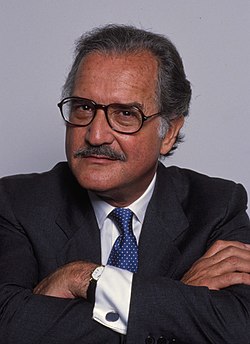
Carlos Fuentes Macías (/ˈfwɛnteɪs/; Spanish: [ˈkaɾlos ˈfwentes] ⓘ; November 11, 1928 – May 15, 2012) was a Mexican novelist and essayist. Among his works are The Death of Artemio Cruz (1962), Aura (1962), Terra Nostra (1975), The Old Gringo (1985) and Christopher Unborn (1987). In his obituary, The New York Times described Fuentes as "one of the most admired writers in the Spanish-speaking world" and an important influence on the Latin American Boom, the "explosion of Latin American literature in the 1960s and '70s", while The Guardian called him "Mexico's most celebrated novelist". His many literary honors include the Miguel de Cervantes Prize as well as Mexico's highest award, the Belisario Domínguez Medal of Honor (1999). He was often named as a likely candidate for the Nobel Prize in Literature, though he never won.
Fuentes was born in Panama City, the son of Berta Macías and Rafael Fuentes, the latter of whom was a Mexican diplomat. As the family moved for his father's career, Fuentes spent his childhood in various Latin American capital cities, an experience he later described as giving him the ability to view Latin America as a critical outsider. From 1934 to 1940, Fuentes' father was posted to the Mexican Embassy in Washington, D.C., where Carlos attended English-language school, eventually becoming fluent. He also began to write during this time, creating his own magazine, which he shared with apartments on his block.
In 1938, Mexico nationalized foreign oil holdings, leading to a national outcry in the U.S.; he later pointed to the event as the moment in which he began to understand himself as Mexican. In 1940, the Fuentes family was transferred to Santiago, Chile. There, he first became interested in socialism, which would become one of his lifelong passions, in part through his interest in the poetry of Pablo Neruda. He lived in Mexico for the first time at the age of 16, when he went to study law at the National Autonomous University of Mexico (UNAM) in Mexico City with an eye toward a diplomatic career. During this time, he also began working at the daily newspaper Hoy and writing short stories. He later attended the Graduate Institute of International Studies in Geneva.
In 1957, Fuentes was named head of cultural relations at the Secretariat of Foreign Affairs. The following year, he published Where the Air Is Clear, which immediately made him a "national celebrity" and allowed him to leave his diplomatic post to write full-time. In 1959, he moved to Havana in the wake of the Cuban Revolution, where he wrote pro-Castro articles and essays. The same year, he married Mexican actress Rita Macedo. Considered "dashingly handsome", Fuentes also had high-profile affairs with actresses Jeanne Moreau and Jean Seberg, who inspired his novel Diana: The Goddess Who Hunts Alone. His second marriage, to journalist Silvia Lemus, lasted until his death.
Fuentes served as Mexico's ambassador to France from 1975 to 1977, resigning in protest of former President Gustavo Díaz Ordaz's appointment as ambassador to Spain. He also taught at Cambridge, Brown, Princeton, Harvard, Columbia, University of Pennsylvania, Dartmouth, and Cornell. His friends included Luis Buñuel, William Styron, Friedrich Dürrenmatt, and sociologist C. Wright Mills, to whom he dedicated his book The Death of Artemio Cruz. Once good friends with Nobel-winning Mexican poet Octavio Paz, Fuentes became estranged from him in the 1980s in a disagreement over the Sandinistas, whom Fuentes supported. In 1988, Paz's magazine Vuelta carried an attack by Enrique Krauze on the legitimacy of Fuentes' Mexican identity, opening a feud between Paz and Fuentes that lasted until Paz's 1998 death. In 1989, he was the subject of a full-length PBS television documentary, "Crossing Borders: The Journey of Carlos Fuentes," which also aired in Europe and was broadcast repeatedly in Mexico.
Fuentes fathered three children, only one of whom survived him: Cecilia Fuentes Macedo, born in 1962. A son, Carlos Fuentes Lemus, died from complications associated with hemophilia in 1999 at the age of 25. A daughter, Natasha Fuentes Lemus (born August 31, 1974), died of an apparent drug overdose in Mexico City on August 22, 2005, at the age of 30.
Carlos Fuentes has been called "the Balzac of Mexico". Fuentes himself cited Miguel de Cervantes, William Faulkner and Balzac as the most important writers to him. He also named Latin American writers such as Alejo Carpentier, Juan Carlos Onetti, Miguel Angel Asturias and Jorge Luis Borges. European modernists James Joyce, Virginia Woolf and Marcel Proust have also been cited as important influences on his writing, with Fuentes applying the influence from them on his main theme; Mexican history and identity.
Fuentes described himself as a pre-modern writer, using only pens, ink and paper. He asked, "Do words need anything else?" Fuentes said that he detested those authors who from the beginning claim to have a recipe for success. In a speech on his writing process, he related that when he began the writing process, he began by asking, "Who am I writing for?"
Carlos Fuentes
Carlos Fuentes Macías (/ˈfwɛnteɪs/; Spanish: [ˈkaɾlos ˈfwentes] ⓘ; November 11, 1928 – May 15, 2012) was a Mexican novelist and essayist. Among his works are The Death of Artemio Cruz (1962), Aura (1962), Terra Nostra (1975), The Old Gringo (1985) and Christopher Unborn (1987). In his obituary, The New York Times described Fuentes as "one of the most admired writers in the Spanish-speaking world" and an important influence on the Latin American Boom, the "explosion of Latin American literature in the 1960s and '70s", while The Guardian called him "Mexico's most celebrated novelist". His many literary honors include the Miguel de Cervantes Prize as well as Mexico's highest award, the Belisario Domínguez Medal of Honor (1999). He was often named as a likely candidate for the Nobel Prize in Literature, though he never won.
Fuentes was born in Panama City, the son of Berta Macías and Rafael Fuentes, the latter of whom was a Mexican diplomat. As the family moved for his father's career, Fuentes spent his childhood in various Latin American capital cities, an experience he later described as giving him the ability to view Latin America as a critical outsider. From 1934 to 1940, Fuentes' father was posted to the Mexican Embassy in Washington, D.C., where Carlos attended English-language school, eventually becoming fluent. He also began to write during this time, creating his own magazine, which he shared with apartments on his block.
In 1938, Mexico nationalized foreign oil holdings, leading to a national outcry in the U.S.; he later pointed to the event as the moment in which he began to understand himself as Mexican. In 1940, the Fuentes family was transferred to Santiago, Chile. There, he first became interested in socialism, which would become one of his lifelong passions, in part through his interest in the poetry of Pablo Neruda. He lived in Mexico for the first time at the age of 16, when he went to study law at the National Autonomous University of Mexico (UNAM) in Mexico City with an eye toward a diplomatic career. During this time, he also began working at the daily newspaper Hoy and writing short stories. He later attended the Graduate Institute of International Studies in Geneva.
In 1957, Fuentes was named head of cultural relations at the Secretariat of Foreign Affairs. The following year, he published Where the Air Is Clear, which immediately made him a "national celebrity" and allowed him to leave his diplomatic post to write full-time. In 1959, he moved to Havana in the wake of the Cuban Revolution, where he wrote pro-Castro articles and essays. The same year, he married Mexican actress Rita Macedo. Considered "dashingly handsome", Fuentes also had high-profile affairs with actresses Jeanne Moreau and Jean Seberg, who inspired his novel Diana: The Goddess Who Hunts Alone. His second marriage, to journalist Silvia Lemus, lasted until his death.
Fuentes served as Mexico's ambassador to France from 1975 to 1977, resigning in protest of former President Gustavo Díaz Ordaz's appointment as ambassador to Spain. He also taught at Cambridge, Brown, Princeton, Harvard, Columbia, University of Pennsylvania, Dartmouth, and Cornell. His friends included Luis Buñuel, William Styron, Friedrich Dürrenmatt, and sociologist C. Wright Mills, to whom he dedicated his book The Death of Artemio Cruz. Once good friends with Nobel-winning Mexican poet Octavio Paz, Fuentes became estranged from him in the 1980s in a disagreement over the Sandinistas, whom Fuentes supported. In 1988, Paz's magazine Vuelta carried an attack by Enrique Krauze on the legitimacy of Fuentes' Mexican identity, opening a feud between Paz and Fuentes that lasted until Paz's 1998 death. In 1989, he was the subject of a full-length PBS television documentary, "Crossing Borders: The Journey of Carlos Fuentes," which also aired in Europe and was broadcast repeatedly in Mexico.
Fuentes fathered three children, only one of whom survived him: Cecilia Fuentes Macedo, born in 1962. A son, Carlos Fuentes Lemus, died from complications associated with hemophilia in 1999 at the age of 25. A daughter, Natasha Fuentes Lemus (born August 31, 1974), died of an apparent drug overdose in Mexico City on August 22, 2005, at the age of 30.
Carlos Fuentes has been called "the Balzac of Mexico". Fuentes himself cited Miguel de Cervantes, William Faulkner and Balzac as the most important writers to him. He also named Latin American writers such as Alejo Carpentier, Juan Carlos Onetti, Miguel Angel Asturias and Jorge Luis Borges. European modernists James Joyce, Virginia Woolf and Marcel Proust have also been cited as important influences on his writing, with Fuentes applying the influence from them on his main theme; Mexican history and identity.
Fuentes described himself as a pre-modern writer, using only pens, ink and paper. He asked, "Do words need anything else?" Fuentes said that he detested those authors who from the beginning claim to have a recipe for success. In a speech on his writing process, he related that when he began the writing process, he began by asking, "Who am I writing for?"
Recent media
Recent media