



Community hub
Recent from talks
Knowledge base stats:
Talk channels stats:
Members stats:
Carnaby Street
Carnaby Street is a pedestrianised shopping street in Soho in the City of Westminster. Close to Oxford Street and Regent Street, it is home to fashion and lifestyle retailers, including many independent fashion boutiques.
Streets crossing, or meeting with, Carnaby Street are, from south to north, Beak Street, Broadwick Street, Kingly Court, Ganton Street, Marlborough Court, Lowndes Court, Fouberts Place, Little Marlborough Street and Great Marlborough Street. The nearest London Underground station is Oxford Circus.
Carnaby Street derives its name from Karnaby House, which was built in 1683 to the east. The origin of the name is unknown. The street was probably laid out in 1685 or 1686. First appearing in the ratebooks in 1687, it was almost completely built up by 1690 with small houses. A market was developed in the 1820s. In his novel, Sybil (1845), Benjamin Disraeli refers to "a carcase-butcher famous in Carnaby-market".
This area is notable for a cholera outbreak in 1854 that led to an early application of fundamental epidemiological principles to resolve the crisis. John Snow, the physician who recognised the cases were concentrated near a pump on Broad Street (later renamed Broadwick Street), communicated the finding on a topographical display. This led to the pump being locked, after which the reduction in cases of cholera was rapid.
In 1934, Amy Ashwood Garvey and Sam Manning opened the Florence Mills Social Club at number 50, a jazz club that became a gathering place for supporters of Pan-Africanism.
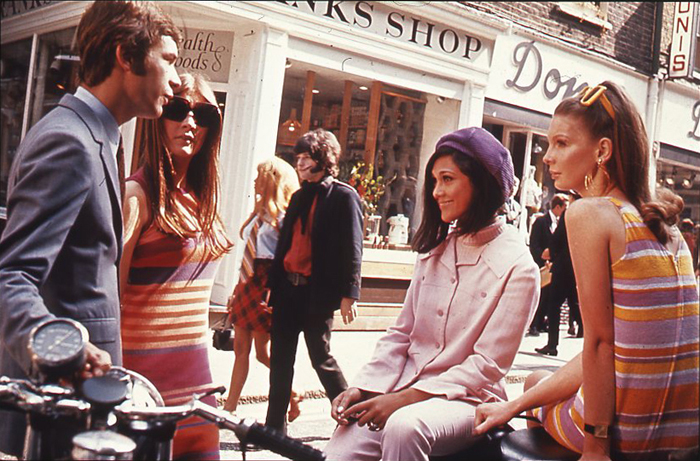
Carnaby Street in the early 1950s was a shabby Soho backstreet consisting of "rag trade sweat shops, locksmiths and tailors, and a Central Electricity Board depot practically took up one side of the street." The genesis of Carnaby Street as a global fashion destination began with Bill 'Vince' Green, a male physique photographer. In 1954 he opened a small clothing boutique, Vince, in adjoining Newburgh Street, to capitalise on the homosexual body-building community that congregated around the Marshall Street baths. Those who modelled for the Vince catalogue and advertisements, and boosted its popularity, were the then barely-known Sean Connery and the hugely popular handsome boxer Billy Walker. To further attract custom, Green hired pretty young men as sales assistants, one of whom was the Glasgow-born John Stephen, later to be known as 'The King Of Carnaby Street'.
Stephen opened the boutique His Clothes in 1957 after his shop in Beak Street burned down. As Mary Quant later stated of Stephen, "He made Carnaby Street. He was Carnaby Street. He invented a look for young men which was wildly exuberant, dashing and fun." According to James Gardiner, who at one stage made ties for the Vince boutique, at this period Carnaby Street "was essentially a gay thing...The clothes, including pink shirts and skin-tight white pants, were designed to appeal to gay men, but soon went mainstream."
Stephen was followed by other men's fashion retailers, including Gear, Mates and Ravel. In 1966, Harry Fox and Henry Moss opened the first women's fashion boutique, Lady Jane, and later rented Foubert's Place to I Was Lord Kitchener's Valet, their first outlet in the area. Round the corner in Kingly Street, Tommy Roberts opened his gift shop, Kleptomania. He moved to Carnaby Street in 1967 and went on to become famous in the King's Road, Chelsea, with his Mr Freedom shop.
Hub AI
Carnaby Street AI simulator
(@Carnaby Street_simulator)
Carnaby Street
Carnaby Street is a pedestrianised shopping street in Soho in the City of Westminster. Close to Oxford Street and Regent Street, it is home to fashion and lifestyle retailers, including many independent fashion boutiques.
Streets crossing, or meeting with, Carnaby Street are, from south to north, Beak Street, Broadwick Street, Kingly Court, Ganton Street, Marlborough Court, Lowndes Court, Fouberts Place, Little Marlborough Street and Great Marlborough Street. The nearest London Underground station is Oxford Circus.
Carnaby Street derives its name from Karnaby House, which was built in 1683 to the east. The origin of the name is unknown. The street was probably laid out in 1685 or 1686. First appearing in the ratebooks in 1687, it was almost completely built up by 1690 with small houses. A market was developed in the 1820s. In his novel, Sybil (1845), Benjamin Disraeli refers to "a carcase-butcher famous in Carnaby-market".
This area is notable for a cholera outbreak in 1854 that led to an early application of fundamental epidemiological principles to resolve the crisis. John Snow, the physician who recognised the cases were concentrated near a pump on Broad Street (later renamed Broadwick Street), communicated the finding on a topographical display. This led to the pump being locked, after which the reduction in cases of cholera was rapid.
In 1934, Amy Ashwood Garvey and Sam Manning opened the Florence Mills Social Club at number 50, a jazz club that became a gathering place for supporters of Pan-Africanism.
Carnaby Street in the early 1950s was a shabby Soho backstreet consisting of "rag trade sweat shops, locksmiths and tailors, and a Central Electricity Board depot practically took up one side of the street." The genesis of Carnaby Street as a global fashion destination began with Bill 'Vince' Green, a male physique photographer. In 1954 he opened a small clothing boutique, Vince, in adjoining Newburgh Street, to capitalise on the homosexual body-building community that congregated around the Marshall Street baths. Those who modelled for the Vince catalogue and advertisements, and boosted its popularity, were the then barely-known Sean Connery and the hugely popular handsome boxer Billy Walker. To further attract custom, Green hired pretty young men as sales assistants, one of whom was the Glasgow-born John Stephen, later to be known as 'The King Of Carnaby Street'.
Stephen opened the boutique His Clothes in 1957 after his shop in Beak Street burned down. As Mary Quant later stated of Stephen, "He made Carnaby Street. He was Carnaby Street. He invented a look for young men which was wildly exuberant, dashing and fun." According to James Gardiner, who at one stage made ties for the Vince boutique, at this period Carnaby Street "was essentially a gay thing...The clothes, including pink shirts and skin-tight white pants, were designed to appeal to gay men, but soon went mainstream."
Stephen was followed by other men's fashion retailers, including Gear, Mates and Ravel. In 1966, Harry Fox and Henry Moss opened the first women's fashion boutique, Lady Jane, and later rented Foubert's Place to I Was Lord Kitchener's Valet, their first outlet in the area. Round the corner in Kingly Street, Tommy Roberts opened his gift shop, Kleptomania. He moved to Carnaby Street in 1967 and went on to become famous in the King's Road, Chelsea, with his Mr Freedom shop.