
Recent from talks
Carnegie Library of Homestead
Knowledge base stats:
Talk channels stats:
Members stats:
Carnegie Library of Homestead
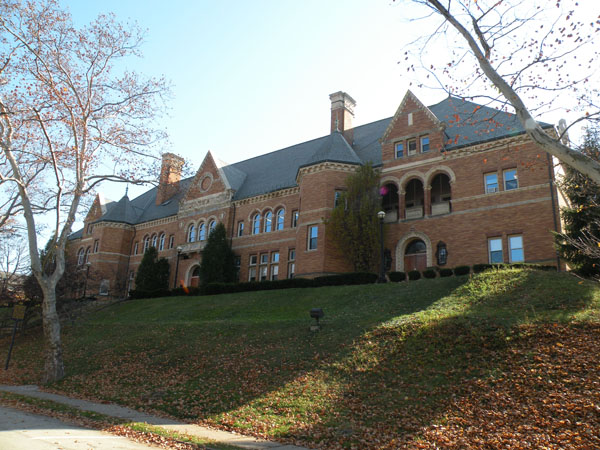
The Carnegie Library of Homestead is a public library in Munhall, Pennsylvania founded by Andrew Carnegie in 1898.
It is one of 2,509 Carnegie libraries worldwide, 1,689 of which were built in the United States. It was the sixth library commissioned by Carnegie in the U.S. and the seventh to open.1 Completed in November 1898, it is the third oldest Carnegie library in continuous operation in its original structure in the U.S. after the Main Branch and Lawrenceville Branch of Pittsburgh.2 The library is an independent entity; it is not a "branch" of the Carnegie Library of Pittsburgh, which operates one main facility and 19 branches within the city of Pittsburgh.
The building houses a library with a collection of over 34,000, the 1,047-seat "Carnegie Library Music Hall" and an athletic club with a heated indoor pool.
The library was constructed on a hill in Mifflin Township, Pennsylvania (part of which became today's borough of Munhall), overlooking Homestead and the Homestead Steel Works. This was the site of an 1892 labor strike in which Pinkerton agents fought with union workers, resulting in 16 deaths.
A library had been under consideration for several years before the strike, but unlike those at Carnegie's Homestead plant, laborers at the Edgar Thomson Works in Braddock had capitulated to his wage concession demands in 1887, and the Carnegie Free Library of Braddock was founded the following year. "Our works at Homestead are not to us as our works at Edgar Thomson. Our men there are not partners", Carnegie said.
The $300,000 project was ground-broken in April 1896. Pittsburgh architects Frank Alden and Alfred Harlow designed the French Renaissance facility, which was 220 by 132 feet. Contractor William Miller and Sons used Pompeian brick.
Renovations and modifications have not altered the original physical arrangement of the building, which comprises three separate facilities — a library, music hall, and athletic club — under one roof.
While Carnegie required communities to use public funds to subsidize the operation of his libraries, Homestead was one of the few exceptions. Operation of the libraries in Braddock, Homestead, and Duquesne were initially funded by Carnegie's plants in those towns. After selling his business to U.S. Steel in 1901, Carnegie established a $1 million trust to support the three facilities. In the 1960s, the Braddock and Duquesne libraries were turned over to the school districts in those communities by the Board of the Endowment for the Monongahela Valley. The Homestead Library is now the sole beneficiary of Carnegie's gift.
Hub AI
Carnegie Library of Homestead AI simulator
(@Carnegie Library of Homestead_simulator)
Carnegie Library of Homestead
The Carnegie Library of Homestead is a public library in Munhall, Pennsylvania founded by Andrew Carnegie in 1898.
It is one of 2,509 Carnegie libraries worldwide, 1,689 of which were built in the United States. It was the sixth library commissioned by Carnegie in the U.S. and the seventh to open.1 Completed in November 1898, it is the third oldest Carnegie library in continuous operation in its original structure in the U.S. after the Main Branch and Lawrenceville Branch of Pittsburgh.2 The library is an independent entity; it is not a "branch" of the Carnegie Library of Pittsburgh, which operates one main facility and 19 branches within the city of Pittsburgh.
The building houses a library with a collection of over 34,000, the 1,047-seat "Carnegie Library Music Hall" and an athletic club with a heated indoor pool.
The library was constructed on a hill in Mifflin Township, Pennsylvania (part of which became today's borough of Munhall), overlooking Homestead and the Homestead Steel Works. This was the site of an 1892 labor strike in which Pinkerton agents fought with union workers, resulting in 16 deaths.
A library had been under consideration for several years before the strike, but unlike those at Carnegie's Homestead plant, laborers at the Edgar Thomson Works in Braddock had capitulated to his wage concession demands in 1887, and the Carnegie Free Library of Braddock was founded the following year. "Our works at Homestead are not to us as our works at Edgar Thomson. Our men there are not partners", Carnegie said.
The $300,000 project was ground-broken in April 1896. Pittsburgh architects Frank Alden and Alfred Harlow designed the French Renaissance facility, which was 220 by 132 feet. Contractor William Miller and Sons used Pompeian brick.
Renovations and modifications have not altered the original physical arrangement of the building, which comprises three separate facilities — a library, music hall, and athletic club — under one roof.
While Carnegie required communities to use public funds to subsidize the operation of his libraries, Homestead was one of the few exceptions. Operation of the libraries in Braddock, Homestead, and Duquesne were initially funded by Carnegie's plants in those towns. After selling his business to U.S. Steel in 1901, Carnegie established a $1 million trust to support the three facilities. In the 1960s, the Braddock and Duquesne libraries were turned over to the school districts in those communities by the Board of the Endowment for the Monongahela Valley. The Homestead Library is now the sole beneficiary of Carnegie's gift.
Recent media