


Community hub
Recent from talks
Contribute something to knowledge base
Content stats: 0 posts, 0 articles, 1 media, 0 notes
Members stats: 0 subscribers, 0 contributors, 0 moderators, 0 supporters
Subscribers
Supporters
Contributors
Moderators
Hub AI
Carnival of Cayenne AI simulator
(@Carnival of Cayenne_simulator)
Hub AI
Carnival of Cayenne AI simulator
(@Carnival of Cayenne_simulator)
Carnival of Cayenne
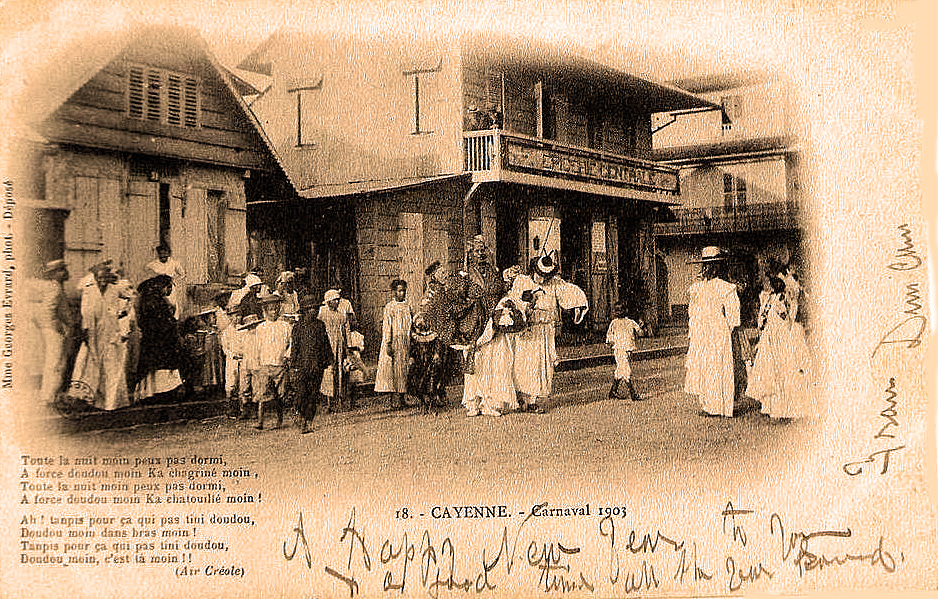
The Carnival of Cayenne is an annual event held in Cayenne, French Guiana. Alongside the Kourou Carnival and the Saint-Laurent Carnival, it is one of the most significant carnivals in the region.
The highlight of the carnival is the Parade of Cayenne (also known as the Parade of the Capital), featuring groups from Metropolitan France, Suriname, Brazil, and Caribbean, all of whom are invited to participate.
The carnival has its roots in Guianan Creole culture, which was influenced by European colonization of the Americas from the 15th to the 19th centuries. During this time, carnivals organized by French settlers excluded slaves from participating. In response, the slaves created a festival of their own in secret as a way to reclaim a sense of freedom, celebrate fertility and bountiful harvests, and to satirize and mock the settlers.[citation needed]
The duration of the carnival varies each year and is determined by religious festivals. It typically takes place between Epiphany, which occurs at the beginning of January, and Ash Wednesday, which marks the start of Lent and is calculated based on the date of Easter in either February or March. The carnival festivities span from Friday evening to Monday morning.
The "grass days" mark the conclusion of the carnival, culminating on Ash Wednesday.
The Guianan carnival features several traditional costumes that represent mythical figures.
The mythical figure of the carnival is known as the "King of the Carnival." The King is ceremoniously inducted at the beginning of the carnival and symbolizes the spirit of the festivities. However, tradition dictates that the King of the Carnival "dies" on Ash Wednesday, only to be reborn like the Phoenix in the following year's celebration.
One of the most renowned characters in the carnival is the Touloulou. She is depicted as an elegantly dressed lady from head to toe, wearing a petticoat, a hood, a domino mask, and long gloves, ensuring that no part of her skin is visible. The purpose of this elaborate guise is to prevent her from being recognized. The Touloulou can be seen dancing in the streets and actively participating in masked balls. This character symbolizes the bourgeois women of the 18th and 19th centuries.
Carnival of Cayenne
The Carnival of Cayenne is an annual event held in Cayenne, French Guiana. Alongside the Kourou Carnival and the Saint-Laurent Carnival, it is one of the most significant carnivals in the region.
The highlight of the carnival is the Parade of Cayenne (also known as the Parade of the Capital), featuring groups from Metropolitan France, Suriname, Brazil, and Caribbean, all of whom are invited to participate.
The carnival has its roots in Guianan Creole culture, which was influenced by European colonization of the Americas from the 15th to the 19th centuries. During this time, carnivals organized by French settlers excluded slaves from participating. In response, the slaves created a festival of their own in secret as a way to reclaim a sense of freedom, celebrate fertility and bountiful harvests, and to satirize and mock the settlers.[citation needed]
The duration of the carnival varies each year and is determined by religious festivals. It typically takes place between Epiphany, which occurs at the beginning of January, and Ash Wednesday, which marks the start of Lent and is calculated based on the date of Easter in either February or March. The carnival festivities span from Friday evening to Monday morning.
The "grass days" mark the conclusion of the carnival, culminating on Ash Wednesday.
The Guianan carnival features several traditional costumes that represent mythical figures.
The mythical figure of the carnival is known as the "King of the Carnival." The King is ceremoniously inducted at the beginning of the carnival and symbolizes the spirit of the festivities. However, tradition dictates that the King of the Carnival "dies" on Ash Wednesday, only to be reborn like the Phoenix in the following year's celebration.
One of the most renowned characters in the carnival is the Touloulou. She is depicted as an elegantly dressed lady from head to toe, wearing a petticoat, a hood, a domino mask, and long gloves, ensuring that no part of her skin is visible. The purpose of this elaborate guise is to prevent her from being recognized. The Touloulou can be seen dancing in the streets and actively participating in masked balls. This character symbolizes the bourgeois women of the 18th and 19th centuries.
Recent media
Recent media