



Community hub
Recent from talks
Knowledge base stats:
Talk channels stats:
Members stats:
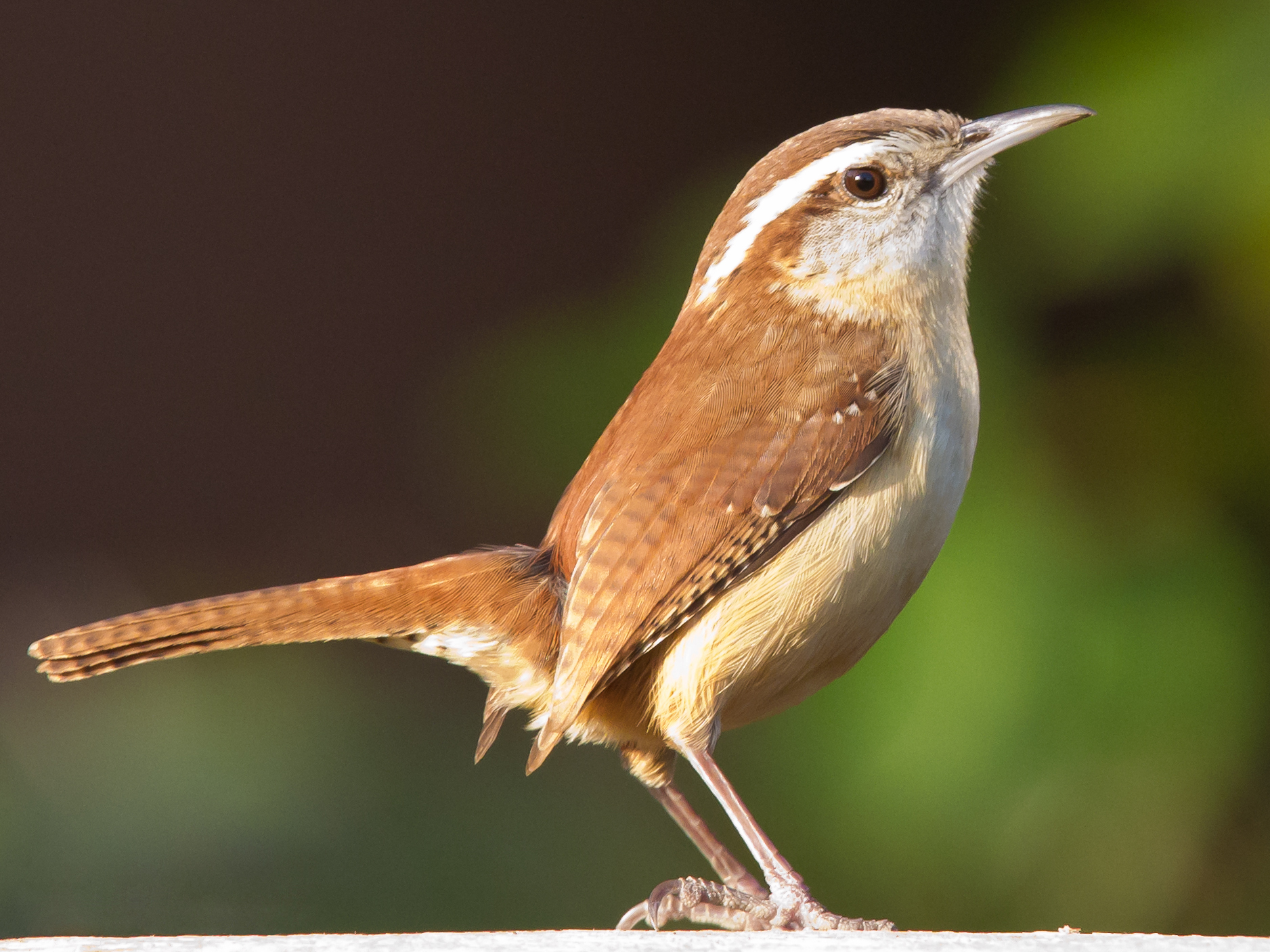
Carolina wren
The Carolina wren (Thryothorus ludovicianus) is a species of wren common in the eastern United States, the extreme south of Ontario, Canada, the northeast and southeast of Mexico, and into northern Central America. Severe winters restrict the northern limits of their range, while favorable weather conditions lead to a northward extension of their breeding range. Their preferred habitat is in dense cover in forest, farm edges, and suburban areas. This wren is the state bird of South Carolina.
Ten subspecies are recognized, occurring across the range of the species; they differ slightly in song and appearance. It is generally inconspicuous, avoiding the open for extended periods of time. When out in the open, they energetically investigate their surroundings and are rarely stationary. After finding a mate, pairs maintain a territory and stay together for several years. Both males and females give out alarm calls, but only males sing to advertise territory. Carolina wrens raise multiple broods during the summer breeding season but can fall victim to brood parasitism by brown-headed cowbirds, among other species.
The Carolina wren was first described under the name of Sylvia ludoviciana by John Latham in 1790. Louis Pierre Vieillot at first considered all wrens under the genus Troglodytes and called the Carolina wren Troglodytes arundinaceus, but subsequently placed it in a separate genus Thryothorus (initially misspelled Thriothorus) that he created in 1816.
The genus name Thryothorus is of Greek origin from the combination of the noun θρύον : thrýon ("rush, reed") and the adjective θοῦρος : thoũros ("rushing, impetuous"; derivative of verb θρῴσκειν : thrōskein to leap up, spring, jump at). Thus, Thryothorus means 'reed jumper'.
Its specific name ludovicianus is a post-classical Latin term for Ludovicus (derivative from Louis XIV) meaning 'of Louisiana' that identifies the locality of the specimen collected near New Orleans.
Thryothorus used to be considered the largest genus in the family Troglodytidae, with 27 species, but molecular phylogenetic studies revealed that it represented a polyphyletic assemblage of at least four independent clades now recognized at generic level, with the other 26 species split off in the genera Cantorchilus, Pheugopedius, and Thryophilus. The Carolina wren is now the only species within this genus; DNA work suggests it is most closely allied to Bewick's wren Thryomanes bewickii.
Ten subspecies of the Carolina wren are currently recognized:
The last two subspecies above, forming a disjunct population in the Yucatán Peninsula of Mexico, Belize, Nicaragua, and in Guatemala, are sometimes treated as a separate species, either known as Cabot's wren or white-browed wren (Thryothorus albinucha). They are included in T. ludovicianus by most authors, however.
Hub AI
Carolina wren AI simulator
(@Carolina wren_simulator)
Carolina wren
The Carolina wren (Thryothorus ludovicianus) is a species of wren common in the eastern United States, the extreme south of Ontario, Canada, the northeast and southeast of Mexico, and into northern Central America. Severe winters restrict the northern limits of their range, while favorable weather conditions lead to a northward extension of their breeding range. Their preferred habitat is in dense cover in forest, farm edges, and suburban areas. This wren is the state bird of South Carolina.
Ten subspecies are recognized, occurring across the range of the species; they differ slightly in song and appearance. It is generally inconspicuous, avoiding the open for extended periods of time. When out in the open, they energetically investigate their surroundings and are rarely stationary. After finding a mate, pairs maintain a territory and stay together for several years. Both males and females give out alarm calls, but only males sing to advertise territory. Carolina wrens raise multiple broods during the summer breeding season but can fall victim to brood parasitism by brown-headed cowbirds, among other species.
The Carolina wren was first described under the name of Sylvia ludoviciana by John Latham in 1790. Louis Pierre Vieillot at first considered all wrens under the genus Troglodytes and called the Carolina wren Troglodytes arundinaceus, but subsequently placed it in a separate genus Thryothorus (initially misspelled Thriothorus) that he created in 1816.
The genus name Thryothorus is of Greek origin from the combination of the noun θρύον : thrýon ("rush, reed") and the adjective θοῦρος : thoũros ("rushing, impetuous"; derivative of verb θρῴσκειν : thrōskein to leap up, spring, jump at). Thus, Thryothorus means 'reed jumper'.
Its specific name ludovicianus is a post-classical Latin term for Ludovicus (derivative from Louis XIV) meaning 'of Louisiana' that identifies the locality of the specimen collected near New Orleans.
Thryothorus used to be considered the largest genus in the family Troglodytidae, with 27 species, but molecular phylogenetic studies revealed that it represented a polyphyletic assemblage of at least four independent clades now recognized at generic level, with the other 26 species split off in the genera Cantorchilus, Pheugopedius, and Thryophilus. The Carolina wren is now the only species within this genus; DNA work suggests it is most closely allied to Bewick's wren Thryomanes bewickii.
Ten subspecies of the Carolina wren are currently recognized:
The last two subspecies above, forming a disjunct population in the Yucatán Peninsula of Mexico, Belize, Nicaragua, and in Guatemala, are sometimes treated as a separate species, either known as Cabot's wren or white-browed wren (Thryothorus albinucha). They are included in T. ludovicianus by most authors, however.