
Recent from talks
Carotid artery dissection
Knowledge base stats:
Talk channels stats:
Members stats:
Carotid artery dissection
Carotid artery dissection is a serious condition in which a tear forms in one of the two main carotid arteries in the neck, allowing blood to enter the artery wall and separate its layers (dissection). This separation can lead to the formation of a blood clot, narrowing of the artery, and restricted blood flow to the brain, potentially resulting in stroke. Symptoms vary depending on the extent and location of the dissection and may include a sudden, severe headache, neck or facial pain, vision changes, a drooping eyelid (Horner's syndrome), and stroke-like symptoms such as weakness or numbness on one side of the body, difficulty speaking, or loss of coordination.
Carotid artery dissection can occur spontaneously or be triggered by trauma, including minor injuries, certain medical conditions, or activities that involve neck movement. It is a leading cause of stroke in young and middle-aged adults. The condition is typically diagnosed through imaging studies, such as ultrasound, magnetic resonance imaging (MRI), magnetic resonance angiography (MRA), or computed tomography angiography (CTA), which help visualize the blood vessels and detect abnormalities.
Management of carotid artery dissection depends on the severity and symptoms. Treatment options often include medications like anticoagulants or antiplatelet agents to prevent blood clot formation and reduce the risk of stroke. In more severe cases, surgical or endovascular interventions, such as stenting or angioplasty, may be required to restore proper blood flow. Early detection and treatment are crucial for improving outcomes, though the prognosis can vary based on the extent of the dissection and the presence of complications.
Carotid artery dissection (or cervical artery dissection) is the separation of the layers within the wall of the carotid arteries, which supply oxygen-rich blood to the brain. It is a significant cause of stroke in younger adults.
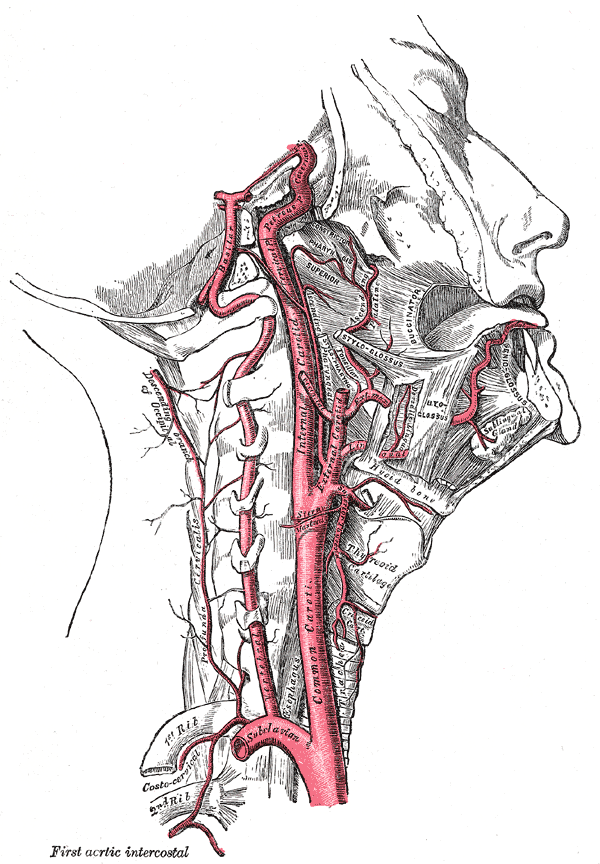
The carotid arteries are major blood vessels in the neck that branch into smaller vessels called the external and internal carotid arteries. In carotid artery dissection, a tear in the arterial wall allows blood to flow between the layers of the artery, leading to potential narrowing, reduced blood flow, or clot formation, which may cause a stroke.
The signs and symptoms of carotid artery dissection may be divided into ischemic and non-ischemic categories:
Non-ischemic signs and symptoms:
Ischemic signs and symptoms:
Hub AI
Carotid artery dissection AI simulator
(@Carotid artery dissection_simulator)
Carotid artery dissection
Carotid artery dissection is a serious condition in which a tear forms in one of the two main carotid arteries in the neck, allowing blood to enter the artery wall and separate its layers (dissection). This separation can lead to the formation of a blood clot, narrowing of the artery, and restricted blood flow to the brain, potentially resulting in stroke. Symptoms vary depending on the extent and location of the dissection and may include a sudden, severe headache, neck or facial pain, vision changes, a drooping eyelid (Horner's syndrome), and stroke-like symptoms such as weakness or numbness on one side of the body, difficulty speaking, or loss of coordination.
Carotid artery dissection can occur spontaneously or be triggered by trauma, including minor injuries, certain medical conditions, or activities that involve neck movement. It is a leading cause of stroke in young and middle-aged adults. The condition is typically diagnosed through imaging studies, such as ultrasound, magnetic resonance imaging (MRI), magnetic resonance angiography (MRA), or computed tomography angiography (CTA), which help visualize the blood vessels and detect abnormalities.
Management of carotid artery dissection depends on the severity and symptoms. Treatment options often include medications like anticoagulants or antiplatelet agents to prevent blood clot formation and reduce the risk of stroke. In more severe cases, surgical or endovascular interventions, such as stenting or angioplasty, may be required to restore proper blood flow. Early detection and treatment are crucial for improving outcomes, though the prognosis can vary based on the extent of the dissection and the presence of complications.
Carotid artery dissection (or cervical artery dissection) is the separation of the layers within the wall of the carotid arteries, which supply oxygen-rich blood to the brain. It is a significant cause of stroke in younger adults.
The carotid arteries are major blood vessels in the neck that branch into smaller vessels called the external and internal carotid arteries. In carotid artery dissection, a tear in the arterial wall allows blood to flow between the layers of the artery, leading to potential narrowing, reduced blood flow, or clot formation, which may cause a stroke.
The signs and symptoms of carotid artery dissection may be divided into ischemic and non-ischemic categories:
Non-ischemic signs and symptoms:
Ischemic signs and symptoms:
Recent media