
Recent from talks
Cassette tape
Knowledge base stats:
Talk channels stats:
Members stats:
Cassette tape
The cassette tape, also called Compact Cassette, audio cassette, or simply tape or cassette, is an analog magnetic tape recording format for audio recording and playback. Invented by Lou Ottens and his team at the Dutch company Philips, the Compact Cassette was introduced in August 1963.
Cassette tapes come in two forms, either containing content as a prerecorded cassette (Musicassette), or as a fully recordable "blank" cassette. Both forms have two sides and are reversible by the user. Although other tape cassette formats have also existed—for example the Microcassette—the generic term cassette tape is normally used to refer to the Compact Cassette because of its ubiquity.
From 1983 to 1991, the cassette tape was the most popular audio format for new music sales in the United States.
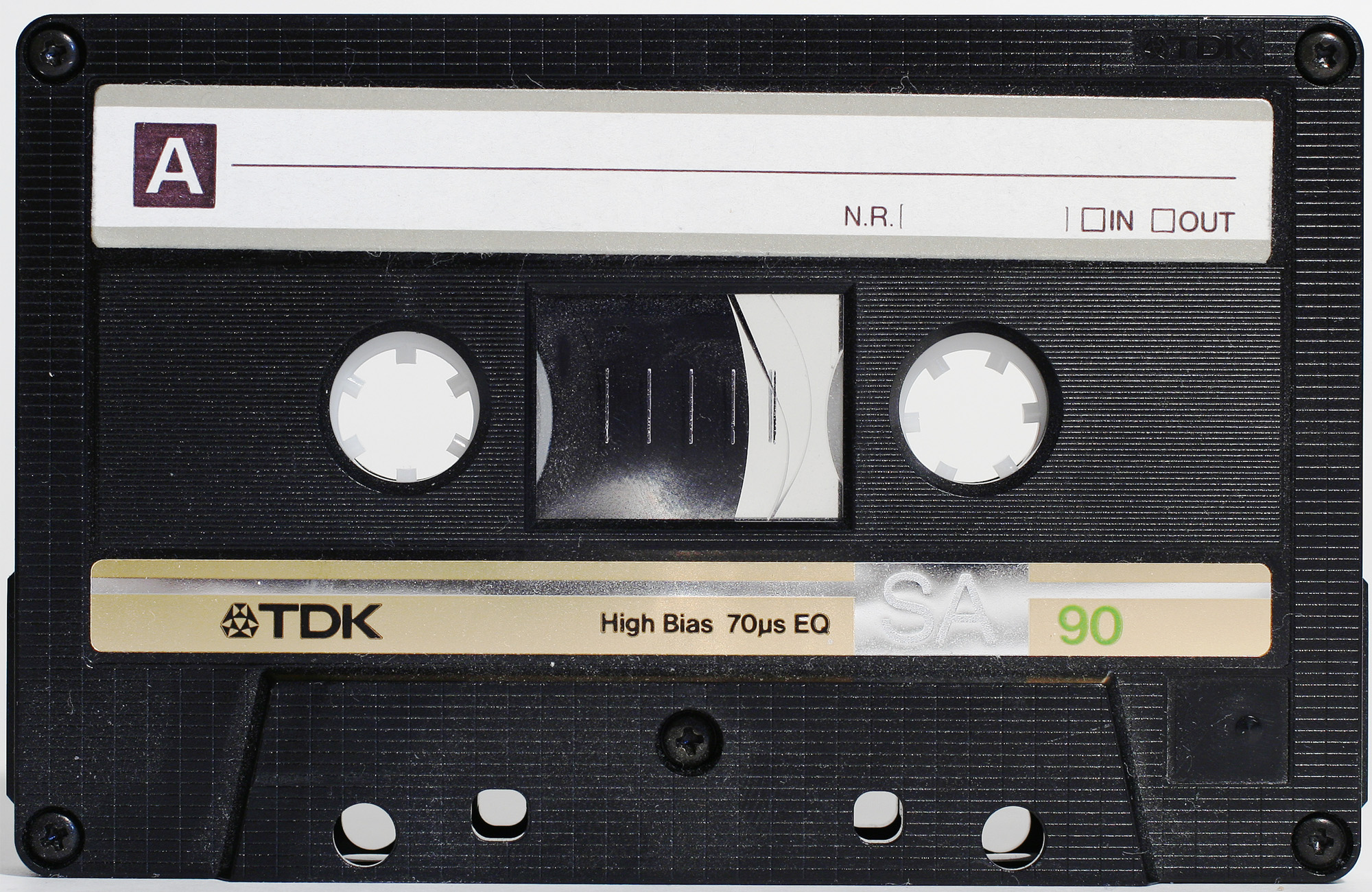
Cassette tapes contain two miniature spools, between which the magnetically coated, polyester-type plastic film (magnetic tape) is passed and wound—essentially miniaturizing reel-to-reel audio tape and enclosing it, with its reels, in a small case (cartridge)—hence "cassette". These spools and their attendant parts are held inside a protective plastic shell which is 4 by 2.5 by 0.5 inches (10.2 cm × 6.35 cm × 1.27 cm) at its largest dimensions. The tape itself is commonly referred to as "eighth-inch" tape, supposedly 1⁄8 inch (0.125 in; 3.175 mm) wide, but actually slightly larger, at 0.15 inches (3.81 mm). Two stereo pairs of tracks (four total) or two monaural audio tracks are available on the tape; one stereo pair or one monophonic track is played or recorded when the tape is moving in one direction and the second (pair) when moving in the other direction. This reversal is achieved either by manually flipping the cassette when the tape comes to an end, or by the reversal of tape movement, known as "auto-reverse", when the mechanism detects that the tape has ended.
After the Second World War, magnetic tape recording technology proliferated across the world. In the United States, Ampex, using equipment obtained in Germany as a starting point, began commercial production of reel-to-reel tape recorders. First used by broadcast studios to pre-record radio programs, tape recorders quickly found their way into schools and homes. By 1953, one million U.S. homes had tape machines, and several major record labels were releasing select titles on prerecorded reel-to-reel tapes.
In 1958, following four years of development, RCA introduced the RCA tape cartridge, which enclosed 60 minutes (30 minutes per side) of stereo quarter-inch reel-to-reel tape within a plastic cartridge that could be utilized on a compatible tape recorder/player without having to thread the tape through the machine. This format was not very successful, and RCA discontinued it in 1964.
In the early 1960s, Philips tasked two teams to design a high-quality tape cartridge for home use, using thinner and narrower tape than that used in reel-to-reel tape recorders. A team at its Vienna factory, which had experience with dictation machines, developed the Einloch-Kassette, or single-hole cassette, with Grundig. At the same time, a team in Hasselt led by Lou Ottens developed a two-hole cassette under the name Pocket Recorder.
Philips selected the two-spool cartridge as a winner and introduced the 2-track 2-direction mono version in Europe on 28 August 1963 at the Berlin Radio Show, and in the United States (under the Norelco brand) in November 1964. The same year, mass production of blank compact cassettes began in Hanover. Philips also offered a machine to play and record the cassettes, the Philips Typ EL 3300. An updated model, Typ EL 3301 was offered in the U.S. in November 1964 as Norelco Carry-Corder 150. The trademark name Compact Cassette came a year later.[citation needed]
Hub AI
Cassette tape AI simulator
(@Cassette tape_simulator)
Cassette tape
The cassette tape, also called Compact Cassette, audio cassette, or simply tape or cassette, is an analog magnetic tape recording format for audio recording and playback. Invented by Lou Ottens and his team at the Dutch company Philips, the Compact Cassette was introduced in August 1963.
Cassette tapes come in two forms, either containing content as a prerecorded cassette (Musicassette), or as a fully recordable "blank" cassette. Both forms have two sides and are reversible by the user. Although other tape cassette formats have also existed—for example the Microcassette—the generic term cassette tape is normally used to refer to the Compact Cassette because of its ubiquity.
From 1983 to 1991, the cassette tape was the most popular audio format for new music sales in the United States.
Cassette tapes contain two miniature spools, between which the magnetically coated, polyester-type plastic film (magnetic tape) is passed and wound—essentially miniaturizing reel-to-reel audio tape and enclosing it, with its reels, in a small case (cartridge)—hence "cassette". These spools and their attendant parts are held inside a protective plastic shell which is 4 by 2.5 by 0.5 inches (10.2 cm × 6.35 cm × 1.27 cm) at its largest dimensions. The tape itself is commonly referred to as "eighth-inch" tape, supposedly 1⁄8 inch (0.125 in; 3.175 mm) wide, but actually slightly larger, at 0.15 inches (3.81 mm). Two stereo pairs of tracks (four total) or two monaural audio tracks are available on the tape; one stereo pair or one monophonic track is played or recorded when the tape is moving in one direction and the second (pair) when moving in the other direction. This reversal is achieved either by manually flipping the cassette when the tape comes to an end, or by the reversal of tape movement, known as "auto-reverse", when the mechanism detects that the tape has ended.
After the Second World War, magnetic tape recording technology proliferated across the world. In the United States, Ampex, using equipment obtained in Germany as a starting point, began commercial production of reel-to-reel tape recorders. First used by broadcast studios to pre-record radio programs, tape recorders quickly found their way into schools and homes. By 1953, one million U.S. homes had tape machines, and several major record labels were releasing select titles on prerecorded reel-to-reel tapes.
In 1958, following four years of development, RCA introduced the RCA tape cartridge, which enclosed 60 minutes (30 minutes per side) of stereo quarter-inch reel-to-reel tape within a plastic cartridge that could be utilized on a compatible tape recorder/player without having to thread the tape through the machine. This format was not very successful, and RCA discontinued it in 1964.
In the early 1960s, Philips tasked two teams to design a high-quality tape cartridge for home use, using thinner and narrower tape than that used in reel-to-reel tape recorders. A team at its Vienna factory, which had experience with dictation machines, developed the Einloch-Kassette, or single-hole cassette, with Grundig. At the same time, a team in Hasselt led by Lou Ottens developed a two-hole cassette under the name Pocket Recorder.
Philips selected the two-spool cartridge as a winner and introduced the 2-track 2-direction mono version in Europe on 28 August 1963 at the Berlin Radio Show, and in the United States (under the Norelco brand) in November 1964. The same year, mass production of blank compact cassettes began in Hanover. Philips also offered a machine to play and record the cassettes, the Philips Typ EL 3300. An updated model, Typ EL 3301 was offered in the U.S. in November 1964 as Norelco Carry-Corder 150. The trademark name Compact Cassette came a year later.[citation needed]
Recent media