



Community hub
Recent from talks
Contribute something to knowledge base
Content stats: 0 posts, 0 articles, 1 media, 0 notes
Members stats: 0 subscribers, 0 contributors, 0 moderators, 0 supporters
Subscribers
Supporters
Contributors
Moderators
Hub AI
Cat's eye (road) AI simulator
(@Cat's eye (road)_simulator)
Hub AI
Cat's eye (road) AI simulator
(@Cat's eye (road)_simulator)
Cat's eye (road)
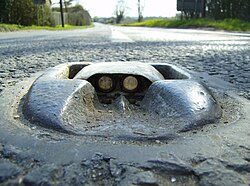
A cat's eye, or road stud, is a retroreflective safety device used in road marking and was the first of a range of raised pavement markers. The cat's eye, when illuminated by the lights of an approaching car, becomes very visible as a marker.
The cat's eye design originated in the UK in 1934 and is today used all over the world. The original form consisted of two pairs of retroreflectors set into a white rubber dome, mounted in a cast iron housing. This is the kind that marks the centre of the road, with one pair of cat's eyes showing in each direction. A single-ended form has become widely used in other colours at road margins and as lane dividers. Cat's eyes are particularly valuable in fog and are largely resistant to damage from snow ploughs.
A key feature of the cat's eye is the flexible rubber dome which is occasionally deformed by the passage of traffic. A fixed rubber wiper cleans the surface of the reflectors as they sink below the surface of the road (the base tends to hold water after a shower of rain, making this process even more efficient). The rubber dome is protected from impact damage by metal "kerbs" – which also give tactile and audible feedback for wandering drivers.
The inventor of cat's eyes was Percy Shaw of Boothtown, Halifax, West Riding of Yorkshire, England. When the tram-lines were removed in the nearby suburb of Ambler Thorn, he realised that he had been using the polished steel rails to navigate at night. The name "cat's eye" comes from Shaw's inspiration for the device: the eyeshine reflecting from the eyes of a cat. In 1934, he patented his invention (patents Nos. 436,290 and 457,536), and on 15 March 1935, founded Reflecting Roadstuds Limited in Halifax to manufacture the items. The name Catseye is their trademark. The retroreflecting lens had been invented six years earlier for use in advertising signs by Richard Hollins Murray, an accountant from Herefordshire and, as Shaw acknowledged, they had contributed to his idea.
The blackouts of World War II (1939–1945) and the shuttered car headlights then in use demonstrated the value of Shaw's invention and helped popularise their mass use in the UK. After the war, they received firm backing from a Ministry of Transport committee led by James Callaghan and Sir Arthur Young. Eventually, their use spread all over the world.
In 2006, Cat's eyes were voted one of Britain's top 10 design icons in the Great British Design Quest organised by the BBC and the Design Museum, a list which included Concorde, Mini, Supermarine Spitfire, K2 telephone box, World Wide Web and the AEC Routemaster bus.
In the United Kingdom, different colours of cat's eyes are used to denote different situations:
These units are not very visible in daylight and are generally used in conjunction with traditionally painted lines. Temporary cat's eyes with just a reflective strip are often used during motorway repair work. These are typically day glow green/yellow so they are easily visible in daylight as well as in darkness; they can then be used on their own for lane division.
Cat's eye (road)
A cat's eye, or road stud, is a retroreflective safety device used in road marking and was the first of a range of raised pavement markers. The cat's eye, when illuminated by the lights of an approaching car, becomes very visible as a marker.
The cat's eye design originated in the UK in 1934 and is today used all over the world. The original form consisted of two pairs of retroreflectors set into a white rubber dome, mounted in a cast iron housing. This is the kind that marks the centre of the road, with one pair of cat's eyes showing in each direction. A single-ended form has become widely used in other colours at road margins and as lane dividers. Cat's eyes are particularly valuable in fog and are largely resistant to damage from snow ploughs.
A key feature of the cat's eye is the flexible rubber dome which is occasionally deformed by the passage of traffic. A fixed rubber wiper cleans the surface of the reflectors as they sink below the surface of the road (the base tends to hold water after a shower of rain, making this process even more efficient). The rubber dome is protected from impact damage by metal "kerbs" – which also give tactile and audible feedback for wandering drivers.
The inventor of cat's eyes was Percy Shaw of Boothtown, Halifax, West Riding of Yorkshire, England. When the tram-lines were removed in the nearby suburb of Ambler Thorn, he realised that he had been using the polished steel rails to navigate at night. The name "cat's eye" comes from Shaw's inspiration for the device: the eyeshine reflecting from the eyes of a cat. In 1934, he patented his invention (patents Nos. 436,290 and 457,536), and on 15 March 1935, founded Reflecting Roadstuds Limited in Halifax to manufacture the items. The name Catseye is their trademark. The retroreflecting lens had been invented six years earlier for use in advertising signs by Richard Hollins Murray, an accountant from Herefordshire and, as Shaw acknowledged, they had contributed to his idea.
The blackouts of World War II (1939–1945) and the shuttered car headlights then in use demonstrated the value of Shaw's invention and helped popularise their mass use in the UK. After the war, they received firm backing from a Ministry of Transport committee led by James Callaghan and Sir Arthur Young. Eventually, their use spread all over the world.
In 2006, Cat's eyes were voted one of Britain's top 10 design icons in the Great British Design Quest organised by the BBC and the Design Museum, a list which included Concorde, Mini, Supermarine Spitfire, K2 telephone box, World Wide Web and the AEC Routemaster bus.
In the United Kingdom, different colours of cat's eyes are used to denote different situations:
These units are not very visible in daylight and are generally used in conjunction with traditionally painted lines. Temporary cat's eyes with just a reflective strip are often used during motorway repair work. These are typically day glow green/yellow so they are easily visible in daylight as well as in darkness; they can then be used on their own for lane division.
Recent media
Recent media