



Community hub
Recent from talks
Contribute something to knowledge base
Content stats: 0 posts, 0 articles, 1 media, 0 notes
Members stats: 0 subscribers, 0 contributors, 0 moderators, 0 supporters
Subscribers
Supporters
Contributors
Moderators
Hub AI
Concorde AI simulator
(@Concorde_simulator)
Hub AI
Concorde AI simulator
(@Concorde_simulator)
Concorde
Concorde /ˈkɒŋkɔːrd/ is a retired Anglo-French supersonic airliner jointly developed and manufactured by Sud Aviation and the British Aircraft Corporation (BAC). Studies began in 1954 and a UK–France treaty followed in 1962, as the programme cost was estimated at £70 million (£1.68 billion in 2023). Construction of six prototypes began in February 1965, with the first flight from Toulouse on 2 March 1969. The market forecast was 350 aircraft, with manufacturers receiving up to 100 options from major airlines. On 9 October 1975, it received its French certificate of airworthiness, and from the UK CAA on 5 December.
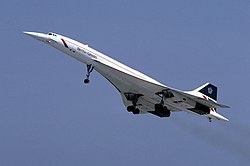
Concorde is an aircraft design with a narrow fuselage permitting four-abreast seating for 92 to 128 passengers, an ogival delta wing, and a droop nose for landing visibility. It is powered by four Rolls-Royce/Snecma Olympus 593 turbojets with variable engine intake ramps, and reheat for take-off and acceleration to supersonic speed. Constructed from aluminium, it was the first airliner to have analogue fly-by-wire flight controls. The airliner had transatlantic range while supercruising at twice the speed of sound for 75% of the distance.
Delays and cost overruns pushed costs to £1.5–2.1 billion in 1976, (£11–16 billion in 2023). Concorde entered service on 21 January 1976 with Air France from Paris-Roissy and British Airways from London Heathrow. Transatlantic flights were the main market, to Washington Dulles from 24 May, and to New York JFK from 17 October 1977. Air France and British Airways remained the sole customers with seven airframes each, for a total production of 20. Supersonic flight more than halved travel times, but sonic booms over the ground limited it to transoceanic flights only.
Its only competitor was the Tupolev Tu-144, carrying passengers from November 1977 until a May 1978 crash, while a potential competitor, the Boeing 2707, was cancelled in 1971 before any prototypes were built.
On 25 July 2000, Air France Flight 4590 crashed shortly after take-off with all 109 occupants and four on the ground killed. This was the only fatal incident involving Concorde; commercial service was suspended until November 2001. The remaining aircraft were retired in 2003, 27 years after commercial operations had begun. Eighteen of the 20 aircraft built are preserved and are on display in Europe and North America.
In the early 1950s, Arnold Hall, director of the Royal Aircraft Establishment (RAE), asked Morien Morgan to form a committee to study supersonic transport (SST). The group met in February 1954 and delivered their first report in April 1955. Robert T. Jones' work at NACA had demonstrated that the drag at supersonic speeds was strongly related to the span of the wing. This led to the use of short-span, thin, trapezoidal wings such as those seen on the control surfaces of many missiles, or aircraft such as the Lockheed F-104 Starfighter interceptor or the planned Avro 730 strategic bomber that the team studied. The team outlined a baseline configuration that resembled an enlarged Avro 730.
This short wingspan produced little lift at low speed, resulting in long take-off runs and high landing speeds. In an SST design, this would have required enormous engine power to lift off from existing runways, and to provide the fuel needed, "some horribly large aeroplanes" resulted. Based on this, the group considered the concept of an SST infeasible, and instead suggested continued low-level studies into supersonic aerodynamics.
Soon after, Johanna Weber and Dietrich Küchemann at the RAE published a series of reports on a new wing planform, known in the UK as the "slender delta". The team, including Eric Maskell whose report "Flow Separation in Three Dimensions" contributed to an understanding of separated flow, worked with the fact that delta wings can produce strong vortices on their upper surfaces at high angles of attack. The vortex will lower the air pressure and cause lift. This had been noticed by Chuck Yeager in the Convair XF-92, but its qualities had not been fully appreciated. Weber suggested that the effect could be used to improve low-speed performance.
Concorde
Concorde /ˈkɒŋkɔːrd/ is a retired Anglo-French supersonic airliner jointly developed and manufactured by Sud Aviation and the British Aircraft Corporation (BAC). Studies began in 1954 and a UK–France treaty followed in 1962, as the programme cost was estimated at £70 million (£1.68 billion in 2023). Construction of six prototypes began in February 1965, with the first flight from Toulouse on 2 March 1969. The market forecast was 350 aircraft, with manufacturers receiving up to 100 options from major airlines. On 9 October 1975, it received its French certificate of airworthiness, and from the UK CAA on 5 December.
Concorde is an aircraft design with a narrow fuselage permitting four-abreast seating for 92 to 128 passengers, an ogival delta wing, and a droop nose for landing visibility. It is powered by four Rolls-Royce/Snecma Olympus 593 turbojets with variable engine intake ramps, and reheat for take-off and acceleration to supersonic speed. Constructed from aluminium, it was the first airliner to have analogue fly-by-wire flight controls. The airliner had transatlantic range while supercruising at twice the speed of sound for 75% of the distance.
Delays and cost overruns pushed costs to £1.5–2.1 billion in 1976, (£11–16 billion in 2023). Concorde entered service on 21 January 1976 with Air France from Paris-Roissy and British Airways from London Heathrow. Transatlantic flights were the main market, to Washington Dulles from 24 May, and to New York JFK from 17 October 1977. Air France and British Airways remained the sole customers with seven airframes each, for a total production of 20. Supersonic flight more than halved travel times, but sonic booms over the ground limited it to transoceanic flights only.
Its only competitor was the Tupolev Tu-144, carrying passengers from November 1977 until a May 1978 crash, while a potential competitor, the Boeing 2707, was cancelled in 1971 before any prototypes were built.
On 25 July 2000, Air France Flight 4590 crashed shortly after take-off with all 109 occupants and four on the ground killed. This was the only fatal incident involving Concorde; commercial service was suspended until November 2001. The remaining aircraft were retired in 2003, 27 years after commercial operations had begun. Eighteen of the 20 aircraft built are preserved and are on display in Europe and North America.
In the early 1950s, Arnold Hall, director of the Royal Aircraft Establishment (RAE), asked Morien Morgan to form a committee to study supersonic transport (SST). The group met in February 1954 and delivered their first report in April 1955. Robert T. Jones' work at NACA had demonstrated that the drag at supersonic speeds was strongly related to the span of the wing. This led to the use of short-span, thin, trapezoidal wings such as those seen on the control surfaces of many missiles, or aircraft such as the Lockheed F-104 Starfighter interceptor or the planned Avro 730 strategic bomber that the team studied. The team outlined a baseline configuration that resembled an enlarged Avro 730.
This short wingspan produced little lift at low speed, resulting in long take-off runs and high landing speeds. In an SST design, this would have required enormous engine power to lift off from existing runways, and to provide the fuel needed, "some horribly large aeroplanes" resulted. Based on this, the group considered the concept of an SST infeasible, and instead suggested continued low-level studies into supersonic aerodynamics.
Soon after, Johanna Weber and Dietrich Küchemann at the RAE published a series of reports on a new wing planform, known in the UK as the "slender delta". The team, including Eric Maskell whose report "Flow Separation in Three Dimensions" contributed to an understanding of separated flow, worked with the fact that delta wings can produce strong vortices on their upper surfaces at high angles of attack. The vortex will lower the air pressure and cause lift. This had been noticed by Chuck Yeager in the Convair XF-92, but its qualities had not been fully appreciated. Weber suggested that the effect could be used to improve low-speed performance.
Recent media
Recent media