


Community hub
Recent from talks
Contribute something to knowledge base
Content stats: 0 posts, 0 articles, 1 media, 0 notes
Members stats: 0 subscribers, 0 contributors, 0 moderators, 0 supporters
Subscribers
Supporters
Contributors
Moderators
Hub AI
Catalysis AI simulator
(@Catalysis_simulator)
Hub AI
Catalysis AI simulator
(@Catalysis_simulator)
Catalysis
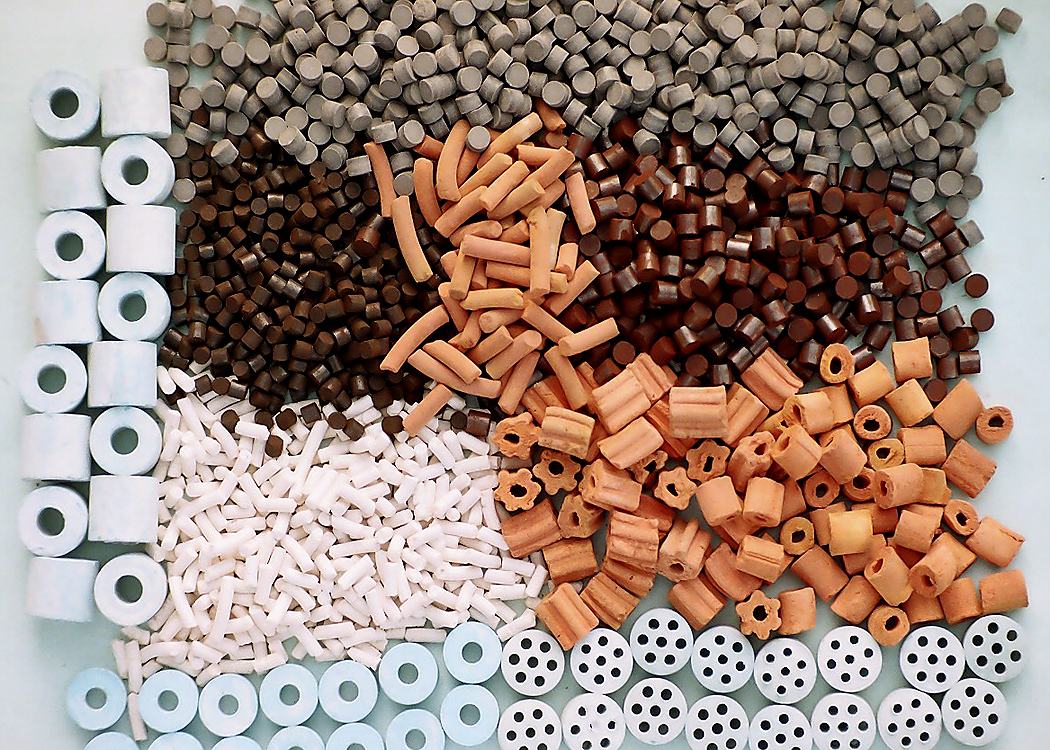
Catalysis (/kəˈtælɪsɪs/ kə-TAL-iss-iss) is the increase in rate of a chemical reaction due to an added substance known as a catalyst (/ˈkætəlɪst/ KAT-əl-ist). Catalysts are not consumed by the reaction and remain unchanged after the reaction. If the reaction is rapid and the catalyst is recycled quickly, a very small amount of catalyst often suffices; mixing, surface area, and temperature are important factors in reaction rate. Catalysts generally react with one or more reactants to form intermediates that subsequently give the final reaction product, in the process of regenerating the catalyst.
The rate increase occurs because the catalyst allows the reaction to occur by an alternative mechanism which may be much faster than the noncatalyzed mechanism. However the noncatalyzed mechanism does remain possible, so that the total rate (catalyzed plus noncatalyzed) can only increase in the presence of the catalyst and never decrease.
Catalysis may be classified as either homogeneous, whose components are dispersed in the same phase (usually gaseous or liquid) as the reactant, or heterogeneous, whose components are not in the same phase. Enzymes and other biocatalysts are often considered as a third category.
Catalysis is ubiquitous in chemical industry of all kinds. Estimates are that 90% of all commercially produced chemical products involve catalysts at some stage in the process of their manufacture.
The term "catalyst" is derived from Greek καταλύειν, kataluein, meaning "loosen" or "untie". The concept of catalysis was invented by chemist Elizabeth Fulhame, based on her novel work in oxidation-reduction experiments.
An illustrative example is the effect of catalysts to speed the decomposition of hydrogen peroxide into water and oxygen:
This reaction proceeds because the reaction products are more stable than the starting compound, but this decomposition is so slow that hydrogen peroxide solutions are commercially available. In the presence of a catalyst such as manganese dioxide, this reaction proceeds much more rapidly. This effect is readily seen by the effervescence of oxygen. The catalyst is not consumed in the reaction, and may be recovered unchanged and re-used indefinitely. Accordingly, manganese dioxide is said to catalyze this reaction. In living organisms, this reaction is catalyzed by enzymes (proteins that serve as catalysts) such as catalase.
Another example is the effect of catalysts on air pollution and reducing the amount of carbon monoxide. Development of active and selective catalysts for the conversion of carbon monoxide into desirable products is one of the most important roles of catalysts. Using catalysts for the hydrogenation of carbon monoxide helps remove this toxic gas and produce useful materials.
Catalysis
Catalysis (/kəˈtælɪsɪs/ kə-TAL-iss-iss) is the increase in rate of a chemical reaction due to an added substance known as a catalyst (/ˈkætəlɪst/ KAT-əl-ist). Catalysts are not consumed by the reaction and remain unchanged after the reaction. If the reaction is rapid and the catalyst is recycled quickly, a very small amount of catalyst often suffices; mixing, surface area, and temperature are important factors in reaction rate. Catalysts generally react with one or more reactants to form intermediates that subsequently give the final reaction product, in the process of regenerating the catalyst.
The rate increase occurs because the catalyst allows the reaction to occur by an alternative mechanism which may be much faster than the noncatalyzed mechanism. However the noncatalyzed mechanism does remain possible, so that the total rate (catalyzed plus noncatalyzed) can only increase in the presence of the catalyst and never decrease.
Catalysis may be classified as either homogeneous, whose components are dispersed in the same phase (usually gaseous or liquid) as the reactant, or heterogeneous, whose components are not in the same phase. Enzymes and other biocatalysts are often considered as a third category.
Catalysis is ubiquitous in chemical industry of all kinds. Estimates are that 90% of all commercially produced chemical products involve catalysts at some stage in the process of their manufacture.
The term "catalyst" is derived from Greek καταλύειν, kataluein, meaning "loosen" or "untie". The concept of catalysis was invented by chemist Elizabeth Fulhame, based on her novel work in oxidation-reduction experiments.
An illustrative example is the effect of catalysts to speed the decomposition of hydrogen peroxide into water and oxygen:
This reaction proceeds because the reaction products are more stable than the starting compound, but this decomposition is so slow that hydrogen peroxide solutions are commercially available. In the presence of a catalyst such as manganese dioxide, this reaction proceeds much more rapidly. This effect is readily seen by the effervescence of oxygen. The catalyst is not consumed in the reaction, and may be recovered unchanged and re-used indefinitely. Accordingly, manganese dioxide is said to catalyze this reaction. In living organisms, this reaction is catalyzed by enzymes (proteins that serve as catalysts) such as catalase.
Another example is the effect of catalysts on air pollution and reducing the amount of carbon monoxide. Development of active and selective catalysts for the conversion of carbon monoxide into desirable products is one of the most important roles of catalysts. Using catalysts for the hydrogenation of carbon monoxide helps remove this toxic gas and produce useful materials.
Recent media
Recent media