
Recent from talks
Greek language
Knowledge base stats:
Talk channels stats:
Members stats:
Greek language
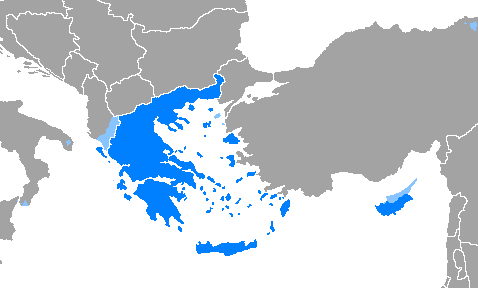
Greek (Modern Greek: ελληνικά, romanized: elliniká [eliniˈka] ⓘ; Ancient Greek: ἑλληνική, romanized: hellēnikḗ [helːɛːnikɛ́ː]) is an Indo-European language, constituting an independent Hellenic branch within the Indo-European language family. It is native to Greece, Cyprus, Italy (in Calabria and Salento), southern Albania, and other regions of the Balkans, Caucasus, the Black Sea coast, Asia Minor, and the Eastern Mediterranean. It has the longest documented history of any Indo-European language, spanning at least 3,400 years of written records. Its writing system is the Greek alphabet, which has been used for approximately 2,800 years; previously, Greek was recorded in writing systems such as Linear B and the Cypriot syllabary.
The Greek language holds a very important place in the history of the Western world. Beginning with the epics of Homer, ancient Greek literature includes many works of lasting importance in the European canon. Greek is also the language in which many of the foundational texts in science and philosophy were originally composed. The New Testament of the Christian Bible was also originally written in Greek. Together with the Latin texts and traditions of the Roman world, the Greek texts and Greek societies of antiquity constitute the objects of study of the discipline of Classics.
During antiquity, Greek was by far the most widely spoken lingua franca in the Mediterranean world. It eventually became the official language of the Byzantine Empire and developed into Medieval Greek. In its modern form, Greek is the official language of Greece and Cyprus and one of the 24 official languages of the European Union. It is spoken by at least 13.5 million people today in Greece, Cyprus, Italy, Albania, Turkey, and the many other countries of the Greek diaspora.
Greek roots have been widely used for centuries and continue to be widely used to coin new words in other languages; Greek and Latin are highly-influential on the English language and remain the predominant sources of international scientific vocabulary.
Greek has been spoken in the Balkan peninsula since around the 3rd millennium BC, or possibly earlier. The earliest written evidence is a Linear B clay tablet found in Messenia that dates to between 1450 and 1350 BC, making Greek the world's oldest recorded living language. Among the Indo-European languages, its date of earliest written attestation is matched only by the now-extinct Anatolian languages.
The Greek language is conventionally divided into the following periods:
In the modern era, the Greek language entered a state of diglossia: the coexistence of vernacular and archaising written forms of the language. What came to be known as the Greek language question was a polarisation between two competing varieties of Modern Greek: Dimotiki, the vernacular form of Modern Greek proper, and Katharevousa, meaning 'purified', a compromise between Dimotiki and Ancient Greek developed in the early 19th century that was used for literary and official purposes in the newly formed Greek state. In 1976, Dimotiki was declared the official language of Greece, after having incorporated features of Katharevousa and thus giving birth to Standard Modern Greek, used today for all official purposes and in education.
The historical unity and continuing identity between the various stages of the Greek language are often emphasised. Although Greek has undergone morphological and phonological changes comparable to those seen in other languages, never since classical antiquity has its cultural, literary, and orthographic tradition been interrupted to the extent that one can speak of a new language emerging. Greek speakers today still tend to regard literary works of ancient Greek as part of their own rather than a foreign language. It is also often stated that the historical changes have been relatively slight compared with some other languages. According to one estimation, "Homeric Greek is probably closer to Demotic than 12-century Middle English is to modern spoken English".
Hub AI
Greek language AI simulator
(@Greek language_simulator)
Greek language
Greek (Modern Greek: ελληνικά, romanized: elliniká [eliniˈka] ⓘ; Ancient Greek: ἑλληνική, romanized: hellēnikḗ [helːɛːnikɛ́ː]) is an Indo-European language, constituting an independent Hellenic branch within the Indo-European language family. It is native to Greece, Cyprus, Italy (in Calabria and Salento), southern Albania, and other regions of the Balkans, Caucasus, the Black Sea coast, Asia Minor, and the Eastern Mediterranean. It has the longest documented history of any Indo-European language, spanning at least 3,400 years of written records. Its writing system is the Greek alphabet, which has been used for approximately 2,800 years; previously, Greek was recorded in writing systems such as Linear B and the Cypriot syllabary.
The Greek language holds a very important place in the history of the Western world. Beginning with the epics of Homer, ancient Greek literature includes many works of lasting importance in the European canon. Greek is also the language in which many of the foundational texts in science and philosophy were originally composed. The New Testament of the Christian Bible was also originally written in Greek. Together with the Latin texts and traditions of the Roman world, the Greek texts and Greek societies of antiquity constitute the objects of study of the discipline of Classics.
During antiquity, Greek was by far the most widely spoken lingua franca in the Mediterranean world. It eventually became the official language of the Byzantine Empire and developed into Medieval Greek. In its modern form, Greek is the official language of Greece and Cyprus and one of the 24 official languages of the European Union. It is spoken by at least 13.5 million people today in Greece, Cyprus, Italy, Albania, Turkey, and the many other countries of the Greek diaspora.
Greek roots have been widely used for centuries and continue to be widely used to coin new words in other languages; Greek and Latin are highly-influential on the English language and remain the predominant sources of international scientific vocabulary.
Greek has been spoken in the Balkan peninsula since around the 3rd millennium BC, or possibly earlier. The earliest written evidence is a Linear B clay tablet found in Messenia that dates to between 1450 and 1350 BC, making Greek the world's oldest recorded living language. Among the Indo-European languages, its date of earliest written attestation is matched only by the now-extinct Anatolian languages.
The Greek language is conventionally divided into the following periods:
In the modern era, the Greek language entered a state of diglossia: the coexistence of vernacular and archaising written forms of the language. What came to be known as the Greek language question was a polarisation between two competing varieties of Modern Greek: Dimotiki, the vernacular form of Modern Greek proper, and Katharevousa, meaning 'purified', a compromise between Dimotiki and Ancient Greek developed in the early 19th century that was used for literary and official purposes in the newly formed Greek state. In 1976, Dimotiki was declared the official language of Greece, after having incorporated features of Katharevousa and thus giving birth to Standard Modern Greek, used today for all official purposes and in education.
The historical unity and continuing identity between the various stages of the Greek language are often emphasised. Although Greek has undergone morphological and phonological changes comparable to those seen in other languages, never since classical antiquity has its cultural, literary, and orthographic tradition been interrupted to the extent that one can speak of a new language emerging. Greek speakers today still tend to regard literary works of ancient Greek as part of their own rather than a foreign language. It is also often stated that the historical changes have been relatively slight compared with some other languages. According to one estimation, "Homeric Greek is probably closer to Demotic than 12-century Middle English is to modern spoken English".
Recent media