
Recent from talks
Cato Street Conspiracy
Knowledge base stats:
Talk channels stats:
Members stats:
Cato Street Conspiracy
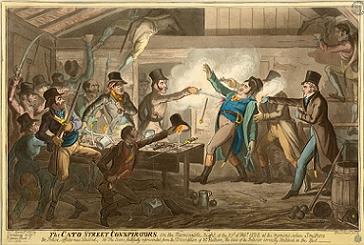
The Cato Street Conspiracy was a plot to murder all the British cabinet ministers and the Prime Minister Lord Liverpool in 1820. The name comes from the meeting place near Edgware Road in London. The police had an informer; the plotters fell into a police trap. Thirteen were arrested, while one policeman, Richard Smithers, was killed. Five conspirators were executed, and five others were transported to Australia.
How widespread the Cato Street conspiracy was is uncertain. It was a time of unrest; rumours abounded. Malcolm Chase noted that "the London-Irish community and a number of trade societies, notably shoemakers, were prepared to lend support, while unrest and awareness of a planned rising were widespread in the industrial north and on Clydeside."
The conspirators were called the Spencean Philanthropists, a group taking their name from the British radical speaker Thomas Spence. The group was known for being a revolutionary organisation, involved in unrest and propaganda and plotting the overthrow of the government.
Some of them, particularly Arthur Thistlewood, had been involved with the Spa Fields riots in 1816. Thistlewood came to dominate the group with George Edwards as his second in command. Edwards was a police spy. Most of the members were angered by the Six Acts and the Peterloo Massacre, as well as with the economic depression and political conditions of the time.
The conspirators planned to assassinate the cabinet which was supposed to be together at a dinner. They would then seize key buildings, overthrow the government and establish a "Committee of Public Safety" to oversee a radical revolution. According to the prosecution at their trial, they had intended to form a provisional government headquartered in the Mansion House.
Hard economic times encouraged social unrest. The end of the Napoleonic Wars in 1815 further worsened the economy and saw the return of job-seeking veterans. King George III's death on 29 January 1820 created a new governmental crisis. In a meeting held on 22 February, George Edwards suggested that the group could exploit the political situation and kill all the cabinet ministers after invading a fabricated cabinet dinner at the home of Lord Harrowby, Lord President of the Council, armed with pistols and grenades. Edwards even provided funds to help arm the conspirators.
Thistlewood thought the act would trigger a massive uprising against the government. James Ings, a coffeeshop keeper and former butcher, later announced that he would have decapitated all the cabinet members and taken two heads to exhibit on Westminster Bridge.
On 23 February, Richard Birnie, Bow Street magistrate, and George Ruthven, another police spy, went to wait at a public house on the other side of the street of the Cato Street building with twelve officers of the Bow Street Runners. Birnie and Ruthven waited for the afternoon because they had been promised reinforcements from the Coldstream Guards, under the command of Captain FitzClarence, an illegitimate son of the Duke of Clarence (later William IV). Thistlewood's group arrived during that time. At 7:30 pm, the Bow Street Runners decided to apprehend the conspirators themselves.[citation needed]
Hub AI
Cato Street Conspiracy AI simulator
(@Cato Street Conspiracy_simulator)
Cato Street Conspiracy
The Cato Street Conspiracy was a plot to murder all the British cabinet ministers and the Prime Minister Lord Liverpool in 1820. The name comes from the meeting place near Edgware Road in London. The police had an informer; the plotters fell into a police trap. Thirteen were arrested, while one policeman, Richard Smithers, was killed. Five conspirators were executed, and five others were transported to Australia.
How widespread the Cato Street conspiracy was is uncertain. It was a time of unrest; rumours abounded. Malcolm Chase noted that "the London-Irish community and a number of trade societies, notably shoemakers, were prepared to lend support, while unrest and awareness of a planned rising were widespread in the industrial north and on Clydeside."
The conspirators were called the Spencean Philanthropists, a group taking their name from the British radical speaker Thomas Spence. The group was known for being a revolutionary organisation, involved in unrest and propaganda and plotting the overthrow of the government.
Some of them, particularly Arthur Thistlewood, had been involved with the Spa Fields riots in 1816. Thistlewood came to dominate the group with George Edwards as his second in command. Edwards was a police spy. Most of the members were angered by the Six Acts and the Peterloo Massacre, as well as with the economic depression and political conditions of the time.
The conspirators planned to assassinate the cabinet which was supposed to be together at a dinner. They would then seize key buildings, overthrow the government and establish a "Committee of Public Safety" to oversee a radical revolution. According to the prosecution at their trial, they had intended to form a provisional government headquartered in the Mansion House.
Hard economic times encouraged social unrest. The end of the Napoleonic Wars in 1815 further worsened the economy and saw the return of job-seeking veterans. King George III's death on 29 January 1820 created a new governmental crisis. In a meeting held on 22 February, George Edwards suggested that the group could exploit the political situation and kill all the cabinet ministers after invading a fabricated cabinet dinner at the home of Lord Harrowby, Lord President of the Council, armed with pistols and grenades. Edwards even provided funds to help arm the conspirators.
Thistlewood thought the act would trigger a massive uprising against the government. James Ings, a coffeeshop keeper and former butcher, later announced that he would have decapitated all the cabinet members and taken two heads to exhibit on Westminster Bridge.
On 23 February, Richard Birnie, Bow Street magistrate, and George Ruthven, another police spy, went to wait at a public house on the other side of the street of the Cato Street building with twelve officers of the Bow Street Runners. Birnie and Ruthven waited for the afternoon because they had been promised reinforcements from the Coldstream Guards, under the command of Captain FitzClarence, an illegitimate son of the Duke of Clarence (later William IV). Thistlewood's group arrived during that time. At 7:30 pm, the Bow Street Runners decided to apprehend the conspirators themselves.[citation needed]
Recent media