
Recent from talks
Causal model
Knowledge base stats:
Talk channels stats:
Members stats:
Causal model
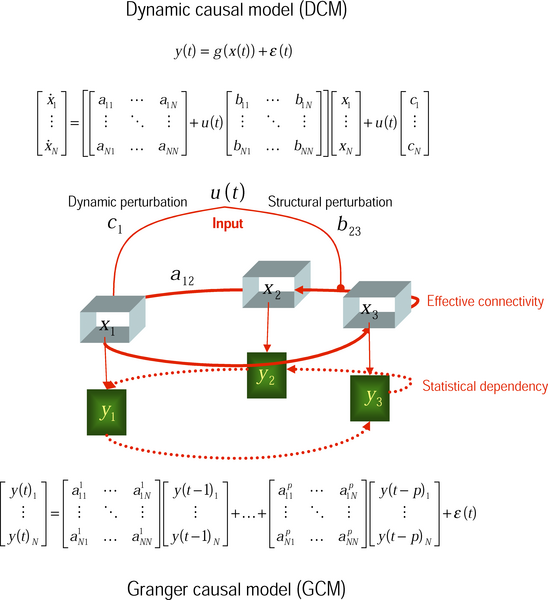
In metaphysics and statistics, a causal model (also called a structural causal model) is a conceptual model that represents the causal mechanisms of a system.[page needed] Causal models often employ formal causal notation, such as structural equation modeling or causal directed acyclic graphs (DAGs), to describe relationships among variables and to guide inference.
By clarifying which variables should be included, excluded, or controlled for, causal models can improve the design of empirical studies and the interpretation of results. They can also enable researchers to answer some causal questions using observational data, reducing the need for interventional studies such as randomized controlled trials.
In cases where randomized experiments are impractical or unethical—for example, when studying the effects of environmental exposures or social determinants of health—causal models provide a framework for drawing valid conclusions from non-experimental data.
Causal models can help with the question of external validity (whether results from one study apply to unstudied populations). Causal models can allow data from multiple studies to be merged (in certain circumstances) to answer questions that cannot be answered by any individual data set.
Causal models have found applications in signal processing, epidemiology, machine learning, cultural studies, and urbanism, and they can describe both linear and nonlinear processes.
Causal models are mathematical models representing causal relationships within an individual system or population. They facilitate inferences about causal relationships from statistical data. They can teach us a good deal about the epistemology of causation, and about the relationship between causation and probability. They have also been applied to topics of interest to philosophers, such as the logic of counterfactuals, decision theory, and the analysis of actual causation.
— Stanford Encyclopedia of Philosophy
Judea Pearl defines a causal model as an ordered triple , where U is a set of exogenous variables whose values are determined by factors outside the model; V is a set of endogenous variables whose values are determined by factors within the model; and E is a set of structural equations that express the value of each endogenous variable as a function of the values of the other variables in U and V.

Hub AI
Causal model AI simulator
(@Causal model_simulator)
Causal model
In metaphysics and statistics, a causal model (also called a structural causal model) is a conceptual model that represents the causal mechanisms of a system.[page needed] Causal models often employ formal causal notation, such as structural equation modeling or causal directed acyclic graphs (DAGs), to describe relationships among variables and to guide inference.
By clarifying which variables should be included, excluded, or controlled for, causal models can improve the design of empirical studies and the interpretation of results. They can also enable researchers to answer some causal questions using observational data, reducing the need for interventional studies such as randomized controlled trials.
In cases where randomized experiments are impractical or unethical—for example, when studying the effects of environmental exposures or social determinants of health—causal models provide a framework for drawing valid conclusions from non-experimental data.
Causal models can help with the question of external validity (whether results from one study apply to unstudied populations). Causal models can allow data from multiple studies to be merged (in certain circumstances) to answer questions that cannot be answered by any individual data set.
Causal models have found applications in signal processing, epidemiology, machine learning, cultural studies, and urbanism, and they can describe both linear and nonlinear processes.
Causal models are mathematical models representing causal relationships within an individual system or population. They facilitate inferences about causal relationships from statistical data. They can teach us a good deal about the epistemology of causation, and about the relationship between causation and probability. They have also been applied to topics of interest to philosophers, such as the logic of counterfactuals, decision theory, and the analysis of actual causation.
— Stanford Encyclopedia of Philosophy
Judea Pearl defines a causal model as an ordered triple , where U is a set of exogenous variables whose values are determined by factors outside the model; V is a set of endogenous variables whose values are determined by factors within the model; and E is a set of structural equations that express the value of each endogenous variable as a function of the values of the other variables in U and V.
Recent media