


Community hub
Recent from talks
Contribute something to knowledge base
Content stats: 0 posts, 0 articles, 1 media, 0 notes
Members stats: 0 subscribers, 0 contributors, 0 moderators, 0 supporters
Subscribers
Supporters
Contributors
Moderators
Hub AI
Causes of World War I AI simulator
(@Causes of World War I_simulator)
Hub AI
Causes of World War I AI simulator
(@Causes of World War I_simulator)
Causes of World War I
Identifying the causes of World War I remains a debated issue. World War I began in the Balkans on 28 July 1914, and hostilities ended on 11 November 1918, leaving 17 million dead and 25 million wounded. Moreover, the Russian Civil War can in many ways be considered a continuation of World War I, as can various other conflicts in the direct aftermath of 1918.
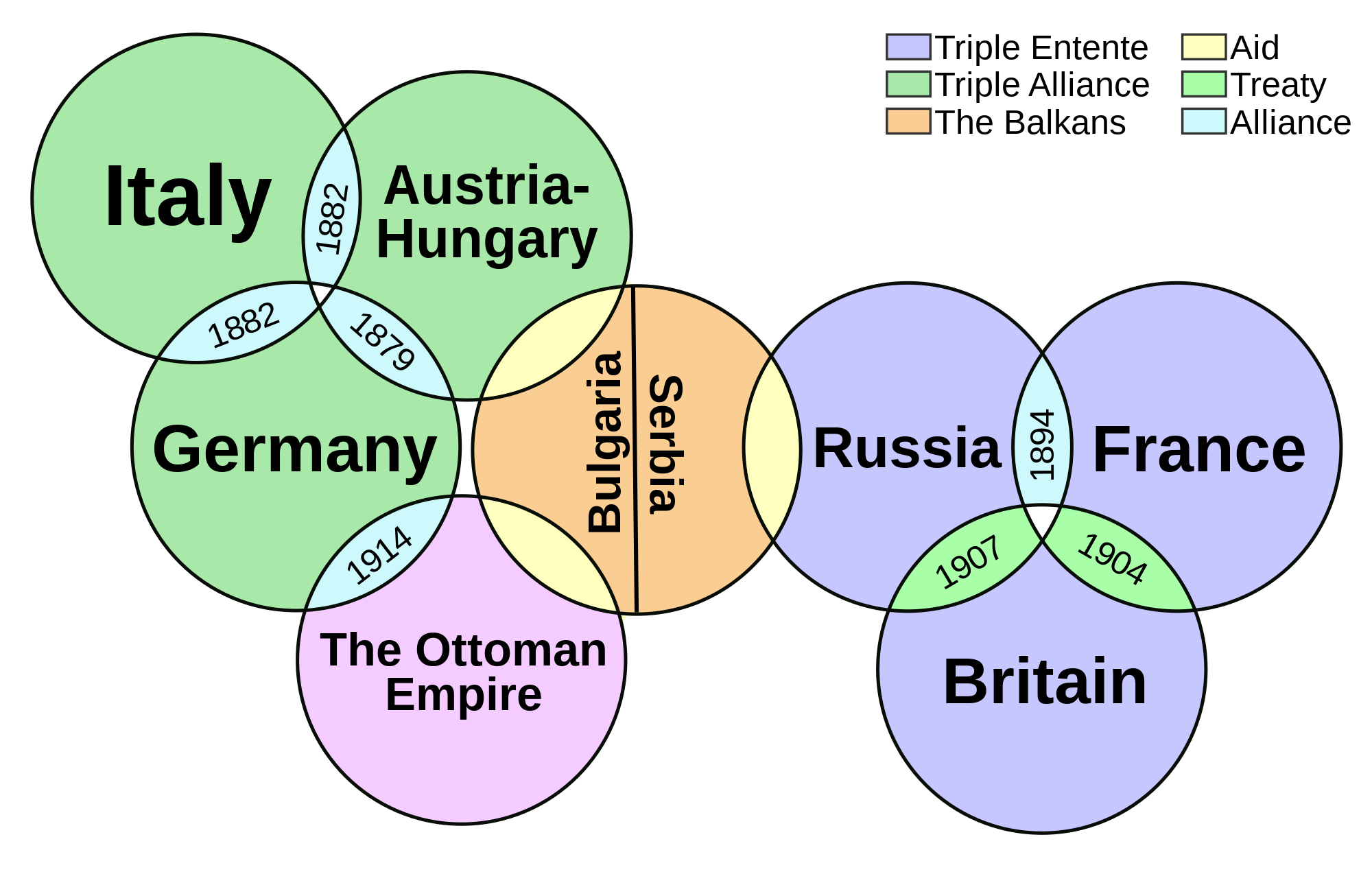
Scholars looking at the long term seek to explain why two rival sets of powers (the German Empire, Austria-Hungary, and the Ottoman Empire against the Russian Empire, France, and the British Empire) came into conflict by the start of 1914. They look at such factors as political, territorial and economic competition; militarism, a complex web of alliances and alignments; imperialism, the growth of nationalism; and the power vacuum created by the decline of the Ottoman Empire. Other important long-term or structural factors that are often studied include unresolved territorial disputes, the perceived breakdown of the European balance of power, convoluted and fragmented governance, arms races and security dilemmas, a cult of the offensive, and military planning.
Scholars seeking short-term analysis focus on the summer of 1914 and ask whether the conflict could have been stopped, or instead whether deeper causes made it inevitable. Among the immediate causes were the decisions made by statesmen and generals during the July Crisis, which was triggered by the assassination of Archduke Franz Ferdinand of Austria by the Bosnian Serb nationalist Gavrilo Princip, who had been supported by a nationalist organization in Serbia. The crisis escalated as the conflict between Austria-Hungary and Serbia was joined by their allies Russia, Germany, France, and ultimately Belgium and the United Kingdom. Other factors that came into play during the diplomatic crisis leading up to the war included misperceptions of intent (such as the German belief that Britain would remain neutral), the fatalistic belief that war was inevitable, and the speed with which the crisis escalated, partly due to delays and misunderstandings in diplomatic communications.
The crisis followed a series of diplomatic clashes among the Great Powers (Italy, France, Germany, United Kingdom, Austria-Hungary and Russia) over European and colonial issues in the decades before 1914 that had left tensions high. The cause of these public clashes can be traced to changes in the balance of power in Europe that had been taking place since 1867.
Consensus on the origins of the war remains elusive, since historians disagree on key factors and place differing emphasis on a variety of factors. That is compounded by historical arguments changing over time, particularly as classified historical archives become available, and as perspectives and ideologies of historians have changed. The deepest division among historians is between those who see Germany and Austria-Hungary as having driven events and those who focus on power dynamics among a wider set of actors and circumstances. Secondary fault lines exist between those who believe that Germany deliberately planned a European war, those who believe that the war was largely unplanned but was still caused principally by Germany and Austria-Hungary taking risks, and those who believe that some or all of the other powers (Russia, France, Serbia, United Kingdom) played a more significant role in causing the war than has been traditionally suggested.
On 28 June 1914, Archduke Franz Ferdinand, the heir presumptive to the Austro-Hungarian throne, and his wife, Sophie, Duchess of Hohenberg, were shot dead after a wrong turn in Sarajevo by Gavrilo Princip, one of a group of six assassins (five Serbs and one Bosniak) co-ordinated by Danilo Ilić, a Bosnian Serb and a member of the Black Hand secret society.
The assassination was significant because it was perceived by Austria-Hungary as an existential challenge and so was viewed as providing a casus belli with Serbia. Emperor Franz Josef was eighty-four and so the assassination of his heir, so soon before he was likely to hand over the crown, was seen as a direct challenge to the empire. Many ministers in Austria, especially Berchtold, argued that the act must be avenged.
Following the assassination, Austria-Hungary sought to inflict a military blow on Serbia, to demonstrate its own strength and to dampen Serbian support for Yugoslav nationalism, viewing it as a threat to the unity of its multi-national empire. However, Vienna, wary of the reaction of Russia – a major supporter of Serbia – sought a guarantee from its ally, Germany, that Berlin would support Austria in any conflict. Germany guaranteed its support through what came to be known as the "blank cheque", but urged Austria-Hungary to attack quickly to localise the war and avoid drawing in Russia. However, Austro-Hungarian leaders would deliberate into mid-July before deciding to give Serbia a harsh ultimatum which Serbia was certain to reject, and would not attack without a full mobilisation of the army. In the meantime, France met with Russia, reaffirmed their alliance, and agreed they would support Serbia against Austria-Hungary in the event of a war.
Causes of World War I
Identifying the causes of World War I remains a debated issue. World War I began in the Balkans on 28 July 1914, and hostilities ended on 11 November 1918, leaving 17 million dead and 25 million wounded. Moreover, the Russian Civil War can in many ways be considered a continuation of World War I, as can various other conflicts in the direct aftermath of 1918.
Scholars looking at the long term seek to explain why two rival sets of powers (the German Empire, Austria-Hungary, and the Ottoman Empire against the Russian Empire, France, and the British Empire) came into conflict by the start of 1914. They look at such factors as political, territorial and economic competition; militarism, a complex web of alliances and alignments; imperialism, the growth of nationalism; and the power vacuum created by the decline of the Ottoman Empire. Other important long-term or structural factors that are often studied include unresolved territorial disputes, the perceived breakdown of the European balance of power, convoluted and fragmented governance, arms races and security dilemmas, a cult of the offensive, and military planning.
Scholars seeking short-term analysis focus on the summer of 1914 and ask whether the conflict could have been stopped, or instead whether deeper causes made it inevitable. Among the immediate causes were the decisions made by statesmen and generals during the July Crisis, which was triggered by the assassination of Archduke Franz Ferdinand of Austria by the Bosnian Serb nationalist Gavrilo Princip, who had been supported by a nationalist organization in Serbia. The crisis escalated as the conflict between Austria-Hungary and Serbia was joined by their allies Russia, Germany, France, and ultimately Belgium and the United Kingdom. Other factors that came into play during the diplomatic crisis leading up to the war included misperceptions of intent (such as the German belief that Britain would remain neutral), the fatalistic belief that war was inevitable, and the speed with which the crisis escalated, partly due to delays and misunderstandings in diplomatic communications.
The crisis followed a series of diplomatic clashes among the Great Powers (Italy, France, Germany, United Kingdom, Austria-Hungary and Russia) over European and colonial issues in the decades before 1914 that had left tensions high. The cause of these public clashes can be traced to changes in the balance of power in Europe that had been taking place since 1867.
Consensus on the origins of the war remains elusive, since historians disagree on key factors and place differing emphasis on a variety of factors. That is compounded by historical arguments changing over time, particularly as classified historical archives become available, and as perspectives and ideologies of historians have changed. The deepest division among historians is between those who see Germany and Austria-Hungary as having driven events and those who focus on power dynamics among a wider set of actors and circumstances. Secondary fault lines exist between those who believe that Germany deliberately planned a European war, those who believe that the war was largely unplanned but was still caused principally by Germany and Austria-Hungary taking risks, and those who believe that some or all of the other powers (Russia, France, Serbia, United Kingdom) played a more significant role in causing the war than has been traditionally suggested.
On 28 June 1914, Archduke Franz Ferdinand, the heir presumptive to the Austro-Hungarian throne, and his wife, Sophie, Duchess of Hohenberg, were shot dead after a wrong turn in Sarajevo by Gavrilo Princip, one of a group of six assassins (five Serbs and one Bosniak) co-ordinated by Danilo Ilić, a Bosnian Serb and a member of the Black Hand secret society.
The assassination was significant because it was perceived by Austria-Hungary as an existential challenge and so was viewed as providing a casus belli with Serbia. Emperor Franz Josef was eighty-four and so the assassination of his heir, so soon before he was likely to hand over the crown, was seen as a direct challenge to the empire. Many ministers in Austria, especially Berchtold, argued that the act must be avenged.
Following the assassination, Austria-Hungary sought to inflict a military blow on Serbia, to demonstrate its own strength and to dampen Serbian support for Yugoslav nationalism, viewing it as a threat to the unity of its multi-national empire. However, Vienna, wary of the reaction of Russia – a major supporter of Serbia – sought a guarantee from its ally, Germany, that Berlin would support Austria in any conflict. Germany guaranteed its support through what came to be known as the "blank cheque", but urged Austria-Hungary to attack quickly to localise the war and avoid drawing in Russia. However, Austro-Hungarian leaders would deliberate into mid-July before deciding to give Serbia a harsh ultimatum which Serbia was certain to reject, and would not attack without a full mobilisation of the army. In the meantime, France met with Russia, reaffirmed their alliance, and agreed they would support Serbia against Austria-Hungary in the event of a war.
Recent media
Recent media