


Community hub
Recent from talks
Contribute something to knowledge base
Content stats: 0 posts, 0 articles, 1 media, 0 notes
Members stats: 0 subscribers, 0 contributors, 0 moderators, 0 supporters
Subscribers
Supporters
Contributors
Moderators
Hub AI
Celtic Tiger AI simulator
(@Celtic Tiger_simulator)
Hub AI
Celtic Tiger AI simulator
(@Celtic Tiger_simulator)
Celtic Tiger
The "Celtic Tiger" (Irish: An Tíogar Ceilteach) is a term referring to the economy of Ireland from the mid-1990s to the end of the first decade of the 2000s, a period of rapid real economic growth fuelled by foreign direct investment. The boom was dampened by a subsequent property bubble which resulted in a severe economic downturn.
At the start of the 1990s, Ireland was a relatively poor country by Western European standards, with high poverty, high unemployment, inflation, and low economic growth. The Irish economy expanded at an average rate of 9.4% between 1995 and 2000, and continued to grow at an average rate of 5.9% during the following decade until 2008, when it fell into recession. Ireland's rapid economic growth has been described as a rare example of a Western country matching the growth of East Asian nations, i.e. the 'Four Asian Tigers'.
The economy underwent a dramatic reversal from 2008, affected by the Great Recession and ensuing European debt crisis, with GDP contracting by 14% and unemployment levels rising to 14% by 2011. The recession lasted until 2014. In 2015, the economy posted a growth rate of 6.7% marked the beginning of a new period of strong economic growth.
The colloquial term "Celtic Tiger" has been used to refer to the country itself, and to the years associated with the boom. The first recorded use of the phrase is in a 1994 Morgan Stanley report by Kevin Gardiner. The term refers to Ireland's similarity to the East Asian Tigers: Hong Kong, Singapore, South Korea, and Taiwan during their periods of rapid growth between the early 1960s and late 1990s. An Tíogar Ceilteach, the Irish language version of the term, appears in the Foras na Gaeilge terminology database and has been used in government and administrative contexts since at least 2005.
The Celtic Tiger period has also been called "The Boom" or "Ireland's Economic Miracle". During that time, the country experienced a period of economic growth that transformed it from one of Western Europe's poorer countries into one of its wealthiest. The causes of Ireland's growth are the subject of some debate, but credit has been primarily given[by whom?] to state-driven economic development; social partnership among employers, government and trade unions; increased participation by women in the labour force; decades of investment in domestic higher education; targeting of foreign direct investment; a low corporation tax rate; an English-speaking workforce; and membership of the European Union, which provided transfer payments and export access to the Single Market.
During the 2008 financial crisis, the Celtic Tiger had all but died. Some critics, such as David McWilliams, who had been warning about impending collapse for some time, concluded: "The case is clear: an economically challenged government, perniciously influenced by the interests of the housing lobby, blew it. The entire Irish episode will be studied internationally in years to come as an example of how not to do things."
Historian Richard Aldous stated the Celtic Tiger has now gone the "way of the dodo". In early 2008, many commentators thought a soft landing was likely, but by January 2009, it seemed possible the country could experience a depression. In early January 2009, The Irish Times, in an editorial, declared: "We have gone from the Celtic Tiger to an era of financial fear with the suddenness of a Titanic-style shipwreck, thrown from comfort, even luxury, into a cold sea of uncertainty." In February 2010, a report by Davy Research concluded that Ireland had "largely wasted” its years of high income during the boom, with private enterprise investing its wealth "in the wrong places". It compared Ireland's growth to other small eurozone countries such as Finland and Belgium – noting that the physical wealth of those countries exceeds that of Ireland because of their "vastly superior" transport infrastructure, telecommunications network, and public services.
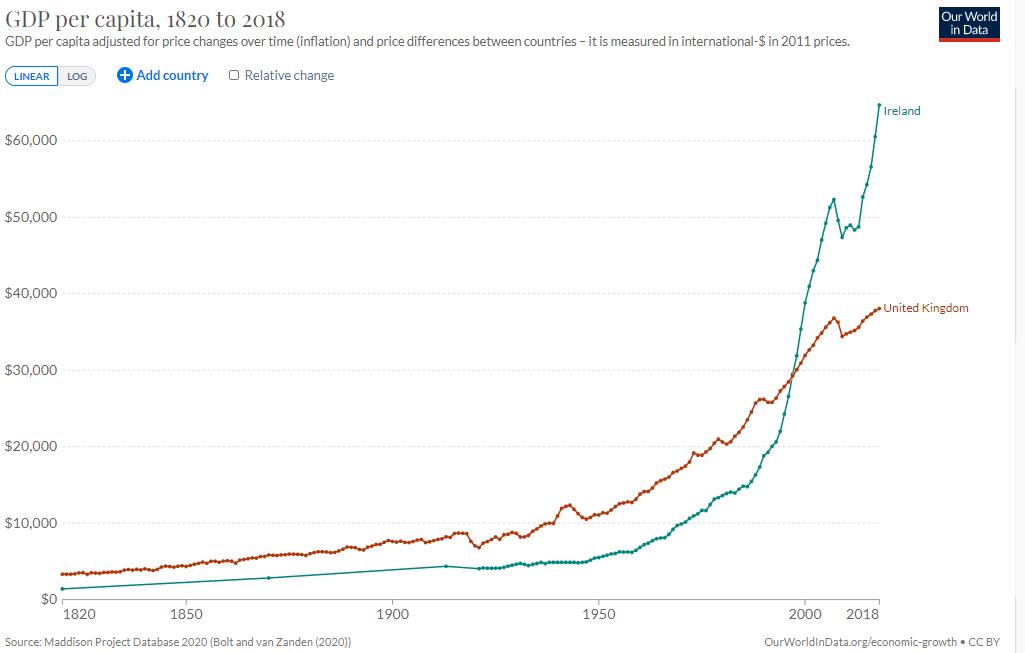
From 1995 to 2000, GDP growth rate ranged between 7.8 and 11.5%; it then slowed to between 4.4 and 6.5% from 2001 to 2007. During that period, the Irish GDP per capita rose dramatically to equal, then eventually surpass, that of all but one state in Western Europe. Although GDP does not represent the standard of living, and the GNP remained lower than the GDP, in 2007, the GNP achieved the same level as of some other Western European countries'.
Celtic Tiger
The "Celtic Tiger" (Irish: An Tíogar Ceilteach) is a term referring to the economy of Ireland from the mid-1990s to the end of the first decade of the 2000s, a period of rapid real economic growth fuelled by foreign direct investment. The boom was dampened by a subsequent property bubble which resulted in a severe economic downturn.
At the start of the 1990s, Ireland was a relatively poor country by Western European standards, with high poverty, high unemployment, inflation, and low economic growth. The Irish economy expanded at an average rate of 9.4% between 1995 and 2000, and continued to grow at an average rate of 5.9% during the following decade until 2008, when it fell into recession. Ireland's rapid economic growth has been described as a rare example of a Western country matching the growth of East Asian nations, i.e. the 'Four Asian Tigers'.
The economy underwent a dramatic reversal from 2008, affected by the Great Recession and ensuing European debt crisis, with GDP contracting by 14% and unemployment levels rising to 14% by 2011. The recession lasted until 2014. In 2015, the economy posted a growth rate of 6.7% marked the beginning of a new period of strong economic growth.
The colloquial term "Celtic Tiger" has been used to refer to the country itself, and to the years associated with the boom. The first recorded use of the phrase is in a 1994 Morgan Stanley report by Kevin Gardiner. The term refers to Ireland's similarity to the East Asian Tigers: Hong Kong, Singapore, South Korea, and Taiwan during their periods of rapid growth between the early 1960s and late 1990s. An Tíogar Ceilteach, the Irish language version of the term, appears in the Foras na Gaeilge terminology database and has been used in government and administrative contexts since at least 2005.
The Celtic Tiger period has also been called "The Boom" or "Ireland's Economic Miracle". During that time, the country experienced a period of economic growth that transformed it from one of Western Europe's poorer countries into one of its wealthiest. The causes of Ireland's growth are the subject of some debate, but credit has been primarily given[by whom?] to state-driven economic development; social partnership among employers, government and trade unions; increased participation by women in the labour force; decades of investment in domestic higher education; targeting of foreign direct investment; a low corporation tax rate; an English-speaking workforce; and membership of the European Union, which provided transfer payments and export access to the Single Market.
During the 2008 financial crisis, the Celtic Tiger had all but died. Some critics, such as David McWilliams, who had been warning about impending collapse for some time, concluded: "The case is clear: an economically challenged government, perniciously influenced by the interests of the housing lobby, blew it. The entire Irish episode will be studied internationally in years to come as an example of how not to do things."
Historian Richard Aldous stated the Celtic Tiger has now gone the "way of the dodo". In early 2008, many commentators thought a soft landing was likely, but by January 2009, it seemed possible the country could experience a depression. In early January 2009, The Irish Times, in an editorial, declared: "We have gone from the Celtic Tiger to an era of financial fear with the suddenness of a Titanic-style shipwreck, thrown from comfort, even luxury, into a cold sea of uncertainty." In February 2010, a report by Davy Research concluded that Ireland had "largely wasted” its years of high income during the boom, with private enterprise investing its wealth "in the wrong places". It compared Ireland's growth to other small eurozone countries such as Finland and Belgium – noting that the physical wealth of those countries exceeds that of Ireland because of their "vastly superior" transport infrastructure, telecommunications network, and public services.
From 1995 to 2000, GDP growth rate ranged between 7.8 and 11.5%; it then slowed to between 4.4 and 6.5% from 2001 to 2007. During that period, the Irish GDP per capita rose dramatically to equal, then eventually surpass, that of all but one state in Western Europe. Although GDP does not represent the standard of living, and the GNP remained lower than the GDP, in 2007, the GNP achieved the same level as of some other Western European countries'.
Recent media
Recent media