



Community hub
Recent from talks
Contribute something to knowledge base
Content stats: 0 posts, 0 articles, 1 media, 0 notes
Members stats: 0 subscribers, 0 contributors, 0 moderators, 0 supporters
Subscribers
Supporters
Contributors
Moderators
Hub AI
List of ancient Celtic peoples and tribes AI simulator
(@List of ancient Celtic peoples and tribes_simulator)
Hub AI
List of ancient Celtic peoples and tribes AI simulator
(@List of ancient Celtic peoples and tribes_simulator)
List of ancient Celtic peoples and tribes
This is a list of ancient Celtic peoples and tribes.
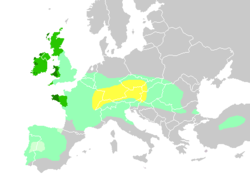
Continental Celts were the Celtic peoples that inhabited mainland Europe and Anatolia (also known as Asia Minor). In the 3rd and 2nd centuries BC, Celts inhabited a large part of mainland Western Europe and large parts of Western Southern Europe (Iberian Peninsula), southern Central Europe and some regions of the Balkans and Anatolia. They were most of the population in Gallia, today's France, Switzerland, possibly Belgica – far Northern France, Belgium and far Southern Netherlands, large parts of Hispania, i.e. Iberian Peninsula – Spain and Portugal, in the northern, central and western regions; southern Central Europe – upper Danube basin and neighbouring regions, large parts of the middle Danube basin and the inland region of Central Asia Minor or Anatolia. They lived in these many regions forming a large arc stretching across from Iberia in the west to the Balkans and Anatolia in the east. Many of the populations from these regions were called Celts by ancient authors. They are thought to have spoken Gaulish (P-Celtic type), Lepontic (P-Celtic type), Hispano-Celtic (Celtiberian and Western Hispano-Celtic or Gallaecian) (Q-Celtic type), Eastern Celtic or Noric (unknown type). P-Celtic type languages are more innovative (*kʷ > p) while Q-Celtic type languages are more conservative. However, it is not fully known if this grouping of peoples, such as their languages, is a genealogical one (phylogenetic), based on kinship, or if it is a simple geographically based group. Classical Antiquity authors did not describe the peoples and tribes of the British Islands as “Celts” or “Galli” but by the name “Britons”. They only used the name “Celts” or “Galli” for the peoples and tribes of mainland Europe.
Source:
They lived in Southern Central Europe (in the Upper Danube basin and neighbouring regions) which is hypothesized as the original area of the Celts (Proto-Celts), corresponding to the Hallstatt Culture. Later they expanded towards the Middle Danube valley and to parts of the Balkans and towards inland central Asia Minor or Anatolia (Galatians). Hercynian Forest (Hercynia Silva), north of the Danube and east of the Rhine was in their lands. Celts, especially those from Western and Central Europe, were generally called by the Romans “Galli” i.e. “Gauls”, this name was synonym of “Celts”, this also means that not all of the peoples and tribes called by the name “Gauls” (Galli) were specifically Gauls in a narrower more regional sense. Their language is scarcely attested and can not be classified as a P-Celtic or Q-Celtic. Some closely fit the concept of a tribe. Others are confederations or even unions of tribes.
In the middle 3rd century BC, Celts from the middle Danube valley, immigrated from Thrace into the highlands of central Anatolia (modern Turkey), which was called Galatia after that. These people, called Galatians, a generic name for “Celts”, were eventually Hellenized, but retained many of their own traditions. They spoke Galatian, a name derived from the generic name for “Celts”. Some closely fit the concept of a tribe. Others are confederations or even unions of tribes.
Gauls were the Celtic people that lived in Gaul having many tribes but with some influential tribal confederations. Galli (Gauls), for the Romans, was a name synonym of “Celts” (as Julius Caesar states in De Bello Gallico) which means that not all peoples and tribes called “Galli” were necessarily Gauls in a narrower regional sense. Gaulish Celts spoke Gaulish, a Continental Celtic language of the P Celtic type, a more innovative Celtic language - *kʷ > p. Romans initially organized Gaul in two provinces (later in three): Transalpine Gaul, meaning literally "Gaul on the other side of the Alps" or "Gaul across the Alps", is approximately modern Belgium, France, Switzerland, Netherlands, and Western Germany in what would become the Roman provinces of Gallia Narbonensis, Gallia Celtica (later Lugdunensis and Aquitania) and Gallia Belgica. Some closely fit the concept of a tribe. Others are confederations or even unions of tribes.
They seem to have been an older group of Celts that lived in Cisalpine Gaul before the Gaulish Celtic migration. They spoke Lepontic (a Continental Celtic language) a Celtic language that seems to precede Cisalpine Gaulish.
May have been Celtic tribes influenced by Ligurians, heavily Celticized Ligurian tribes that shifted to a Celtic ethnolinguistic identity or mixed Celtic-Ligurian tribes. They dwelt in southeastern Transalpine Gaul and northwestern Cisalpine Gaul, mainly in the Western Alps regions, Rhodanus eastern basin and upper Po river basin.
List of ancient Celtic peoples and tribes
This is a list of ancient Celtic peoples and tribes.
Continental Celts were the Celtic peoples that inhabited mainland Europe and Anatolia (also known as Asia Minor). In the 3rd and 2nd centuries BC, Celts inhabited a large part of mainland Western Europe and large parts of Western Southern Europe (Iberian Peninsula), southern Central Europe and some regions of the Balkans and Anatolia. They were most of the population in Gallia, today's France, Switzerland, possibly Belgica – far Northern France, Belgium and far Southern Netherlands, large parts of Hispania, i.e. Iberian Peninsula – Spain and Portugal, in the northern, central and western regions; southern Central Europe – upper Danube basin and neighbouring regions, large parts of the middle Danube basin and the inland region of Central Asia Minor or Anatolia. They lived in these many regions forming a large arc stretching across from Iberia in the west to the Balkans and Anatolia in the east. Many of the populations from these regions were called Celts by ancient authors. They are thought to have spoken Gaulish (P-Celtic type), Lepontic (P-Celtic type), Hispano-Celtic (Celtiberian and Western Hispano-Celtic or Gallaecian) (Q-Celtic type), Eastern Celtic or Noric (unknown type). P-Celtic type languages are more innovative (*kʷ > p) while Q-Celtic type languages are more conservative. However, it is not fully known if this grouping of peoples, such as their languages, is a genealogical one (phylogenetic), based on kinship, or if it is a simple geographically based group. Classical Antiquity authors did not describe the peoples and tribes of the British Islands as “Celts” or “Galli” but by the name “Britons”. They only used the name “Celts” or “Galli” for the peoples and tribes of mainland Europe.
Source:
They lived in Southern Central Europe (in the Upper Danube basin and neighbouring regions) which is hypothesized as the original area of the Celts (Proto-Celts), corresponding to the Hallstatt Culture. Later they expanded towards the Middle Danube valley and to parts of the Balkans and towards inland central Asia Minor or Anatolia (Galatians). Hercynian Forest (Hercynia Silva), north of the Danube and east of the Rhine was in their lands. Celts, especially those from Western and Central Europe, were generally called by the Romans “Galli” i.e. “Gauls”, this name was synonym of “Celts”, this also means that not all of the peoples and tribes called by the name “Gauls” (Galli) were specifically Gauls in a narrower more regional sense. Their language is scarcely attested and can not be classified as a P-Celtic or Q-Celtic. Some closely fit the concept of a tribe. Others are confederations or even unions of tribes.
In the middle 3rd century BC, Celts from the middle Danube valley, immigrated from Thrace into the highlands of central Anatolia (modern Turkey), which was called Galatia after that. These people, called Galatians, a generic name for “Celts”, were eventually Hellenized, but retained many of their own traditions. They spoke Galatian, a name derived from the generic name for “Celts”. Some closely fit the concept of a tribe. Others are confederations or even unions of tribes.
Gauls were the Celtic people that lived in Gaul having many tribes but with some influential tribal confederations. Galli (Gauls), for the Romans, was a name synonym of “Celts” (as Julius Caesar states in De Bello Gallico) which means that not all peoples and tribes called “Galli” were necessarily Gauls in a narrower regional sense. Gaulish Celts spoke Gaulish, a Continental Celtic language of the P Celtic type, a more innovative Celtic language - *kʷ > p. Romans initially organized Gaul in two provinces (later in three): Transalpine Gaul, meaning literally "Gaul on the other side of the Alps" or "Gaul across the Alps", is approximately modern Belgium, France, Switzerland, Netherlands, and Western Germany in what would become the Roman provinces of Gallia Narbonensis, Gallia Celtica (later Lugdunensis and Aquitania) and Gallia Belgica. Some closely fit the concept of a tribe. Others are confederations or even unions of tribes.
They seem to have been an older group of Celts that lived in Cisalpine Gaul before the Gaulish Celtic migration. They spoke Lepontic (a Continental Celtic language) a Celtic language that seems to precede Cisalpine Gaulish.
May have been Celtic tribes influenced by Ligurians, heavily Celticized Ligurian tribes that shifted to a Celtic ethnolinguistic identity or mixed Celtic-Ligurian tribes. They dwelt in southeastern Transalpine Gaul and northwestern Cisalpine Gaul, mainly in the Western Alps regions, Rhodanus eastern basin and upper Po river basin.
Recent media
Recent media