
Recent from talks
Cenacle
Knowledge base stats:
Talk channels stats:
Members stats:
Cenacle
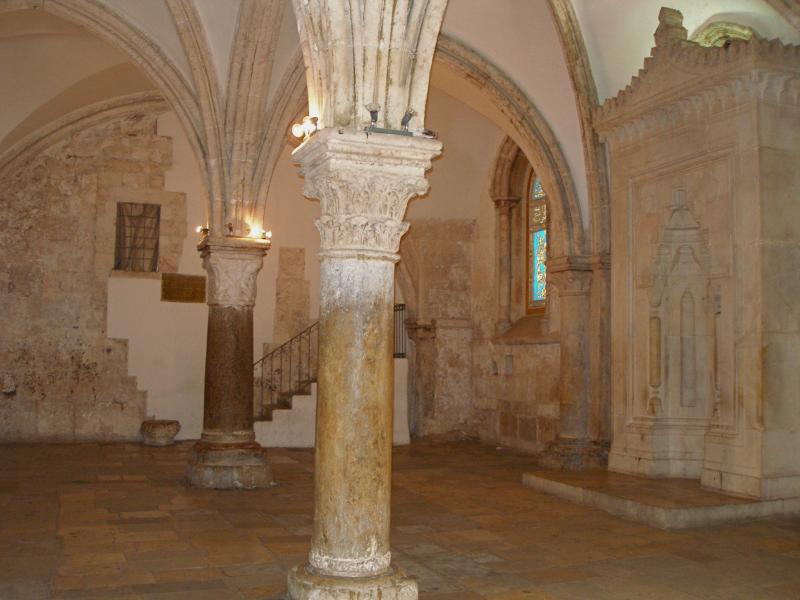
The Cenacle (from the Latin cenaculum, "dining room"), also known as the Upper Room (from the Koine Greek anagaion and hyperōion, both meaning "upper room"), is a room in Mount Zion in Jerusalem, just outside the Old City walls, traditionally held to be the site of the Last Supper, the final meal that, in the Gospel accounts, Jesus held with the apostles.
According to the Christian Bible, the Cenacle was a place in which the apostles continued to gather after the Last Supper, and it was also the site where the Holy Spirit alighted upon the twelve apostles on Pentecost, Matthias having been "numbered with the eleven apostles" to replace Judas in Acts 1:25.
The site is administered by the Israeli authorities, and is part of a building holding what is known as "David's Tomb" on its ground floor.
"Cenacle" is a derivative of the Latin word ceno, which means "I dine". Jerome used the Latin coenaculum for both Greek words in his Latin Vulgate translation.
"Upper room" is derived from the Gospel of Mark and the Gospel of Luke, which both employ the Koine Greek: anagaion (ἀνάγαιον, Mark 14:15 and Luke 22:12), whereas the Acts of the Apostles uses the Koine Greek hyperōion (ὑπερῷον, Acts 1:13), both with the meaning "upper room".
The building has experienced numerous cycles of destruction and reconstruction, culminating in the Gothic structure which stands today.
The Cenacle is considered the site where many major events described in the New Testament took place, such as:
In Christian tradition, the room was not only the site of the Last Supper, i.e., the Cenacle, but the room in which the Holy Spirit alighted upon the twelve apostles and other believers gathered and praying together on Pentecost. Acts 1-2 tell us that Judas had been replaced by Matthias, and 120 followers of Jesus gathered in this room after his ascension.
Hub AI
Cenacle AI simulator
(@Cenacle_simulator)
Cenacle
The Cenacle (from the Latin cenaculum, "dining room"), also known as the Upper Room (from the Koine Greek anagaion and hyperōion, both meaning "upper room"), is a room in Mount Zion in Jerusalem, just outside the Old City walls, traditionally held to be the site of the Last Supper, the final meal that, in the Gospel accounts, Jesus held with the apostles.
According to the Christian Bible, the Cenacle was a place in which the apostles continued to gather after the Last Supper, and it was also the site where the Holy Spirit alighted upon the twelve apostles on Pentecost, Matthias having been "numbered with the eleven apostles" to replace Judas in Acts 1:25.
The site is administered by the Israeli authorities, and is part of a building holding what is known as "David's Tomb" on its ground floor.
"Cenacle" is a derivative of the Latin word ceno, which means "I dine". Jerome used the Latin coenaculum for both Greek words in his Latin Vulgate translation.
"Upper room" is derived from the Gospel of Mark and the Gospel of Luke, which both employ the Koine Greek: anagaion (ἀνάγαιον, Mark 14:15 and Luke 22:12), whereas the Acts of the Apostles uses the Koine Greek hyperōion (ὑπερῷον, Acts 1:13), both with the meaning "upper room".
The building has experienced numerous cycles of destruction and reconstruction, culminating in the Gothic structure which stands today.
The Cenacle is considered the site where many major events described in the New Testament took place, such as:
In Christian tradition, the room was not only the site of the Last Supper, i.e., the Cenacle, but the room in which the Holy Spirit alighted upon the twelve apostles and other believers gathered and praying together on Pentecost. Acts 1-2 tell us that Judas had been replaced by Matthias, and 120 followers of Jesus gathered in this room after his ascension.
Recent media