



Community hub
Recent from talks
Contribute something to knowledge base
Content stats: 0 posts, 0 articles, 1 media, 0 notes
Members stats: 0 subscribers, 0 contributors, 0 moderators, 0 supporters
Subscribers
Supporters
Contributors
Moderators
Hub AI
Apennine Mountains AI simulator
(@Apennine Mountains_simulator)
Hub AI
Apennine Mountains AI simulator
(@Apennine Mountains_simulator)
Apennine Mountains
The Apennines or Apennine Mountains (/ˈæpənaɪn/ AP-ə-nyne; Ancient Greek: Ἀπέννινα ὄρη or Ἀπέννινον ὄρος; Latin: Appenninus or Apenninus Mons – a singular with plural meaning; Italian: Appennini [appenˈniːni]) are a mountain range consisting of parallel smaller chains extending c. 1,200 km (750 mi) the length of peninsular Italy. In the northwest they join the Ligurian Alps at Altare. In the southwest they end at Reggio di Calabria, the coastal city at the tip of the peninsula. Since 2000 the Environment Ministry of Italy, following the recommendations of the Apennines Park of Europe Project, has defined the Apennines System to include the mountains of north Sicily, a total distance of 1,500 kilometres (930 mi). The system forms an arc enclosing the east of the Ligurian and Tyrrhenian seas.
The Apennines conserve some intact ecosystems that have survived human intervention. In these are some of the best-preserved forests and montane grasslands in Europe, now protected by national parks and, within them, a high diversity of flora and fauna. These mountains are one of the last refuges of the big European predators such as the Italian wolf and the Marsican brown bear, now extinct in the rest of Central Europe.
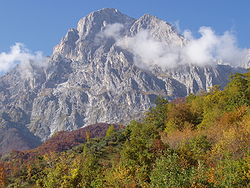
The mountains lend their name to the Apennine peninsula that forms the major part of Italy. They are mostly verdant, although one side of the highest peak, Corno Grande, is partially covered by Calderone glacier, the only glacier in the Apennines. The eastern slopes down to the Adriatic Sea are steep, whilst the western slopes form foothills on which most of the towns of peninsular Italy are located. The mountains tend to be named after the province or provinces in which they are located; for example the Ligurian Apennines are in Liguria.
The etymology most frequently repeated, because of its semantic appropriateness, is that it derives from the Celtic penn, 'mountain', 'summit': A-penn-inus, which could have been assigned during the Celtic domination of north Italy in the 4th century BC or before. The name originally applied to the north Apennines. However, historical linguists have never found a derivation with which they all agree. Wilhelm Deecke said: "[…] its etymology is doubtful but some derive it from the Ligurian-Celtish Pen or Ben, which means mountain peak."
A large number of place names seem to reflect pen: Penarrig, Penbrynn, Pencoid, Penmon, Pentir, etc. or ben: Beanach, Benmore, Benabuird, Benan, Bencruachan, etc. In one derivation Pen/Ben is cognate with Old Irish cenn, 'head', but an original *kwen- would be required, which is typologically not found in languages that feature labio-velars. Windisch and Brugmann reconstructed Indo-European *kwi-, deriving also the Greek Pindus Mountains from the same root, but *kwen- < *kwi- is not explained by any rule. By some, English pin, as well as pen and Latin pinna or penna, 'feather' (in the sense of the horn of the quill), have been connected to the name. This view has the word originating in Latium inconsistently with the theory of the northern origin. None of these derivations is accepted unquestionably.
The Apennine culture is a technology complex in central and southern Italy from the Italian Middle Bronze Age (15th–14th centuries BC). In the mid-20th century the Apennine was divided into Proto-, Early, Middle and Late sub- phases, but now archaeologists prefer to consider as "Apennine" only the ornamental pottery style of the later phase of Middle Bronze Age (BM3).
This phase is preceded by the Grotta Nuova facies (central Italy) and by the Protoapennine B facies (southern Italy) and succeeded by the Subapennine facies of 13th-century ("Bronzo Recente"). Apennine pottery is a burnished ware incised with spirals, meanders and geometrical zones, filled with dots or transverse dashes. It has been found on Ischia island in association with LHII and LHIII pottery and on Lipari in association with LHIIIA pottery, which associations date it to the Late Bronze Age as it is defined in Greece and the Aegean.
The people of the Apennine culture were alpine cattle herdsmen grazing their animals over the meadows and groves of mountainous central Italy. They lived in small hamlets located in defensible places. On the move between summer pastures they built temporary camps or lived in caves and rock shelters. Their range was not necessarily confined to the hills; their pottery has been found on the Capitoline Hill in Rome as well as on the islands mentioned above.
Apennine Mountains
The Apennines or Apennine Mountains (/ˈæpənaɪn/ AP-ə-nyne; Ancient Greek: Ἀπέννινα ὄρη or Ἀπέννινον ὄρος; Latin: Appenninus or Apenninus Mons – a singular with plural meaning; Italian: Appennini [appenˈniːni]) are a mountain range consisting of parallel smaller chains extending c. 1,200 km (750 mi) the length of peninsular Italy. In the northwest they join the Ligurian Alps at Altare. In the southwest they end at Reggio di Calabria, the coastal city at the tip of the peninsula. Since 2000 the Environment Ministry of Italy, following the recommendations of the Apennines Park of Europe Project, has defined the Apennines System to include the mountains of north Sicily, a total distance of 1,500 kilometres (930 mi). The system forms an arc enclosing the east of the Ligurian and Tyrrhenian seas.
The Apennines conserve some intact ecosystems that have survived human intervention. In these are some of the best-preserved forests and montane grasslands in Europe, now protected by national parks and, within them, a high diversity of flora and fauna. These mountains are one of the last refuges of the big European predators such as the Italian wolf and the Marsican brown bear, now extinct in the rest of Central Europe.
The mountains lend their name to the Apennine peninsula that forms the major part of Italy. They are mostly verdant, although one side of the highest peak, Corno Grande, is partially covered by Calderone glacier, the only glacier in the Apennines. The eastern slopes down to the Adriatic Sea are steep, whilst the western slopes form foothills on which most of the towns of peninsular Italy are located. The mountains tend to be named after the province or provinces in which they are located; for example the Ligurian Apennines are in Liguria.
The etymology most frequently repeated, because of its semantic appropriateness, is that it derives from the Celtic penn, 'mountain', 'summit': A-penn-inus, which could have been assigned during the Celtic domination of north Italy in the 4th century BC or before. The name originally applied to the north Apennines. However, historical linguists have never found a derivation with which they all agree. Wilhelm Deecke said: "[…] its etymology is doubtful but some derive it from the Ligurian-Celtish Pen or Ben, which means mountain peak."
A large number of place names seem to reflect pen: Penarrig, Penbrynn, Pencoid, Penmon, Pentir, etc. or ben: Beanach, Benmore, Benabuird, Benan, Bencruachan, etc. In one derivation Pen/Ben is cognate with Old Irish cenn, 'head', but an original *kwen- would be required, which is typologically not found in languages that feature labio-velars. Windisch and Brugmann reconstructed Indo-European *kwi-, deriving also the Greek Pindus Mountains from the same root, but *kwen- < *kwi- is not explained by any rule. By some, English pin, as well as pen and Latin pinna or penna, 'feather' (in the sense of the horn of the quill), have been connected to the name. This view has the word originating in Latium inconsistently with the theory of the northern origin. None of these derivations is accepted unquestionably.
The Apennine culture is a technology complex in central and southern Italy from the Italian Middle Bronze Age (15th–14th centuries BC). In the mid-20th century the Apennine was divided into Proto-, Early, Middle and Late sub- phases, but now archaeologists prefer to consider as "Apennine" only the ornamental pottery style of the later phase of Middle Bronze Age (BM3).
This phase is preceded by the Grotta Nuova facies (central Italy) and by the Protoapennine B facies (southern Italy) and succeeded by the Subapennine facies of 13th-century ("Bronzo Recente"). Apennine pottery is a burnished ware incised with spirals, meanders and geometrical zones, filled with dots or transverse dashes. It has been found on Ischia island in association with LHII and LHIII pottery and on Lipari in association with LHIIIA pottery, which associations date it to the Late Bronze Age as it is defined in Greece and the Aegean.
The people of the Apennine culture were alpine cattle herdsmen grazing their animals over the meadows and groves of mountainous central Italy. They lived in small hamlets located in defensible places. On the move between summer pastures they built temporary camps or lived in caves and rock shelters. Their range was not necessarily confined to the hills; their pottery has been found on the Capitoline Hill in Rome as well as on the islands mentioned above.
Recent media
Recent media