



Community hub
Recent from talks
Contribute something to knowledge base
Content stats: 0 posts, 0 articles, 1 media, 0 notes
Members stats: 0 subscribers, 0 contributors, 0 moderators, 0 supporters
Subscribers
Supporters
Contributors
Moderators
Hub AI
Marsican brown bear AI simulator
(@Marsican brown bear_simulator)
Hub AI
Marsican brown bear AI simulator
(@Marsican brown bear_simulator)
Marsican brown bear
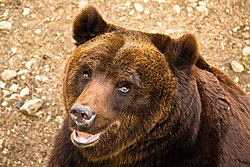
The Marsican brown bear (Ursus arctos arctos, formerly Ursus arctos marsicanus), also known as the Apennine brown bear, is a critically endangered population of the Eurasian brown bear, with a range restricted to the Parco Nazionale d'Abruzzo, Lazio e Molise, and the surrounding region in Italy. The Marsican brown bear differs slightly from other brown bears in its appearance and hibernation techniques. The bear's popular name is derived from Marsica, a historic area of the modern-day region of Abruzzo where the bear has long had a significant presence.
With their existence dwindling, the Italian government has recently begun to stress their conservation. The park has become a sanctuary dedicated to animals such as the Marsican brown bear, with hopes of rekindling the large, yet isolative bears' once-thriving existence. Debate exists as to whether it should be considered a subspecies or a taxon of its own.
The Marsican brown bear lives its life in isolation and their numbers are dwindling, with 50 bears remaining in the Parco Nazionale d'Abruzzo, Lazio e Molise. They have characteristics that differ from other brown bear subspecies. The Marsican brown bear, otherwise known as the Apennine brown bear, has a relatively calm temperament, with no aggression shown towards humans. In terms of size, the male Marsican brown bear is larger than most of the other brown bear subspecies, with a weight of around 217 kilograms (478 pounds), while the female is significantly smaller, at around 140 kilograms (310 pounds). These bears are known to be omnivorous in nature, mainly eating berries, while occasionally eating small animals such as chickens and other livestock. All of these traits the bear shows can likely be attributed to its existence in isolation. Baby Marsican brown bears tend to grow up fairly quickly. In a standing position, the Marsican brown bear can reach heights of up to two metres. Their large size, as well as noticeably different forepaws to their rear are characteristics that help distinguish their presence. The footprints, hair residue, colour of faeces, and claw marks the bears leave are special to their species. These large mammals have been spotted rolling rocks over in search of insects as well as reaching high into branches looking for berries, honey, etc. Their great sense of smell makes up for their mediocre eyesight when it comes to searching for food. A characteristic of the Marsican brown bear is that their winter hibernation is not made up of a single consecutive slumber. The bear wakes at times, which makes their official resurgence less lethargic.
Through the years, the Marsican brown bear became the symbol of the Parco Nazionale d'Abruzzo, Lazio e Molise and lent its name to pan dell'orso (bear bread) and other traditional regional foods. Thanks to its presence, ecotourism improved in the whole Abruzzi region, though conflicts with shepherds and honey farmers are still reported. In prehistoric times, hundreds of bears used to live in these mountains.[citation needed]
The Marsican brown bear's behaviour is relatively typical of any brown bear. These bears are mainly nocturnal, except when with their cubs, or mating, where they seem to be very independent and self-contained. Mating season for these bears is usually between May and July, landing birthing of the cubs in early winter. Around February every year females give birth anywhere from one to three cubs, weighing less than 500 grams (18 oz) at birth, but heavily relying on the size of their mother.
Marsican brown bear cubs grow up very quickly because of their mother's fat-induced milk they feed on, allowing them to roam on their own and be independent after only a few months of existence. On average, Marsican Brown Bear cubs stay with their mothers for a little over a year. As they grow older, females become fertile and sexually mature at around age three, allowing reproduction early in the mother's life.
These bears mature very quickly and develop a very good sense of hearing and smell, which helps them find food and roam their environment. In contrast, the eyesight of the Marsican brown bear is rather ordinary, or average.
As they start to grow, they turn to eating more of a plant-based diet including grass, fruit, berries, etc. Because they are omnivores, it is a common pattern seen with this specific subspecies of brown bears.
Marsican brown bear
The Marsican brown bear (Ursus arctos arctos, formerly Ursus arctos marsicanus), also known as the Apennine brown bear, is a critically endangered population of the Eurasian brown bear, with a range restricted to the Parco Nazionale d'Abruzzo, Lazio e Molise, and the surrounding region in Italy. The Marsican brown bear differs slightly from other brown bears in its appearance and hibernation techniques. The bear's popular name is derived from Marsica, a historic area of the modern-day region of Abruzzo where the bear has long had a significant presence.
With their existence dwindling, the Italian government has recently begun to stress their conservation. The park has become a sanctuary dedicated to animals such as the Marsican brown bear, with hopes of rekindling the large, yet isolative bears' once-thriving existence. Debate exists as to whether it should be considered a subspecies or a taxon of its own.
The Marsican brown bear lives its life in isolation and their numbers are dwindling, with 50 bears remaining in the Parco Nazionale d'Abruzzo, Lazio e Molise. They have characteristics that differ from other brown bear subspecies. The Marsican brown bear, otherwise known as the Apennine brown bear, has a relatively calm temperament, with no aggression shown towards humans. In terms of size, the male Marsican brown bear is larger than most of the other brown bear subspecies, with a weight of around 217 kilograms (478 pounds), while the female is significantly smaller, at around 140 kilograms (310 pounds). These bears are known to be omnivorous in nature, mainly eating berries, while occasionally eating small animals such as chickens and other livestock. All of these traits the bear shows can likely be attributed to its existence in isolation. Baby Marsican brown bears tend to grow up fairly quickly. In a standing position, the Marsican brown bear can reach heights of up to two metres. Their large size, as well as noticeably different forepaws to their rear are characteristics that help distinguish their presence. The footprints, hair residue, colour of faeces, and claw marks the bears leave are special to their species. These large mammals have been spotted rolling rocks over in search of insects as well as reaching high into branches looking for berries, honey, etc. Their great sense of smell makes up for their mediocre eyesight when it comes to searching for food. A characteristic of the Marsican brown bear is that their winter hibernation is not made up of a single consecutive slumber. The bear wakes at times, which makes their official resurgence less lethargic.
Through the years, the Marsican brown bear became the symbol of the Parco Nazionale d'Abruzzo, Lazio e Molise and lent its name to pan dell'orso (bear bread) and other traditional regional foods. Thanks to its presence, ecotourism improved in the whole Abruzzi region, though conflicts with shepherds and honey farmers are still reported. In prehistoric times, hundreds of bears used to live in these mountains.[citation needed]
The Marsican brown bear's behaviour is relatively typical of any brown bear. These bears are mainly nocturnal, except when with their cubs, or mating, where they seem to be very independent and self-contained. Mating season for these bears is usually between May and July, landing birthing of the cubs in early winter. Around February every year females give birth anywhere from one to three cubs, weighing less than 500 grams (18 oz) at birth, but heavily relying on the size of their mother.
Marsican brown bear cubs grow up very quickly because of their mother's fat-induced milk they feed on, allowing them to roam on their own and be independent after only a few months of existence. On average, Marsican Brown Bear cubs stay with their mothers for a little over a year. As they grow older, females become fertile and sexually mature at around age three, allowing reproduction early in the mother's life.
These bears mature very quickly and develop a very good sense of hearing and smell, which helps them find food and roam their environment. In contrast, the eyesight of the Marsican brown bear is rather ordinary, or average.
As they start to grow, they turn to eating more of a plant-based diet including grass, fruit, berries, etc. Because they are omnivores, it is a common pattern seen with this specific subspecies of brown bears.
Recent media
Recent media