
Recent from talks
Central Time Zone
Knowledge base stats:
Talk channels stats:
Members stats:
Central Time Zone
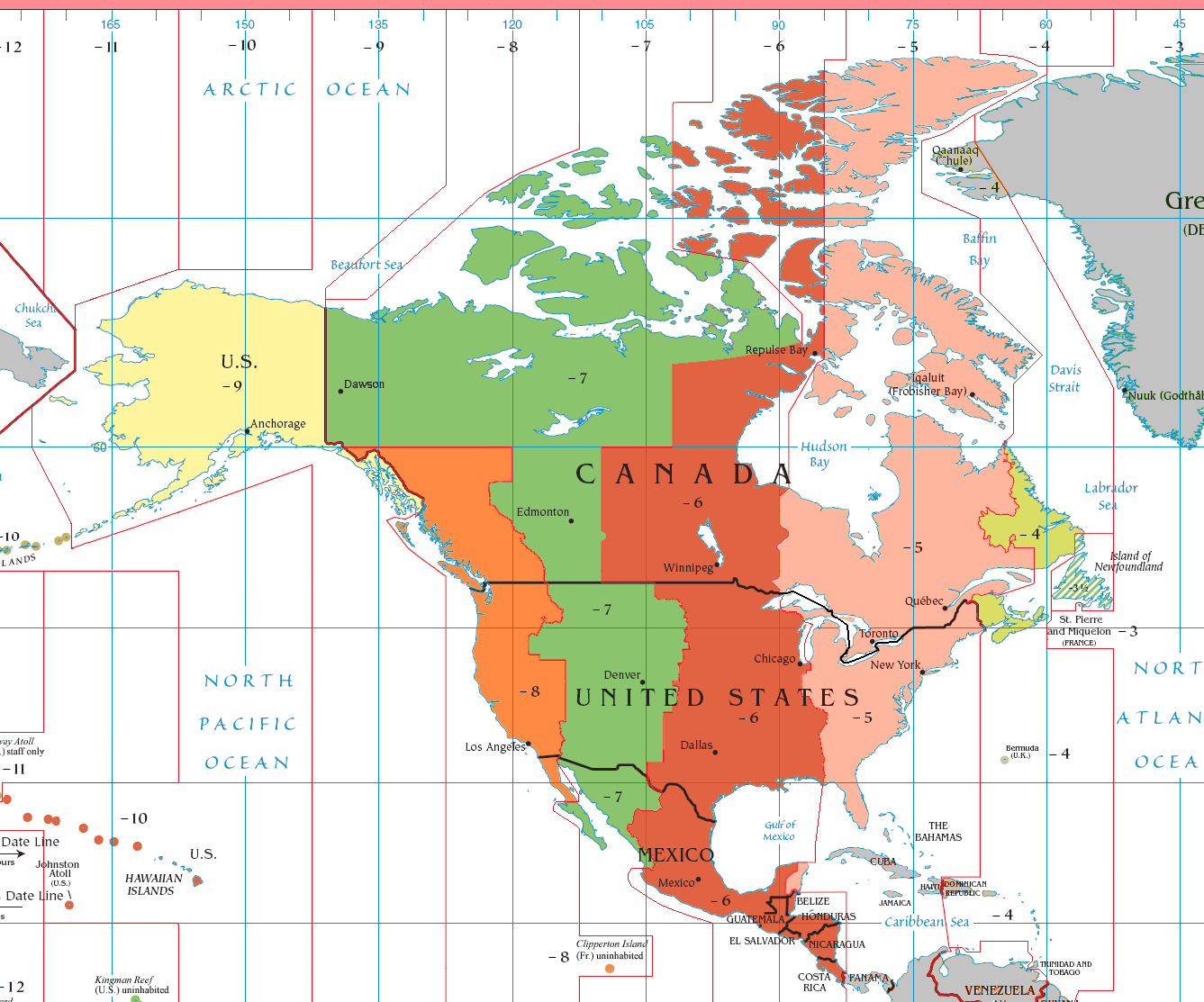
The Central Time Zone is a time zone in parts of Canada, the United States, Mexico, Central America, and a few Caribbean islands. It is one hour behind the Eastern Time Zone.
Daylight saving time is observed in most parts of that zone (20 states in the US, three provinces or territories in Canada, and several border municipalities in Mexico): Central Standard Time (CST) is observed from the first Sunday in November to the second Sunday in March. It is six hours behind Coordinated Universal Time (UTC) and designated internationally as UTC−6. From the second Sunday in March to the first Sunday in November the same areas observe daylight saving time (DST), creating the designation of Central Daylight Time (CDT), which is five hours behind UTC and known internationally as UTC−5.
The province of Manitoba is the only province or territory in Canada that observes Central Time in all areas.
The following Canadian provinces and territories observe Central Time in the areas noted, while their other areas observe Eastern Time:
Also, most of the province of Saskatchewan is on Central Standard Time year-round, never adjusting for Daylight Saving Time. One major exception includes Lloydminster, a city whose borders overlap both Alberta and Saskatchewan. The city charter stipulates that it shall observe Mountain Time and DST, putting the community on the same time as all of Alberta (UTC−7) in the winter, and in time with Saskatchewan (UTC−6) during the summer.
Ten states are contained entirely in the Central Time Zone:
Five states are split between the Central Time Zone and the Mountain Time Zone:
Five states are split between the Central Time Zone and the Eastern Time Zone:
Hub AI
Central Time Zone AI simulator
(@Central Time Zone_simulator)
Central Time Zone
The Central Time Zone is a time zone in parts of Canada, the United States, Mexico, Central America, and a few Caribbean islands. It is one hour behind the Eastern Time Zone.
Daylight saving time is observed in most parts of that zone (20 states in the US, three provinces or territories in Canada, and several border municipalities in Mexico): Central Standard Time (CST) is observed from the first Sunday in November to the second Sunday in March. It is six hours behind Coordinated Universal Time (UTC) and designated internationally as UTC−6. From the second Sunday in March to the first Sunday in November the same areas observe daylight saving time (DST), creating the designation of Central Daylight Time (CDT), which is five hours behind UTC and known internationally as UTC−5.
The province of Manitoba is the only province or territory in Canada that observes Central Time in all areas.
The following Canadian provinces and territories observe Central Time in the areas noted, while their other areas observe Eastern Time:
Also, most of the province of Saskatchewan is on Central Standard Time year-round, never adjusting for Daylight Saving Time. One major exception includes Lloydminster, a city whose borders overlap both Alberta and Saskatchewan. The city charter stipulates that it shall observe Mountain Time and DST, putting the community on the same time as all of Alberta (UTC−7) in the winter, and in time with Saskatchewan (UTC−6) during the summer.
Ten states are contained entirely in the Central Time Zone:
Five states are split between the Central Time Zone and the Mountain Time Zone:
Five states are split between the Central Time Zone and the Eastern Time Zone:
Recent media