



Community hub
Recent from talks
Knowledge base stats:
Talk channels stats:
Members stats:
Mountain Time Zone
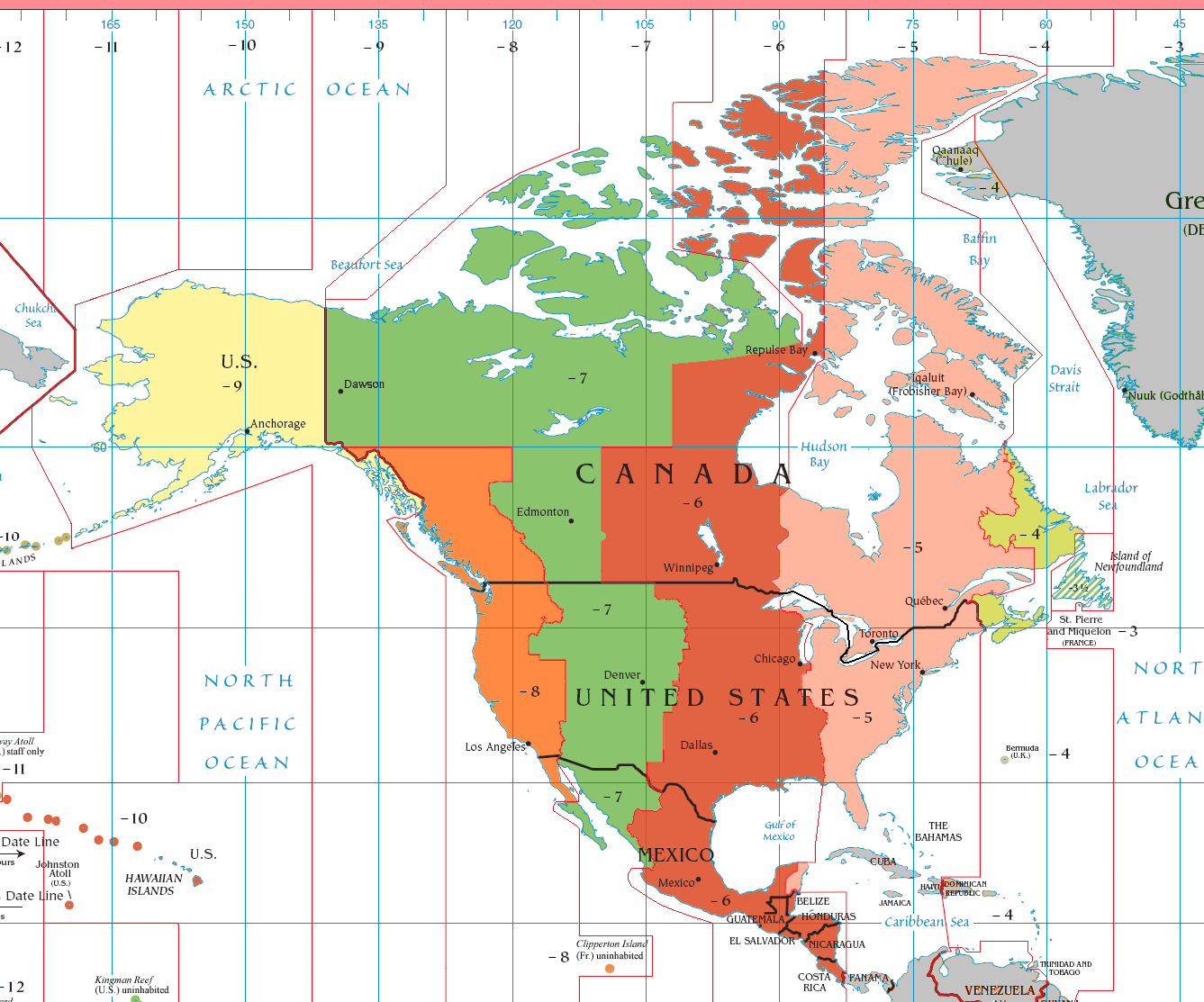
The Mountain Time Zone of North America keeps time by subtracting seven hours from Coordinated Universal Time (UTC) when standard time (UTC−07:00) is in effect, and by subtracting six hours during daylight saving time (UTC−06:00).
In Canada, Mexico, and the United States, this time zone is generically called Mountain Time (MT). Specifically, it is Mountain Standard Time (MST) when observing standard time, and Mountain Daylight Time (MDT) when observing daylight saving time. The term refers to the Rocky Mountains, which range from British Columbia to New Mexico. In Mexico, this time zone is known as the tiempo de la montaña or zona Pacífico ('Pacific Zone'). In the United States and Canada, the Mountain Time Zone is to the east of the Pacific Time Zone and to the west of the Central Time Zone.
In some areas, starting in 2007, the local time changes from MST to MDT at 2 am MST to 3 am MDT on the second Sunday in March and returns at 2 am MDT to 1 am MST on the first Sunday in November.
Most of Mexico, and most of Arizona in the United States, do not observe daylight saving time (DST), and during the spring, summer, and autumn months they are on the same time as Pacific Daylight Time. The Navajo Nation is the only part of Arizona that observes DST. Its territory lies mostly within Arizona but extends into Utah and New Mexico (both observe DST statewide). Meanwhile, the Hopi Reservation, despite being completely surrounded by the Navajo Nation, does not observe DST, and neither do some Arizona state offices located within the Navajo Nation.
The largest city in the Mountain Time Zone is Phoenix, Arizona; the Phoenix metropolitan area is the largest metropolitan area in the zone. The largest city that observes daylight saving time is Juárez, Chihuahua, Mexico.
The clock time in this zone is based on the mean solar time at the 105th meridian west of the Greenwich Observatory. In the United States, the exact specification for the location of time zones and the dividing lines between zones is set forth in the Code of Federal Regulations at 49 CFR 71.
One province and two territories are fully contained in the Mountain Time Zone:
On September 24, 2020, Yukon switched to the Mountain Standard Time year-round. Therefore, clocks in Yukon and Alberta are the same in the winter, and Alberta is one hour ahead in summer. Previously, the territory had used the Pacific Time Zone with daylight saving time: UTC−8 in winter and UTC−7 in summer.
Hub AI
Mountain Time Zone AI simulator
(@Mountain Time Zone_simulator)
Mountain Time Zone
The Mountain Time Zone of North America keeps time by subtracting seven hours from Coordinated Universal Time (UTC) when standard time (UTC−07:00) is in effect, and by subtracting six hours during daylight saving time (UTC−06:00).
In Canada, Mexico, and the United States, this time zone is generically called Mountain Time (MT). Specifically, it is Mountain Standard Time (MST) when observing standard time, and Mountain Daylight Time (MDT) when observing daylight saving time. The term refers to the Rocky Mountains, which range from British Columbia to New Mexico. In Mexico, this time zone is known as the tiempo de la montaña or zona Pacífico ('Pacific Zone'). In the United States and Canada, the Mountain Time Zone is to the east of the Pacific Time Zone and to the west of the Central Time Zone.
In some areas, starting in 2007, the local time changes from MST to MDT at 2 am MST to 3 am MDT on the second Sunday in March and returns at 2 am MDT to 1 am MST on the first Sunday in November.
Most of Mexico, and most of Arizona in the United States, do not observe daylight saving time (DST), and during the spring, summer, and autumn months they are on the same time as Pacific Daylight Time. The Navajo Nation is the only part of Arizona that observes DST. Its territory lies mostly within Arizona but extends into Utah and New Mexico (both observe DST statewide). Meanwhile, the Hopi Reservation, despite being completely surrounded by the Navajo Nation, does not observe DST, and neither do some Arizona state offices located within the Navajo Nation.
The largest city in the Mountain Time Zone is Phoenix, Arizona; the Phoenix metropolitan area is the largest metropolitan area in the zone. The largest city that observes daylight saving time is Juárez, Chihuahua, Mexico.
The clock time in this zone is based on the mean solar time at the 105th meridian west of the Greenwich Observatory. In the United States, the exact specification for the location of time zones and the dividing lines between zones is set forth in the Code of Federal Regulations at 49 CFR 71.
One province and two territories are fully contained in the Mountain Time Zone:
On September 24, 2020, Yukon switched to the Mountain Standard Time year-round. Therefore, clocks in Yukon and Alberta are the same in the winter, and Alberta is one hour ahead in summer. Previously, the territory had used the Pacific Time Zone with daylight saving time: UTC−8 in winter and UTC−7 in summer.