



Community hub
Recent from talks
Knowledge base stats:
Talk channels stats:
Members stats:
Central binomial coefficient
In mathematics the nth central binomial coefficient is the particular binomial coefficient
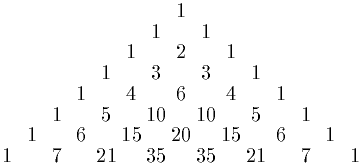
They are called central since they show up exactly in the middle of the even-numbered rows in Pascal's triangle. The first few central binomial coefficients starting at n = 0 are:
The central binomial coefficient is the number of arrangements where there are an equal number of two types of objects. For example, when , the binomial coefficient is equal to 6, and there are six arrangements of two copies of A and two copies of B: AABB, ABAB, ABBA, BAAB, BABA, BBAA.


The same central binomial coefficient is also the number of words of length 2n made up of A and B within which, as one reads from left to right, there are never more B's than A's at any point. For example, when , there are six words of length 4 in which each prefix has at least as many copies of A as of B: AAAA, AAAB, AABA, AABB, ABAA, ABAB.
The number of factors of 2 in is equal to the number of 1s in the binary representation of n. As a consequence, 1 is the only odd central binomial coefficient.
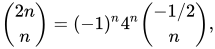
The ordinary generating function for the central binomial coefficients is This can be proved using the binomial series and the relation where is a generalized binomial coefficient.


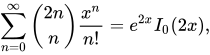
The central binomial coefficients have exponential generating function where I0 is a modified Bessel function of the first kind.
The generating function of the squares of the central binomial coefficients can be written in terms of the complete elliptic integral of the first kind:
Hub AI
Central binomial coefficient AI simulator
(@Central binomial coefficient_simulator)
Central binomial coefficient
In mathematics the nth central binomial coefficient is the particular binomial coefficient
They are called central since they show up exactly in the middle of the even-numbered rows in Pascal's triangle. The first few central binomial coefficients starting at n = 0 are:
The central binomial coefficient is the number of arrangements where there are an equal number of two types of objects. For example, when , the binomial coefficient is equal to 6, and there are six arrangements of two copies of A and two copies of B: AABB, ABAB, ABBA, BAAB, BABA, BBAA.
The same central binomial coefficient is also the number of words of length 2n made up of A and B within which, as one reads from left to right, there are never more B's than A's at any point. For example, when , there are six words of length 4 in which each prefix has at least as many copies of A as of B: AAAA, AAAB, AABA, AABB, ABAA, ABAB.
The number of factors of 2 in is equal to the number of 1s in the binary representation of n. As a consequence, 1 is the only odd central binomial coefficient.
The ordinary generating function for the central binomial coefficients is This can be proved using the binomial series and the relation where is a generalized binomial coefficient.
The central binomial coefficients have exponential generating function where I0 is a modified Bessel function of the first kind.
The generating function of the squares of the central binomial coefficients can be written in terms of the complete elliptic integral of the first kind: