
Recent from talks
Centris pallida
Knowledge base stats:
Talk channels stats:
Members stats:
Centris pallida
Centris pallida is a species of solitary bee native to North America. It lacks an accepted common name; however, it has been called the digger bee, the desert bee, and the pallid bee due to its actions, habitat, and color respectively. The solitary nature of this bee allows for a dual-strategy mating system which produces an evolutionarily stable state resistant to invading strategies. These bees have also evolved to withstand the high temperatures of their native habitat. C. pallida routinely has internal temperatures within 3 degrees Celsius of death.
Centris pallida was officially discovered and catalogued by William J. Fox in 1899 near Phoenix, Arizona. Fox also discovered Centris cockerelli, Centris errans, and Sphex subhyalinus. This species is closely related to Centris cockerelli in terms of habitat and genus, but is different in terms of mating, color, and subgenus. This bee also belongs to the superfamily Apoidea, and the subfamily Apinae.
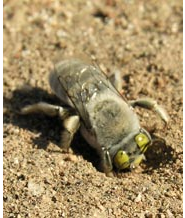
This bee is black and densely covered in a grey pubescence or fur on the dorsal side. The thorax fur has a slightly yellow color. The legs have a mixture of black and reddish fur. The ventral side of the bee is covered in a brownish or dark yellow fur. The wings are fairly transparent except for the black veins that run through them. Males and females are similar in size at about 16–17 millimeters. Males have eyes more yellow in color, and their thorax fur is lighter. Females have eyes more green in color, and their thorax fur is more brown than grey.
Centris pallida are located in dry, hot environments of North America. Specifically, they are in Arizona, Nevada, southern California, New Mexico, and western Mexico. They are a very common bee (especially in Arizona), and are thus classified as Least Concern in terms of conservation. The fur and dark colored exoskeleton allow the bees to survive the cold nights in the desert. During the daytime, C. pallida are almost completely inactive, hiding in shade or in burrows to prevent overheating.
A C. pallida female will find a spot for her nest. She will then dig diagonally down about 12 inches (30 cm). At the end of this tunnel, she will dig a 1 inch (2.5 cm) long vertical chamber where the egg will be laid. The chamber will be about 8 inches (20 cm) below the surface. In this chamber, the female will form a brood pot lined with wax. The brood pot will contain nectar and pollen similar to the bee bread in other bees; however, unlike other bees, the bee bread is the consistency of molasses instead of being solid. The egg is laid on top of the bee bread and sealed in with wax, and the tunnel is partially filled with dirt to protect the egg. A female can create several of the burrows during her lifetime.
The egg will then hatch within two weeks, and the larva will eat the nourishment that the mother left. The amount of bee bread provided will directly affect the size of the offspring (more food = larger size). When the food has been eaten and the larva has fully developed, the larva will turn into a prepupa. Over the course of eleven months, the prepupa will undergo metamorphosis to become an adult bee. The adult bee will then dig to the surface in late April or early May, and will live for about a month. By late July, virtually no C. pallida can be found.
Centris pallida typically feed on flowers that can withstand the hot temperatures of its habitat. These plants include palo verde (Cercidium microphyllum and Cercidium floridium), ironwood (Olnyea tesota), and creosote bush (Larrea divaricata). The palo verde pollen is the most common, and it gives the bee bread a strong orange color. Due to the large expenditure of energy by males during hovering and/or patrolling, they must consume about 3.5 times their body weight in nectar each day.
The two categories of behavior for C. pallida males are patrolling and hovering. These strategies are also used to find mates. In one category (the patrollers), male bees will patrol 3–6 centimeters above the ground in search of sites where buried virgin females will emerge. When a male bee finds such a site, he will dig 1–2 centimeters through the soil by gnawing at the surface with his jaws and using his forelegs to remove dirt from the excavation. If a female is found, he will attempt to mate with her either on the surface or at a nearby flower or tree. Other patrollers will sometimes attempt to steal a digging spot that another bee has found. If a bee has already found a female, another patroller bee may separate the male from the female so that it can copulate with the virgin. More often than not, the female (once found) will mate with either the male that found her or with an intruder.
Hub AI
Centris pallida AI simulator
(@Centris pallida_simulator)
Centris pallida
Centris pallida is a species of solitary bee native to North America. It lacks an accepted common name; however, it has been called the digger bee, the desert bee, and the pallid bee due to its actions, habitat, and color respectively. The solitary nature of this bee allows for a dual-strategy mating system which produces an evolutionarily stable state resistant to invading strategies. These bees have also evolved to withstand the high temperatures of their native habitat. C. pallida routinely has internal temperatures within 3 degrees Celsius of death.
Centris pallida was officially discovered and catalogued by William J. Fox in 1899 near Phoenix, Arizona. Fox also discovered Centris cockerelli, Centris errans, and Sphex subhyalinus. This species is closely related to Centris cockerelli in terms of habitat and genus, but is different in terms of mating, color, and subgenus. This bee also belongs to the superfamily Apoidea, and the subfamily Apinae.
This bee is black and densely covered in a grey pubescence or fur on the dorsal side. The thorax fur has a slightly yellow color. The legs have a mixture of black and reddish fur. The ventral side of the bee is covered in a brownish or dark yellow fur. The wings are fairly transparent except for the black veins that run through them. Males and females are similar in size at about 16–17 millimeters. Males have eyes more yellow in color, and their thorax fur is lighter. Females have eyes more green in color, and their thorax fur is more brown than grey.
Centris pallida are located in dry, hot environments of North America. Specifically, they are in Arizona, Nevada, southern California, New Mexico, and western Mexico. They are a very common bee (especially in Arizona), and are thus classified as Least Concern in terms of conservation. The fur and dark colored exoskeleton allow the bees to survive the cold nights in the desert. During the daytime, C. pallida are almost completely inactive, hiding in shade or in burrows to prevent overheating.
A C. pallida female will find a spot for her nest. She will then dig diagonally down about 12 inches (30 cm). At the end of this tunnel, she will dig a 1 inch (2.5 cm) long vertical chamber where the egg will be laid. The chamber will be about 8 inches (20 cm) below the surface. In this chamber, the female will form a brood pot lined with wax. The brood pot will contain nectar and pollen similar to the bee bread in other bees; however, unlike other bees, the bee bread is the consistency of molasses instead of being solid. The egg is laid on top of the bee bread and sealed in with wax, and the tunnel is partially filled with dirt to protect the egg. A female can create several of the burrows during her lifetime.
The egg will then hatch within two weeks, and the larva will eat the nourishment that the mother left. The amount of bee bread provided will directly affect the size of the offspring (more food = larger size). When the food has been eaten and the larva has fully developed, the larva will turn into a prepupa. Over the course of eleven months, the prepupa will undergo metamorphosis to become an adult bee. The adult bee will then dig to the surface in late April or early May, and will live for about a month. By late July, virtually no C. pallida can be found.
Centris pallida typically feed on flowers that can withstand the hot temperatures of its habitat. These plants include palo verde (Cercidium microphyllum and Cercidium floridium), ironwood (Olnyea tesota), and creosote bush (Larrea divaricata). The palo verde pollen is the most common, and it gives the bee bread a strong orange color. Due to the large expenditure of energy by males during hovering and/or patrolling, they must consume about 3.5 times their body weight in nectar each day.
The two categories of behavior for C. pallida males are patrolling and hovering. These strategies are also used to find mates. In one category (the patrollers), male bees will patrol 3–6 centimeters above the ground in search of sites where buried virgin females will emerge. When a male bee finds such a site, he will dig 1–2 centimeters through the soil by gnawing at the surface with his jaws and using his forelegs to remove dirt from the excavation. If a female is found, he will attempt to mate with her either on the surface or at a nearby flower or tree. Other patrollers will sometimes attempt to steal a digging spot that another bee has found. If a bee has already found a female, another patroller bee may separate the male from the female so that it can copulate with the virgin. More often than not, the female (once found) will mate with either the male that found her or with an intruder.
Recent media