Hubbry Logo
Cessna 172Cessna 172Main
Open search
Cessna 172
Community hub
Cessna 172
logo
8 pages, 0 posts
0 subscribers
Be the first to start a discussion here.
Cessna 172
Cessna 172
from Wikipedia

The Cessna 172 Skyhawk is an American four-seat, single-engine, high wing, fixed-wing aircraft made by the Cessna Aircraft Company.[2] First flown in 1955,[2] more 172s have been built than any other aircraft.[3] It was developed from the 1948 Cessna 170 but with tricycle landing gear rather than conventional landing gear. The Skyhawk name was originally used for a trim package, but was later applied to all standard-production 172 aircraft, while some upgraded versions were marketed as the Cutlass, Powermatic, and Hawk XP. The aircraft was also produced under license in France by Reims Aviation, which marketed upgraded versions as the Reims Rocket.

Key Information

Measured by its longevity and popularity, the Cessna 172 is the most successful aircraft in history. Cessna delivered the first production model in 1956, and as of 2015, the company and its partners had built more than 44,000 units.[1][4][5] With a break from 1986 to 1996, the aircraft remains in production today.

A light general aviation airplane, the Skyhawk's main competitors throughout much of its history were the Beechcraft Musketeer and Grumman American AA-5 series, though neither are currently in production. Other prominent competitors still in production include the Piper PA-28 Cherokee,[6] and, more recently, the Diamond DA40 Diamond Star and Cirrus SR20.

Design and development

[edit]
Early Cessna 172s, like this 1957 model, had a "fastback" rear cabin with no rear window and featured a "square" fin design.

The Cessna 172 started as a tricycle landing gear variant of the taildragger Cessna 170, with a basic level of standard equipment. In January 1955, Cessna flew an improved variant of the Cessna 170, a Continental O-300-A-powered Cessna 170C with larger elevators and a more angular tailfin.[7] Although the variant was tested and certified, Cessna decided to modify it with a tricycle landing gear, and the modified Cessna 170C flew again on June 12, 1955.[7] To reduce the time and cost of certification, the type was added to the Cessna 170 type certificate as the Model 172.[7] Later, the 172 was given its own type certificate.[8][9] The 172 became an overnight sales success, and over 1,400 were built in 1956, its first full year of production.[10]

Early 172s were similar in appearance to the 170s, with the same straight aft fuselage and tall landing gear legs, although the 172 had a straight tailfin while the 170 had a rounded fin and rudder. In 1960, the 172A incorporated revised landing gear and the swept-back tailfin, which is still in use today.

The final aesthetic development, found in the 1963 172D and all later 172 models, was a lowered rear deck allowing an aft window. Cessna advertised this added rear visibility as "Omni-Vision".[11]

Production halted in 1986 because of Product liability costs, but resumed in 1996 at Cessna's new factory at Independence, Kansas with the Cessna 172R Skyhawk.[12] Cessna supplemented this in 1998 with the 180 hp (134 kW) Cessna 172S Skyhawk SP.[13]

Modifications

[edit]

The Cessna 172 may be modified via a wide array of supplemental type certificates (STCs), including increased engine power and higher gross weights. Available STC engine modifications increase power from 180 to 210 hp (134 to 157 kW), add constant-speed propellers, or allow the use of automobile gasoline. Other modifications include additional fuel tank capacity in the wing tips, added baggage compartment tanks, added wheel pants to reduce drag, or enhanced landing and takeoff performance and safety with a STOL kit.[14] The 172 has also been equipped with the 180 hp (134 kW) fuel injected Superior Air Parts Vantage engine.[15]

Operational history

[edit]
The record-setting 1958-built Cessna 172

World records

[edit]

From December 4, 1958, to February 7, 1959, Robert Timm and John Cook set the world record for (refueled) flight endurance in a used Cessna 172, registration number N9172B. They took off from McCarran Field (now Harry Reid International Airport) in Las Vegas, Nevada, and landed back at McCarran Field after 64 days, 22 hours, 19 minutes and 5 seconds in a flight covering an estimated 150,000 miles (240,000 km), over 6 times further than flying around the world at the equator. The flight was part of a fund-raising effort for the Damon Runyon Cancer Fund.[16][17] The aircraft is now on display at the airport.[18]

Variants

[edit]

Cessna has historically used model years similar to U.S. auto manufacturers, with sales of new models typically starting a few months prior to the actual calendar year.

172

Introduced in November 1955 for the 1956 model year as a development of the Cessna 170B with tricycle landing gear, dubbed "Land-O-Matic" by Cessna. The 172 also featured a redesigned tail similar to the experimental 170C, "Para-Lift" flaps, and a maximum gross weight of 2,200 lb (998 kg) while retaining the 170B's 145 hp (108 kW) Continental O-300-A six-cylinder, air-cooled engine. The 1957 and 1959 model years brought only minor changes, while 1959 introduced a new cowling for improved engine cooling. The prototype 172, c/n 612, was modified from 170 c/n 27053, which previously served as the prototype of the 170B. A total of 3,757 were constructed over the four model years; 1,178 (1956), 1,041 (1957), 750 (1958), 788 (1959).[11][19][20]

172A
A 1960 Cessna 172A

1960 model year with a swept-back vertical tail and rudder and powered by a 145 hp (108 kW) O-300-C engine. It was also the first 172 to be certified for floatplane operation. 994 built.[11][21][20]

172B

1961 model year with shorter landing gear, engine mounts lengthened by three inches (76 mm), a reshaped cowling, a pointed propeller spinner, and an increased gross weight of 2,250 lb (1,021 kg). The stepped firewall introduced in the closely related Cessna 175 was adopted in the 172, along with the 175's wider, rearranged instrument panel located further aft in the fuselage. For the first time, the Skyhawk name was applied to an available deluxe option package that included optional wheel fairings, avionics, and a cargo door along with full exterior paint rather than partial paint stripes. The Skyhawk was also powered by an O-300-D in place of the O-300-C of the standard model. 989 built.[11][21][20][22]

172C

1962 model year with fiberglass wingtips, redesigned wheel fairings, a key starter to replace the previous pull-starter, and an optional autopilot. The seats were redesigned to be six-way adjustable, and a child seat was made optional to allow two children to be carried in the baggage area. 810 built.[11][21][20]

172D
1963 Cessna 172D

1963 model year with a cut down rear fuselage with a wraparound Omni-Vision rear window, a one-piece windshield, increased horizontal stabilizer span, and a folding hat shelf in the rear cabin. Gross weight was increased to 2,300 lb (1,043 kg), where it would stay until the 172P. New rudder and brake pedals were also added. 1,011 were built by Cessna, while a further 18 were produced by Reims Aviation in France as the F172D.[11][21][20]

172E

1964 model year with a redesigned instrument panel with center-mounted avionics and circuit breakers replacing the electrical fuses of previous models. 1,209 built, 67 built by Reims as the F172E.[11][23][20]

172F

1965 model year with electrically operated flaps to replace the previous lever-operated system and improved instrument lighting. 1,400 built, plus 94 by Reims as the F172F.[8][11][23][20]

The 172F formed the basis for the U.S. Air Force's T-41A Mescalero primary trainer, which was used during the 1960s and early 1970s as initial flight screening aircraft in USAF Undergraduate Pilot Training (UPT). Following their removal from the UPT program, some extant USAF T-41s were assigned to the U.S. Air Force Academy for the cadet pilot indoctrination program, while others were distributed to Air Force aero clubs.[24]

172G
1966 Reims F172G

1966 model year with a longer, more pointed spinner and sold for US$12,450 in its basic 172 version and US$13,300 in the upgraded Skyhawk version. 1,474 built (including 26 as the T-41A), plus 140 by Reims as the F172G.[11][23][20]

172H

1967 model year with a 60A alternator replacing the generator, a rotating beacon replacing the flashing unit, redesigned wheel fairings, and a shorter-stroke nose gear oleo to reduce drag and improve the appearance of the aircraft in flight. A new cowling was used, introducing shock-mounts that transmitted lower noise levels to the cockpit and reduced cowl cracking. The electric stall warning horn was replaced by a pneumatic one. 1,586 built (including 34 as the T-41A), plus 435 by Reims as the F172H for both the 1967 and 1968 model years.[11][23][20]

172I
The 1968-built Cessna 172I introduced the Lycoming O-320-E2D engine of 150 hp (112 kW).

The 1968 model year marked the beginning of the Lycoming-powered 172s, with the 172I introduced with a Lycoming O-320-E2D engine of 150 hp (112 kW), an increase of 5 hp (3.7 kW) over the Continental powerplant. The increased power resulted in an increase in optimal cruise from 130 mph (209 km/h) true airspeed (TAS) to 131 mph (211 km/h) TAS. There was no change in the sea level rate of climb at 645 ft (197 m) per minute. Starting with this model, the standard and deluxe Skyhawk models were no longer powered by different engines.[23] The 172I also introduced the first standard "T" instrument arrangement. 649 built.[11][23][25]

172J

For 1968, Cessna planned to replace the 172 with a newly designed aircraft called the 172J, featuring the same general configuration but with a more sloping windshield, a strutless cantilever wing, a more stylish interior, and various other improvements. A single 172J prototype, registered N3765C (c/n 660), was built. However, the popularity of the previous 172 with Cessna dealers and flight schools prompted the cancellation of the replacement plan, and the 172J was redesignated as the 177 from the second prototype onward and sold alongside the 172.[26][27][28]

172K
1969 model-year Cessna 172K, built in 1968

Introduced for the 1969 model year with a redesigned tailfin cap and reshaped rear windows enlarged by 16 square inches (103 cm2). Optional long-range 52 US gal (197 L) wing fuel tanks were also offered. The 1970 model year featured fiberglass, downward-shaped, conical camber wingtips and optional fully articulated seats. 2,055 built for both model years, plus 50 by Reims as the F172K.[11][29][25]

172L

Introduced for the 1971 model year with tapered, tubular steel landing gear legs replacing the original flat spring steel legs, increasing landing gear width by 12 in (30 cm). The new landing gear was lighter, but required aerodynamic fairings to maintain the same speed and climb performance as experienced with the flat steel design. 172L also had a nose-mounted landing light, a bonded baggage door, and optional cabin skylights. The 1972 model year introduced a plastic fairing between the dorsal fin and vertical fin to introduce a greater family resemblance to the 182's vertical fin. 1972 also introduced a reduced-diameter propeller, bonded cabin doors, and improved instrument panel controls. 1,535 built for both model years, plus 100 by Reims as the F172L.[11][29][25]

172M
1975 Cessna 172M

Introduced for the 1973 model year with a "Camber-Lift" wing with a drooped leading edge for improved low-speed handling, a key-locking baggage door, and new lighting switches. The 1974 model year introduced the Skyhawk II, which was sold alongside the baseline 172M and Skyhawk models with higher standard equipment, including a second nav/comm radio, an ADF and transponder, a larger baggage compartment, and nose-mounted dual landing lights. 1975 introduced inertia-reel shoulder harnesses and an improved instrument panel and door seals. Beginning in 1976, Cessna stopped marketing the aircraft as the 172 and began exclusively using the "Skyhawk" designation. This model year also saw a redesigned instrument panel to hold more avionics. Among other changes, the fuel and other small gauges were relocated to the left side for improved pilot readability compared with the earlier 172 panel designs. 6,826 built; 4,926 (1973–75) and 1,900 (1976), plus 610 by Reims as the F172M.[11][29][25]

172N Skyhawk/100
1979 Cessna 172N Skyhawk in 2019

1977 model year powered by a 160 horsepower (119 kW) Lycoming O-320-H2AD engine designed to run on 100-octane fuel (hence the "Skyhawk/100" name), whereas all previous engines used 80/87 fuel. Other changes included pre-select flap control and optional rudder trim. The 1978 model year brought a 28-volt electrical system to replace the previous 14-volt system as well as optional air conditioning. The 1979 model year increased the flap-extension speed to 110 knots (204 km/h). 6,425 total built; 1,725 (1977), 1,725 (1978), 1,850 (1979), and 1,125 (1980), plus 525 by Reims as the F172N.[11][30][25]

172O

There was no "O" model 172, to avoid confusion with the number zero.[11]

172P Skyhawk P
Cessna 172P in October 2012

Introduced for the 1981 model year with a Lycoming O-320-D2J engine replacing the O-320-H2AD of the 172N, which had proven unreliable.[31] Other changes included a decreased maximum flap deflection from 40 degrees to 30 to allow a gross weight increase from 2,300 lb (1,043 kg) to 2,400 lb (1,089 kg). A 62 US gal (235 L) wet wing and air conditioning were optional. The 1982 model year moved the landing lights from the nose to the wing to increase bulb life, while 1983 added some minor soundproofing improvements and thicker windows. 1984 introduced a second door latch pin, a thicker windshield and side windows, additional avionics capacity, and low-vacuum warning lights. 2,664 total built; 1,052 (1981), 724 (1982), 319 (1983), 179 (1984), 256 (1985), and 134 (1986), plus 215 by Reims as the F172P. Following the end of 172P production in 1986, Cessna ceased production of the Skyhawk for ten years.[11][30][25]

172Q Cutlass

Introduced for the 1983 model year, the 172Q was given the name "Cutlass" to create an affiliation with the 172RG Cutlass RG, although it was actually a 172P with a Lycoming O-360-A4N engine of 180 horsepower (134 kW). The aircraft had a gross weight of 2,550 lb (1,157 kg) and an optimal cruise speed of 122 knots (226 km/h) compared to the 172P's cruise speed of 120 knots (222 km/h) on 20 hp (15 kW) less. It had a useful load that was about 100 lb (45 kg) more than the Skyhawk P and a rate of climb that was actually 20 feet (6 m) per minute lower, due to the higher gross weight. The Cutlass II was offered as a deluxe model of the 172Q, as was the Cutlass II/Nav-Pac with IFR equipment. The 172Q was produced alongside the 172P for the 1983 and 1984 model years before being discontinued. Sources disagree on the exact number of 172Q aircraft built,[note 1] and the construction numbers listed on the Federal Aviation Administration type certificate overlap with those of the 1983 and 1984 172P.[11][32][25]

172R Skyhawk R

The Skyhawk R was introduced in 1996 and is powered by a derated Lycoming IO-360-L2A producing a maximum of 160 horsepower (120 kW) at just 2,400 rpm. This is the first Cessna 172 to have a factory-fitted fuel-injected engine.[citation needed]

The 172R's maximum takeoff weight is 2,450 lb (1,111 kg). This model year introduced many improvements, including a new interior with soundproofing, an all new multi-level ventilation system, a standard four point intercom, contoured, energy absorbing, 26g front seats with vertical and reclining adjustments and inertia reel harnesses.[citation needed]

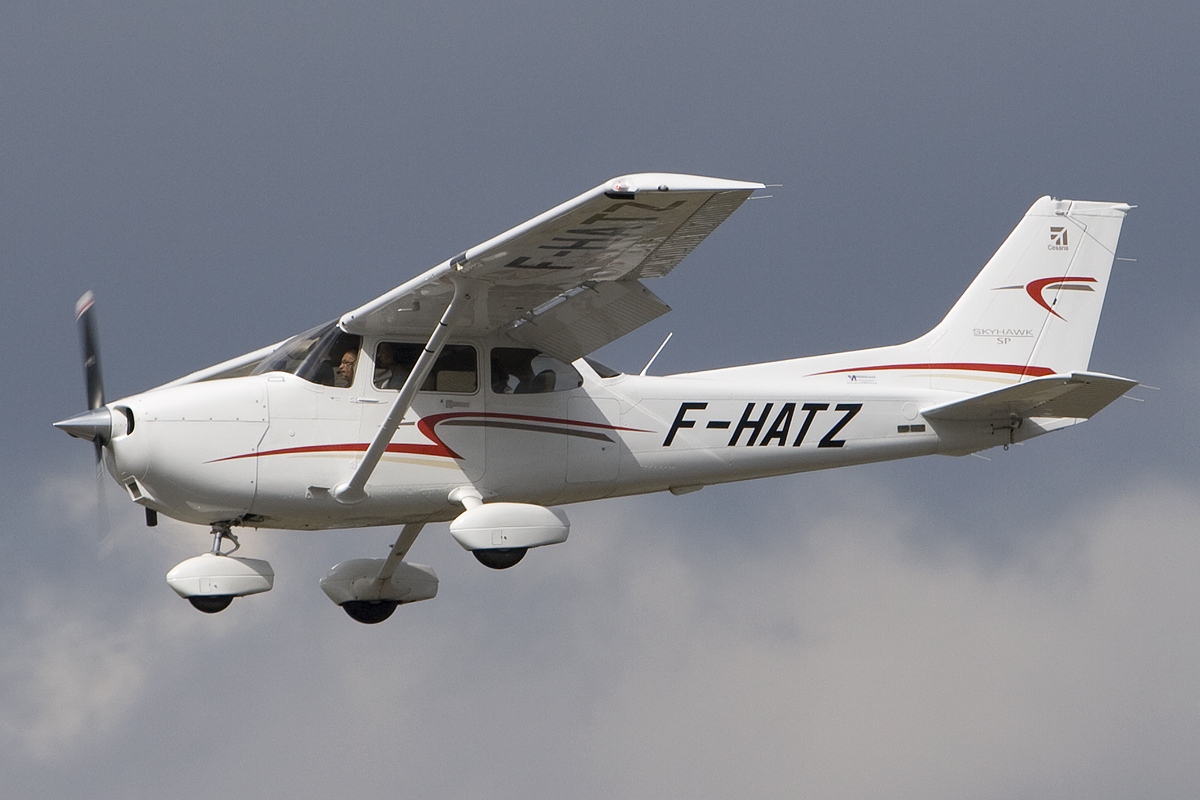
172S Skyhawk SP
Cessna 172S Skyhawk SP

The Cessna 172S was introduced in 1998 and is powered by a Lycoming IO-360-L2A producing 180 horsepower (134 kW). The maximum engine rpm was increased from 2,400 rpm to 2,700 rpm resulting in a 20 hp (15 kW) increase over the "R" model. As a result, the maximum takeoff weight was increased to 2,550 lb (1,157 kg). This model is marketed under the name Skyhawk SP, although the Type Certification data sheet specifies it is a 172S.[8][33]

The 172S is built primarily for the private owner-operator and is, in its later years, offered with the Garmin G1000 avionics package and leather seats as standard equipment.[34]

As of 2009, the 172S model was the only Skyhawk model in production.[35]

Variants under 175 type certificate

[edit]

As the Cessna 175 Skylark had gained a reputation for poor engine reliability, Cessna attempted to regain sales by rebranding the aircraft as a variant of the 172. Several later 172 variants, generally those with higher-than-standard engine power or gross weight, were built under the 175 type certificate although most did not use the unpopular Continental GO-300-E engine from the 175.

P172D Powermatic
Reims FP172D

The 175 Skylark was rebranded for the 1963 model year as the P172D Powermatic, continuing where the Skylark left off at 175C. It was powered by a 175 hp (130 kW) Continental GO-300-E with a geared reduction drive powering a constant-speed propeller, increasing cruise speed by 11 mph (18 km/h) over the standard 172D. It differed from the 175C in that it had a cut-down rear fuselage with an "Omni-Vision" rear window and an increased horizontal stabilizer span. A deluxe version was marketed as the Skyhawk Powermatic with a slightly increased top speed. Despite the rebranding, sales did not meet expectations, and the 175 type was discontinued for the civilian market after the 1963 model year.[11][36][21] 65 were built, plus 3 by Reims as the FP172D.[21]

R172E
The first production R172E operating as a T-41B Mescalero with the US Army, c. 1967

Although the 175 type was discontinued for the civilian market, Cessna continued to produce the aircraft for the United States Armed Forces as the T-41 Mescalero. Introduced in 1967, the R172E was built in T-41B, T-41C, and T-41D variants for the US Army, USAF Academy, and US Military Aid Program, respectively.[37] As the T-41B, the R172E was powered by a fuel-injected 210 hp (157 kW) Continental IO-360-D or -DE driving a constant-speed propeller, and featured a 28V electrical system, jettisonable doors, an openable right front window, a 6.00x6 nose wheel tire and military avionics, but no baggage door. The T-41C was similar to the T-41B, but had a 14V electrical system, a fixed-pitch propeller, civilian avionics, and no rear seats. The T-41D featured a 28V electrical system, four seats, corrosion-proofing, reinforced flaps and ailerons, a baggage door, and provisions for wing-mounted pylons. 255 T-41B, 45 T-41C, and 34 T-41D aircraft were built. While Cessna produced the R172E exclusively for military use, Reims built a civilian model as the FR172E Reims Rocket, with 60 built for the 1968 model year.[36][38]

R172F

The R172F was similar to the R172E and was built in both T-41C and T-41D variants. 7 (T-41C) and 74 (T-41D) built, plus 85 by Reims as the FR172F Reims Rocket for the 1969 model year.[36][38]

R172G

The R172G was similar to the R172E/F, differing in that it was certified to be powered by a 210 hp (157 kW) Continental IO-360-C, -D, -CB, or -DB engine. 28 (T-41D) built, plus 80 by Reims as the FR172G Reims Rocket for the 1970 model year.[36][38]

R172H

The R172H introduced the extended dorsal fillet of the 172L to the T-41D. It was also certified to be powered by a 210 hp (157 kW) Continental IO-360-C, -D, -H, -CB, -DB, or -HB engine. 163 (T-41D) built, plus 125 by Reims as the FR172H Reims Rocket for the 1971 and 1972 model years.[36][38]

R172J

Certified to be powered by a 210 hp (157 kW) Continental IO-360-H or -HB engine. Only one was built by Cessna, while Reims built 240 as the FR172J Reims Rocket for the 1973 through 1976 model years.[36][38]

R172K Hawk XP
1977 Model R172K Hawk XP on Wipline amphibious floats

Following the success of the Reims Rocket in Europe, Cessna decided to once again produce the 175 type for the civilian market as the R172K Hawk XP, beginning with the 1977 model year. It was powered by a derated 195 hp (145 kW) Continental IO-360-K or -KB engine driving a McCauley constant-speed propeller and featured a new cowling with landing lights and an upgraded interior. The Hawk XP II was also available with full IFR avionics.[36][39] However, owners claimed that the increased performance of the "XP" did not compensate for its increased purchase price and the higher operating costs associated with the larger engine. The aircraft was well accepted for use on floats, however, as the standard 172 is not a strong floatplane, even with only two people on board, while the XP's extra power improves water takeoff performance dramatically.[11] 1 (1973 prototype), 725 (1977), 205 (1978), 270 (1979), 200 (1980), and 55 (1981) built, plus 85 (30 in 1977, 55 in 1978–81) by Reims as the FR172K Reims Rocket for the 1977 through 1981 model years.[39][40]

172RG Cutlass RG
Cessna 172RG Cutlass RG with landing gear retracted

Cessna introduced a retractable landing gear version of the 172 in 1980, designating it as the 172RG and marketing it as the Cutlass RG.[41][42]

The Cutlass RG sold for about US$19,000 more than the standard 172 and featured a variable-pitch, constant-speed propeller and a more powerful Lycoming O-360-F1A6 engine of 180 horsepower (130 kW), giving it an optimal cruise speed of 140 knots (260 km/h), compared to 122 knots (226 km/h) for the contemporary 160 horsepower (120 kW) 172N or 172P.[11] It also had more fuel capacity than a standard Skyhawk, 62 US gallons (230 L; 52 imp gal) versus 53 US gallons (200 L; 44 imp gal), giving it greater range and endurance.[43]

The 172RG first flew on August 24, 1976.[44] It was the lowest-priced four-seat retractable-gear airplane on the U.S. market when it was introduced.[41] Although the general aviation aircraft market was contracting at the time, the RG proved popular as an inexpensive flight-school trainer for complex aircraft and commercial pilot ratings under U.S. pilot certification rules, which required demonstrating proficiency in an aircraft with retractable landing gear.[42]

The 172RG uses the same basic landing gear as the heavier R182 Skylane RG, which Cessna touted as a benefit, saying it was a proven design;[41] however, owners have found the landing gear to have higher maintenance requirements than comparable systems from other manufacturers, with several parts prone to rapid wear or cracking.[42] Compared to a standard 172, the 172RG is easier to load with its center of gravity too far aft,[42] which adversely affects the aircraft's longitudinal stability.

While numbered and marketed as a 172, the 172RG was certified on the Cessna 175 type certificate.[36] No significant design updates were made to the 172RG during its five-year model run.[42] 1,191 were produced.[45]

Although it is slower and has less passenger and cargo capacity than popular competing single-engine retractable-gear aircraft such as the Beechcraft Bonanza, the Cutlass RG is praised by owners for its relatively low operating costs, robust and reliable engine, and docile flying qualities comparable to the standard 172, although it has higher landing gear maintenance and insurance costs than a fixed-gear 172.[42][43]

Special versions

[edit]
J172T Turbo Skyhawk JT-A

Model introduced in July 2014 for 2015 customer deliveries, powered by a 155 hp (116 kW) Continental CD-155 diesel engine installed by the factory under a supplemental type certificate.[46] Initial retail price in 2014 was $435,000 (~$566,105 in 2024).[47] The model has a top speed of 131 kn (243 km/h) and burns 3 U.S. gallons (11 L; 2.5 imp gal) per hour less fuel than the standard 172.[48] As a result, the model has an 885 nmi (1,639 km) range, an increase of more than 38% over the standard 172.[49] This model is a development of the proposed and then canceled Skyhawk TD.[50] Cessna has indicated that the JT-A will be made available in 2016.[51]

In reviewing this new model Paul Bertorelli of AVweb said: "I'm sure Cessna will find some sales for the Skyhawk JT-A, but at $420,000, it's hard to see how it will ignite much market expansion just because it's a Cessna. It gives away $170,000 to the near-new Redbird Redhawk conversion which is a lot of change to pay merely for the smell of a new airplane. Diesel engines cost more than twice as much to manufacture as gasoline engines do and although their fuel efficiency gains back some of that investment, if the complete aircraft package is too pricey, the debt service will eat up any savings, making a new aircraft not just unattractive, but unaffordable. I haven't run the numbers on the JT-A yet, but I can tell from previous analysis that there are definite limits."[50]

The model was certified by both EASA and the FAA in June 2017.[52] It was discontinued in May 2018, due to poor sales as a result of the aircraft's high price, which was twice the price of the same aircraft as a diesel conversion. The aircraft remains available as an STC conversion from Continental Motors, Inc.[53][54]

Electric-powered 172

In July 2010, Cessna announced it was developing an electrically powered 172 as a proof-of-concept in partnership with Bye Energy. In July 2011, Bye Energy, whose name had been changed to Beyond Aviation, announced the prototype had commenced taxi tests on 22 July 2011 and a first flight would follow soon.[55][56] In 2012, the prototype, using Panacis batteries, engaged in multiple successful test flights.[57] The R&D project was not pursued for production.

Canceled model

[edit]
172TD Skyhawk TD

On October 4, 2007, Cessna announced its plan to build a diesel-powered model, to be designated the 172 Skyhawk TD ("Turbo Diesel") starting in mid-2008.[46] The planned engine was to be a Thielert Centurion 2.0, liquid-cooled, two-liter displacement, dual overhead cam, four-cylinder, in-line, turbo-diesel with full authority digital engine control with an output of 155 hp (116 kW) and burning Jet-A fuel. In July 2013, the 172TD model was canceled due to Thielert's bankruptcy. The aircraft was later refined into the Turbo Skyhawk JT-A, which was certified in June 2014 and discontinued in May 2018.[3][48][58][59]

Simulator company Redbird Flight uses the same engine and reconditioned 172 airframes to produce a similar model, the Redbird Redhawk.[60][61]

Premier Aircraft Sales also announced in February 2014 that it would offer refurbished 172 airframes equipped with the Continental/Thielert Centurion 2.0 diesel engine.[62]

Military operators

[edit]

A variant of the 172, the T-41 Mescalero was used as a trainer with the United States Air Force and Army. In addition, the United States Border Patrol uses a fleet of 172s for aerial surveillance along the Mexico-US border.

From 1972 to 2019 the Irish Air Corps used the Reims version for aerial surveillance and monitoring of cash, prisoner and explosive escorts, in addition to army cooperation and pilot training roles.[63]

Irish Air Corps Reims FR.172H Rocket

For T-41 operators, see Cessna T-41 Mescalero.

Angola
 Austria
 Bolivia
 Chile
 Colombia
 Ecuador
 Guatemala
 Honduras
 Indonesia
 Iraq
Iraqi Air Force Cessna 172 lands at Kirkuk Air Base.
 Ireland
 Liberia
Lithuania
 Madagascar
 Nicaragua
 Pakistan
 Philippines
  • Philippine Army -3 Units of 172M in In service (PA-101, PA-103 & PA-911)
  • Philippine Navy - 1×172F - Donated By Olympic Aviation in 2007 as PN 330.[82][83] 1×172N - Purchased from Welcome Export Inc. in July 2008 as PN 331,[83] 4x172S- acquired from US Foreign Military Sales delivered in February 2022[84]
 Saudi Arabia
 Singapore
 Suriname

Accidents and incidents

[edit]
Mathias Rust's Cessna F172P, used in his flight from Helsinki to Moscow, on display at the German Museum of Technology, Berlin

Specifications (172R)

[edit]
3-view line drawing of the base model Cessna 172
3-view line drawing of the Cessna 172 Skyhawk
Cessna 172R instrument panel

Data from Cessna,[109][110] FAA type certificate[8]

General characteristics

  • Crew: one
  • Capacity: three passengers, 120 lb (54 kg) of baggage
  • Length: 27 ft 2 in (8.28 m)
  • Wingspan: 36 ft 1 in (11.00 m)
  • Height: 8 ft 11 in (2.72 m)
  • Wing area: 174 sq ft (16.2 m2)
  • Aspect ratio: 7.32
  • Airfoil: modified NACA 2412
  • Empty weight: 1,691 lb (767 kg)
  • Gross weight: 2,450 lb (1,111 kg)
  • Fuel capacity: 56 US gal (210 L) (52 US gal (200 L) usable)
  • Powerplant: 1 × Lycoming IO-360-L2A four cylinder, horizontally opposed aircraft engine, 160 hp (120 kW)
  • Propellers: 2-bladed metal, fixed pitch McCauley Model 1C235/LFA7570, 6 ft 3 in (1.91 m) diameter (maximum)

Performance

  • Cruise speed: 122 kn (140 mph, 226 km/h)
  • Stall speed: 47 kn (54 mph, 87 km/h) (power off, flaps down)[111]
  • Never exceed speed: 163 kn (188 mph, 302 km/h) (IAS)
  • Range: 696 nmi (801 mi, 1,289 km) with 45 minute reserve, 55% power, at 12,000 feet (3,700 m)
  • Service ceiling: 13,500 ft (4,100 m)
  • Rate of climb: 721 ft/min (3.66 m/s)
  • Wing loading: 14.1 lb/sq ft (68.6 kg/m2)

Avionics

See also

[edit]

Related development

Aircraft of comparable role, configuration, and era

Related lists

Notes

[edit]

References

[edit]
[edit]
Revisions and contributorsEdit on WikipediaRead on Wikipedia
from Grokipedia
The Cessna 172 Skyhawk is an American four-seat, single-engine, high-wing, fixed-wing aircraft produced by the Aircraft Company, a subsidiary of . It features tricycle landing gear, a Lycoming IO-360-L2A rated at 180 horsepower, a maximum cruise speed of 124 knots , and a range of 640 nautical miles, making it suitable for pilot training, personal travel, and light utility roles with a useful load of 878 pounds and capacity for up to four occupants. First flown on June 12, 1955, and entering production in 1956 as an evolution of the tailwheel , the Skyhawk quickly gained popularity for its stable handling, forgiving flight characteristics, and low operating costs. Over its seven decades of continuous production, with intermittent pauses such as from 1986 to 1997 due to market conditions, the Cessna 172 has become the most produced in aviation history, with more than 44,000 units built worldwide as of 2024 and recent annual deliveries averaging over 150 . Its enduring success stems from numerous variants, including the 172R and 172S models introduced in the 1990s with fuel-injected engines and modern avionics like the NXi , recent enhancements including the 2025 adoption of dual electronic ignition as standard, alongside programs such as the 2015 Top Hawk initiative that has equipped flight schools and universities with customized fleets. The aircraft's reputation as the "ultimate training airplane" has solidified its role in developing generations of pilots, contributing to its widespread use in flight instruction, aerial observation, and recreational flying across the globe.

Design and Development

Origins

The Cessna 172 originated in the mid-1950s as a successor to the , a taildragger four-seat aircraft introduced in 1948, with the goal of creating a lighter, more accessible model featuring landing gear to appeal to a broader range of pilots. Cessna engineers, initially resistant to the change due to concerns over added weight and complexity, ultimately adopted the configuration following market demand for easier ground handling and takeoff/landing visibility, inspired in part by a popular for the 170 developed by Met-Co-Aire. This redesign positioned the 172 as a refined evolution, retaining the 170's engine while emphasizing simplicity and stability for novice pilots. The prototype, derived from a modified Cessna 170C (registration N41678), achieved its first flight on June 12, 1955, piloted by Cessna test pilot Emil "Fritz" Feutz from the company's Wichita, Kansas, airfield to a sod strip near Kingman for evaluation. The aircraft demonstrated improved handling characteristics, leading to FAA type certification (TC 3A12) on November 4, 1955, and entry into service the following year. Initial production commenced at Cessna's Wichita facility in 1956, with the model priced at $8,750, making it an affordable option for flight schools and private owners. From its debut, the Cessna 172 was marketed as a versatile trainer and personal aircraft, capable of 115-knot cruise speeds and a 600-nautical-mile range, directly challenging competitors like the Piper PA-22 Tri-Pacer in the growing segment of user-friendly four-seaters. Its tricycle gear and high-wing design enhanced training efficacy, contributing to strong initial sales of 1,178 units in the first year and establishing it as a staple in .

Evolution and Production

The Cessna 172 entered production in 1956, with the first units delivered that year following FAA certification of the initial 172 model. Over the subsequent three decades, Cessna manufactured more than 30,000 units through 1986, establishing the aircraft as a cornerstone of amid strong demand for its reliable design. Production ceased in 1986 due to escalating costs and a challenging economic environment in the general sector, which led to financial losses and a broader halt of Cessna's single-engine lines. After an 11-year hiatus, manufacturing resumed in 1997 under —following Textron's 1992 acquisition of —enabled by the General Aviation Revitalization Act of 1994, which limited manufacturer liability for older and revitalized market confidence. The restarted production focused on updated models like the 172R, incorporating modern and engine improvements while maintaining the core . By 2015, cumulative production had surpassed 44,000 units, making the Cessna 172 the most produced in . As of 2025, over 44,000 units have been produced, with annual deliveries maintaining rates of approximately 150-200 amid sustained demand for training and personal use. Annual output has since continued at rates of several hundred units per year, with reporting steady deliveries into the despite market fluctuations. Primary manufacturing occurs at 's facility in , near the company's Wichita headquarters, supporting a global for components and assembly. The disrupted operations from to 2022, causing supply chain delays and reduced deliveries—for instance, reported a 21% drop in shipments in the first quarter of compared to the prior year, with Cessna 172 output affected by workforce limitations and component shortages. Recovery followed as rebounded, bolstered by needs. In a notable recent advancement, the FAA issued a (STC) in September 2024 for Swift Fuels 100R, a 100-octane unleaded , allowing its use in Cessna 172R and 172S models equipped with Lycoming IO-360-L2A engines, supporting broader industry efforts to phase out leaded fuels.

Key Design Features

The Cessna 172 features a high-wing configuration mounted atop a semimonocoque fuselage, which enhances lateral stability by positioning the center of gravity below the wing, providing a pendulum-like effect that naturally returns the aircraft to level flight during minor disturbances. This design, combined with fixed tricycle landing gear consisting of a steerable nose wheel and two main gear struts, contributes to inherent directional stability on the ground and simplifies operations for pilots, particularly during takeoff and landing on unprepared surfaces. The tricycle arrangement provides a level attitude on the ground for better visibility and control, with adequate propeller clearance, thereby reducing the risk of propeller strikes during operations and improving ease of taxiing. The aircraft integrates engines from the and IO-360 series, delivering power outputs ranging from 150 to 180 horsepower at 2,700 RPM, with the O-320 variants typically carbureted and the IO-360 fuel-injected for improved efficiency in higher-performance models. The system employs two vented integral wing tanks feeding a four-position selector (BOTH, LEFT, RIGHT, OFF), with standard capacity of 43 gallons usable (out of 48 total) in earlier configurations and up to 53 gallons usable (out of 56 total) in later ones, ensuring balanced distribution and reliable operation through an -driven supplemented by an auxiliary electric for starting and emergencies. This setup supports extended range while maintaining simplicity in maintenance and pilot workload. The cabin accommodates four occupants in a side-by-side front seating arrangement with two rear seats, emphasizing simplicity through straightforward controls, ample visibility via large windows and the elevated high- vantage, and a low of approximately 14.7 pounds per square foot that promotes forgiving handling characteristics by allowing gentle responses to control inputs and stable low-speed flight. Constructed primarily from aluminum alloy for the bulkheads, stringers, skins, and spars, ribs, and coverings, the structure provides a lightweight yet robust framework resistant to . is further bolstered by conventional characteristics, where the exhibits a nose-high attitude with minimal drop, accompanied by a pneumatic aural warning activating 5-10 knots above speed, and straightforward spin recovery achieved by idling the , applying full opposite , and pushing the control wheel forward to break the rotation.

Variants

Standard Civil Variants

The Cessna 172 entered production in as a four-seat, single-engine powered by a 145 horsepower engine, marking the start of a lineage that emphasized reliability, ease of maintenance, and versatility for civilian use. Early models, designated simply as the 172, featured a tricycle landing gear, high-wing configuration, and a fixed-pitch propeller, with initial production reaching 1,174 units in its debut year alone. Over the subsequent decades, the series evolved through incremental refinements to address performance, fuel efficiency, and regulatory requirements, while maintaining the core airframe design. A significant upgrade occurred with the 172I model in 1968, which introduced an integral fuel tank system—known as a wet wing—for improved capacity and reduced maintenance compared to earlier bladder-type tanks, alongside a switch to a 150 horsepower Lycoming O-320-E2D engine for better climb performance. Production of the 172I totaled 1,206 units. Further advancements came in the 172N variant starting in 1977, which incorporated a 160 horsepower Lycoming O-320-H2AD engine and revised system components to comply with updated certification standards, including a new constant-speed propeller option; approximately 5,410 of these were built through 1985. The 172M, produced from 1972 to 1977, represented a high-volume transitional model with 7,306 units manufactured, featuring modernized avionics and optional long-range tanks. Production paused from 1986 to 1996 due to market conditions, resuming with the 172R in 1996, which adopted a fuel-injected Lycoming IO-360-L2A rated at 160 horsepower for enhanced efficiency and reduced leaded dependency. This progressed to the current 172S Skyhawk SP in 1998, boosting power to 180 horsepower while integrating advanced for improved and navigation; by 2025, over 1,400 units of the 172S had been produced, with annual sales around 164 in 2024 alone and ongoing deliveries exceeding 150 in 2025. These later models prioritize reduced pilot workload through digital and angle-of-attack indicators, contributing to the series' total production exceeding 45,000 as of 2025. In addition to U.S. , licensing agreements enabled international production, notably by in , which built the F172 series from 1963 to 1986 as corrosion-resistant adaptations for European markets. The F172 paralleled U.S. models from the 172D through 172M equivalents, with approximately 1,600 units produced at a peak rate of 150 per year by the mid-1970s, featuring local sourcing of components and optional higher-performance engines in select sub-variants.

Military Variants

The Cessna 172 was adapted for military service primarily as the T-41 Mescalero, a designation applied to versions used for primary pilot training, liaison, and light utility roles by the (USAF) and (US Army) starting in 1964. These aircraft retained the core design of the civil Cessna 172 but incorporated militarized features, including dual flight controls for instructor-pilot operations, jettisonable doors for emergency egress, and auxiliary fuel pumps to enhance reliability in training environments. Over 500 T-41s were produced under separate military type certificates, distinguishing them from standard civil models while allowing for potential surplus sales to civilian operators post-service. The initial T-41A variant, based on the Cessna 172F, was procured by the USAF for undergraduate pilot screening and basic flight instruction, featuring a 145 hp and fixed-pitch ; 211 examples were built between 1964 and the late 1960s. The T-41B, adopted by the US Army in 1964, upgraded to a 210 hp fuel-injected and constant-speed for improved climb performance and versatility in initial flight evaluation and liaison duties; 255 units were delivered, with a reduced range of approximately 500 miles due to higher power settings. Subsequent USAF models included the T-41C (52 built), which mirrored the T-41B's powerplant for advanced academy training, and the export-oriented T-41D (238 built), equipped similarly for international programs. Other specialized designations emerged from the T-41 lineage, such as the prototype XT-41A, which tested enhanced configurations for potential evaluation in the mid-1960s. The R-172K Hawk XP, a high-performance 172 variant with a 195 hp engine (upgradable to 210 hp), saw limited adaptation for and roles, leveraging its improved speed and visibility for border patrol and missions under designations. Internationally, T-41D exports equipped air forces in over 20 countries, including , , , , , , , and , for primary training and utility tasks. As of 2024, limited numbers remain active with forces, including four T-41D in USAF service for specialized instruction, while the has largely phased out its T-41B fleet in favor of more advanced trainers like the TH-67 Creek or T-6 Texan II. Many international operators continue utilization through 2025, though replacement trends toward modern turboprops and jets, such as the , are evident in nations like (via surplus T-41s in auxiliary roles) and ongoing retirements in .

Special and Experimental Variants

The Cessna 172RG Cutlass RG was a retractable-gear variant introduced in the model year, featuring a 180-horsepower Lycoming O-360-F1A6 and a constant-speed for improved performance over the standard fixed-gear 172. This model addressed demand for a more capable trainer and tourer, with a gross weight of 2,650 pounds and enhanced cruise speeds up to 140 knots. Production continued through 1985, resulting in 1,192 built before discontinuation due to shifting market preferences toward simpler fixed-gear designs. The 172Q , produced from 1982 to 1984, represented a fixed-gear of the 172P with a 180-horsepower Lycoming O-360-A4N engine, aimed at providing higher performance at a lower cost than the retractable-gear RG. It included aerodynamic refinements and a gross weight of 2,550 pounds, achieving cruise speeds around 122 knots while maintaining the Skyhawk's forgiving handling characteristics. Only a limited number were manufactured, totaling fewer than 200 units, as shifted focus back to the standard 172 lineup amid economic pressures in the early . In 2007, Cessna announced the 172 Skyhawk TD, a diesel-powered prototype under development with a Continental CD-155 155-horsepower engine designed to burn Jet-A fuel for lower operating costs and reduced emissions. Certification efforts advanced, but the project was canceled in 2013 following the bankruptcy of engine supplier Thielert Aircraft Engines, which halted further progress on the type. Production of the rebranded Turbo Skyhawk JT-A resumed in 2014 using a 155-horsepower Continental CD-155 diesel, offering a range of 720 nautical miles and fuel efficiency of about 15 gallons per hour. Approximately 100 units were built before discontinuation in 2018, as market adoption of diesel singles remained limited despite advantages in fuel availability. The Reims F172, produced under license by in from 1963 to 1990s, adapted the Cessna 172 airframe for European markets with corrosion-resistant features and optional upgrades like the FR172 Rocket variant featuring a 180-horsepower Lycoming IO-360 engine. Over 1,000 F172s were manufactured, serving primarily in training and utility roles across and export markets, with enhancements for wet climates and international certification standards. In 2010, collaborated with Bye Aerospace on an electric proof-of-concept 172N, replacing the engine with a 160-horsepower and lithium-ion batteries weighing 318 kilograms to demonstrate feasibility for the fleet. The underwent ground testing and short flights but did not advance to certification or production by 2012, as battery technology limitations prevented viable range and for practical operations. Post-2020, , Cessna's parent company, has explored hybrid-electric propulsion concepts through its eAviation division, including the 2022 acquisition of Pipistrel Aircraft for expertise in electric systems, though no hybrid 172 variant has entered production as of 2025. These efforts focus on integrating hybrid powertrains into existing designs to improve and reduce emissions, building on studies of battery and motor integrations without specific 172 prototypes announced.

Operational History

Civilian Operations

The Cessna 172 serves as a cornerstone of general aviation, particularly in flight training programs worldwide. It is the most popular single-engine aircraft for pilot instruction due to its forgiving handling characteristics, reliability, and ease of maintenance, making it ideal for ab initio and advanced training. Major U.S. flight schools, such as ATP Flight School, operate large fleets of Cessna 172s, with ATP expanding to 327 Skyhawks in its nationwide network by September 2025 to meet growing demand for commercial pilot training. Globally, the aircraft's ubiquity in training stems from its proven track record, with over 44,000 units produced since 1956, ensuring widespread availability and standardized curricula across aviation academies. Beyond training, the Cessna 172 supports diverse civilian applications, including personal transport for recreational and , aerial for mapping and , and in remote areas. Its high-wing design and short-field capabilities, often enhanced with modifications like larger tires and upgraded engines, enable operations from unprepared strips in regions such as . An estimated tens of thousands of Cessna 172s remain active globally, contributing to a robust fleet that facilitates everything from family outings to pipeline patrols and agricultural observation. The aircraft's economic viability enhances its appeal in civilian operations, with direct operating costs typically ranging from $100 to $150 per hour, covering fuel, oil, and routine maintenance. This affordability, combined with relatively low insurance premiums for trainers—averaging $1,200 to $5,000 annually depending on pilot experience and coverage—makes it accessible for flight schools and private owners. These factors support its role in cost-effective personal and commercial use, minimizing barriers to entry in general aviation. Regulatory adaptations have further solidified the Cessna 172's place in civilian aviation, particularly through updates to FAA Part 23 airworthiness standards for small airplanes. The 2025 Small Airplane Issues List addresses ongoing certification issues like airframe loads and flutter for Part 23 aircraft, ensuring continued compliance for models like the 172. Additionally, the rule, effective October 22, 2025, expands definitions to include higher-performance planes such as the Cessna 172, allowing sport pilots to operate them under simplified rules and broadening access for recreational flying.

Military Operations

The Cessna 172, designated as the T-41 in military service, has played a significant role in U.S. military pilot training programs since the . The U.S. adopted the T-41A variant in as an off-the-shelf Cessna 172 for preliminary flight screening of pilot candidates, providing introductory training to those with minimal or no prior flying experience. This model featured minimal modifications from the civilian version, emphasizing its reliability and ease of operation for basic instruction. Meanwhile, the U.S. Army procured 255 T-41B aircraft starting in 1966, equipped with a more powerful 210-horsepower engine and a constant-speed to enhance for primary training at facilities like the U.S. Academy. These variants supported routine training missions through the and 1970s, contributing to the development of thousands of military aviators. By the 1990s, the T-41's role began to evolve amid modernization efforts. The U.S. initiated a phase-out in 1993, replacing much of the T-41 fleet with the Slingsby T-3A Firefly to incorporate aerobatic capabilities into initial flight screening. Despite these transitions, T-41 aircraft persisted in limited U.S. military applications, including liaison and utility duties, due to their enduring simplicity and cost-effectiveness. As of 2025, select T-41s remain in service for supplementary training and support roles, even as advanced trainers like the T-6 Texan II have assumed primary responsibilities in joint programs such as the Joint Primary Aircraft Training System (JPATS). Internationally, the Cessna 172 in T-41 configuration has been operated by over 30 nations' armed forces for similar and utility purposes. For instance, the received its first T-41D trainers in 1968 from the US, with an additional 15 T-41D acquired from in 2009, assembled from kits, and used for basic pilot instruction. Australia's employed Cessna 172s during the 1980s for cadet instruction, often painted in distinctive yellow schemes for visibility. In utility roles, modified Cessna 172s have supported surveillance and liaison tasks in various conflicts.

Records and Notable Flights

One of the most remarkable achievements involving the Cessna 172 is the for the longest continuous flight by a manned , set between December 4, 1958, and February 7, 1959. Pilots Robert Timm and John Cook flew a modified Cessna 172, dubbed "Hacienda," for 64 days, 22 hours, and 19 minutes, covering over 150,000 miles (241,000 kilometers) in oval patterns above the desert near . The aircraft was refueled 306 times mid-air via a lowered to a moving truck on the ground, with one pilot resting in the rear seat while the other flew; this endurance feat, sponsored by the Hotel, remains unbroken for crewed, refueled flights and earned Timm and Cook a from the (FAI), though the FAI ceased ratifying new endurance records due to safety concerns. In a daring demonstration of the aircraft's simplicity and range, 19-year-old West German pilot undertook an unauthorized flight on May 28, 1987, departing from , , in a rented Cessna 172. Evading Soviet air defenses despite multiple detections, Rust flew approximately 550 miles (885 kilometers) low over the border and through , landing on a bridge near in after nearly five hours aloft. The incident, which exposed vulnerabilities in Soviet military and fighter interception, led to the dismissal of Defense Minister Sergei Sokolov and several high-ranking officers, while Rust was convicted of aviation violations but later amnestied; the flight underscored the Cessna 172's ability to operate undetected in a single-engine configuration. Post-2000 achievements highlight the Cessna 172's ongoing role in global exploration. In 2021, British teenager Travis Ludlow, then 17, completed a solo of the world in a diesel-powered Cessna 172 Skyhawk, departing from , , on March 31 and returning after 44 days, 16 countries, and over 30,000 miles (48,000 kilometers). This journey set a record for the youngest pilot to circumnavigate solo in a single-engine under FAI rules for class C-1b (single reciprocating-engine landplanes up to 2,500 kg ), averaging about 140 knots (259 km/h) and navigating challenges like Pacific crossings and African weather; Ludlow's flight promoted aviation accessibility for youth and demonstrated modern enhancements in the type.

Safety Record

Accidents and Incidents

The Cessna 172 has been involved in several notable accidents and incidents throughout its history, often highlighting vulnerabilities in general aviation operations. One significant historical event occurred on January 5, 2002, when 15-year-old student pilot Charles J. Bishop deliberately crashed a Cessna 172R into the Bank of America tower in Tampa, Florida, resulting in his death but no other fatalities or significant structural damage to the building. Another prominent incident took place on May 28, 1987, when 19-year-old West German pilot Mathias Rust flew a rented Cessna 172 from Helsinki to Moscow's Red Square, evading Soviet air defenses in a bold unauthorized flight that embarrassed the military leadership, leading to the dismissal of over 150 high-ranking officers, including the defense minister, and contributing to political shifts under Mikhail Gorbachev. In recent years, several incidents have underscored ongoing challenges with management and mechanical reliability. On October 7, 2025, a Cessna 172M registered N433PT force-landed in the near after departing from Kendall-Tamiami Executive Airport, with two occupants sustaining no injuries; preliminary reports indicated possible -related issues, though the exact cause remains under investigation by the NTSB. Similarly, on October 13, 2025, Cessna 172 N1206U, operated by OSM , experienced engine failure due to a selector malfunction and made an on a bike path in , where a post-impact damaged the but caused no injuries to the two aboard. Earlier that month, on September 20, 2025, Cessna 172 N78938 crashed in a field at Lime Rock Park in , after a mechanical failure forced an ; the two occupants avoided serious injury, with one passenger treated for minor wounds, and the NTSB is investigating the precise cause. Analysis of NTSB accident data for Cessna 172 operations reveals common contributing factors, with pilot-related errors accounting for approximately 60-70% of incidents, including inadequate planning, delayed responses to warnings, and improper use of controls in adverse conditions. Weather-related issues, such as inadvertent entry into , contribute to about 11% of cases, while mechanical failures represent around 21%, with frequently cited as a factor in power loss during descent or low-power operations due to pilots neglecting application. Non-fatal incidents involving the Cessna 172 often stem from environmental hazards, as documented in FAA strike reports from 1990 to 2024, which recorded over 292,000 civil aircraft strikes globally, with birds involved in 90% of U.S. cases under 3,000 feet AGL; representative examples include a 2025 Cessna 172 bird ingestion at low altitude that damaged the but allowed a safe return to base. excursions, another prevalent non-fatal occurrence, frequently result from loss of directional control during landing, as seen in multiple 2025 events such as a Cessna 172N veering off at Waterbury-Oxford Airport into an embankment with no injuries, and another at , where the aircraft hit a lamp post after encountering obstacles.

Safety Improvements

The Cessna 172 has demonstrated a strong safety profile, historically reported a fatal accident rate of 0.56 per 100,000 flight hours in AOPA analyses from the , the lowest among comparable single-engine aircraft. This rate positions the model as best in class for general aviation trainers, reflecting its widespread use and inherent stability that contributes to fewer loss-of-control incidents. Key design enhancements have further bolstered safety. Since the 2016 model year, angle-of-attack (AoA) indicators have been standard equipment on new Cessna 172 aircraft, providing pilots with visual and aural cues to prevent stalls by displaying the aircraft's proximity to the critical angle. Additionally, in 2025, DeltaHawk Engines announced development of a (STC) for a diesel powerplant installation on the Cessna 172, incorporating fuel system modifications to support Jet-A fuel, which reduces fire risk due to lower volatility compared to . Regulatory and training initiatives have addressed common risk areas. The FAA has emphasized spin recovery and high-altitude operations through 61-67C, which mandates and spin awareness for flight instructors, incorporating practical demonstrations in like the Cessna 172 to mitigate inadvertent spins often linked to post-incident analyses. This focus stems from broader efforts to enhance pilot proficiency in upset recovery, particularly for operations above 10,000 feet where hypoxia risks increase. Comparatively, the Cessna 172's accident rates remain lower than competitors like the Piper Cherokee or , attributable to its forgiving high-wing design that promotes lateral stability and easier recovery from disturbances. Updates from 2020 to 2025, including those prompted by NTSB recommendations on loss-of-control prevention, have driven these enhancements, such as improved integration to align with evolving certification standards.

Specifications (Cessna 172S Skyhawk SP)

General Characteristics

The Cessna 172S Skyhawk SP is certified for a crew of one pilot and a capacity of three passengers in its standard configuration. The aircraft's overall dimensions include a length of 27 ft 2 in (8.28 m), a wingspan of 36 ft 1 in (10.97 m), and a height of 8 ft 11 in (2.72 m). Its basic empty weight is 1,680 lb (762 kg), with a maximum takeoff weight of 2,550 lb (1,157 kg). The fuel capacity provides 53 US gal (201 L) of usable fuel. The powerplant is a Lycoming IO-360-L2A horizontally opposed four-cylinder engine producing 180 hp (134 kW) at 2,700 rpm. It drives a two-blade fixed-pitch McCauley 1A170E/JHA7660 metal propeller with a diameter of 76 in (1.93 m). As of 2025 models, the standard avionics suite features the NXi integrated flight deck, including dual 10.6-inch displays, the GFC 700 , ADS-B In/Out capability via the GTX 345 transponder, and the GI 275 electronic standby instrument.

Performance

The Cessna 172S Skyhawk SP exhibits a balanced performance profile suited for training and , with a maximum speed of 126 knots at under standard conditions. Its cruise speed reaches 124 knots at 75% power, enabling efficient long-distance flights while maintaining operational economy. This speed , combined with a never-exceed speed of 163 knots , defines the aircraft's high-speed limits for safe maneuvering. Range capabilities extend to 640 nautical miles with reserves, based on 53 gallons of usable and accounting for engine start, , takeoff, climb, and 45 minutes of reserve. The service ceiling stands at 14,000 feet, allowing access to typical en route altitudes, while the is 730 feet per minute at . These metrics highlight the aircraft's versatility in varying atmospheric conditions, though performance degrades with altitude and temperature increases. Takeoff performance includes a ground roll of 960 feet and a total distance of 1,630 feet over a 50-foot at under standard conditions. Landing requires a ground roll of 575 feet and 1,335 feet total over a 50-foot . The stall speed is 48 knots with full flaps extended, providing a forgiving low-speed handling characteristic. Fuel consumption at cruise is approximately 9.9 gallons per hour under lean mixture conditions at 75% power, supporting endurance of about 5.4 hours with full usable fuel before reserves. This efficiency contributes to the 's popularity for cross-country operations, where fuel planning is critical for and range optimization.
ParameterValueConditions
Maximum Speed126 knots, standard
Cruise Speed (75% power)124 knots8,500 ft, standard
Range with Reserves640 nm53 gal usable fuel
Service Ceiling14,000 ftStandard
730 ft/min
Takeoff Ground Roll960 ft, standard
Takeoff over 50 ft1,630 ft, standard
Landing Ground Roll575 ft, standard
Speed (flaps down)48 KCASPower off, standard
Fuel Consumption (cruise)9.9 gph75% power, lean mixture

References

Add your contribution
Related Hubs
User Avatar
No comments yet.