



Community hub
Recent from talks
Contribute something to knowledge base
Content stats: 0 posts, 0 articles, 1 media, 0 notes
Members stats: 0 subscribers, 0 contributors, 0 moderators, 0 supporters
Subscribers
Supporters
Contributors
Moderators
Hub AI
Cessna T-37 Tweet AI simulator
(@Cessna T-37 Tweet_simulator)
Hub AI
Cessna T-37 Tweet AI simulator
(@Cessna T-37 Tweet_simulator)
Cessna T-37 Tweet
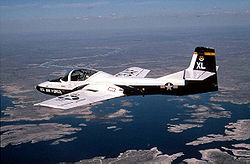
The Cessna T-37 Tweet (designated Model 318 by Cessna) is a small, economical twin-engine jet trainer aircraft. It was flown for decades as a primary trainer of the United States Air Force (USAF) as well as in the air forces of several other nations.
The T-37 was developed in response to the launch of the "Trainer Experimental (TX)" program for the United States Air Force (USAF) in early 1952. On 12 October 1954, the prototype XT-37 performed its maiden flight. While the first prototype was lost during spin tests, features to improve handling were installed upon subsequent prototypes, such as nose-mounted strakes and a heavily redesigned large tail unit, after which the USAF chose to order the aircraft into production as the T-37A. The service received the first production aircraft during June 1956.
In response to the T-37A being underpowered, the USAF ordered an improved version, the T-37B, that was powered by uprated J-69-T-25 engines and was also equipped with improved avionics. A total of 552 new-built T-37Bs were constructed through 1973; all surviving T-37As were eventually upgraded to the T-37B standard as well. The T-37 served as the USAF's primary pilot training vehicle for over 50 years after its first flight. After completing initial training in the T-37, students progressed on to other advanced Air Force, Navy, Marine Corps or Allied trainers. A total of 1,269 T-37s were constructed prior to production ending in 1975. In 2009, the USAF withdrew its final T-37, having replaced the type with the newer turboprop-powered Beechcraft T-6 Texan II.
In addition to its use as a trainer, an armed T-37C variant was developed as a weapons trainer. A dedicated attack variant, the A-37 Dragonfly, was also developed by Cessna during the 1960s in response to a need for counter-insurgency aircraft (COIN) aircraft for the Vietnam War. Both the A-37 and T-37C were exported to various other countries, leading to their adoption by the air forces of several South American nations.
The T-37 can be traced back to the spring of 1952 and the issuing of a request for proposals by the United States Air Force (USAF) for what would become the "Trainer Experimental (TX)" program. The request called for a lightweight twin-seat basic trainer that would be suitable for introducing USAF cadets to jet aircraft. More specifically, the aircraft had to be simple to operate, easy to maintain, structurally strong, possess favourable low-speed handling qualities, be relatively safe while performing high altitude maneuvers, adequate fuel capacity for at least two flight hours, a service ceiling of 30,000 feet, a maximum approach speed of 113 knots, a maximum all-up weight of 4,000 lbs, and the ability to land and take off in less than 4,000 feet.
Cessna was one of eight aircraft manufacturers to respond to the TX request, the company designed a twin-jet aircraft with side-by-side seating that it internally designated as the Model 318. The USAF favorably received Cessna's submission, particularly the use of the side-by-side seating configuration as it let the student and instructor interact more closely than would be possible with tandem seating. In the spring of 1954, the USAF issued a contract to Cessna for the production of three prototypes of the Model 318 along with a separate contract for a single static test aircraft. The aircraft was designated XT-37 by the USAF. According to aviation author Kev Darling, the selection of Cessna was a surprising result as the company was only experienced with piston-engined aircraft at the time.
The XT-37 was an all-metal aircraft with a semi-monocoque fuselage. It was an aerodynamically clean aircraft, so much so that a speedbrake was fitted behind the nosewheel doors that would be deployed to increase drag when the aircraft was landing as well as in other phases of flight. Since the relatively short landing gear placed the engine's air intakes close to the ground, screens pivoted over the intakes from underneath when the landing gear was extended to prevent foreign object damage. The wide track and a steerable nosewheel enabled it to be relatively easy to handle on the ground while the short landing gear avoided the need for access ladders and service stands. For simplicity of maintenance, the fuselage featured in excess of 100 access panels and doors; an experienced ground crew could change an engine in about half an hour.
The XT-37 was fitted with a pair of Continental-Teledyne J69-T-9 turbojet engines, which were French Turbomeca Marboré engines produced under license, each being capable of generating up to 920 lbf (4.1 kN) of thrust. These engines were equipped with thrust attenuators that permitted them to remain spooled-up (i.e. rotating at speeds above idle) during landing approach, permitting shorter landings while still allowing the aircraft to easily make another go-around in case something went wrong. The empty weight of the XT-37 was 5,000 lb (2,300 kg).
Cessna T-37 Tweet
The Cessna T-37 Tweet (designated Model 318 by Cessna) is a small, economical twin-engine jet trainer aircraft. It was flown for decades as a primary trainer of the United States Air Force (USAF) as well as in the air forces of several other nations.
The T-37 was developed in response to the launch of the "Trainer Experimental (TX)" program for the United States Air Force (USAF) in early 1952. On 12 October 1954, the prototype XT-37 performed its maiden flight. While the first prototype was lost during spin tests, features to improve handling were installed upon subsequent prototypes, such as nose-mounted strakes and a heavily redesigned large tail unit, after which the USAF chose to order the aircraft into production as the T-37A. The service received the first production aircraft during June 1956.
In response to the T-37A being underpowered, the USAF ordered an improved version, the T-37B, that was powered by uprated J-69-T-25 engines and was also equipped with improved avionics. A total of 552 new-built T-37Bs were constructed through 1973; all surviving T-37As were eventually upgraded to the T-37B standard as well. The T-37 served as the USAF's primary pilot training vehicle for over 50 years after its first flight. After completing initial training in the T-37, students progressed on to other advanced Air Force, Navy, Marine Corps or Allied trainers. A total of 1,269 T-37s were constructed prior to production ending in 1975. In 2009, the USAF withdrew its final T-37, having replaced the type with the newer turboprop-powered Beechcraft T-6 Texan II.
In addition to its use as a trainer, an armed T-37C variant was developed as a weapons trainer. A dedicated attack variant, the A-37 Dragonfly, was also developed by Cessna during the 1960s in response to a need for counter-insurgency aircraft (COIN) aircraft for the Vietnam War. Both the A-37 and T-37C were exported to various other countries, leading to their adoption by the air forces of several South American nations.
The T-37 can be traced back to the spring of 1952 and the issuing of a request for proposals by the United States Air Force (USAF) for what would become the "Trainer Experimental (TX)" program. The request called for a lightweight twin-seat basic trainer that would be suitable for introducing USAF cadets to jet aircraft. More specifically, the aircraft had to be simple to operate, easy to maintain, structurally strong, possess favourable low-speed handling qualities, be relatively safe while performing high altitude maneuvers, adequate fuel capacity for at least two flight hours, a service ceiling of 30,000 feet, a maximum approach speed of 113 knots, a maximum all-up weight of 4,000 lbs, and the ability to land and take off in less than 4,000 feet.
Cessna was one of eight aircraft manufacturers to respond to the TX request, the company designed a twin-jet aircraft with side-by-side seating that it internally designated as the Model 318. The USAF favorably received Cessna's submission, particularly the use of the side-by-side seating configuration as it let the student and instructor interact more closely than would be possible with tandem seating. In the spring of 1954, the USAF issued a contract to Cessna for the production of three prototypes of the Model 318 along with a separate contract for a single static test aircraft. The aircraft was designated XT-37 by the USAF. According to aviation author Kev Darling, the selection of Cessna was a surprising result as the company was only experienced with piston-engined aircraft at the time.
The XT-37 was an all-metal aircraft with a semi-monocoque fuselage. It was an aerodynamically clean aircraft, so much so that a speedbrake was fitted behind the nosewheel doors that would be deployed to increase drag when the aircraft was landing as well as in other phases of flight. Since the relatively short landing gear placed the engine's air intakes close to the ground, screens pivoted over the intakes from underneath when the landing gear was extended to prevent foreign object damage. The wide track and a steerable nosewheel enabled it to be relatively easy to handle on the ground while the short landing gear avoided the need for access ladders and service stands. For simplicity of maintenance, the fuselage featured in excess of 100 access panels and doors; an experienced ground crew could change an engine in about half an hour.
The XT-37 was fitted with a pair of Continental-Teledyne J69-T-9 turbojet engines, which were French Turbomeca Marboré engines produced under license, each being capable of generating up to 920 lbf (4.1 kN) of thrust. These engines were equipped with thrust attenuators that permitted them to remain spooled-up (i.e. rotating at speeds above idle) during landing approach, permitting shorter landings while still allowing the aircraft to easily make another go-around in case something went wrong. The empty weight of the XT-37 was 5,000 lb (2,300 kg).
Recent media
Recent media