
Recent from talks
Veil
Knowledge base stats:
Talk channels stats:
Members stats:
Veil
A veil is an article of clothing or hanging cloth that is intended to cover some part of the head or face, or an object of some significance. Veiling has a long history in European, Asian, and African societies. The practice has been prominent in different forms in Judaism, Christianity, and Islam. The practice of veiling is especially associated with women and sacred objects, though in some cultures, it is men, rather than women, who are expected to wear a veil. Besides its enduring religious significance, veiling continues to play a role in some modern secular contexts, such as wedding customs.
Elite women in ancient Mesopotamia and in the Macedonian and Persian empires wore the veil as a sign of respectability and high status. The earliest attested reference to veiling is found in a Middle Assyrian law code dating from between 1400 and 1100 BC. Assyria had explicit sumptuary laws detailing which women must veil and which women must not, depending upon the woman's class, rank, and occupation in society. Female slaves and prostitutes were forbidden to veil and faced harsh penalties if they did so. The Middle Assyrian law code states:
§ 40. A wife-of-a-man, or [widows], or [Assyrian] women who go out into the main thoroughfare [shall not have] their heads [bare]. […] A prostitute shall not veil herself, her head shall be bare. Whoever sees a veiled prostitute shall seize her, secure witnesses, and bring her to the palace entrance. They shall not take her jewellery; he who has seized her shall take her clothing; they shall strike her 50 blows with rods; they shall pour hot pitch over her head. And if a man should see a veiled prostitute and release her and not bring her to the palace entrance: they shall strike that man 50 blows with rods; the one who informs against him shall take his clothing; they shall pierce his ears, thread (them) on a cord, tie (it) at his back; he shall perform the king's service for one full month. Slave-women shall not veil themselves, and he who should see a veiled slave-woman shall seize her and bring her to the palace entrance: they shall cut off her ears; he who seizes her shall take her clothing.
Veiling not only was thus a marker of aristocratic rank, but also served to "differentiate between 'respectable' women and those who were publicly available". The veiling of matrons was also customary in ancient Greece. Between 550 and 323 B.C.E respectable women in classical Greek society were expected to seclude themselves and wear clothing that concealed them from the eyes of strange men.
The Mycenaean Greek term 𐀀𐀢𐀒𐀺𐀒, a-pu-ko-wo-ko, possibly meaning "headband makers" or "craftsmen of horse veil", and written in Linear B syllabic script, is also attested since ca. 1300 BC. In ancient Greek the word for veil was καλύπτρα (kalyptra; Ionic Greek: καλύπτρη, kalyptrē; from the verb καλύπτω, kalyptō, "I cover").
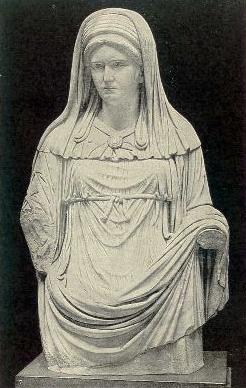
Classical Greek and Hellenistic statues sometimes depict Greek women with both their head and face covered by a veil. Caroline Galt and Lloyd Llewellyn-Jones have both argued from such representations and literary references that it was commonplace for women (at least those of higher status) in ancient Greece to cover their hair and face in public. Roman women were expected to wear veils as a symbol of the husband's authority over his wife; a married woman who omitted the veil was seen as withdrawing herself from marriage. In 166 BC, consul Sulpicius Gallus divorced his wife because she had left the house unveiled, thus allowing all to see, as he said, what only he should see. Unmarried girls normally did not veil their heads, but matrons did so to show their modesty and chastity, their pudicitia. Veils also protected women against the evil eye, it was thought.
A veil called flammeum was the most prominent feature of the costume worn by the bride at Roman weddings. The veil was a deep yellow color reminiscent of a candle flame. The flammeum also evoked the veil of the Flaminica Dialis, the Roman priestess who could not divorce her husband, the high priest of Jupiter, and thus was seen as a good omen for lifelong fidelity to one man. The Romans apparently thought of the bride as being "clouded over with a veil" and connected the verb nubere (to be married) with nubes, the word for cloud.
Intermixing of populations resulted in a convergence of the cultural practices of Greek, Persian, and Mesopotamian empires and the Semitic-speaking peoples of the Middle East. With the spread of Christianity, the ordinance of headcovering by women became normative throughout Christendom because it was enjoined in the Bible and by the Church Fathers. Veiling and seclusion of women appear to have established themselves among Jews and Christians, before spreading to urban Arabs of the upper classes and eventually among the urban masses. In the rural areas it was common to cover the hair, but not the face.
Hub AI
Veil AI simulator
(@Veil_simulator)
Veil
A veil is an article of clothing or hanging cloth that is intended to cover some part of the head or face, or an object of some significance. Veiling has a long history in European, Asian, and African societies. The practice has been prominent in different forms in Judaism, Christianity, and Islam. The practice of veiling is especially associated with women and sacred objects, though in some cultures, it is men, rather than women, who are expected to wear a veil. Besides its enduring religious significance, veiling continues to play a role in some modern secular contexts, such as wedding customs.
Elite women in ancient Mesopotamia and in the Macedonian and Persian empires wore the veil as a sign of respectability and high status. The earliest attested reference to veiling is found in a Middle Assyrian law code dating from between 1400 and 1100 BC. Assyria had explicit sumptuary laws detailing which women must veil and which women must not, depending upon the woman's class, rank, and occupation in society. Female slaves and prostitutes were forbidden to veil and faced harsh penalties if they did so. The Middle Assyrian law code states:
§ 40. A wife-of-a-man, or [widows], or [Assyrian] women who go out into the main thoroughfare [shall not have] their heads [bare]. […] A prostitute shall not veil herself, her head shall be bare. Whoever sees a veiled prostitute shall seize her, secure witnesses, and bring her to the palace entrance. They shall not take her jewellery; he who has seized her shall take her clothing; they shall strike her 50 blows with rods; they shall pour hot pitch over her head. And if a man should see a veiled prostitute and release her and not bring her to the palace entrance: they shall strike that man 50 blows with rods; the one who informs against him shall take his clothing; they shall pierce his ears, thread (them) on a cord, tie (it) at his back; he shall perform the king's service for one full month. Slave-women shall not veil themselves, and he who should see a veiled slave-woman shall seize her and bring her to the palace entrance: they shall cut off her ears; he who seizes her shall take her clothing.
Veiling not only was thus a marker of aristocratic rank, but also served to "differentiate between 'respectable' women and those who were publicly available". The veiling of matrons was also customary in ancient Greece. Between 550 and 323 B.C.E respectable women in classical Greek society were expected to seclude themselves and wear clothing that concealed them from the eyes of strange men.
The Mycenaean Greek term 𐀀𐀢𐀒𐀺𐀒, a-pu-ko-wo-ko, possibly meaning "headband makers" or "craftsmen of horse veil", and written in Linear B syllabic script, is also attested since ca. 1300 BC. In ancient Greek the word for veil was καλύπτρα (kalyptra; Ionic Greek: καλύπτρη, kalyptrē; from the verb καλύπτω, kalyptō, "I cover").
Classical Greek and Hellenistic statues sometimes depict Greek women with both their head and face covered by a veil. Caroline Galt and Lloyd Llewellyn-Jones have both argued from such representations and literary references that it was commonplace for women (at least those of higher status) in ancient Greece to cover their hair and face in public. Roman women were expected to wear veils as a symbol of the husband's authority over his wife; a married woman who omitted the veil was seen as withdrawing herself from marriage. In 166 BC, consul Sulpicius Gallus divorced his wife because she had left the house unveiled, thus allowing all to see, as he said, what only he should see. Unmarried girls normally did not veil their heads, but matrons did so to show their modesty and chastity, their pudicitia. Veils also protected women against the evil eye, it was thought.
A veil called flammeum was the most prominent feature of the costume worn by the bride at Roman weddings. The veil was a deep yellow color reminiscent of a candle flame. The flammeum also evoked the veil of the Flaminica Dialis, the Roman priestess who could not divorce her husband, the high priest of Jupiter, and thus was seen as a good omen for lifelong fidelity to one man. The Romans apparently thought of the bride as being "clouded over with a veil" and connected the verb nubere (to be married) with nubes, the word for cloud.
Intermixing of populations resulted in a convergence of the cultural practices of Greek, Persian, and Mesopotamian empires and the Semitic-speaking peoples of the Middle East. With the spread of Christianity, the ordinance of headcovering by women became normative throughout Christendom because it was enjoined in the Bible and by the Church Fathers. Veiling and seclusion of women appear to have established themselves among Jews and Christians, before spreading to urban Arabs of the upper classes and eventually among the urban masses. In the rural areas it was common to cover the hair, but not the face.
Recent media