


Community hub
Recent from talks
Contribute something
Nothing was collected or created yet.
Linear B
View on Wikipedia
| Linear B | |
|---|---|
 | |
| Script type | with additional ideograms |
Period | c. 1450–1200 BC |
| Status | Extinct |
| Direction | Left-to-right  |
| Languages | Mycenaean Greek |
| Related scripts | |
Parent systems | Linear A
|
Sister systems | Cypro-Minoan syllabary |
| ISO 15924 | |
| ISO 15924 | Linb (401), Linear B |
| Unicode | |
Unicode alias | Linear B |
| |
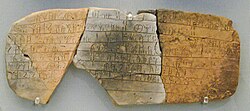
Linear B is a syllabic script that was used for writing in Mycenaean Greek, the earliest attested form of the Greek language.[1] The script predates the Greek alphabet by several centuries, the earliest known examples dating to around 1450 BC.[2][3] It is adapted from the earlier Linear A, an undeciphered script perhaps used for writing the Minoan language, as is the later Cypriot syllabary, which also recorded Greek. Linear B, found mainly in the palace archives at Knossos, Kydonia,[4] Pylos, Thebes and Mycenae,[5] disappeared with the fall of Mycenaean civilization during the Late Bronze Age collapse. The succeeding period, known as the Greek Dark Ages, provides no evidence of the use of writing.
Linear B was deciphered in 1952 by English architect and self-taught linguist Michael Ventris[6] based on the research of American classicist Alice Kober.[7] It is the only Bronze Age Aegean script to have been deciphered, with Linear A, Cypro-Minoan, and Cretan hieroglyphic remaining unreadable.[8]
Linear B consists of around 87 syllabic signs and over 100 ideographic signs. These ideograms or "signifying" signs symbolize objects or commodities. They have no phonetic value and are never used as word signs in writing a sentence.
The application of Linear B texts appear to have been mostly confined to administrative contexts, mainly at Mycenaean palatial sites.[9] In the handwriting of all the thousands of clay tablets, a relatively small number of scribes have been detected: 45 in Pylos (west coast of the Peloponnese, in Southern Greece) and 66 in Knossos (Crete). The use of Linear B signs on trade objects like amphora was more widespread.[10] Once the palaces were destroyed, the script disappeared.[11]
Script
[edit]Linear B has roughly 200 signs, divided into syllabic signs with phonetic values and ideograms with semantic values. The representations and naming of these signs have been standardized by a series of international colloquia starting in Paris in 1956. After the third meeting in 1961 at the Wingspread Conference Center in Racine, Wisconsin, a standard proposed primarily by Emmett L. Bennett, Jr. became known as the Wingspread Convention, which was adopted by a new organization, the Comité International Permanent des Études Mycéniennes (CIPEM: Permanent International Committee of Mycenaean Studies), affiliated in 1970 by the fifth colloquium with UNESCO.[12] Colloquia continue: the 13th occurred in 2010 in Paris.
Many of the signs are identical or similar to those in Linear A; however, Linear A encodes an as yet unknown language, and it is uncertain whether similar signs had the same phonetic values.[13]
Syllabic signs
[edit]The grid developed during decipherment by Michael Ventris and John Chadwick of phonetic values for syllabic signs is shown below.[14] (Note that "q" represents the labialized velar stops [ɡʷ, kʷ, kʷʰ], not the uvular stop of the IPA, whereas "j" does represent the IPA voiced palatal approximant [j], represented by the letter "y" in English words such as "yes" and "yoke".)
Initial consonants are in the leftmost column; vowels are in the top row beneath the title. The transcription of the syllable, which may not have been pronounced that way, is listed next to the sign along with Bennett's identifying number for the sign preceded by an asterisk (as was Ventris' and Chadwick's convention).[note 1] If the transcription of the sign remains uncertain, Bennett's number serves to identify the sign.[15] The signs on the tablets and sealings often show considerable variation from each other and from the representations below. Discovery of the reasons for the variation and possible semantic differences is a topic of ongoing debate in Mycenaean studies.
| Recognised signs of shape V, CV[note 2] | ||||||||||
|---|---|---|---|---|---|---|---|---|---|---|
| -a | -e | -i | -o | -u | ||||||
𐀀 
|
a
*08 |
𐀁 
|
e
*38 |
𐀂 
|
i
*28 |
𐀃 
|
o
*61 |
𐀄 
|
u
*10 | |
| d- | 𐀅 
|
da
*01 |
𐀆 
|
de
*45 |
𐀇 
|
di
*07 |
𐀈 
|
do
*14 |
𐀉 
|
du
*51 |
| j- | 𐀊 
|
ja
*57 |
𐀋 
|
je
*46 |
𐀍 
|
jo
*36 |
||||
| k- | 𐀏 
|
ka
*77 |
𐀐 
|
ke
*44 |
𐀑 
|
ki
*67 |
𐀒 
|
ko
*70 |
𐀓 
|
ku
*81 |
| m- | 𐀔 
|
ma
*80 |
𐀕 
|
me
*13 |
𐀖 
|
mi
*73 |
𐀗 
|
mo
*15 |
𐀘 
|
mu
*23 |
| n- | 𐀙 
|
na
*06 |
𐀚 
|
ne
*24 |
𐀛 
|
ni
*30 |
𐀜 
|
no
*52 |
𐀝 
|
nu
*55 |
| p- | 𐀞 
|
pa
*03 |
𐀟 
|
pe
*72 |
𐀠 
|
pi
*39 |
𐀡 
|
po
*11 |
𐀢 
|
pu
*50 |
| q- | 𐀣 
|
qa
*16 |
𐀤 
|
qe
*78 |
𐀥 
|
qi
*21 |
𐀦 
|
qo
*32 |
||
| r- | 𐀨 
|
ra
*60 |
𐀩 
|
re
*27 |
𐀪 
|
ri
*53 |
𐀫 
|
ro
*02 |
𐀬 
|
ru
*26 |
| s- | 𐀭 
|
sa
*31 |
𐀮 
|
se
*09 |
𐀯 
|
si
*41 |
𐀰 
|
so
*12 |
𐀱 
|
su
*58 |
| t- | 𐀲 
|
ta
*59 |
𐀳 
|
te
*04 |
𐀴 
|
ti
*37 |
𐀵 
|
to
*05 |
𐀶 
|
tu
*69 |
| w- | 𐀷 
|
wa
*54 |
𐀸 
|
we
*75 |
𐀹 
|
wi
*40 |
𐀺 
|
wo
*42 |
||
| z- | 𐀼 
|
za
*17 |
𐀽 
|
ze
*74 |
𐀿 
|
zo
*20 |
||||
Special and unknown signs
[edit]In addition to the grid, the first edition of Documents in Mycenaean Greek contained a number of other signs termed "homophones" because they appeared at that time to resemble the sounds of other syllables and were transcribed accordingly: pa2 and pa3 were presumed homophonous to pa. Many of these were identified by the second edition and are shown in the "special values" below.[16] The second edition relates: "It may be taken as axiomatic that there are no true homophones." The unconfirmed identifications of *34 and *35 as ai2 and ai3 were removed. pa2 became qa.[17]
| Special values | |||||||||||||||||||||||||||||
|---|---|---|---|---|---|---|---|---|---|---|---|---|---|---|---|---|---|---|---|---|---|---|---|---|---|---|---|---|---|
| Character | 𐁀 
|
𐁁 
|
𐁂 
|
𐁃 
|
𐁄 
|
𐁅 
|
𐁇 
|
𐁆 
|
𐁈 
|
𐁉 
|
𐁊 
|
𐁋 
|
𐁌 
|
𐁍 
| |||||||||||||||
| Transcription | a2 (ha) | a3 (ai) | au | dwe | dwo | nwa | pte | pu2 (phu) | ra2 (rya) | ra3 (rai) | ro2 (ryo) | ta2 (tya) | twe | two | |||||||||||||||
| Bennett's number | *25 | *43 | *85 | *71 | *90 | *48 | *62 | *29 | *76 | *33 | *68 | *66 | *87 | *91 | |||||||||||||||
Other values remain unknown, mainly because of scarcity of evidence concerning them.[16][note 3] Note that *34 and *35 are mirror images of each other, but whether this graphic relationship indicates a phonetic one remains unconfirmed.[18]
| Untranscribed and doubtful values | |||||||||||||||||||||||||||||
|---|---|---|---|---|---|---|---|---|---|---|---|---|---|---|---|---|---|---|---|---|---|---|---|---|---|---|---|---|---|
| Character | 𐁐 
|
𐁑 
|
𐁒 
|
𐁓 
|
𐁔 
|
𐁕 
|
𐁖 
|
𐁗 
|
𐁘 
|
𐀎 
|
𐁙 
|
𐁚 
|
𐁛 
|
𐁜 
|
𐁝 
| ||||||||||||||
| Transcription | *18 | *19 | *22 | *34 | *35 | *47 | *49 | pa3? | *63 | swi? | ju? | zu? | swa? | *83 | *86 | *89 | |||||||||||||
| Bennett's number | *18 | *19 | *22 | *34 | *35 | *47 | *49 | *56 | *63 | *64 | *65 | *79 | *82 | *83 | *86 | *89 | |||||||||||||
CIPEM inherited the former authority of Bennett and the Wingspread convention in deciding what signs are "confirmed" and how to officially represent the various sign categories. In editions of Mycenaean texts, the signs whose values have not been confirmed by CIPEM are always transcribed as numbers preceded by an asterisk (e.g., *64). CIPEM also allocates the numerical identifiers, and until such allocation, new signs (or obscured or mutilated signs) are transcribed as a bullet-point enclosed in square brackets: [•].
Spelling and pronunciation
[edit]
The signs are approximations, since each may be used to represent a variety of about 70 distinct combinations of sounds within rules and conventions. The grid presents a system of monosyllabic signs of the type V/CV. Clarification of the 14 or so special values tested the limits of the grid model, but Chadwick eventually concluded that even with the ramifications, the syllabic signs can unexceptionally be considered monosyllabic.[19]
Possible exceptions, Chadwick goes on to explain, include the two diphthongs, 𐁀 (ai) and 𐁁 (au), as in 𐁀𐀓𐀠𐀴𐀍, ai-ku-pi-ti-jo, for Aiguptios (Αἰγύπτιος, "Egyptian") and 𐁁𐀐𐀷, au-ke-wa, for Augewās (Αὐγείας "Augeas").[note 4] However, a diphthong is by definition two vowels united into a single sound and therefore might be typed as just V. Thus 𐁉 (rai), as in 𐀁𐁉𐀺, e-rai-wo, for elaiwon (ἔλαιον),[note 5] is of the type CV. Diphthongs are otherwise treated as two monosyllables: 𐀀𐀫𐀄𐀨, a-ro-u-ra, for arourans (accusative plural of ἄρουραι, "tamarisk trees"), of the types CV and V.[20] Lengths of vowels and accents are not marked.
𐁌 (Twe), 𐁍 (two), 𐁃 (dwe), 𐁄 (dwo), 𐁅 (nwa) and the more doubtful 𐁘 (swi) and 𐁙 (swa) may be regarded as beginning with labialized consonants, rather than two consonants, even though they may alternate with a two-sign form: o-da-twe-ta and o-da-tu-we-ta for Odatwenta; a-si-wi-jo and a-swi-jo for Aswios (Ἄσιος). Similarly, 𐁈 (rya), 𐁊 (ryo) and 𐁋 (tya) begin with palatalized consonants rather than two consonants: -ti-ri-ja for -trja (-τρια).
The one sign Chadwick tags as the exception to the monosyllabic rule is 𐁇 (pte), but this he attributes to a development pte<*pje as in kleptei<*klep-jei.
Linear B does not consistently distinguish between voiced and unvoiced stop consonants or between aspirated and unaspirated stops, even though these distinctions are phonemic in Mycenaean Greek. (The exception is the dental series, where syllables starting with the voiced dental stop are written differently from syllables starting with the voiceless unaspirated or voiceless aspirated dental stop.) For example,[21] pa-te is patēr (πατήρ), pa-si is phāsi (φησί),[note 6] ko-ru is korus (κόρυς, "helmet"), ka-ra-we is grāwes (plural of γρηύς), ko-no is skhoinos ("rope"), to-so is tosos (τόσος or τόσσος), to-ra-ke is thōrākes (plural of θώραξ, "breastplate"). The exceptional d-series for voiced dentals is illustrated by do-ra for dōra (plural of δῶρον, "gift").
In some cases aspiration may be marked, but this is optional: pu-te for phutēr ("planter", from φυτεύω), but phu-te-re for phutēres ("planters"). Initial /h/ may be marked only when followed by a, and only rarely: ha-te-ro for hateron (masculine ἅτερος),[22] and yet a-ni-ja for hāniai (ἁνίαι).
The q-series is used for syllables beginning with labialized velar consonants (see under Mycenaean Greek), a class of consonants that disappeared from classical Greek by regular phonetic change (becoming in various circumstances β, π, φ, or δ, τ, θ). These consonants had various sources: inheritance from Proto-Indo-European, assimilation, borrowing of foreign words, especially names. In Mycenaean they are /kʷ/, /gʷ/, and rarely /kʷh/ in names and a few words:[23] a-pi-qo-ro for amphiquoloi (ἀμφίπολοι); qo-u-ko-ro for guoukoloi (βουκόλοι, "cowherders"); qa-si-re-u for guasileus (βασιλεύς, "basileus", meaning in this period "court official or local chieftain"), -qo-i-ta for -φόντης.
The j-series represents the semivowel equivalent to English "y", and is used word-initially and as an intervocalic glide after a syllable ending in i: -a-jo for -αῖος (-aios); a-te-mi-ti-jo for Ἀρτεμίτιος (Artemitios). The w-series similarly are semivowels used word-initially and intervocalically after a syllable ending in u: ku-wa-no for kuanos (κύανος, "blue").[24]
The r-series includes both the /r/ and /l/ phonemes: ti-ri-po for tripos (τρίπος, i.e. τρίπους) and tu-ri-so for Tulisos (Τυλισός).
Some consonants in some contexts are not written (but are understood to be present), such as word-initial s- and -w before a consonant, as in pe-ma for sperma (σπέρμα, "seed"). The pe-, which was primarily used as its value pe of grid class CV, is here being used for sper-. This was not an innovative or exceptional use, but followed the stated rules. Syllable-final -l, -m, -n, -r and -s are also not written out, and only word-final velars are notated by plene writing: a-to-ro-qo for anthrōquos (ἄνθρωπος, "human being, person"). Here a, being primarily of grid class V, is being used as an- and could be used for al, am, ar, and so on.
In the case of clusters of two or three consonants that do not follow the initial s- and -w rule or the double consonants: ξ (ks or x), ψ (ps) and qus (which later did not exist in classical Greek), each consonant in the cluster is represented by a type CV sign that shares its consonant value: ko-no-so for Knōsos,[note 7] or ku-ru-so for khrusos (χρυσός, "gold"). The vowels of these signs have been called "empty", "null", "extra", "dead", "dummy" and other terms by various writers as they represent no sound. There were rules though, that governed the selection of the "empty" vowel and therefore determined which sign was to be used. The vowel had to be the same as that of the first syllable following the cluster or, if at the end of the word, preceding: ti-ri-po with ti- (instead of ta-, te- and so on) to match -ri-. A rare exception occurs in words formed from wa-na-ka, wanax (ϝάναξ, Homeric and Classical ἄναξ): wa-na-ka-te for wanaktei (dative), and wa-na-ka-te-ro for wanakteros, the adjectival form. This exception may not have applied to all contexts, as an example of wa-na-ka that follows standard rules has emerged in Agios Vasileios in Laconia. The text reads wa-na-ko-to (genitive) and is written on a sealing nodule dating to the late 14th or early 13th century, slightly earlier than other Linear B texts found on mainland Greece.[25]
Ideograms
[edit]Linear B also uses a large number of ideograms. They express:
- the type of object concerned (e.g. a cow, wool, a spear),
- a unit of measure.
They have no phonetic value and are never used as word signs in writing a sentence, unlike Japanese kanji or Hittite cuneiform. Ideograms are typically at the end of a line before a number and appear to signify to which object the number applies. Many of the values remain unknown or disputed. Some commodities such as cloth and containers are divided into many different categories represented by distinct ideograms. Livestock may be marked with respect to sex.
The numerical references for the ideograms were originally devised by Ventris and Bennett and divided into functional groups corresponding to the breakdown of Bennett's index. The groups are numbered beginning 100, 110, 120 etc., with some provision of spare numbers for future additions; the official CIPEM numberings used today are based on Ventris and Bennett's numbering, with the provision that three or four letter codes (written in small capitals), based on Latin words that seemed relevant at the time, are used where the meanings are known and agreed. Unicode (as of version 5.0) encodes 123 Linear B ideograms.
The ideograms are symbols, not pictures of the objects in question; for example, one tablet records a tripod with missing legs, but the ideogram used is of a tripod with three legs. In modern transcriptions of Linear B tablets, it is typically convenient to represent an ideogram by its Latin or English name or by an abbreviation of the Latin name. Ventris and Chadwick generally used English; Bennett, Latin. Neither the English nor the Latin can be relied upon as an accurate name of the object; in fact, the identification of some of the more obscure objects is a matter of exegesis.[26][failed verification]
| Glyph | Code point[note 8] | Bennett[27] | CIPEM[28] | English[29] |
|---|---|---|---|---|
| People and animals | ||||
| 𐂀 | U+10080 | 100[30] A- | VIR vir |
MAN |
| 𐂁 | U+10081 | 102 A- | MUL mulier |
WOMAN |
| 𐂂 | U+10082 | 104 Cn | CERV cervus |
DEER |
| 𐂃 | U+10083 | 105 Ca S- | EQU equus |
HORSE |
| 𐂄 | U+10084 | 105 Ca | EQUf | mare[31] |
| 𐂅 | U+10085 | 105 Ca | EQUm | stallion |
| 𐀥 | U+10025 | 106 QI *21 |
OVIS ovis |
SHEEP |
| 𐀸 | WE *75 |
we-ka-ta Bous ergatēs |
"Adjunct to ox" (1973)[32] | |
| 𐂆 | U+10086 | 106b C- D- | OVISf | EWE |
| 𐂇 | U+10087 | 106a C- D- | OVISm | RAM |
| 𐁒 | U+10052 | 107 RA *22 |
CAP capra |
GOAT |
| 𐂈 | U+10088 | 107b C- Mc | CAPf | SHE-GOAT |
| 𐂉 | U+10089 | 107a C- | CAPm | HE-GOAT |
| 𐁂 | U+10042 | 108 AU *85 C- |
SUS sūs |
PIG |
| 𐂊 | U+1008A | 108b C- | SUSf | SOW |
| 𐂋 | U+1008B | 108a C- | SUSm | BOAR |
| 𐀘 | U+10018 | 109 MU *23 C- |
BOS bōs |
OX |
| 𐂌 | U+1008C | 109b C- | BOSf | COW |
| 𐂍 | U+1008D | 109a C- | BOSm | OX/BULL |
| Units of measurement | ||||
| 𐄿 | U+1013F | 110 | Z kotylai |
Volume Cup[33] |
| 𐄾 | U+1013E | 111 | V khoinikes |
Volume |
| 𐄼 | U+1013C | 112 | T | Dry |
| 𐄽 | U+1013D | 113 | S | Liquid |
| 𐄻 | U+1013B | 114 | Weight | |
| *21 | Weight | |||
| *2 | Weight | |||
| 𐄺 | U+1013A | 115 | P | Weight |
| 𐄹 | U+10139 | 116 | N | Weight |
| 𐄸 | U+10138 | 117 | M dimnaion[34] |
Weight |
| 𐄷 | U+10137 | 118 | L talanton |
TALENT |
| *72 G- | Bunch? | |||
| *74 S- | Pair | |||
| *15 S- | Single | |||
| *61 | Deficit | |||
| By dry measure | ||||
| 𐂎 | U+1008E | 120 E- F- | GRA grānum |
WHEAT |
| 𐂏 | U+1008F | 121 F- | HORD hordeum |
BARLEY |
| 𐂐 | U+10090 | 122 F- U- | OLIV olīva |
OLIVES |
| 𐀛 | U+1001B | NI *30 F |
FICUS | FIGS |
| 𐀎 | U+1000E | *65 | FARINA | FLOUR "some kind of grain"[35] |
| 𐂑 | U+10091 | 123 G- Un | AROM arōma |
CONDIMENT / SPICE |
| KO *70 G- |
Coriander | |||
| 𐀭 | U+1002D | SA *31 G- |
Sesame | |
| KU *81 G- |
Cumin | |||
| SE *9 G- |
Celery | |||
| MA *80 G- |
Fennel | |||
| 124 G- | PYC | cyperus | ||
| 𐂒 | U+10092 | 125 F- | CYP | cyperus? |
| 126 F- | CYP+KU | cyperus+ku | ||
| 𐂓 | U+10093 | 127 Un | KAPO | fruit? |
| 𐂔 | U+10094 | 128 G- | KANAKO | safflower |
| By liquid measure | ||||
| 𐂕 | U+10095 | 130 | OLE ŏlĕum |
oil |
| 𐂖 | U+10096 | 131 | VIN vinum |
wine |
| 𐂘 | U+10098 | 133 | unguent | |
| 𐂙 | U+10099 | 135 | honey | |
| By weight | ||||
| By weight or in units | ||||
| Counted in units | ||||
| Vessels[36] | ||||
| 𐃟 | U+100DF | 200 | sartāgo |
BOILING PAN |
| 𐃠 | U+100E0 | 201 | TRI tripūs |
TRIPOD CAULDRON |
| 𐃡 | U+100E1 | 202 | pōculum |
GOBLET? |
| 𐃢 | U+100E2 | 203 | urceus |
WINE JAR? |
| 𐃣 | U+100E3 | 204 Ta | hirnea |
EWER |
| 𐃤 | U+100E4 | 205 K Tn | hirnula |
JUG |
| 𐃥 | U+100E5 | 206 | HYD hydria |
HYDRIA |
| 𐃦 | U+100E6 | 207 | TRIPOD AMPHORA | |
| 𐃧 | U+100E7 | 208 | PAT patera |
BOWL |
| 𐃨 | U+100E8 | 209 | AMPH amphora |
AMPHORA |
| 𐃩 | U+100E9 | 210 | STIRRUP JAR | |
| 𐃪 | U+100EA | 211 | WATER BOWL? | |
| 𐃫 | U+100EB | 212 | SIT situla |
WATER JAR? |
| 𐃬 | U+100EC | 213 | LANX lanx |
COOKING BOWL |
| Furniture | ||||
| 𐃄 | U+100C4 | 220 Ta | scamnum |
FOOTSTOOL |
| 𐃅 | U+100C5 | 225 | ALV alveus |
|
| Weapons | ||||
| 𐃆 | U+100C6 | 230 R | HAS hasta |
SPEAR |
| 𐃇 | U+100C7 | 231 R | SAG sagitta |
ARROW |
| 𐃈 | U+100C8 | 232 Ta | *232 | AXE |
| 𐃉 | U+100C9 | 233 Ra | DAGGER | |
| 𐃊 | U+100CA | 234 | GLA gladius |
SWORD |
| Chariots | ||||
| 𐃌 | U+100CC | 240 Sc | BIG biga |
WHEELED CHARIOT |
| 𐃍 | U+100CD | 241 Sd Se | CUR currus |
WHEEL-LESS CHARIOT |
| 𐃎 | U+100CE | 242 Sf Sg | CAPS capsus |
CHARIOT FRAME |
| 𐃏 | U+100CF | 243 Sa So | ROTA rota |
WHEEL |
Sample text
[edit]| Line | Mycenaean Greek (Linear B script) |
Transliteration | Transcription |
|---|---|---|---|
| 1 | 𐀗𐀛𐄁𐀀𐀸𐀆𐄁𐀳𐀀𐄁𐀟𐀩𐀷𐀆𐀃𐀍𐄁𐀀𐀑𐀩𐀺𐄁 | mo-ni a-we-de te-a pe-re-wa-de-o-jo a-ki-re-wo | Monin aweyde Tʰeha Pelewadeohyo Akʰilēwos |
| 2 | 𐀃𐀫𐀕𐀙𐄁𐁀𐀘𐀹𐀊𐄁𐀀𐀏𐀺𐄁𐀀𐀑𐀊𐄁𐀁𐀳𐀐𐄁 | o-ro-me-na ha=mu-wi-ja a-ka-wo a-ki-ja e-te-ke | olomenān, hā=murwia Akʰaywoys algya etʰēke, |
| 3 | 𐀡𐀩𐀷𐀆𐄁𐀂𐀠𐀴𐀗𐄁𐀢𐀱𐀏𐄁𐀀𐀹𐀅𐄁𐀡𐀫𐀊𐀟𐀮𐄁 | po-re-wa=de i-pi-ti-mo pu-su-ka a-wi-da po-ro-ja-pe-se | polewas=de ipʰtʰimons psūkʰans Awidāy proyapse |
| 4 | 𐀁𐀫𐀺𐄁𐁂𐀵𐀆𐄁𐀸𐀫𐀨𐄁𐀳𐀄𐀐𐄁𐀓𐀯𐄁 | e-ro-wo au-to=de we-ro-ra te-u-ke ku-si | hērōwōn, awtons=de welōra tewkʰe kunsi |
| 5 | 𐀃𐀺𐀜𐀂𐀤𐄁𐀞𐀯𐄁𐀇𐀺𐀆𐄁𐀁𐀤𐀩𐀁𐀵𐄁𐀦𐀨𐄁 | o-wo-no-i=qe pa-si di-wo=de e-qe-re-e-to qo-ra | oywonoyhi=kʷe pansi, Diwos=de ekʷeleeto gʷōlā, |
| 6 | 𐀁𐀐𐀰𐀍𐄁𐀆𐄁𐀲𐀡𐀫𐀷𐀲𐄁𐀇𐀹𐀀𐀂𐀲𐀲𐄁𐀁𐀪𐀭𐀳𐄁 | e-ke-so-jo de ta≈po-ro-wa-ta di-wi-a-i-ta-ta e-ri-sa-te | eks=hohyo dē tā≈prōwata dwiahistātān erisante |
| 7 | 𐀀𐀳𐀩𐀹𐀅𐀤𐄁𐀷𐀙𐀏𐄁𐀀𐀈𐀫𐄁𐀏𐄁𐀇𐀺𐄁𐀀𐀑𐀩𐀄𐄁 | a-te-re-wi-da=qe wa-na-ka a-do-ro ka di-wo a-ki-re-u | Atrewidās=kʷe wanaks andrōn kas diwos Akʰilews. |
| 8 | 𐀥𐀤𐄁𐀀𐀡𐀸𐄁𐀳𐀃𐄁𐀁𐀪𐀆𐄁𐀓𐀱𐀚𐀋𐀐𐄁𐀔𐀐𐀲𐄁 | qi=qe a=po-we te-o e-ri-de ku-su-ne-je-ke ma-ke-ta | Kʷis=kʷe ar=spʰōwe tʰehōn eridey ksuneyēke makʰestʰay; |
| 9 | 𐀨𐀵𐀺𐄁𐀏𐄁𐀇𐀺𐄁𐀄𐀍𐄁𐀍𐀒𐄁𐀣𐀯𐀩𐀹𐄁𐀒𐀫𐀳𐄁 | ra-to-wo ka di-wo u-jo jo=ko qa-si-re-wi ko-ro-te | Lātows kas Diwos huyos: yo=gor gʷasilēwi kʰolotʰēns |
| 10 | 𐀜𐀺𐄁𐀃𐀙𐄁𐀵𐀫𐀵𐄁𐀃𐀮𐄁𐀏𐀏𐄁𐀃𐀩𐀒𐀵𐀆𐄁𐀨𐀺𐀂𐄁 | no-wo o-na to-ro-to o-se ka-ka o-re-ko-to=de ra-wo-i | noswon ona stroton orse kakān, olekonto=de lāwoy, |
| 11 | 𐀃𐀄𐀁𐀚𐀏𐄁𐀵𐄁𐀓𐀬𐀭𐄁𐀀𐀁𐀥𐀔𐀮𐄁𐀀𐀷𐀳𐀨𐄁 | o-u=e-ne-ka to ku-ru-sa a-e-qi-ma-se a-wa-te-ra | oyu=eneka ton Kʰrūsān aekʷīmase arwātēra |
| 12 | 𐀀𐀳𐀩𐀹𐀅𐄁𐀍𐀒𐄁𐀁𐀬𐀳𐄁𐀵𐀷𐄁𐀂𐀠𐀙𐀷𐄁𐀀𐀏𐀺𐄁 | a-te-re-wi-da jo=ko e-ru-te to-wa i-pi≈na-wa a-ka-wo | Atrewidās: yo=gor elutʰe tʰowans ipi≈nāwas Akʰaywōn |
| 13 | 𐀬𐀰𐀕𐀜𐀤𐄁𐀶𐀏𐀲𐀨𐄁𐀠𐀫𐀜𐀰𐀤𐄁𐀀𐀠𐀷𐀯𐀊𐄁𐀀𐀦𐀙𐄁 | ru-so-me-no=qe tu-ka-ta-ra pi-ro-no-so=qe a-pi-wa-si-ja a-qo-na | lūsomenos=kʷe tʰugatra pʰirōns=kʷe apirwasia akʷoyna, |
| 14 | 𐀴𐀡𐀗𐀲𐄁𐀁𐀒𐄁𐀂𐀐𐀯𐄁𐀸𐀏𐀦𐀫𐀍𐄁𐀀𐀡𐀫𐀜𐄁 | ti-po-mo-ta e-ko i=ke-si we-ka-qo-ro-jo a-po-ro-no | stipʰmota hekʰons in=kʰehrsi hwekagʷolohyo Apollōnos |
| 15 | 𐀓𐀬𐀮𐀃𐄁𐀃𐀙𐄁𐀏𐀡𐀵𐀫𐄁𐀏𐄁𐀪𐀮𐀵𐄁𐀞𐀲𐄁𐀀𐀏𐀺𐄁 | ku-ru-se-o o-na ka-po-to-ro ka ri-se-to pa-ta a-ka-wo | kʰrūseōy ona skāptrōy, kas lisseto pantas Akʰaywons, |
| 16 | 𐀀𐀳𐀩𐀹𐀅𐀆𐄁𐀗𐀪𐀲𐄁𐀉𐀺𐄁𐀒𐀕𐀵𐀩𐄁𐀨𐀺𐄁 | a-te-re-wi-da=de mo-ri-ta du-wo ko-me-to-re ra-wo | Atrewidā=de molista duwō, kosmētore lāwōn: |
| 17 | 𐀀𐀳𐀩𐀹𐀅𐀤𐄁𐀏𐄁𐀀𐀫𐄁𐀁𐀄𐀏𐀙𐀖𐀆𐄁𐀀𐀏𐀺𐄁 | a-te-re-wi-da=qe ka a-ro e-u-ka-na-mi-de a-ka-wo | Atrewidāy=kʷe kas alloy ehuknāmides Akʰaywoy, |
| 18 | 𐀄𐀖𐀕𐄁𐀳𐀃𐄁𐀈𐀋𐄁𐀃𐀬𐀠𐀊𐄁𐀈𐀔𐀲𐄁𐀁𐀒𐀳𐄁 | u-mi≈me te-o do-je o-ru-pi-ja do-ma-ta e-ko-te | umi≈men tʰehoy doyen Olumpia dōmata hekʰontes |
| 19 | 𐀁𐀑𐀠𐀭𐄁𐀠𐀪𐀀𐀗𐀍𐄁𐀡𐀪𐄁𐀁𐀄𐀆𐄁𐀺𐀏𐀆𐄁𐀂𐀐𐀲𐄁 | e-ki=pi-sa pi-ri-a-mo-jo po-ri e-u=de wo-ka-de i-ke-ta | ek=pirsay Priamohyo polin, ehu=de woykade hikestʰay: |
| 20 | 𐀞𐀹𐀅𐀆𐄁𐀁𐀗𐄁𐀬𐀭𐀳𐄁𐀠𐀨𐄁𐀲𐀆𐄁𐀀𐀦𐀙𐄁𐀆𐀐𐀲𐄁 | pa-wi-da=de e-mo ru-sa-te pi-ra ta=de a-qo-na de-ke-ta | pawida=de emoy lusayte pʰilān, ta=de akʷoyna dekestʰay, |
| 21 | 𐀊𐀿𐀕𐀜𐄁𐀇𐀺𐄁𐀄𐀍𐄁𐀸𐀏𐀦𐀫𐄁𐀀𐀡𐀫𐀙𐄁 | ja-zo-me-no di-wo u-jo we-ka-qo-ro a-po-ro-na | yazomenoy Diwos huyon hwekagʷolon Apollōna. |
| 22 | 𐀁𐀲𐀀𐀫𐀕𐄁𐀞𐀳𐄁𐀂𐀠𐀄𐀞𐀔𐀭𐄁𐀀𐀏𐀺𐄁 | e-ta≈a-ro≈me pa-te i-pi-u-pa-ma-sa a-ka-wo | Entʰa≈alloy≈men pantes ipihupʰāmāsa Akʰaywoy |
| 23 | 𐁁𐀆𐀲𐀤𐄁𐀂𐀋𐀩𐀷𐄁𐀏𐄁𐀀𐀒𐀫𐀷𐄁𐀆𐀏𐀲𐄁𐀀𐀦𐀙𐄁 | ai-de-ta=qe i-je-re-wa ka a-ko-ro-wa de-ka-ta a-qo-na | aydestʰay=kʷe iherēwa kas aglowa dekstʰay akʷoyna: |
| 24 | 𐀀𐀨𐀃𐀄𐀏𐀳𐀩𐀹𐀅𐄁𐀀𐀏𐀕𐀜𐀛𐄁𐀷𐀆𐄁𐀶𐀗𐄁 | a-ra≈o-u-ka=te-re-wi-da a-ka-me-no-ni wa-de tu-mo | alla≈oyuk=Atrewidāy Agamemnoni hwande tʰūmōy, |
| 25 | 𐀀𐀨𐀏𐀒𐄁𐀀𐀠𐀋𐄁𐀒𐀫𐀳𐀫𐀆𐄁𐀂𐀠𐀘𐀵𐄁𐀁𐀤𐀩𐄁 | a-ra≈ka-ko a-pi-je ko-ro-te-ro=de i-pi≈mu-to e-qe-re | alla≈kakōs apʰiyē, kroteron=de ipi≈mūtʰon ekʷelle: |
| 26 | 𐀕𐀳𐄁𐀐𐀫𐄁𐀒𐀹𐀨𐄁𐀁𐀒𐄁𐀡𐀨𐀙𐀄𐀯𐄁𐀑𐀐𐀃𐄁 | me=te ke-ro ko-wi-ra e-ko po-ra≈na-u-si ki-ke-o | mē=te geron kowilāys egō pora≈nāusi kikʰēō |
| 27 | 𐀸𐀝𐄁𐀅𐀷𐀶𐀜𐀲𐄁𐀸𐄁𐀄𐀳𐀫𐄁𐁂𐀴𐄁𐀂𐀃𐀲𐄁 | we=nu da-wa-tu-no-ta we u-te-ro au-ti i-o-ta | wē=nūn dwātunonta wē usteron autʰis ihonta, |
| 28 | 𐀕𐀝𐀵𐄁𐀃𐀄𐀒𐀫𐀕𐀂𐄁𐀏𐀡𐀵𐀫𐄁𐀏𐄁𐀴𐀞𐀔𐄁𐀳𐀃𐀍𐄁 | me=nu=to o-u=ko-ro-me-i ka-po-to-ro ka ti-pa-ma te-o-jo | mē=nū=toy oyu=kʰroysmēhi skaptron kas stipʰma tʰehohyo: |
| 29 | 𐀲𐀆𐄁𐀁𐀒𐄁𐀃𐀄𐀬𐀰𐄁𐀠𐀪𐀖𐄁𐀏𐄁𐀐𐀨𐄁𐀂𐀟𐀯𐄁 | ta=de e-ko o-u=ru-so pi-ri≈mi ka ke-ra i-pe-si | tān=de egō oyu=lūsō: prin≈min kas gēras ip=eysi |
| 30 | 𐀀𐀕𐀳𐀫𐄁𐀂𐀛𐀺𐀒𐄁𐀂𐀙𐀐𐀂𐄁𐀤𐀫𐀴𐄁𐀞𐀲𐀨𐄁 | a-me-te-ro i-ni=wo-ko i=na-ke-i qe-ro-ti pa-ta-ra | ameterōy ini=woykōy in=Argēyi kʷēlotʰi patrās |
| 31 | 𐀂𐀲𐀖𐄁𐀂𐀡𐀒𐀕𐀙𐄁𐀏𐄁𐀁𐀗𐄁𐀩𐀒𐄁𐀀𐀯𐀃𐀺𐀯𐀊𐄁 | i-ta-mi i-po-ko-me-na ka e-mo re-ko a-si-o-wo-si-ja | histāmi ipoykʰomenān kas emon lekʰos ansiowosyan: |
| 32 | 𐀀𐀨𐀂𐀴𐄁𐀕𐀕𐄁𐀁𐀩𐀴𐀽𐄁𐀲𐀷𐀺𐀳𐀫𐄁𐀃𐄁𐀀𐀙𐄁𐀚𐀁𐀀𐄁 | a-ra≈i-ti me=me e-re-ti-ze ta-wa-wo-te-ro o a-na ne-e-a | allā≈itʰi mē=me eretʰize twawoteros hōs ana nehēay. |
| 33 | 𐀃𐀁𐀞𐀵𐄁𐀁𐁃𐀮𐀆𐄁𐀍𐀐𐀫𐄁𐀏𐄁𐀁𐀠𐀳𐀵𐄁𐀘𐀵𐄁 | o≈e-pa-to e-dwe-se=de jo=ke-ro ka e-pi-te-to mu-to | Hōs≈epʰato, edweyse=de yo=gerōn kas epītʰeto mutʰōy: |
| 34 | 𐀣𐀆𐄁𐀀𐀐𐀃𐄁𐀡𐀨𐀴𐀹𐀙𐄁𐀡𐀬𐀡𐀫𐀡𐀍𐄁𐀲𐀨𐀭𐄁 | qa=de a-ke-o po-ra≈ti-wi-na po-ru=po-ro-po-jo ta-ra-sa | gʷa=de akēon pora≈tʰwīna polu=pʰloysbohyo tʰalassās: |
| 35 | 𐀡𐀩𐀷𐀆𐄁𐀂𐀠𐀲𐄁𐀀𐀞𐀚𐀄𐀳𐄁𐀑𐀃𐄁𐀁𐀀𐀷𐀵𐄁𐀍𐀐𐀨𐀍𐄁 | po-re-wa=de i-pi-ta a-pa=ne-u-te ki-o e-a-wa-to jo=ke-ra-jo | polewa=de ipīta ap=anēwtʰe kīon earwato yo=gerayos |
| 36 | 𐀀𐀡𐀫𐀛𐄁𐀷𐀙𐀑𐀯𐄁𐀵𐄁𐀁𐀄𐀒𐀗𐄁𐀳𐀐𐄁𐀨𐀵𐀄𐄁 | a-po-ro-ni wa-na-ki-si to e-u-ko-mo te-ke ra-to-u | Apollōni wanaksi, ton ehukomos teke Lātow: |
| 37 | 𐀓𐀬𐀴𐀕𐀃𐄁𐀀𐀓𐀫𐀵𐀏𐀭𐄁𐀍𐀓𐀬𐀭𐄁𐀀𐀠𐀠𐀞𐀏𐄁 | ku-ru-ti=me-o a-ku-ro-to-ka-sa jo=ku-ru-sa a-pi-pi-pa-ka | klutʰi=meo argurotokˢa, yos=Kʰrūsān ampʰibibāka |
| 38 | 𐀑𐀨𐀤𐄁𐀇𐀹𐀀𐀳𐁀𐄁𐀳𐀚𐀈𐀍𐀤𐄁𐀹𐀠𐄁𐀷𐀙𐀮𐀂𐄁 | ki-ra=qe di-wi-a-te-ha te-ne-do-jo=qe wi-pi wa-na-se-i | Killan=kʷe dwiatʰehān Tenedohyo=kʷe wīpʰi wanassehi, |
| 39 | 𐀖𐀳𐀄𐄁𐀁𐀦𐀤𐀵𐄁𐀒𐀪𐀸𐀲𐄁𐀂𐀠𐀙𐀺𐄁𐀁𐀪𐀞𐀭𐄁 | mi-te-u e=qo-qe=to ko-ri-we-ta i-pi≈na-wo e-ri-pa-sa | Sminthew ē=kʷokʷe=toy kʰoriwenta ipi≈nahwon eripsa, |
| 40 | 𐀸𐄁𐀁𐀆𐄁𐀦𐀤𐀵𐄁𐀏𐀲𐄁𐀠𐀺𐀙𐄁𐀕𐀪𐀊𐄁𐀁𐀏𐀷𐄁 | we e-de qo-qe-to ka-ta pi-wo-na me-ri-ja e-ka-wa | we ē=dē kʷokʷe=toy kata pīwona mēria ekāwa |
| 41 | 𐀲𐀄𐀫𐀚𐀆𐄁𐁁𐀒𐄁𐀵𐀆𐀗𐄁𐀒𐀫𐁀𐀜𐄁𐀁𐀸𐀈𐄁 | ta-u-ro-ne-de ai-ko to-de-mo ko-ro-ha-no e-we-do | taurōn=ēde aygōn to=de=moy krōhannon eweldōr: |
| 42 | 𐀥𐀮𐀊𐄁𐀅𐀙𐀍𐄁𐀁𐀔𐄁𐀅𐀓𐀬𐀀𐄁𐀵𐀯𐄁𐀤𐀩𐀯𐄁 | qi-se-ja da-na-jo e-ma da-ku-ru-a to-si qe-re-si | kʷīseyan Danayoy ema dakrua toysi gʷelessi. |
| 43 | 𐀃𐀁𐀞𐀵𐄁𐀁𐀄𐀒𐀕𐀜𐄁𐀵𐀍𐀆𐄁𐀁𐀓𐀬𐀁𐄁𐀡𐀦𐄁𐀀𐀡𐀫𐄁 | o≈e-pa-to e-u-ko-me-no to-jo=de e-ku-ru-e po-qo a-po-ro | Hos≈epʰato eukʰomenos, tohyo=de eklue Pʰoygʷos Apollōn, |
| 44 | 𐀣𐀆𐄁𐀏𐀲𐄁𐀃𐀬𐀡𐀍𐄁𐀒𐀨𐀜𐄁𐀒𐀺𐀕𐀜𐄁𐀐𐄁 | qa=de ka-ta o-ru-po-jo ko-ra-no ko-wo-me-no ke | gʷā=de kata Olumpohyo korannōn kʰowomenos kēr, |
| 45 | 𐀵𐀏𐀭𐄁𐀃𐀗𐀯𐄁𐀁𐀒𐄁𐀀𐀠𐀪𐀠𐁀𐀤𐄁𐀡𐀩𐀲𐀨𐄁 | to-ka-sa o-mo-si e-ko a-pi-ri-pi-ha=qe po-re-ta-ra | toksā ōmhoysi hekʰon ampʰiripʰiha=kʷe pʰoretrān: |
| 46 | 𐀁𐀏𐀨𐀏𐀭𐀆𐄁𐀃𐀫𐀵𐄁𐀂𐀠𐀃𐀗𐄁𐀒𐀺𐀕𐀜𐀍𐄁 | e-ka-ra-ka-sa=de o≈ro-to i-pi≈o-mo ko-wo-me-no-jo | eklaŋksan=de or≈oystoy ipi≈omhōn kʰowomenohyo, |
| 47 | 𐁂𐀵𐀍𐄁𐀑𐀚𐀭𐀵𐀍𐄁𐀍𐀆𐄁𐀁𐀁𐀋𐄁𐀝𐀑𐀯𐄁𐀸𐀺𐀒𐀺𐄁 | au-to-jo ki-ne-sa-to-jo jo=de e-e-je nu-ki-si we-wo-ko-wo | awtohyo kinēsantohyo: yo=de eeye nuksi wewoykwōs. |
| 48 | 𐀁𐀽𐀵𐄁𐀂𐀠𐀲𐄁𐀀𐀞𐀚𐀄𐀳𐄁𐀙𐀺𐄁𐀕𐀲𐀆𐄁𐀂𐀃𐄁𐀁𐀋𐀐𐄁 | e-ze-to i-pi-ta a-pa-ne-u-te na-wo me-ta=de i-o e-je-ke | Hezeto ipīta apanēwtʰe nāwōn, meta=de ihon eyēke: |
| 49 | 𐁃𐀙𐀆𐄁𐀏𐀨𐀏𐄁𐀐𐀚𐀵𐄁𐀀𐀓𐀩𐀃𐀊𐄁𐀠𐀃𐀍𐄁 | dwe-na=de ka-ra-ka ke-ne-to a-ku-re-o-ja pi-o-jo | dweynā=de klaŋgā geneto argureohyo biohyo: |
| 50 | 𐀃𐀩𐀷𐀕𐄁𐀡𐀫𐀺𐀵𐄁𐀂𐀡𐀐𐀵𐄁𐀏𐄁𐀓𐀙𐄁𐀀𐀒𐄁 | o-re-wa≈me po-ro-wo-to i-po-ke-to ka ku-na a-ko | orēwas≈men prōwoton ipoykʰeto kas kunās argons, |
| 51 | 𐁂𐀲𐄁𐀂𐀠𐀲𐄁𐁂𐀵𐀂𐄁𐀤𐀫𐄁𐀁𐀑𐀠𐀄𐀐𐄁𐀂𐀠𐀋𐄁𐀣𐀩𐄁 | au-ta i-pi-ta au-to-i qe-ro e-ki-pi-u-ke i-pi-je qa-re | awtar ipīta awtoyhi gʷelos hekʰipiwkes ipiyēs gʷalle: |
| 52 | 𐁁𐀸𐀂𐀆𐄁𐀢𐀩𐄁𐀚𐀓𐀃𐄁𐀏𐀺𐀵𐄁𐀲𐀕𐀁𐄁 | ai-we-i=de pu-re ne-ku-o ka-wo-to ta-me-e | aywehi=de pūres nekuōn kāwyonto tʰameyes. |
| 53 | 𐀁𐀙𐀗𐀕𐄁𐀃𐀙𐀵𐀫𐀵𐄁𐀃𐀐𐀵𐄁𐀏𐀸𐀨𐄁𐀳𐀃𐀍𐄁 | e-na-mo≈me o-na≈to-ro-to o-ke-to ka-we-ra te-o-jo | Ennāmor≈men ona≈stroton oykʰeto kawelā tʰehohyo, |
| 54 | 𐀲𐀂𐀆𐀏𐀲𐀆𐄁𐀀𐀒𐀨𐀆𐄁𐀒𐀩𐀭𐀵𐄁𐀨𐀺𐄁𐀀𐀑𐀩𐀄𐄁 | ta-i≈de-ka-ta=de a-ko-ra=de ko-re-sa-to ra-wo a-ki-re-u | tāhi≈dekatāy=de agorān=de kolesato lawon Akʰilews: |
| 55 | 𐀵𐀒𐄁𐀂𐀠𐀤𐀩𐀯𐄁𐀳𐀐𐄁𐀳𐁀𐄁𐀩𐀄𐀒𐀩𐀜𐄁𐀁𐀨𐄁 | to≈ko i-pi≈qe-re-si te-ke te-ha re-u-ko-re-no e-ra | tōy≈gor ipi≈gʷresi tʰēke tʰehā leukōlenos Hērā: |
| 56 | 𐀏𐀆𐀵𐀒𐄁𐀅𐀙𐀍𐄁𐀍𐀥𐀫𐄁𐁌𐀙𐀒𐀲𐄁𐀺𐀨𐀵𐄁 | ka-de-to≈ko da-na-jo jo-qi=ro twe-na-ko-ta wo-ra-to | kādeto≈gor Danayōn, yokʷi=ro tʰwenaskontas worāto. |
| 57 | 𐀵𐀆𐀁𐀤𐀃𐄁𐀀𐀐𐀭𐀵𐄁𐀃𐀔𐀐𐀩𐀁𐀤𐄁𐀐𐀚𐀵𐄁 | to=de≈e-qe≈o a-ke-sa-to o-ma-ke-re-e=qe ke-ne-to | Toy=de≈ekʷey≈ōn agersatoy homagerees=kʷe genonto, |
| 58 | 𐀵𐀯𐀆𐄁𐀃𐀛𐀲𐀕𐀜𐄁𐀕𐀲𐀞𐄁𐀡𐀅𐄁𐀃𐀓𐄁𐀀𐀑𐀩𐀄𐄁 | to-si=de o-ni-ta-me-no me-ta-pa po-da o-ku a-ki-re-u | toysi=de onhistamenos metapʰā podas ōkus Akʰilews: |
| 59 | 𐀀𐀳𐀩𐀹𐀅𐀝𐄁𐀀𐀕𐄁𐀦𐀪𐀡𐀫𐀐𐀮𐀕𐀜𐄁𐀃𐀺𐄁 | a-te-re-wi-da≈nu a-me qo-ri-po-ro-ke-se-me-no o-wo | Atrewidā≈nūn ahme kʷolimploŋksmenōs oywō |
| 60 | 𐀀𐀞𐀭𐀀𐀡𐀜𐀳𐀮𐀁𐄁𐀁𐀀𐀙𐄁𐀲𐀷𐀜𐀵𐀐𐄁𐀢𐀒𐀕𐄁 | a-pa-sa≈a-po-no-te-se-e e=a-na ta-wa-no-to=ke pu-ko-me | aps≈aponostēsehen, ē=ana tʰwanaton=ge pʰugoymen, |
| 61 | 𐀁𐀆𐄁𐀃𐀗𐄁𐀡𐀩𐀗𐀤𐄁𐀅𐀔𐀮𐀂𐄁𐀏𐄁𐀫𐀗𐄁𐀀𐀏𐀺𐄁 | e=de o-mo po-re-mo=qe da-ma-se-i ka ro-mo a-ka-wo | ē=dē homō polemos=kʷe damasey kas loymos Akʰaywons |
| 62 | 𐀀𐀨𐄁𐀀𐀐𐀆𐀥𐀙𐄁𐀗𐀯𐄁𐀸𐀩𐀃𐀕𐄁𐀁𐀂𐀋𐀩𐀷𐄁 | a-ra a-ke≈de-qi-na mo-si we-re-o-me e=i-je-re-wa | alla age≈dē=kʷina monsin wrēomen ē=iherēwa |
| 63 | 𐀁𐀏𐄁𐀃𐀚𐀫𐀦𐀫𐄁𐀏𐀒𐀤𐄁𐀃𐀜𐄁𐀁𐀑𐀇𐀺𐀁𐀯𐄁 | e=ka o-ne-ro-qo-ro ka=ko=qe o-no e-ki-di-wo=e-si | ē=kas onerrokʷolon kas=gor=kʷe onor ek=Diwos=essi |
| 64 | 𐀍𐀀𐀙𐄁𐀸𐀦𐄁𐀃𐀥𐄁𐀵𐀰𐄁𐀁𐀒𐀄𐀭𐀵𐄁𐀡𐀦𐄁𐀀𐀡𐀫𐄁 | jo=a-na we-qo o=qi to-so e-ko-u-sa-to po-qo a-po-ro | yos=ana weykʷoy ho=kʷi tossos ekʰowsato Pʰoygʷos Apollōn |
| 65 | 𐀁𐀤𐀃𐀫𐄁𐀃𐀐𐄁𐀁𐀄𐀏𐄁𐀂𐀠𐀕𐀠𐀵𐄁𐀁𐀆𐄁𐀁𐀏𐀵𐀣𐄁 | e=qe≈o-ro o=ke e-u-ka i-pi-me-pi-to e=de e-ka-to-qa | ē=kʷe≈oro ho=ge ewkʰās ipimempʰitoy ē=de hekatomgʷās, |
| 66 | 𐀁𐀀𐀙𐀦𐄁𐀺𐀜𐄁𐀑𐀛𐀭𐄁𐁁𐀒𐀤𐄁𐀤𐀩𐀃𐄁 | e=a-na=qo wo-no ki-ni-sa ai-ko=qe qe-re-o | ē=ana=kʷōs wornōn knīssās aygon=kʷe kʷeleyhōn |
| 67 | 𐀦𐀩𐀵𐄁𐀀𐀯𐀀𐀭𐄁𐀀𐀖𐄁𐀀𐀡𐀩𐀒𐄁𐀀𐀘𐀙𐄁 | qo-re-to a-si-a-sa a-mi a-po≈re-ko a-mu-na | gʷōletoy ansiāsas ahmi apo≈leygon amūnay. |
| 68 | 𐀁𐀵𐄁𐀍𐀐𐄁𐀃𐀸𐀦𐄁𐀏𐀲𐀃𐀫𐄁𐀂𐀽𐀵𐄁𐀵𐀯𐀆𐄁𐀃𐀚𐀲𐄁 | e=to jo=ke o=we-qo ka-ta≈o-ro i-ze-to to-si=de o-ne-ta | Ē=toy yo=ge hos=weykʷōn kata≈oro hizeto: toysi=de onestā |
| 69 | 𐀏𐀏𐄁𐀳𐀵𐀪𐀅𐄁𐀃𐀺𐀜𐀦𐀫𐄁𐀃𐀏𐀀𐀪𐀵𐄁 | ka-ka te-to-ri-da o-wo-no-qo-ro o-ka≈a-ri-to | Kalkʰās Tʰestoridās oywonokʷolōn hokʰa≈aristos, |
| 70 | 𐀍𐄁𐀁𐀸𐀹𐀆𐄁𐀲𐀤𐄁𐀁𐀃𐀲𐄁𐀲𐀤𐄁𐀁𐀰𐀕𐀙𐄁𐀡𐀫𐀤𐄁𐀁𐀃𐀲𐄁 | jo e-we-wi-de ta=qe e-o-ta ta=qe e-so-me-na po-ro=qe e-o-ta | yos ewewidē tā=kʷe ehonta tā=kʷe essomena pro=kʷe ehonta, |
| 71 | 𐀏𐄁𐀙𐀄𐀯𐄁𐁀𐀏𐀭𐀵𐄁𐀀𐀏𐀺𐄁𐀹𐀪𐀍𐀂𐀜𐄁 | ka na-u-si ha-ka-sa-to a-ka-wo wi-ri-jo≈i-no | kas nāusi hāgāsato Akʰaywōn Wilion≈inō |
| 72 | 𐀊𐄁𐀇𐀹𐀀𐄁𐀗𐀵𐀱𐀙𐄁𐀲𐄁𐀵𐀡𐀩𐄁𐀡𐀦𐄁𐀀𐀡𐀫𐄁 | ja di-wi-a mo-to-su-na ta to=po-re po-qo a-po-ro | yān dwia montosunān, tān toy=pore Pʰoygʷos Apollōn: |
| 73 | 𐀃𐀠𐄁𐀁𐀄𐀡𐀫𐀚𐀃𐄁𐀀𐀒𐀨𐀭𐀵𐄁𐀏𐄁𐀕𐀲𐀸𐀤𐄁 | o=pi e-u=po-ro-ne-o a-ko-ra-sa-to ka me-ta-we=qe | ho=spʰin ehu=pʰroneōn agorāsato kas metaweykʷe: |
| 74 | 𐀃𐄁𐀀𐀑𐀩𐀄𐄁𐀐𐀩𐀃𐀕𐄁𐀇𐀸𐀂𐄁𐀠𐀩𐄁𐀘𐀳𐀭𐀲𐄁 | o a-ki-re-u ke-re-o=me di-we-i pi-re mu-te-sa-ta | ō Akʰilew kelehoi=me Diwei pʰile mūtʰēsastʰay |
| 75 | 𐀗𐀛𐄁𐀀𐀡𐀫𐀜𐄁𐀸𐀏𐀲𐀤𐀩𐀲𐀃𐄁𐀷𐀙𐀒𐀵𐄁 | mo-ni a-po-ro-no we-ka-ta-qe-re-ta-o wa-na-ko-to | monin Apollōnos hwekatagʷelatāo wanaktos: |
| 76 | 𐀦𐀒𐄁𐀁𐀒𐄁𐀸𐀩𐀃𐄁𐀶𐀆𐄁𐀓𐀱𐀳𐀃𐄁𐀏𐀗𐄁𐀃𐀗𐀰𐄁 | qo≈ko e-ko we-re-o tu=de ku-su-te-o ka=mo o-mo-so | kʷoy≈gor egō werehō: tu=de ksun=tʰēho kas=moy omoson |
| 77 | 𐀁𐄁𐀕𐀗𐄁𐀡𐀫𐀡𐀫𐄁𐀸𐀤𐀯𐄁𐀏𐄁𐀐𐀯𐄁𐀀𐀩𐀐𐀮𐀁𐄁 | e me=mo po-ro-po-ro we-qe-si ka ke-si a-re-ke-se-e | ē men=moy propʰrōn wekʷesi kas kʰehrsi areksehen: |
| 78 | 𐀁𐀒𐄁𐀃𐀺𐀔𐄁𐀀𐀅𐀨𐄁𐀒𐀫𐀮𐀕𐄁𐀍𐄁𐀕𐀏𐄁𐀞𐀵𐄁 | e≈ko o-wo-ma a-da-ra ko-ro-se-me jo me-ka pa-to | ē≈gor oywomay andra kʰolōsemen, yos mega pantōn |
| 79 | 𐀀𐀐𐀃𐄁𐀒𐀳𐀁𐄁𐀏𐄁𐀵𐀠𐀵𐀵𐄁𐀀𐀏𐀺𐄁 | a-ke-o ko-te-e ka to=pi-to-to a-ka-wo | Argēōn korteey kas toy=pītʰontoy Akʰaywoy: |
| 80 | 𐀐𐀰𐀒𐄁𐀣𐀯𐀩𐀄𐄁𐀃𐀤𐄁𐀒𐀄𐀮𐀵𐄁𐀀𐀇𐀪𐄁𐀐𐀩𐀂𐄁 | ke-so≈ko qa-si-re-u o=qe ko-u-se-to a-di-ri ke-re-i | kerssōs≈gor gʷasilews ho=kʷe kʰowsetoy andri kʰerehi: |
| 81 | 𐀁𐀟𐄁𐀒𐀤𐄁𐀒𐀫𐀐𐄁𐀏𐄁𐁂𐀲𐀗𐄁𐀏𐀲𐀠𐀤𐀮𐄁 | e=pe ko=qe ko-ro=ke ka au-ta-mo ka-ta-pi-qe-se | ē=per gor=kʷe kʰolon=ge kas awtāmor katapikʷsēy, |
| 82 | 𐀀𐀨𐀤𐄁𐀏𐄁𐀕𐀵𐀠𐀳𐄁𐀁𐀐𐄁𐀒𐀵𐄁𐀃𐀞𐀨𐄁𐀤𐀩𐀮𐄁 | a-ra=qe ka me-to-pi-te e-ke ko-to o-pa-ra qe-re-se | allā=kʷe kas metopitʰen hekʰey koton, opʰra kʷelesēy, |
| 83 | 𐀂𐀳𐀳𐀯𐄁𐀸𐀃𐀯𐄁𐀶𐀆𐄁𐀡𐀫𐀰𐄁𐀁𐀕𐄁𐀭𐀺𐀮𐀂𐄁 | i=te-te-si we-o-si tu=de po-ro-so e=me sa-wo-se-i | in=stētʰesi hweoysi: tu=de pʰrosoy ē=me sawōsehi. |
| 84 | 𐀵𐀆𐄁𐀀𐀞𐀕𐀦𐀕𐀜𐄁𐀡𐀫𐀮𐀞𐄁𐀡𐀅𐄁𐀃𐀓𐄁𐀀𐀑𐀩𐀄𐄁 | to=de a-pa-me-qo-me-no po-ro-se-pa po-da o-ku a-ki-re-u | Ton=de apameygʷomenos prosepʰā podas ōkus Akʰilews |
| 85 | 𐀵𐀮𐀭𐀗𐀨𐄁𐀸𐀂𐀤𐄁𐀳𐀃𐀡𐀫𐀠𐀍𐄁𐀍𐀥𐄁𐀺𐀲𐄁 | to-se-sa≈mo-ra we-i-qe te-o-po-ro-pi-jo jo=qi wo-ta | tʰorsēsas≈mola weykʷe tʰehopropion yo=kʷi woystʰa: |
| 86 | 𐀃𐀄𐀔𐀒𐄁𐀀𐀡𐀫𐀙𐄁𐀇𐀸𐄁𐀠𐀫𐄁𐀵𐀤𐄁𐀶𐀏𐀏𐄁 | o-u=ma-ko a-po-ro-na di-we pi-ro to=qe tu≈ka-ka | oyu=ma=gor Apollōna diwey pʰilon tōy=kʷe tu≈Kalkʰān |
| 87 | 𐀁𐀄𐀒𐀕𐀜𐄁𐀅𐀙𐀍𐀂𐄁𐀳𐀃𐀡𐀫𐀠𐀊𐄁𐀃𐀙𐀞𐀚𐀂𐄁 | e-u-ko-me-no da-na-jo-i te-o-po-ro-pi-ja o-na-pa-ne-i | eukʰomenos Danayoyhi tʰehopropiāns onapʰannehi |
| 88 | 𐀃𐀄𐀥𐄁𐀁𐀕𐀍𐄁𐀿𐀵𐄁𐀏𐄁𐀂𐀠𐀒𐀵𐀛𐄁𐀆𐀒𐀕𐀜𐀍𐄁 | o-u=qi e-me-jo zo-to ka i-pi≈ko-to-ni de-ko-me-no-jo | oyu=kʷis emeyo zōntos kas ipi≈kʰtʰoni derkomenohyo |
| 89 | 𐀵𐀒𐀹𐀨𐄁𐀡𐀨𐀙𐀄𐀠𐄁𐀦𐀩𐀊𐄁𐀐𐀨𐄁𐀂𐀡𐀂𐀮𐄁 | to=ko-wi-ra po-ra≈na-u-pi qo-re-ja ke-ra i-po-i-se | toy=kowilāys pora≈nāupʰi gʷorehyāns kʰehras ipoysey |
| 90 | 𐀓𐀱𐀞𐀵𐄁𐀅𐀙𐀍𐄁𐀃𐀄𐀆𐄁𐀁𐀙𐀏𐀕𐀜𐀙𐄁𐀸𐀤𐀂𐄁 | ku-su-pa-to da-na-jo o-u=de e-na=ka-me-no-na we-qe-i | ksumpanton Danayōn oyu=de ēn=Agamemnona weykʷēhi |
| 91 | 𐀍𐀝𐄁𐀡𐀩𐀺𐄁𐀀𐀪𐀵𐄁𐀀𐀏𐀺𐄁𐀁𐀄𐀐𐀵𐄁𐀁𐀙𐄁 | jo≈nu po-re-wo a-ri-to a-ka-wo e-u-ke-to e-na | yos≈nūn polewon aristos Akʰaywōn eukʰetoy ēsnay |
| 92 | 𐀏𐀦𐀤𐀆𐄁𐀵𐀮𐀋𐀮𐄁𐀏𐄁𐀁𐁂𐀅𐄁𐀗𐀴𐄁𐀀𐀘𐀗𐄁 | ka=qo-qe≈de to-se-je-se ka e-au-da mo-ti a-mu-mo | kas=kʷokʷe≈dē tʰorseyese kas eawda montis amumōns: |
| 93 | 𐀃𐀄𐀤𐀃𐀫𐄁𐀃𐀐𐄁𐀁𐀸𐀏𐄁𐀂𐀠𐀕𐀠𐀵𐄁𐀃𐀄𐀆𐄁𐀁𐀏𐀵𐀣𐄁 | o-u=qe≈o-ro o=ke e-we-ka i-pi-me-pi-to o-u=de e-ka-to-qa | oyu=kʷe≈oro ho=ge ewekʰās ipimempʰitoy oyu=de hekatomgʷās, |
| 94 | 𐀀𐀨𐄁𐀁𐀚𐀏𐄁𐀀𐀨𐀳𐀫𐄁𐀵𐄁𐀀𐀥𐀔𐀮𐄁𐀀𐀏𐀕𐀜𐄁 | a-ra e-ne-ka a-ra-te-ro to a-qi-ma-se a-ka-me-no | alla heneka arāteros ton akʷimāse Agamemnōn, |
| 95 | 𐀃𐀄𐀆𐄁𐀀𐀡𐀬𐀮𐄁𐀶𐀏𐀲𐀨𐄁𐀏𐄁𐀃𐀄𐀏𐀟𐀆𐀒𐀭𐀵𐄁𐀀𐀦𐀙𐄁 | o-u=de a-po-ru-se tu-ka-ta-ra ka o-u-ka=pe-de-ko-sa-to a-qo-na | oyu=de apoluse tʰugatra kas oyuk=apedeksato akʷoyna, |
| 96 | 𐀦𐀁𐀚𐀏𐀀𐀨𐄁𐀀𐀏𐀊𐄁𐀁𐀈𐀐𐄁𐀸𐀏𐀦𐀫𐀁𐀆𐀁𐀴𐄁𐀈𐀮𐄁 | qo=e-ne-ka≈a-ra a-ka-ja e-do-ke we-ka-qo-ro=e-de≈e-ti do-se | kʷo=neka≈ara algya edōke hwekagʷolos=ēde≈eti dōsey: |
| 97 | 𐀃𐀄𐀆𐄁𐀃𐀐𐄁𐀡𐀫𐄁𐀅𐀙𐀍𐀂𐄁𐀀𐀸𐀐𐀀𐄁𐀫𐀒𐄁𐀀𐀡𐀺𐀮𐄁 | o-u=de o=ke po-ro da-na-jo-i a-we-ke-a ro-ko a-po-wo-se | oyu=de ho=ge pron Danayoyhi aweykea loygon apowōssey |
| 98 | 𐀡𐀫𐀐𐄁𐀀𐀡𐀞𐀴𐀪𐄁𐀠𐀫𐄁𐀈𐀕𐀙𐄁𐀸𐀪𐀒𐀠𐀅𐄁𐀒𐀷𐄁 | po-ro=ke a-po≈pa-ti-ri pi-ro do-me-na we-ri-ko-pi-da ko-wa | pron=ge apo≈patri pʰilōy domenay welikopida korwān |
| 99 | 𐀀𐀥𐀪𐀀𐀲𐄁𐀀𐀙𐀦𐀜𐄁𐀀𐀐𐀁𐀤𐄁𐀂𐀋𐀩𐀷𐄁𐀁𐀏𐀵𐀣𐄁 | a-qi-ri-a-ta a-na-qo-no a-ke-e=qe i-je-re-wa e-ka-to-qa | akʷriatān anakʷoynon, agehen=kʷe iherēwān hekatomgʷān |
| 100 | 𐀁𐀓𐀬𐀮𐄁𐀦𐀤𐀀𐀙𐀖𐄁𐀂𐀨𐀭𐀕𐀜𐄁𐀠𐀠𐀵𐀕 | e≈ku-ru-se qo-qe=a-na=mi i-ra-sa-me-no pi-pi-to-me | ens≈Kʰrūsen: kʷokʷe=ana=min hilasamenoy pipitʰoymen. |
Archives
[edit]Corpus
[edit]Inscriptions in Linear B have been found on tablets, stirrup jars and other objects; they are catalogued and classified by, inter alia, the location of the excavation they were found in.
| Prefix | Location | Number of items and/or notes |
|---|---|---|
| ARM | Armenoi | 1 stirrup jar inscribed "wi-na-jo".[38] |
| DIM or IOL[39] | Dimini | 1 kylix shard and 1 stone (possibly a weight).[40] |
| EL | Eleusis | 1 stirrup jar.[41] |
| GL | Gla | 1 stirrup jar bearing either an inscription or a potter's mark.[42] |
| HV | Agios Vasileios (Xerocampion, Laconia) |
211 inscribed pieces, comprising ca. 115 tablets, 9 sealing nodules and 3 labels as of 21 September 2021.[43] |
| IK | Iklaina | 1 tablet.[44] |
| KH | Chania/Khania | ca. 8 tablets, 42 stirrup jars, 2 cups and a bowl.[45][46][47][48] |
| KN | Knossos | ca. 5500 fragments, comprising ca. 4158 tablets, 31 sealing nodules and 35 labels.[49] |
| KR | Kreusis (Livadostra, Boeotia) |
1 stirrup jar.[50] |
| MA | Malia | 4 stirrup jars.[51] |
| MAM | Mameloukou Cave (Perivolia, Kissamos) |
1 stirrup jar.[52] |
| MED | Medeon (Steiri, Boeotia) |
1 ivory seal.[53] |
| MI | Midea | 4 sealing nodules and 4 stirrup jars.[54] |
| MY | Mycenae | 88 documents.[55] |
| OR | Orchomenos | 1 stirrup jar bearing either an inscription or pseudo-script.[56] |
| PY | Pylos | ca. 1,026 tablets, 24 sealing nodules, 22 labels and 7 stirrup jars.[57][58][59] |
| TH | Thebes | 368 documents.[55] |
| TI | Tiryns | 27 tablets and fragments, ca. 51 stirrup jars and a possibly inscribed skyphos.[60][61][62] |
| VOL | Kastro-Palaia (Volos) |
Two tablets found in 1950s excavations resurfaced in the early 2010s; a sketch depicts a third tablet.[63] |
Another 170 inscriptions in Linear B have been found on various vessels, for a total of some 6,058 known inscriptions. The primary source of vessel markings are on Inscribed Stirrup Jars, with most found at Thebes, Mycenae, Tiryns, and Khania.[64]
For several decades scholars have worked to join tablet fragments together, thus making the tablets and their information more complete while reducing their numbers as a whole.[65]
The oldest Linear B tablets are probably those from the Room of Chariot Tablets at Knossos, and date to the latter half of the 15th century BC.[66] The Kafkania pebble, though from an earlier context, is not genuine.[67] The earliest inscription from the mainland is an inscribed clay tablet found at Iklaina dating to between 1400 and 1350 BC.[68]
An amber seal incised with Linear B signs was found in 2000 at Bernstorf near Kranzberg, southern Germany, and is of much debated authenticity.[69]
Chronology
[edit]Timeline of Bronze Age eastern Mediterranean scripts
[edit]The Aegean is responsible for many of the early Greek language words that have to do with daily life such as words for tools and items that are seen every day.[70] The sequence and the geographical spread of Cretan hieroglyphs, Linear A, and Linear B, the three overlapping, but distinct, writing systems on Bronze Age Crete, the Aegean islands, and mainland Greece are summarized as follows:[71]
| Writing system | Geographical area | Time span[note 9] |
|---|---|---|
| Cretan hieroglyphs | Crete | c. 2100–1700 BC |
| Linear A | Crete, Aegean Islands (Kea, Kythira, Milos, Santorini), and Laconia | c. 1800–1450 BC[72] |
| Linear B | Crete (Knossos), and mainland (Pylos, Mycenae, Thebes, Tiryns) | c. 1425−1200 BC |
Timeline of Linear B
[edit]The main archives for Linear B are associated with these stages of Late Minoan and Helladic pottery:[73]
| Relative date | Period dates | Location | Locale or tablet |
|---|---|---|---|
| LM II | 1425–1390 BC | Knossos | Room of the Chariot Tablets |
| LH IIIA1/early LH IIIA2 | 1400–1370 BC | Iklaina | 1 tablet found in refuse pit[74] |
| LM IIIA2 or LM IIIB |
1370–1340 BC or 1340–1190 BC |
Knossos | main archive |
| LM IIIB | 1340–1190 BC | Chania | tablets Sq 1, 6659, KH 3 (possibly Linear B) |
| LH/LM IIIB1 end[note 10] | Chania Mycenae Thebes |
tablets Ar 3, Gq 5, X 6 tablets from Oil Merchant group of houses Ug tablets and Wu sealings | |
| LH IIIB2, end | Mycenae Tiryns Thebes Pylos |
tablets from the Citadel all tablets Of tablets and new Pelopidou Street deposit all but five tablets |
Sixteen tablets found at the Megaron at Pylos are also thought to be dated to LHIIIA.[75]
Controversy on the date of the Knossos tablets
[edit]The Knossos archive was dated by Arthur Evans to the destruction by conflagration of about 1400 BC, which would have baked and preserved the clay tablets. He dated this event to the LM II period. This view stood until Carl Blegen excavated the site of ancient Pylos in 1939 and uncovered tablets inscribed in Linear B. They were fired in the conflagration that destroyed Pylos about 1200 BC, at the end of LHIIIB. With the decipherment of Linear B by Michael Ventris in 1952,[76] serious questions about Evans's date began to be considered. Most notably, Blegen said that the inscribed stirrup jars, which are oil flasks with stirrup-shaped handles imported from Crete around 1200, were of the same type as those dated by Evans to the destruction of 1400. Blegen found a number of similarities between 1200 BC Pylos and 1400 BC Knossos and suggested the Knossian evidence be reexamined, as he was sure of the 1200 Pylian date.
The examination uncovered a number of difficulties. The Knossos tablets had been found at various locations in the palace. Evans had not kept exact records. Recourse was had to the day books of Evans's assistant, Duncan Mackenzie, who had conducted the day-to-day excavations. There were discrepancies between the notes in the day books and Evans's excavation reports. Moreover, the two men had disagreed over the location and strata of the tablets. The results of the reinvestigation were eventually published by Palmer and Boardman, On the Knossos Tablets.[77] It contains two works, Leonard Robert Palmer's The Find-Places of the Knossos Tablets and John Boardman's The Date of the Knossos Tablets, representing Blegen's and Evans's views respectively. Consequently, the dispute was known for a time as "the Palmer–Boardman dispute". There has been no generally accepted resolution to it yet.
Contents
[edit]The major cities and palaces used Linear B for records of disbursements of goods. Wool, sheep, and grain were some common items, often given to groups of religious people. A number of tablets also deal with military matters.[78]
As is often the case with cuneiform tablets, when the buildings they were housed in were destroyed by fire many of the tablets were baked which preserved them.[79]
Discovery and decipherment
[edit]
_NAMA_Tablette_7671.jpg)
Bottom: tracing of the inscription (obverse).
Right: Tracing of the reverse side depicting a male figure.
Ancient Greece
[edit]The Greeks of the historical era were unable to decipher Linear B, but its ideograms are sometimes mentioned by ancient authors.[80] For example, Plutarch gives an account of the Spartan king Agesilaus II (r. 400–360 BC) sending a bronze tablet with "many letters marvellously old, for nothing could be made of them" to Egyptian priests in the hope they could understand them.[81]
Arthur Evans's classification of scripts
[edit]The British archaeologist Arthur Evans, keeper of the Ashmolean Museum, was presented by Greville Chester in 1886 with a sealstone from Crete engraved with a writing he took to be Mycenaean.[82] Heinrich Schliemann had encountered signs similar to these, but had never identified the signs clearly as writing, relating in his major work on Mycenae that "of combinations of signs resembling inscriptions I have hitherto only found three or four ...."[83] In 1893 Evans purchased more sealstones in Athens, verifying from the antiquarian dealers that the stones came from Crete. During the next year he noticed the script on other artefacts in the Ashmolean. In 1894 he embarked for Crete in search of the script. Soon after arrival, at Knossos he saw the sign of the double axe on an excavated wall, considering this the source of the script. Subsequently, he found more stones from the various ruins being worn by Cretan women as amulets called γαλόπετρες "milk-stones", thought to encourage the production of breast milk.[84]
Starting in 1894, Evans published his theories that the signs evidenced various phases in the development of a writing system in The Journal of Hellenic Studies, the first article being "Primitive Pictographs and a Prae-Phoenician Script from Crete".[85] In these articles Evans distinguished between "pictographic writing" and "a linear system of writing". He did not explicitly define these terms, causing some confusion among subsequent writers concerning what he meant, but in 1898 he wrote[86] "These linear forms indeed consist of simple geometrical figures which unlike the more complicated pictorial class were little susceptible to modification," and "That the linear or quasi-alphabetic signs ... were in the main ultimately derived from the rudely scratched line pictures belonging to the infancy of art can hardly be doubted."
Meanwhile, Evans began to negotiate for the land purchase of the Knossos site. He established the Cretan Exploration Fund, with only his own money at first, and by 1896 the fund had purchased one-fourth of Kephala Hill, on which the ruins were located, with first option to buy the rest. However, he could not obtain a firman excavation permit from the Ottoman government. He returned to Britain. In January 1897, the Christian population of Crete staged its final insurrection against the Ottoman Empire. The last Ottoman troops were ferried off the island by the British fleet on 5 December 1898.[87] In that year also, Evans and his friends returned to complete purchase of the site. By this time, the Fund had other contributors as well.[88] In 1899, the Constitution of a new Cretan Republic went into effect. Once Evans had received permission to excavate from the local authorities, excavation on the hill began on 23 March 1900.
According to Evans's report to the British School at Athens for that year,[89] on 5 April, the excavators discovered the first large cache ever of Linear B tablets among the remains of a wooden box in a disused terracotta bathtub. Subsequently, caches turned up at multiple locations, including the Room of the Chariot Tablets, where over 350 pieces from four boxes were found. The tablets were 4.5 cm (1.8 in) to 19.5 cm (7.7 in) long by 1.2 cm (0.47 in) to 7.2 cm (2.8 in) wide and were scored with horizontal lines over which text was written in about 70 characters. Even in this earliest excavation report, Evans could tell that "a certain number of quasi-pictorial characters also occur which seem to have an ideographic or determinative meaning."[89]
The excavation was over for that year by 2 June. Evans reported: "only a comparatively small proportion of the tablets were preserved in their entirety,"[89] the causes of destruction being rainfall through the roof of the storage room, crumbling of small pieces, and being thrown away by workmen who failed to identify them. A report on 6 September to the Royal Anthropological Institute of Great Britain and Ireland[90] began to use some of the concepts characteristic of Evans's later thought: "palace of Knossos" and "palace of Minos". Appletons' Cyclopædia of American Biography, 1900,[91] notes that Evans took up Stillman's theme that the palace was the labyrinth of mythology in which the half-bovine son of King Minos lurked. In the report, the tablets are now called a "linear script" as opposed to the "hieroglyphic or conventionalized pictographic script". The linear script has characters that are "of a free, upright, European character" and "seem to have been for the most part syllabic". Evans reasserts the ideographic idea: "a certain number are unquestionably ideographic or determinative."
The years after 1900 were consumed by excavations at Knossos and the discovery and study by Evans of tablets, with a projected comprehensive work on Cretan scripts to be called Scripta Minoa. A year before the publication of volume I, he began to drop hints that he now believed the linear script was two scripts, to be presented in the forthcoming book.
In Scripta Minoa I,[92] which appeared in 1909, he explained that the discovery of the Phaistos Disc in July 1908 had caused him to pull the book from the presses so that he could include the disk by permission, as it had not yet been published. On the next page[93] he mentioned that he was also including by permission of Federico Halbherr of the Italian Mission in Crete unpublished tablets from Hagia Triada written in a linear script of "Class A". To what degree if any Halbherr was responsible for Evans's division of the "linear script" into "Class A" and "Class B" is not stated. The Knossos tablets were of Class B, so that Evans could have perceived Class A only in tablets from elsewhere, and so recently that he needed permission to include the examples.
Evans summarized the differences between the two scripts as "type" or "form of script;' that is, varieties in the formation and arrangement of the characters. For example, he says "the clay documents belonging to Class A show a certain approximation in their forms to those presenting the hieroglyphic inscriptions ... the system of numerals is also in some respects intermediate between that of the hieroglyphic documents and that of the linear Class B."[94] [check quotation syntax] The first volume covered "the Hieroglyphic and Primitive Linear Classes" in three parts: the "pre-Phoenician Scripts of Crete", the "Pictorial Script" and "the Phaistos Disk". One or two more volumes publishing the Linear A and Linear B tablets were planned, but Evans ran out of time; the project required more than one man could bring to it. For a good many of the years left to him, he was deeply enmeshed in war and politics in the Balkans. When he did return to Knossos, completion and publication of the palace excavations took priority. His greatest work, Palace of Minos, came out in 1935. It did include scattered descriptions of tablets. He died in 1941, soon after Nazi forces invaded Crete.
The Knossos tablets had remained in the museum at Irakleion, Crete, where many of them now were missing. The unpublished second volume consisted of notes by Evans and plates and fonts created by Clarendon Press. In 1939, Carl Blegen had uncovered the Pylos Tablets; pressure was mounting to finish Scripta Minoa II. After Evans's death, Alice Kober, assistant to John Myres and a major transcriber of the Knossos tablets, prompted Myres to come back from retirement and finish the work. Emmett L. Bennett, Jr. added more transcriptions. The second volume came out in 1952 with Evans cited as author and Myres as editor,[95] just before the discovery that Linear B writes an early form of Greek. An impatient Ventris and Chadwick declared: "Two generations of scholars had been cheated of the opportunity to work constructively on the problem."[96]
Early attempts
[edit]Despite the limited source materials, during this time there were efforts to decipher the newly discovered Cretan script. Australian classicist Florence Stawell published an interpretation of the Phaistos Disc in the April 1911 issue of The Burlington Magazine.[97] She followed this with the book A Clue to the Cretan Scripts, published in 1931. Stawell declared all three Cretan script forms to represent early Homeric Greek, and offered her attempts at translations.[98] Also in 1931, F. G. Gordon's Through Basque to Minoan was published by the Oxford University Press. Gordon attempted to prove a close link between the Basque language and Linear B, without lasting success.[99]
In 1949, Bedřich Hrozný published Les Inscriptions Crétoises, Essai de déchiffrement, a proposed decipherment of the Cretan scripts.[100] Hrozny was internationally renowned as the translator of Hittite cuneiform decades previously. His Minoan translations into academic French, though, proved to be considerably subjective, and incorrect.
From the 1930s to 1950s there was correspondence between, and papers published by, various international academic figures. These included Johannes Sundwall, K. D. Ktistopoulos, Ernst Sittig, and V. I. Georgiev.[101] None of them succeeded with decipherment, yet they added to knowledge and debate.
Alice Kober's triplets
[edit]About the same time, Alice Kober studied Linear B and managed to construct grids, linking similar symbols in groups of threes.[102] Kober noticed that a number of Linear B words had common roots and suffixes. This led her to believe that Linear B represented an inflected language, with nouns changing their endings depending on their case. However, some characters in the middle of the words seemed to correspond with neither a root nor a suffix. Because this effect was found in other known languages, Kober surmised that the odd characters were bridging syllables, with the beginning of the syllable belonging to the root and the end belonging to the suffix. This was a reasonable assumption, since Linear B had far too many characters to be considered alphabetic and too few to be logographic; therefore, each character should represent a syllable. Kober's systematic approach allowed her to demonstrate the existence of three grammatical cases and identify several pairs of signs that shared vowels or consonants with one another.[103][104]
Kober also showed that the two-symbol word for 'total' at the end of livestock and personnel lists, had a different symbol for gender. This gender change with one letter, usually a vowel, is most frequent in Indo-European languages.[105] Kober had rejected any speculation on the language represented, preferring painstaking cataloguing and analysis of the actual symbols,[106] though she did believe it likely that Linear A and Linear B represented different languages.[103]
Emmett L. Bennett's transcription conventions
[edit]The convention for numbering the symbols still in use today was first devised by Emmett L. Bennett Jr. Working alongside fellow academic Alice Kober, by 1950 Bennett had deciphered the metrical system, based on his intensive study of Linear B tablets unearthed at Pylos. He concluded that those tablets contained exactly the same script as the Linear B found at Knossos, and he classified and assigned identification numbers to the Linear B signs as he prepared a publication on the Pylos tablets.[103] Like Kober, Bennett was also an early proponent of the idea that Linear A and B represented different languages.[103] His book The Pylos Tablets became a crucial resource for Michael Ventris, who later described it as "a wonderful piece of work".[107]
Michael Ventris' identification as Greek
[edit]
In 1935, the British School at Athens was celebrating its fiftieth anniversary with an exhibition at Burlington House, London. Among the speakers was Arthur Evans, then 84 years old; a teenage Michael Ventris was present in the audience.[108] In 1940, the 18-year-old Ventris had an article Introducing the Minoan Language published in the American Journal of Archaeology.[109][110] After wartime service as a navigator with RAF Bomber Command, and a post-war year in Occupied Germany, he returned to civilian life, and completed qualification as an architect. Ventris continued with his interest in Linear B, corresponding with known scholars, who usually but not always replied.[111]
Ventris and John Chadwick, a university lecturer in Ancient Greek philology, performed the bulk of the decipherment of Linear B between 1951 and 1953. At first Ventris chose his own numbering method, but later switched to Bennett's system. His initial decipherment was achieved using Kober's classification tables, to which he applied his own theories. Some Linear B tablets had been discovered on the Greek mainland. Noticing that certain symbol combinations appeared only on the tablets found in Crete, he conjectured that these might be names of places on the island. This proved to be correct. Working with the symbols he could decipher from this, Ventris soon unlocked much text and determined that the underlying language of Linear B was in fact Greek. This contradicted general scientific views of the time, and indeed Ventris himself had previously agreed with Evans's hypothesis that Linear B was not Greek.[103] Ventris's first public announcement of his breakthrough came on 1 July 1952, on BBC Radio, with Ventris describing the language of Linear B as "A difficult and archaic Greek, seeing that it's five hundred years older than Homer, and written in a rather abbreviated form, but Greek nevertheless."[112] Ventris' discovery was of significance in demonstrating a Greek-speaking Minoan-Mycenaean culture on Crete, and thus presenting Greek in writing centuries earlier than had been previously accepted.[113] Chadwick, who helped Ventris develop his decipherment of the text and discover the vocabulary and grammar of Mycenaean Greek, noted:[114]
That any Linear B tablets are written in a language other than Greek still remains to be demonstrated; but that words and usages not exactly paralleled in later Greek occur is both certain and to be expected. But we must not resort to "non-Greek" whenever we come up against an insoluble problem.
The first edition of their book, Documents in Mycenaean Greek, was published in 1956, shortly after Ventris's death in an automobile accident.[103]
The Ventris decipherment did not immediately meet with universal approval,[115] and was initially viewed with some scepticism.[116] Professor A. J. Beattie of Edinburgh published his doubts in the later 1950s. Saul Levin of the State University of New York considered that Linear B was partly Greek but with an earlier substrate, in his 1964 book The Linear B controversy reexamined.[117] Nevertheless, starting from the mid-50s onward the Ventris discovery came to be viewed favourably by scholars, such as professors Carl Blegen and Sterling Dow, which along with Ventris' 1954 article, resulted to the discovery's wide acceptance.[116]
Unicode
[edit]Linear B was added to the Unicode Standard in April 2003 with the release of version 4.0.
The Linear B Syllabary block is U+10000–U+1007F. The Linear B Ideograms block is U+10080–U+100FF. The Unicode block for the related Aegean Numbers is U+10100–U+1013F.
A variety of fonts encode Linear B.[118]
| Linear B Syllabary[1][2] Official Unicode Consortium code chart (PDF) | ||||||||||||||||
| 0 | 1 | 2 | 3 | 4 | 5 | 6 | 7 | 8 | 9 | A | B | C | D | E | F | |
| U+1000x | 𐀀 | 𐀁 | 𐀂 | 𐀃 | 𐀄 | 𐀅 | 𐀆 | 𐀇 | 𐀈 | 𐀉 | 𐀊 | 𐀋 | 𐀍 | 𐀎 | 𐀏 | |
| U+1001x | 𐀐 | 𐀑 | 𐀒 | 𐀓 | 𐀔 | 𐀕 | 𐀖 | 𐀗 | 𐀘 | 𐀙 | 𐀚 | 𐀛 | 𐀜 | 𐀝 | 𐀞 | 𐀟 |
| U+1002x | 𐀠 | 𐀡 | 𐀢 | 𐀣 | 𐀤 | 𐀥 | 𐀦 | 𐀨 | 𐀩 | 𐀪 | 𐀫 | 𐀬 | 𐀭 | 𐀮 | 𐀯 | |
| U+1003x | 𐀰 | 𐀱 | 𐀲 | 𐀳 | 𐀴 | 𐀵 | 𐀶 | 𐀷 | 𐀸 | 𐀹 | 𐀺 | 𐀼 | 𐀽 | 𐀿 | ||
| U+1004x | 𐁀 | 𐁁 | 𐁂 | 𐁃 | 𐁄 | 𐁅 | 𐁆 | 𐁇 | 𐁈 | 𐁉 | 𐁊 | 𐁋 | 𐁌 | 𐁍 | ||
| U+1005x | 𐁐 | 𐁑 | 𐁒 | 𐁓 | 𐁔 | 𐁕 | 𐁖 | 𐁗 | 𐁘 | 𐁙 | 𐁚 | 𐁛 | 𐁜 | 𐁝 | ||
| U+1006x | ||||||||||||||||
| U+1007x | ||||||||||||||||
| Notes | ||||||||||||||||
| Linear B Ideograms[1][2] Official Unicode Consortium code chart (PDF) | ||||||||||||||||
| 0 | 1 | 2 | 3 | 4 | 5 | 6 | 7 | 8 | 9 | A | B | C | D | E | F | |
| U+1008x | 𐂀 | 𐂁 | 𐂂 | 𐂃 | 𐂄 | 𐂅 | 𐂆 | 𐂇 | 𐂈 | 𐂉 | 𐂊 | 𐂋 | 𐂌 | 𐂍 | 𐂎 | 𐂏 |
| U+1009x | 𐂐 | 𐂑 | 𐂒 | 𐂓 | 𐂔 | 𐂕 | 𐂖 | 𐂗 | 𐂘 | 𐂙 | 𐂚 | 𐂛 | 𐂜 | 𐂝 | 𐂞 | 𐂟 |
| U+100Ax | 𐂠 | 𐂡 | 𐂢 | 𐂣 | 𐂤 | 𐂥 | 𐂦 | 𐂧 | 𐂨 | 𐂩 | 𐂪 | 𐂫 | 𐂬 | 𐂭 | 𐂮 | 𐂯 |
| U+100Bx | 𐂰 | 𐂱 | 𐂲 | 𐂳 | 𐂴 | 𐂵 | 𐂶 | 𐂷 | 𐂸 | 𐂹 | 𐂺 | 𐂻 | 𐂼 | 𐂽 | 𐂾 | 𐂿 |
| U+100Cx | 𐃀 | 𐃁 | 𐃂 | 𐃃 | 𐃄 | 𐃅 | 𐃆 | 𐃇 | 𐃈 | 𐃉 | 𐃊 | 𐃋 | 𐃌 | 𐃍 | 𐃎 | 𐃏 |
| U+100Dx | 𐃐 | 𐃑 | 𐃒 | 𐃓 | 𐃔 | 𐃕 | 𐃖 | 𐃗 | 𐃘 | 𐃙 | 𐃚 | 𐃛 | 𐃜 | 𐃝 | 𐃞 | 𐃟 |
| U+100Ex | 𐃠 | 𐃡 | 𐃢 | 𐃣 | 𐃤 | 𐃥 | 𐃦 | 𐃧 | 𐃨 | 𐃩 | 𐃪 | 𐃫 | 𐃬 | 𐃭 | 𐃮 | 𐃯 |
| U+100Fx | 𐃰 | 𐃱 | 𐃲 | 𐃳 | 𐃴 | 𐃵 | 𐃶 | 𐃷 | 𐃸 | 𐃹 | 𐃺 | |||||
| Notes | ||||||||||||||||
| Aegean Numbers[1][2] Official Unicode Consortium code chart (PDF) | ||||||||||||||||
| 0 | 1 | 2 | 3 | 4 | 5 | 6 | 7 | 8 | 9 | A | B | C | D | E | F | |
| U+1010x | 𐄀 | 𐄁 | 𐄂 | 𐄇 | 𐄈 | 𐄉 | 𐄊 | 𐄋 | 𐄌 | 𐄍 | 𐄎 | 𐄏 | ||||
| U+1011x | 𐄐 | 𐄑 | 𐄒 | 𐄓 | 𐄔 | 𐄕 | 𐄖 | 𐄗 | 𐄘 | 𐄙 | 𐄚 | 𐄛 | 𐄜 | 𐄝 | 𐄞 | 𐄟 |
| U+1012x | 𐄠 | 𐄡 | 𐄢 | 𐄣 | 𐄤 | 𐄥 | 𐄦 | 𐄧 | 𐄨 | 𐄩 | 𐄪 | 𐄫 | 𐄬 | 𐄭 | 𐄮 | 𐄯 |
| U+1013x | 𐄰 | 𐄱 | 𐄲 | 𐄳 | 𐄷 | 𐄸 | 𐄹 | 𐄺 | 𐄻 | 𐄼 | 𐄽 | 𐄾 | 𐄿 | |||
| Notes | ||||||||||||||||
See also
[edit]- Aegean civilizations
- Aegean numerals
- Cypriot syllabary
- Cypro-Minoan syllabary
- Linear A
- Old European script
- Proto-Greek language
- PY Ta 641
- Trojan script
- The Riddle of the Labyrinth, a 2013 popular book detailing the decipherment of Linear B
Notes
[edit]- ^ In the Unicode character names, Bennett's number has been rendered into a three-digit code by padding with initial zeros and preceding with a B (for "Linear B").
- ^ In linguistics C and V in this type of context stand for consonant and vowel.
- ^ Sign *89 is not listed in Ventris & Chadwick's (1973) tables, but it does appear in the appendix of Bennett (1964) as part of the Wingspread convention.
- ^ Ventris and Chadwick use Roman characters for the reconstructed Mycenaean Greek and give the closest later literary word in Greek characters. Often the phonetics are the same, but equally as often the reconstructed words represent an earlier form. Here the classical Greek was formed by dropping the w and lengthening the e to ei.
- ^ The w is dropped to form the classical Greek.
- ^ Classical words typically have the η of the Attic-Ionic dialect where Linear B represents the original α.
- ^ Double letters, as in Knossos, were never represented; one was dropped.
- ^ Note that the codes do not represent all glyphs, only the major ones.
- ^ Beginning date refers to first attestations, the assumed origins of all scripts lie further back in the past.
- ^ LM III is equivalent to LH III from a chronological perspective.
References
[edit]Citations
[edit]- ^ "Palaeolexicon - Mycenaean Greek and Linear B". www.palaeolexicon.com. Retrieved 21 June 2024.
- ^ The New Penguin Dictionary of Archaeology. Penguin. 2004. p. 282. ISBN 978-0-14-051447-6.
- ^ Professor Shelmerdine's Exciting Mycenaean Find, UT Austin 2 June 2011.
- ^ E. Hallager, M. Vlasakis, and B. P. Hallager, "The First Linear B Tablet(s) from Khania", Kadmos, 29 (1990). pp. 24–34
- ^ Wren, Linnea Holmer; Wren, David J.; Carter, Janine M. (1987). Perspectives on Western Art: Source Documents and Readings from the Ancient Near East Through the Middle Ages. Harper & Row. p. 55. ISBN 978-0-06-438942-6.
- ^ "Cracking the code: the decipherment of Linear B 60 years on". Faculty of Classics, University of Cambridge. 13 October 2012. Retrieved 31 May 2017.
- ^ Fox, Margalit (2013). The Riddle of the Labyrinth: The Quest to Crack an Ancient Code. Ecco Press (Harper Collins). ISBN 978-0-06222883-3.
- ^ Packard, David W. (1974). Minoan Linear A. Berkeley: University of California Press. ISBN 0-520-02580-6. OCLC 1055287.
- ^ [1] Bennet, John, "The structure of the Linear B administration at Knossos", American Journal of Archaeology 89.2, pp. 231-249, 1985
- ^ Hooker, J.T. (1980). Linear B: An Introduction. Bristol Classical Press UK. ISBN 978-0-906515-69-3.
- ^ Ventris and Chadwick 1973, p. 60.
- ^ Emmett L. Bennett Jr., "Mycenaean studies : proceedings of the Third International Colloquium for Mycenaean Studies held at 'Wingspread,' 4–8 September 1961", University of Wisconsin Press (January 1, 1964)
- ^ Ventris and Chadwick (1973), page 37, quotes Bennett: "where the same sign is used in both Linear A and B there is no guarantee that the same value is assigned to it."
- ^ Ventris and Chadwick (1973), Fig. 4 on page 23 states the "Proposed values of the Mycenaean syllabary", which is mainly the same as the table included in this article. The "grid" from which it came, which was built up in "successive stages", is shown in Fig. 3 on page 20.
- ^ Ventris and Chadwick (1973), Fig. 9 on page 41 states Bennett's numbers from 1 through 87 opposite the signs being numbered. The table includes variants from Knossos, Pylos, Mycenae and Thebes opposite the same numbers.
- ^ a b Ventris and Chadwick (1973), page 385.
- ^ Ventris and Chadwick (1973), pages 391–392.
- ^ Evangelos Kyriakidis, "Phonetic attributions of undeciphered characters: The case of sign *56 in Linear B", The Cambridge Classical Journal, vol. 53, Cambridge University Press, pp. 202–28, 2007
- ^ Ventris & Chadwick (1973), pages 385–391.
- ^ Ventris and Chadwick (1973), page 43.
- ^ The examples in this section except where otherwise noted come from the Mycenaean Glossary of Ventris & Chadwick (1973).
- ^ Ventris & Chadwick (1973), pages 388–391.
- ^ Ventris & Chadwick (1973), page 45. The authors use q instead of k: qu, gu and quh, following the use of q- in transcription.
- ^ Ventris & Chadwick (1973), page 44.
- ^ Petrakis, Vassilis P. (2016). "Addenda to "Writing the wanax: Spelling peculiarities of Linear B wa-na-ka and their possible implications"". Minos: Revista de Filología Egea. 39: 407–408. Retrieved 5 June 2020.
- ^ Chadwick, John, The Decipherment of Linear B, 1958, p. 82.
- ^ This table follows the numbering scheme worked out by Ventris and Bennett and presented in Ventris and Chadwick (1973) in the table of Figure 10, pages 50–51. The superscript a refers to Bennett's "Editio a", "a hand from Pylos, of Class III". The superscript b refers to Bennett's "Editio b", "a hand of Knosses". The superscript c refers to Bennett's "Editio c", "a hand of Pylos, of Class I". The non-superscript letters represent the class of tablets, which precedes the individual tablet number; for example, Sa 787 is Tablet Number 787 of the class Sa, which concerns chariots and features the WHEEL ideogram.
- ^ Figure 10 in Ventris and Chadwick (1973) states only the English names of the ideograms where they exist, but the Latin is given where it exists in Emmett L. Bennett Jr, ed. (1964). Mycenaean Studies: Proceedings of the Third International Colloquium for Mycenaean Studies Held at "Wingspread," 4–8 September 1961. Madison: University of Wisconsin Press. pp. 258–259., "Ideogrammatum Scripturae Mycenaeae Transcriptio". The "m" and "f" superscript are male and female.
- ^ Given in capital letters if it repeats Ventris and Chadwick (1973) Figure 10; otherwise, in lowercase. Note that not all the CIPEM glyphs appear in Figure 10.
- ^ Ventris and Chadwick (1973) page 391: "100 MAN is now used for all forms of the ideogram, so that 101 and 103 are now suppressed."
- ^ Ventris & Chadwick either edition do not follow the Wingspread Convention here but have 105a as a HE-ASS and 105c as a FOAL.
- ^ The 1956 edition has "Kind of sheep".
- ^ Chadwick (1976) page 105.
- ^ "Double mina", Chadwick (1976) page 102.
- ^ Ventris & Chadwick (1973) page 392.
- ^ Ventris and Chadwick (1973) page 324 has a separate table.
- ^ Wiseman 2010, p. 30-40.
- ^ Tzedakis, Yannis; Kolivaki, Vicky (2018). "Background and History of Excavation". In Tzedakis, Yannis; Martlew, Holley; Arnott, Robert (eds.). The Late Minoan III Necropolis of Armenoi. Vol. 1: Introduction and Background. Philadelphia, PA: INSTAP Academic Press. p. 1. ISBN 9781623034191. ProQuest 2227961808. Retrieved 30 April 2022.
- ^ Del Freo, Maurizio (2016). "Classificazione dei documenti e regole di trascrizione". In Del Freo, Maurizio; Perna, Massimo (eds.). Manuale di Epigrafia Micenea: Introduzione allo studio dei testi in lineare B. Vol. 1. Padova, Italy: Libreria Universitaria. p. 247. ISBN 9788862927161. Retrieved 30 April 2022.
- ^ Adrimi-Sismani, Vasso; Godart, Louis (2005). "Les Inscriptions en Linéaire B de Dimini/Iolkos et leur contexte archéologique". Annuario della Scuola Archeologica di Atene e delle Missioni Italiane in Oriente. 83 (1): 46–69. Retrieved 30 April 2022.
- ^ Cosmopoulos, Michael B. (2015). Bronze Age Eleusis and the Origins of the Eleusinian Mysteries. Cambridge UP. p. 123. doi:10.1017/CBO9780511820700. ISBN 9780511820700. Retrieved 5 May 2022.
- ^ Zurbach, Julien (2006). "Les vases inscrits en Linéaire B: Tentative d'interprétation globale". Mitteilungen des Deutschen Archäologischen Instituts, Athenische Abteilung. 121: 24.
- ^ Petrakis, Vassilis (17 November 2021) [presented on 21 September 2021]. An Assemblage of Linear B Administrative Documents from Ayios Vasileios, Laconia. 15th Mycenological Colloquium (Virtual Lectures). British School at Athens. 5:01 minutes in. Retrieved 23 February 2022 – via Youtube.
- ^ Cosmopoulos, Michael B. (2019). "State Formation in Greece: Iklaina and the Unification of Mycenaean Pylos". American Journal of Archaeology. 123 (3). The University of Chicago Press: 358. doi:10.3764/aja.123.3.0349. S2CID 198037416. Retrieved 20 March 2022.
- ^ [2] Andreadaki-Vlasaki, Maria, and Erik Hallager, "New and unpublished Linear A and Linear B inscriptions from Khania", Proceedings of the Danish Institute at Athens 5, pp. 7-22, 2007
- ^ Hallager, Erik (2011). "The Linear B Inscriptions and Potter's Marks". In Hallager, Birgitta P.; Hallager, Erik (eds.). The Greek-Swedish Excavations at the Agia Aikaterini Square, Kastelli, Khania 1970–1987 and 2001. Vol. 4: The Late Minoan IIIB:1 and IIIA:2 Settlements. Stockholm: The Swedish Institute at Athens. pp. 414–426. ISBN 9789179160609. Retrieved 23 April 2022.
- ^ Andreadaki-Vlazaki, Maria; Godart, Louis (2014). "Three new Linear A and B tablets from Khania". Pasiphae: Rivista di filologia e antichità egee. 8: 11–18. Retrieved 23 April 2022.
- ^ Godart, L., Andreadaki-Vlazaki, M., "A new Linear B tablet from Khania: KH X 8", pp. 37–42, 2022
- ^ Melena, José L.; Firth, Richard J. (2019). The Knossos Tablets (6th ed.). Philadelphia, Pennsylvania: INSTAP Academic Press. pp. 425–457, 481–679. ISBN 9781623034184. ProQuest 2227879530. Retrieved 16 April 2022.
- ^ Zurbach 2006, pp. 23–24.
- ^ Driessen, Jan; Farnoux, Alexandre; Langohr, Charlotte (2015). "Two More Linear B Inscribed Stirrup Jars from Malia". In Panagiotopoulos, Diamantis; Kaiser, Ivonne; Kouka, Ourania (eds.). Ein Minoer im Exil: Festschrift für Wolf-Dietrich Niemeier. Bonn, Germany: Dr. Rudolf Habelt GmbH. p. 60. ISBN 9783774939714. Retrieved 17 April 2022.
- ^ Zurbach 2006, pp. 45–46.
- ^ Marazzi, Massimiliano (2009). "Il corpus delle iscrizioni in lineare B oggi: organizzazione e provenienze". Pasiphae: Rivista di filologia e antichità egee. 3: 142. Retrieved 13 May 2022.
- ^ Demakopoulou, Katie (2015). "The Mycenaean Acropolis of Midea: New discoveries and new interpretations". In Schallin, Ann-Louise; Tournavitou, Iphiyenia (eds.). Mycenaeans Up to Date: The archaeology of the north-eastern Peloponnese – current concepts and new directions. Stockholm: Svenska Institutet i Athen. pp. 193–194. ISBN 9789179160630.
- ^ a b Del Freo, Maurizio (2024). "The Linear B Documents". In Killen, John (ed.). The New Documents in Mycenaean Greek. Vol. 1: Introductory Essays. Translated by Rockenhaus, Melanie. Cambridge UP. p. 218. doi:10.1017/9781139029049. ISBN 9781139029049. Retrieved 14 October 2024.
- ^ Zurbach 2006, pp. 22–23.
- ^ Montecchi, Barbara (2020). "The Inscriptions in Linear B". review. The Classical Review. 71 (1). Cambridge University Press on behalf of The Classical Association: 17. doi:10.1017/S0009840X20001900. S2CID 232223668. Retrieved 20 March 2022.
- ^ Judson, Anna P. (2013). "The Linear B Inscribed Stirrup Jars". Kadmos. 52 (1). De Gruyter: 88. doi:10.1515/kadmos-2013-0005. S2CID 163791226. Retrieved 20 March 2022.
- ^ Melena, José L., "A new personal name in the Linear B tablets from Pylos", Kadmos, vol. 62, no. 1-2, pp. 33-42, 2023
- ^ Melena, J. L. and J.-P. Olivier. (1991). Tithemy: The Tablets and Nodules in Linear B from Tiryns, Thebes and Mycenae. Suplementos a Minos 12. Salamanca.
- ^ Olivier, Jean-Pierre. "Eighteen more fragments of linear B tablet from Tiryns." Archäologischer Anzeiger (1983): 413–426
- ^ Zurbach 2006, pp. 33–40.
- ^ Janko, Richard (2017). "The Greek Dialects in the Palatial and Post-Palatial Late Bronze Age". In Giannakis, Georgios; et al. (eds.). Studies in Ancient Greek Dialects: From Central Greece to the Black Sea. De Gruyter. p. 107. ISBN 9783110532135.
- ^ Catling, H. W., et al., "The Linear B Inscribed Stirrup Jars and West Crete", The Annual of the British School at Athens, vol. 75, pp. 49–113, 1980
- ^ Owens, Gareth, "A Linear B Tablet at University College London", Bulletin of the Institute of Classical Studies, no. 37, Wiley, pp. 95–98, 1990
- ^ Driessen, Jan (2000). The Scribes of the Room of the Chariot Tablets at Knossos. Salamanca: Ediciones universidad de Salamanca.
- ^ Palaima, Thomas G. (2003). "OL Zh1: QVOSQVE TANDEM". Minos. 38: 373–85.
- ^ Than, Ker (30 March 2011). "Ancient Tablet Found: Oldest Readable Writing in Europe". National Geographic. Retrieved 1 April 2011.
- ^ [3]Harding, Anthony; Hughes-Brock, Helen (2017). "Mycenaeans in Bavaria? Amber and gold from the Bronze Age site of Bernstorf". review. Antiquity. 91 (359). Cambridge University Press: 1382–1385. doi:10.15184/aqy.2017.147. S2CID 164227841. Retrieved 31 March 2022.
- ^ Neer, Richard (2012). Greek Art and Archaeology. New York: Thames & Hudson. p. 44. ISBN 978-0500288771.
- ^ Olivier, J.-P. (February 1986). "Cretan writing in the second millennium B.C." World Archaeology. 17 (3): 377–389. doi:10.1080/00438243.1986.9979977.
- ^ Daniels, Peter T.; Bright, William (1996). The World's Writing Systems. Oxford: Oxford University Press. ISBN 0-19-507993-0.
- ^ Shelmerdin, Cynthia W. (1998). "Where Do We Go From Here? And How Can the Linear B Tablets Help Us Get There?". In Cline, Eric H.; Harris-Cline, Diane (eds.). The Aegean and the Orient in the Second Millennium: Proceedings of the 50th Anniversary Symposium, Cincinnati, 18–20 April 1997. Aegaeum. Universite de Liege, Histoire de L'art Et Archeologie de la Grece Antiquei. The table is heavily indebted to this chapter.
- ^ Summer, Amanda. "The Birth of Bureaucracy." Archaeology, vol. 65, no. 4, Archaeological Institute of America, 2012, pp. 33–39
- ^ Skelton, Christina. "Re-Examining the Pylos Megaron Tablets", KADMOS, vol. 48, no. 1-2, 2010, pp. 107–123
- ^ Salomon, Marilyn J. (1974). Great Cities of the World 3: Next Stop... Athens. The Symphonette Press. p. 15.
- ^ Palmer, L.R.; Boardman, John (1963). On the Knossos Tablets. Oxford: Clarendon Press.
- ^ Driessen, Jan, and Colin Macdonald. "Some Military Aspects of the Aegean in the Late Fifteenth and Early Fourteenth Centuries B.C." The Annual of the British School at Athens, vol. 79, [British School at Athens, Cambridge University Press], 1984, pp. 49–74
- ^ Hallager, Erik, Maria Vlasakis, and Birgitta P. Hallager, "New Linear B Tablets from Khania", pp. 61-87, 1992
- ^ Forsdyke, Greece Before Homer, p. 40.
- ^ Forsdyke, Greece Before Homer, pp. 41, 42.
- ^ Ventris & Chadwick 1973, p. 8.
- ^ Schliemann, Heinrich; Gladstone, William Ewart (1880). Mycenæ. New York: Charles Scribner's Sons. p. 114. ISBN 978-0-405-09851-2.
{{cite book}}: ISBN / Date incompatibility (help) - ^ Crawford, James (2019). Fallen glory: the lives and deaths of history's greatest buildings. New York: Picador. p. 45. ISBN 978-1-250-11831-8. OCLC 1076499808.
- ^ Evans, A.J. (1894). "Primitive Pictographs and a Prae-Phoenician Script, from Crete and the Peloponnese". Journal of Hellenic Studies. 14: 270–372, 394. doi:10.2307/623973. JSTOR 623973. S2CID 163720432.
- ^ Evans, Arthur J. (1898). "Further Discoveries of Cretan and Aegean Script". Journal of Hellenic Studies. XVII: 327–395. doi:10.2307/623835. hdl:2027/hvd.32044005544283. JSTOR 623835. S2CID 163638328.
- ^ Clowes, William Laird; Markham, Clements Robert; Mahan, Alfred Thayer; Wilson, Herbert Wrigley; Roosevelt, Theodore; Laughton, Leonard George Carr (1903). The Royal Navy. Vol. VII. London: Sampson, Low, Marston and Company. pp. 444–448. ISBN 978-1-86176-017-3.
{{cite book}}: ISBN / Date incompatibility (help) - ^ Brown, Cynthia Ann (1983). Arthur Evans and the Palace of Minos (Ashmolean Museum: illustrated ed.). Oxford: Ashmolean Museum. pp. 15–30. ISBN 9780900090929.
- ^ a b c Evans, Arthur J. (1901). "Knossos: Summary Report of the Excavations in 1900: I The Palace". The Annual of the British School at Athens (VI: Session 1899–1900): 3–70.
- ^ Evans, Arthur J. (1900). "Crete: Systems of Writing". Journal of the Anthropological Institute of Great Britain and Ireland. XXX (New Series, III) (90): 91–93. doi:10.2307/2842725. JSTOR 2842725.
- ^ "Archaeology: Crete". Appletons' Annual Cyclopedia and Register of Important Events of the Year 1900. Vol. Third Series, V, Whole Series, XI. 1901. pp. 25–28.
- ^ Evans, Arthur J. (1909). Scripta Minoa: The Written Documents of Minoan Crete: With Special Reference to the Archives of Knossos. Vol. I: The Hieroglyphic and Primitive Linear Classes with an Account of the Discovery of the Pre-Phoenician Scripts, their Place in Minoan Story and their Mediterranean Relations: with Plates, Tables and Figures in the Text. Oxford: The Clarendon Press.
- ^ Scripta Minoa I, page ix.
- ^ Scripta Minoa I, page 36.
- ^ Evans, Arthur J. (1952). Scripta Minoa: The Written Documents of Minoan Crete: With Special Reference to the Archives of Knossos. Vol. II: The Archives of Knossos: Clay Tablets Inscribed in Linear Script B Edited from Notes, and Supplemented by John L. Myres. Oxford: The Clarendon Press.
- ^ Documents in Mycenaean Greek, page 11.
- ^ Stawell, F. Melian (1911). "An Interpretation of the Phaistos Disk". The Burlington Magazine for Connoisseurs. 19 (97): 23–38. JSTOR 858643.
- ^ Stawell, F. Melian, "Suggestions towards an Interpretation of the Minoan Scripts.", American Journal of Archaeology, vol. 28, no. 2, pp. 120–41, 1924
- ^ Chadwick, Decipherment... p.28
- ^ Chsdwick, Decipherment.., pp27–8
- ^ Chadwick, Decipherment pp30–32
- ^ Fox, (2013) pp.163–7
- ^ a b c d e f Pope, Maurice (2008). "The Decipherment of Linear B". In Duhoux, Yves; Davies, Anna Morpurgo (eds.). A Companion to Linear B: Mycenaean Texts and their World. Vol. 1. Louvain-la-Neuve, Belgium: Peeters. pp. 3–11. ISBN 9789042918481.
- ^ [4] Kober, Alice E., "The Minoan Scripts: Fact and Theory.", American Journal of Archaeology, vol. 52, no. 1, pp. 82–103, 1948
- ^ Robinson, (2002) p.71
- ^ Fox, (2013) pp.107–9
- ^ Emmett L. Bennett Jr – obituary – Daily Telegraph, London, 23 January 2012
- ^ [5] Thomas G Palaima, "Michael Ventris's Blueprint: Letters reveal how a British architect and two American scholars worked to decipher a Bronze Age script and read the earliest writings in western civilization", Discovery: Research and Scholarship at the University of Texas at Austin, 1993
- ^ Robinson, (2002) pp32–3
- ^ Ventris, M. G. F., "Introducing the Minoan Language.", American Journal of Archaeology, vol. 44, no. 4, pp. 494–520, 1940
- ^ Chadwick, Decipherment 1961 Pelican edition pp. 47–9
- ^ "In Search of the Trojan War Episode Two". YouTube. British Broadcasting Corporation. 1985. Retrieved 25 October 2024.
- ^ Jacquetta Hawkes Dawn of the Gods 1972 Sphere Books pp. 49–51
- ^ Best, Jan G. P.; Woudhuizen, Fred C. (1989). Lost Languages from the Mediterranean. Brill Archive. ISBN 978-90-04-08934-1.
- ^ Treweek, A. P., "Chain reaction or house of cards? An examination of the validity of the Ventris decipherment", Bulletin of the Institute of Classical Studies, no. 4, pp. 10–26, 1957
- ^ a b Tracy 2018, pp. 1–16.
- ^ Levin, Saul (1964). The Linear B Decipherment Controversy Re-examined. State University of New York Press. OCLC 288842.
- ^ Judson, Anna P. (7 October 2021). "Aegean scripts in the digital age: a guide to fonts". It's All Greek To Me. Retrieved 20 August 2022.
Sources
[edit]- Carpenter, Rhys (1957). "Linear B", Phoenix, Vol. 11, No. 2 (Summer, 1957), pp. 47–62.
- Chadwick, John (1990) [1958]. The Decipherment of Linear B (2nd ed.). Cambridge UP. ISBN 978-0-521-39830-5.
- Chadwick, John (1976). The Mycenaean World. Cambridge UP. ISBN 978-0-521-29037-1.
- Chadwick, John (1987). Linear B and Related Scripts; "Reading the Past". Third impression (1997). University of California Press/British Museum. ISBN 978-0-520-06019-7. has the Enkomi clay tablet, circa 1500 BCE., examples of Linear B tablets, and translated, the basic Linear B syllabary, the Cypriot syllabary and discussions thereof, and short sections on Linear A, and the Phaistos Disk.
- Fox, Margalit (2013). The Riddle of the Labyrinth: The Quest to Crack an Ancient Code. Ecco. ISBN 978-0062228833.
- Forsdyke, John (1957). Greece before Homer, Ancient Chronology and Mythology. New York: Norton.
- McDorman, Richard E. (2010). Language and the Ancient Greeks and On the Decipherment of Linear B (A Pair of Essays). Richard E. McDorman. ISBN 978-0-9839112-3-4.
- [6] T.G. Palaima, "Contiguities' in the Linear B Tablets from Pylos", in E. de Miro, L. Godart, A. Sacconi eds., Atti e memorie del secondo congresso interazionale di micenologia (Rome 1996) pp. 379–396, 1996
- Palaima, Thomas G., "Unlocking the Secrets of Ancient Writing: The Parallel Lives of Michael Ventris and Linda Schele and the Decipherment of Mycenaean and Mayan Writing", University of Texas at Austin, Eleventh International Mycenological Colloquium, 2000.
- Robinson, Andrew The Man Who Deciphered Linear B: the story of Michael Ventris (2002) Thames & Hudson ISBN 0500510776
- Singh, Simon (2000). The Code Book. Anchor. ISBN 978-0-385-49532-5. for a general outline of the Linear B deciphering story, from Schliemann to Chadwick.
- Tracy, Stephen V. (2018). "The Acceptance of the Greek Solution for Linear B". Hesperia: The Journal of the American School of Classical Studies at Athens. 87 (1): 1–16. doi:10.2972/hesperia.87.1.0001. ISSN 0018-098X.
- Ventris, Michael (1988). Work notes on Minoan language research and other unedited papers. Edizioni dell'Ateneo 1988 Roma.
- Ventris, Michael; Chadwick, John (1973). Documents in Mycenaean Greek (Second ed.). Cambridge: Cambridge University Press. ISBN 978-0-521-08558-8.
- Ventris, Michael; Chadwick, John (1953) "Evidence for Greek Dialect in the Mycenaean Archives", The Journal of Hellenic Studies, Vol. 73, (1953), pp. 84–103.
- Wiseman, Rob (2010). A Mycenaean Iliad: A linguistic reconstruction of the opening one hundred lines of the Iliad in Normal Mycenaean. London, United Kingdom.
{{cite book}}: CS1 maint: location missing publisher (link)
Further reading
[edit]- Bakker, Egbert J., ed., "A companion to the Ancient Greek language", Oxford: Wiley-Blackwell, 2010 ISBN 978-1405153263
- Bennet, John, "Knossos in Context: Comparative Perspectives on the Linear B Administration of LM II-III Crete", American Journal of Archaeology, vol. 94, no. 2, pp. 193–211, 1990
- Bennett, E.L., "Names for Linear B Writing and for its Signs", Kadmos 2, pp. 98–123, 1963
- Bennett, E.L., "Linear B Sematographic Signs", Minos Revista de filología egea 1, pp. 55–72, 1972
- Chadwick, John, "The decipherment of Linear B", Cambridge, UK: Cambridge University Press, 1958
- Christidis, Anastasios-Phoivos, ed., "A history of Ancient Greek: From the beginnings to Late Antiquity", Cambridge, UK: Cambridge University Press, 2007 ISBN 978-0521833073
- Colvin, Stephen C., "A historical Greek reader: Mycenaean to the koiné", Oxford: Oxford University Press, 2007 ISBN 978-0199226597
- Morpurgo Davies, Anna, and Yves Duhoux, eds., "Linear B: A 1984 survey", Louvain, Belgium: Peeters, 1985
- Duhoux, Yves, and Anna Morpurgo Davies, eds., "A companion to Linear B: Mycenaean Greek texts and their world", Vol. 1, Louvain, Belgium: Peeters, 2008
- Fox, Margalit, "The Riddle of the Labyrinth", HarperCollins Publishers Inc. New York, NY, 2013
- Freo, M. D., Nosch, M.-L., & Rougemont, F., "The Terminology of Textiles in the Linear B Tablets, including Some Considerations on Linear A Logograms and Abbreviations", in C. Michel & M.-L. Nosch (Eds.). Textile Terminologies in the Ancient Near East and Mediterranean from the Third to the First Millennnia BC, (Vol. 8), Oxbow Books, pp. 338–373, 2010
- Halstead, Paul, "Late Bronze Age Grain Crops and Linear B Ideograms *65, *120, and *121", The Annual of the British School at Athens, vol. 90, pp. 229–34, 1995
- Horrocks, Geoffrey, "Greek: A history of the language and its speakers", 2nd ed., Oxford: Wiley-Blackwell, 2010 ISBN 978-1405134156
- Judson, Anna P., "The Undeciphered Signs of Linear B: Interpretation and Scribal Practices", Cambridge: Cambridge University Press, 2020 ISBN 978-1108494724
- Judson, Anna P., "Learning to spell in Linear B: orthography and scribal training in Mycenaean Pylos", The Cambridge Classical Journal, pp. 1–31, 2022
- Owens, Gareth, "Was Se-To-I-Ja at Archanes?", KADMOS, vol. 33, no. 1, pp. 22–28, 1994
- Palaima, Thomas G., "The development of the Mycenaean writing system", in Texts, tablets and scribes Edited by J. P. Olivier and T. G. Palaima, Suplementos a "Minos" 10. Salamanca, Spain: Consejo Superior de Investigaciones Científicas, pp. 269–342, 1988
- Palmer, Leonard R., "The Greek language", London: Faber & Faber, 1980 ISBN 978-0571113903
- Ruijgh, C.J., "Études sur la grammaire et le vocaulaire du grec mycénien", Amsterdam: Adolf M. Hakkert, 1967
- Salgarella, Ester, "Drawing lines: The palaeography of Linear A and Linear B", Kadmos, vol. 58, no. 1–2, pp. 61–92, 2019 doi:10.1515/kadmos-2019-0004
- E. Salgarella, "Aegean Linear Script(s). Rethinking the Relationship Between Linear A and Linear", Cambridge: Cambridge University Press, 2020 ISBN 978-1-108-47938-7
- [7] Salgarella, Ester, and Anna P. Judson, "Signs of the times? Testing the chronological significance of Linear A and B palaeography", Ariadne, pp. 359–379, 2025
- Srivatsan, Nikita, et al., "Neural Representation Learning for Scribal Hands of Linear B", International Conference on Document Analysis and Recognition, Springer, Cham, 2021
- Ventris, Michael, and John Chadwick, "Documents in Mycenaean Greek", 2nd ed. Cambridge, UK: Cambridge University Press, 1959
- Young, Douglas, "Is Linear B Deciphered?", Arion: A Journal of Humanities and the Classics, vol. 4, no. 3, pp. 512–42, 1965
- John Killen, ed. (2024). The New Documents in Mycenaean Greek: Volume 1: Introductory Essays. Vol. 1. Cambridge University Press. doi:10.1017/9781139029049. ISBN 978-0-521-83812-2.
External links
[edit]

- Minoan Language Linear A Linked to Linear B in Groundbreaking Research – Greek Reporter – 20 April 2022
- Ager, Simon (1998–2009). "Linear B". Omniglot. Retrieved 6 January 2009.
- "Google Noto Fonts: Beautiful and free fonts for all languages: Linear B".
- Aurora, Federico; Haug, Dag Trygve Truslew. "DĀMOS: Database of Mycenaean at Oslo". et al. University of Oslo.
- Fox, Margalit (11 May 2013). "Alice E. Kober, 43; Lost to History No More". The New York Times. Retrieved 13 May 2013.
- Linear B online transliterator
- Linear B Explorer
- McCreedy, David; Weiss, Mimi. "Gallery of Unicode Fonts: Linear B Syllabary". WAZU, Japan. Retrieved 11 January 2009.
- Palaeolexicon – "Word study tool of Ancient languages, including Linear B". Palaeolexicon.com.
- Palaima, Thomas G.; Pope, Elizabeth I.; Reilly III, F. Kent (2000). The Parallel Lives of Michael Ventris and Linda Schele and the Decipherment of Mycenaean and Mayan Writing (PDF). Austin: University of Texas. ISBN 978-0-9649410-4-5. Retrieved 13 January 2009.
- Raymoure, K.A. (2012). "Linear B Transliterations". Minoan Linear A & Mycenaean Linear B. Deaditerranean. Archived from the original on 18 March 2016.
- The Prehistoric Archaeology of the Aegean – The Foundation of the Hellenic World at Dartmouth College
- Del Freo, Maurizio; Di Filippo, Francesco. "LiBER – Linear B Electronic Resources Portal". Consiglio Nazionale delle Ricerche, CNR.
- Archive tells of cracking ancient Greek language - Michael Miller, University of Cincinnati - 10 October 2024 - Phys.org