
Recent from talks
Chaparral 2F
Knowledge base stats:
Talk channels stats:
Members stats:
Chaparral 2F
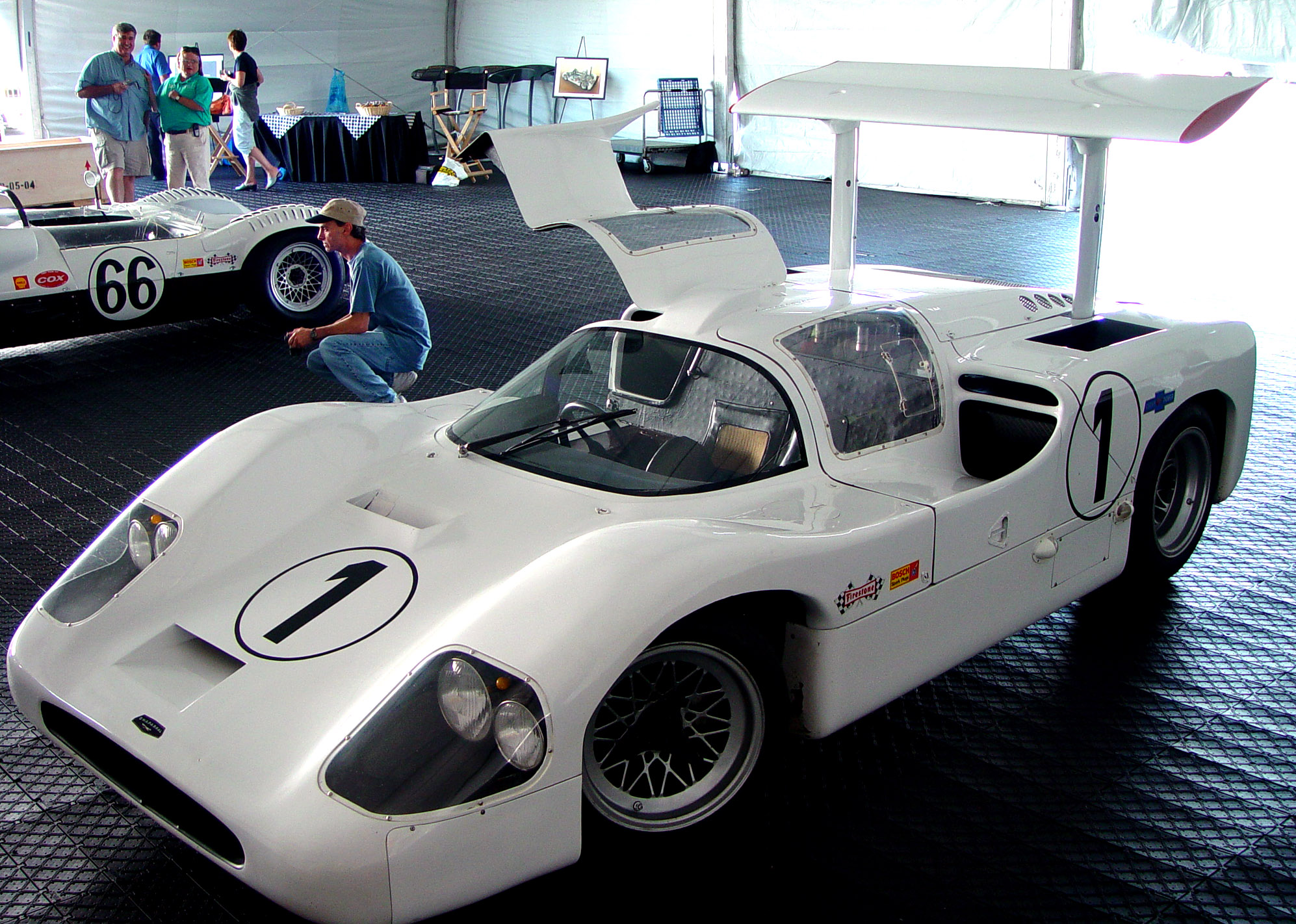
The Chaparral 2F is a Group 6 prototype designed by Jim Hall and Hap Sharp and built under their company Chaparral Cars. Built with the intention to compete in the World Sportscar Championship, it competed in the 1967 season, with a best finish of first at the BOAC 500, driven by Phil Hill and Mike Spence. The 2F, alongside its Can-Am sibling the 2E, had a heavy influence in dictating the direction of Formula One car design in the late 1960s and early 1970s. With the amounts of mechanical grip the car and tires could provide approaching their respective limits, there was a larger emphasis on aerodynamic efficiency with race car designer Colin Chapman quick to include them on his Formula One cars.
The importance and role of aerodynamics in motorsports was not particularly well understood in the 1960s; privateer Michael Mayer attempted what was the first implementation of an airfoil at the 1956 1000 km of Nürburgring with his Porsche 550. He mounted a wing just above the driving position, later being forced by scrutineers to remove it. Jim Hall of Chaparral Cars, with his degree from the California Institute of Technology in mechanical engineering, saw the potential in using lift-generating airplane wings as a means to generate downforce to increase the performance of his cars. Hall first realized the role of reversing lift-generating structures in the winter of 1963, where his first race car, the Chaparral 2, was experiencing issues with lift at the front of the car. As Hall experimented and changed the bodywork, he discovered that further modifying the bodywork to generate reverse lift, or downforce, could drastically improve lap times. The luxury of having a private racetrack nearby meant Hall's development of his aerodynamics progressed much more rapidly than that of other teams.
In 1965, Jim Hall, alongside colleagues at General Motors (GM), collaborated in experimenting with rear aero structures, which resulted in a small adjustable rear wickerbill being mounted onto the rear of Chaparral's 2C for the 1965 United States Road Racing Championship, where it proved to be highly successful. The 2C's rear wickerbill was adjustable by a third pedal within the driver's cockpit, and with that the 2C became the first racing car in the world to feature active aerodynamics.
The 2C's evolution in the 2 series, the 2E, took the concept even further, with a full-blown rear wing mounted at the rear of the chassis, high above the driving position. Another aerodynamic innovation was the changing of the radiator position from the front of the nose to the sides of the car, freeing up space at the front and allowing the nose to act as a miniature Venturi tunnel in one of the first uses of ground effect in motorsport, giving the car balance between front and rear downforce. The 2E would almost win the inaugural 1966 Can-Am season championship, having been narrowly defeated by John Surtees in a Lola T70. Jim Hall and Hap Sharp were encouraged by the 2E's results, which included a 1–2 finish at Laguna Seca.
With the success of the 2E in the Can-Am championship, Hall decided to implement his rear wing structure into the 2D's successor. The 2D was a closed-roof version of the Chaparral 2, which had been Chaparral's primary race car from 1963 to 1965 in the World Sportscar Championship (WSC). Introduced for the 1966 season of the WSC, the 2D was oft stricken with mechanical issues, with a single win coming at the 1966 1000 km of Nürburgring. The third original 2 chassis was converted into a single 2F, with the other 2D being converted into a 2F later on in the 1967 World Sportscar Championship season.
Hall's connection to Chevrolet began in 1962, at the unveiling of the Chevrolet Corvair Monza GT at Elkhart Lake, Wisconsin. The concept car's semi-monocoque piqued his interest, and thus began his relationship with Frank Winchell, the Monza GT's designer. Winchell was simultaneously running a program in his department at General Motors to develop a mid-engined version of the Chevrolet Corvette, featuring an automatic transaxle. Hall further courted GM when their research and development department requested to use his track, Rattlesnake Raceway, for testing after Ralph Nader published his book Unsafe at Any Speed: The Designed-In Dangers of the American Automobile in 1965, which alleged that the American automobile industry was ignoring safety features when designing cars. The relationship never extended to a full on factory-backed effort, with GM engineer Jim Musser saying "We stayed in the background because we weren't meant to be racing at the time. We never sponsored the Chaparral program with cash. We did provide bits and pieces, and they did lots of our testing, from which we both benefited." Among those "bits and pieces" was the transmission for the 2F, a Chevrolet automatic 3-speed transaxle, replacing the previous Cooper and Colotti manual transmissions they had previously used. Despite Musser's assertions that Chaparral was never officially or unofficially supported by GM, there still remained much speculation within the racing community as to what capacity Hall and Sharp were involved with GM.
The 2F did not carry over the 2E's aluminum tube-frame chassis, with Hall and Sharp instead opting to continue with the fiberglass semi-monocoque, and General Motors supplied Chaparral with Chevrolet's "Porcupine" 427 big-block V8 engine, and a 3-speed automatic transaxle. The 427-aluminum block was fitted with Weber 58IDM carburetors that allowed it to produce 392 kW (533 PS; 526 hp) at 6,000 rpm, far more power than the 427s found in production versions. The nose's Venturi-like structure was retained, along with the side-mounted radiators. The large rear wing struts were attached onto the suspension uprights, so that the downforce generated by the wing acted directly on the tires, shifting weight-bias rearwards too. The positioning of the radiators on the side also meant that a roof-mounted intake was no longer needed, with cold air flowing straight to the engine. With the longer endurance races of the World Sportscar Championship in mind, centerlock wheels also replaced the 2D's bolt-on wheels. Initially, only a single chassis was constructed, but a 2D that retired at the 1967 12 Hours of Sebring was later converted into a second 2F chassis. Like its previous iterations, the rear wing was hydraulically actuated by a third pedal within the driver's cockpit, with a high-downforce mode and a low-drag mode. A small luggage compartment was also included in the front of the car, which was required by Group 6 regulations.
The 2F debuted at the opening round of the 1967 World Sportscar Championship, the 1967 24 Hours of Daytona. It qualified second with a time of 1:55.36, close behind the pole-sitting Ford GT40 Mk II of Dan Gurney, and in front of numerous Ferraris entered, which included several factory-backed efforts along with several factory-backed Fords. Phil Hill led the early stages of the race, the 2F's downforce and power playing in Chaparral's favor on Daytona's steep banks. Hill later came in to change seats with Mike Spence, who handed the car back to Hill on the 88th lap. Hill's stint did not last long, when he came into turn six he ran over debris of segments of where the track had disintegrated, despite resurfacing attempts prior to the race. The following loss of traction caused Hill to strike the upper barrier on the infield banking twice, damaging several suspension components which were repaired when Hill limped back to the pitlane. The 2F came out for a few more laps, but eventually retired four hours into the race. Hill partially took the blame for the crash, citing his excessive exit speed from turn six, however, mentioned that Spence failed to inform him of the conditions at turn six. Prior to retiring, Hill did manage to capture the fastest lap, almost equalling his qualifying time with a 1:55.69.
Hub AI
Chaparral 2F AI simulator
(@Chaparral 2F_simulator)
Chaparral 2F
The Chaparral 2F is a Group 6 prototype designed by Jim Hall and Hap Sharp and built under their company Chaparral Cars. Built with the intention to compete in the World Sportscar Championship, it competed in the 1967 season, with a best finish of first at the BOAC 500, driven by Phil Hill and Mike Spence. The 2F, alongside its Can-Am sibling the 2E, had a heavy influence in dictating the direction of Formula One car design in the late 1960s and early 1970s. With the amounts of mechanical grip the car and tires could provide approaching their respective limits, there was a larger emphasis on aerodynamic efficiency with race car designer Colin Chapman quick to include them on his Formula One cars.
The importance and role of aerodynamics in motorsports was not particularly well understood in the 1960s; privateer Michael Mayer attempted what was the first implementation of an airfoil at the 1956 1000 km of Nürburgring with his Porsche 550. He mounted a wing just above the driving position, later being forced by scrutineers to remove it. Jim Hall of Chaparral Cars, with his degree from the California Institute of Technology in mechanical engineering, saw the potential in using lift-generating airplane wings as a means to generate downforce to increase the performance of his cars. Hall first realized the role of reversing lift-generating structures in the winter of 1963, where his first race car, the Chaparral 2, was experiencing issues with lift at the front of the car. As Hall experimented and changed the bodywork, he discovered that further modifying the bodywork to generate reverse lift, or downforce, could drastically improve lap times. The luxury of having a private racetrack nearby meant Hall's development of his aerodynamics progressed much more rapidly than that of other teams.
In 1965, Jim Hall, alongside colleagues at General Motors (GM), collaborated in experimenting with rear aero structures, which resulted in a small adjustable rear wickerbill being mounted onto the rear of Chaparral's 2C for the 1965 United States Road Racing Championship, where it proved to be highly successful. The 2C's rear wickerbill was adjustable by a third pedal within the driver's cockpit, and with that the 2C became the first racing car in the world to feature active aerodynamics.
The 2C's evolution in the 2 series, the 2E, took the concept even further, with a full-blown rear wing mounted at the rear of the chassis, high above the driving position. Another aerodynamic innovation was the changing of the radiator position from the front of the nose to the sides of the car, freeing up space at the front and allowing the nose to act as a miniature Venturi tunnel in one of the first uses of ground effect in motorsport, giving the car balance between front and rear downforce. The 2E would almost win the inaugural 1966 Can-Am season championship, having been narrowly defeated by John Surtees in a Lola T70. Jim Hall and Hap Sharp were encouraged by the 2E's results, which included a 1–2 finish at Laguna Seca.
With the success of the 2E in the Can-Am championship, Hall decided to implement his rear wing structure into the 2D's successor. The 2D was a closed-roof version of the Chaparral 2, which had been Chaparral's primary race car from 1963 to 1965 in the World Sportscar Championship (WSC). Introduced for the 1966 season of the WSC, the 2D was oft stricken with mechanical issues, with a single win coming at the 1966 1000 km of Nürburgring. The third original 2 chassis was converted into a single 2F, with the other 2D being converted into a 2F later on in the 1967 World Sportscar Championship season.
Hall's connection to Chevrolet began in 1962, at the unveiling of the Chevrolet Corvair Monza GT at Elkhart Lake, Wisconsin. The concept car's semi-monocoque piqued his interest, and thus began his relationship with Frank Winchell, the Monza GT's designer. Winchell was simultaneously running a program in his department at General Motors to develop a mid-engined version of the Chevrolet Corvette, featuring an automatic transaxle. Hall further courted GM when their research and development department requested to use his track, Rattlesnake Raceway, for testing after Ralph Nader published his book Unsafe at Any Speed: The Designed-In Dangers of the American Automobile in 1965, which alleged that the American automobile industry was ignoring safety features when designing cars. The relationship never extended to a full on factory-backed effort, with GM engineer Jim Musser saying "We stayed in the background because we weren't meant to be racing at the time. We never sponsored the Chaparral program with cash. We did provide bits and pieces, and they did lots of our testing, from which we both benefited." Among those "bits and pieces" was the transmission for the 2F, a Chevrolet automatic 3-speed transaxle, replacing the previous Cooper and Colotti manual transmissions they had previously used. Despite Musser's assertions that Chaparral was never officially or unofficially supported by GM, there still remained much speculation within the racing community as to what capacity Hall and Sharp were involved with GM.
The 2F did not carry over the 2E's aluminum tube-frame chassis, with Hall and Sharp instead opting to continue with the fiberglass semi-monocoque, and General Motors supplied Chaparral with Chevrolet's "Porcupine" 427 big-block V8 engine, and a 3-speed automatic transaxle. The 427-aluminum block was fitted with Weber 58IDM carburetors that allowed it to produce 392 kW (533 PS; 526 hp) at 6,000 rpm, far more power than the 427s found in production versions. The nose's Venturi-like structure was retained, along with the side-mounted radiators. The large rear wing struts were attached onto the suspension uprights, so that the downforce generated by the wing acted directly on the tires, shifting weight-bias rearwards too. The positioning of the radiators on the side also meant that a roof-mounted intake was no longer needed, with cold air flowing straight to the engine. With the longer endurance races of the World Sportscar Championship in mind, centerlock wheels also replaced the 2D's bolt-on wheels. Initially, only a single chassis was constructed, but a 2D that retired at the 1967 12 Hours of Sebring was later converted into a second 2F chassis. Like its previous iterations, the rear wing was hydraulically actuated by a third pedal within the driver's cockpit, with a high-downforce mode and a low-drag mode. A small luggage compartment was also included in the front of the car, which was required by Group 6 regulations.
The 2F debuted at the opening round of the 1967 World Sportscar Championship, the 1967 24 Hours of Daytona. It qualified second with a time of 1:55.36, close behind the pole-sitting Ford GT40 Mk II of Dan Gurney, and in front of numerous Ferraris entered, which included several factory-backed efforts along with several factory-backed Fords. Phil Hill led the early stages of the race, the 2F's downforce and power playing in Chaparral's favor on Daytona's steep banks. Hill later came in to change seats with Mike Spence, who handed the car back to Hill on the 88th lap. Hill's stint did not last long, when he came into turn six he ran over debris of segments of where the track had disintegrated, despite resurfacing attempts prior to the race. The following loss of traction caused Hill to strike the upper barrier on the infield banking twice, damaging several suspension components which were repaired when Hill limped back to the pitlane. The 2F came out for a few more laps, but eventually retired four hours into the race. Hill partially took the blame for the crash, citing his excessive exit speed from turn six, however, mentioned that Spence failed to inform him of the conditions at turn six. Prior to retiring, Hill did manage to capture the fastest lap, almost equalling his qualifying time with a 1:55.69.
Recent media