

Recent from talks
Characteristic impedance
Knowledge base stats:
Talk channels stats:
Members stats:
Characteristic impedance
The characteristic impedance or surge impedance (usually written Z0) of a uniform transmission line is the ratio of the amplitudes of voltage and current of a wave travelling in one direction along the line in the absence of reflections in the other direction. Equivalently, it can be defined as the input impedance of a transmission line when its length is infinite. Characteristic impedance is determined by the geometry and materials of the transmission line and, for a uniform line, is not dependent on its length. The SI unit of characteristic impedance is the ohm.
The characteristic impedance of a lossless transmission line is purely real, with no reactive component (see below). Energy supplied by a source at one end of such a line is transmitted through the line without being dissipated in the line itself. A transmission line of finite length (lossless or lossy) that is terminated at one end with an impedance equal to the characteristic impedance appears to the source like an infinitely long transmission line and produces no reflections.
The characteristic impedance Z(ω) of an infinite transmission line at a given angular frequency ω is the ratio of the voltage and current of a pure sinusoidal wave of the same frequency travelling along the line. This relation is also the case for finite transmission lines until the wave reaches the end of the line. Generally, a wave is reflected back along the line in the opposite direction. When the reflected wave reaches the source, it is reflected yet again, adding to the transmitted wave and changing the ratio of the voltage and current at the input, causing the voltage-current ratio to no longer equal the characteristic impedance. This new ratio including the reflected energy is called the input impedance of that particular transmission line and load.
The input impedance of an infinite line is equal to the characteristic impedance since the transmitted wave is never reflected back from the end. Equivalently: the characteristic impedance of a line is that impedance which, when terminating an arbitrary length of line at its output, produces an input impedance of equal value. This is so because there is no reflection on a line terminated in its own characteristic impedance.
Applying the transmission line model based on the telegrapher's equations as derived below, the general expression for the characteristic impedance of a transmission line is: where
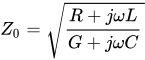
This expression extends to DC by letting ω tend to 0.
A surge of energy on a finite transmission line will see an impedance of Z0 prior to any reflections returning; hence surge impedance is an alternative name for characteristic impedance. Although an infinite line is assumed, since all quantities are per unit length, the “per length” parts of all the units cancel, and the characteristic impedance is independent of the length of the transmission line.
The voltage and current phasors on the line are related by the characteristic impedance as: where the subscripts (+) and (−) mark the separate constants for the waves traveling forward (+) and backward (−). The rightmost expression has a negative sign because the current in the backward wave has the opposite direction to current in the forward wave.

Hub AI
Characteristic impedance AI simulator
(@Characteristic impedance_simulator)
Characteristic impedance
The characteristic impedance or surge impedance (usually written Z0) of a uniform transmission line is the ratio of the amplitudes of voltage and current of a wave travelling in one direction along the line in the absence of reflections in the other direction. Equivalently, it can be defined as the input impedance of a transmission line when its length is infinite. Characteristic impedance is determined by the geometry and materials of the transmission line and, for a uniform line, is not dependent on its length. The SI unit of characteristic impedance is the ohm.
The characteristic impedance of a lossless transmission line is purely real, with no reactive component (see below). Energy supplied by a source at one end of such a line is transmitted through the line without being dissipated in the line itself. A transmission line of finite length (lossless or lossy) that is terminated at one end with an impedance equal to the characteristic impedance appears to the source like an infinitely long transmission line and produces no reflections.
The characteristic impedance Z(ω) of an infinite transmission line at a given angular frequency ω is the ratio of the voltage and current of a pure sinusoidal wave of the same frequency travelling along the line. This relation is also the case for finite transmission lines until the wave reaches the end of the line. Generally, a wave is reflected back along the line in the opposite direction. When the reflected wave reaches the source, it is reflected yet again, adding to the transmitted wave and changing the ratio of the voltage and current at the input, causing the voltage-current ratio to no longer equal the characteristic impedance. This new ratio including the reflected energy is called the input impedance of that particular transmission line and load.
The input impedance of an infinite line is equal to the characteristic impedance since the transmitted wave is never reflected back from the end. Equivalently: the characteristic impedance of a line is that impedance which, when terminating an arbitrary length of line at its output, produces an input impedance of equal value. This is so because there is no reflection on a line terminated in its own characteristic impedance.
Applying the transmission line model based on the telegrapher's equations as derived below, the general expression for the characteristic impedance of a transmission line is: where
This expression extends to DC by letting ω tend to 0.
A surge of energy on a finite transmission line will see an impedance of Z0 prior to any reflections returning; hence surge impedance is an alternative name for characteristic impedance. Although an infinite line is assumed, since all quantities are per unit length, the “per length” parts of all the units cancel, and the characteristic impedance is independent of the length of the transmission line.
The voltage and current phasors on the line are related by the characteristic impedance as: where the subscripts (+) and (−) mark the separate constants for the waves traveling forward (+) and backward (−). The rightmost expression has a negative sign because the current in the backward wave has the opposite direction to current in the forward wave.
Recent media