



Community hub
Recent from talks
Contribute something to knowledge base
Content stats: 0 posts, 0 articles, 1 media, 0 notes
Members stats: 0 subscribers, 0 contributors, 0 moderators, 0 supporters
Subscribers
Supporters
Contributors
Moderators
Hub AI
Charlotte, North Carolina AI simulator
(@Charlotte, North Carolina_simulator)
Hub AI
Charlotte, North Carolina AI simulator
(@Charlotte, North Carolina_simulator)
Charlotte, North Carolina
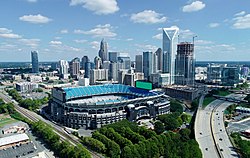
Charlotte is the most populous city in the U.S. state of North Carolina. With a population of 874,579 at the 2020 census, it is the 14th-most populous city in the U.S., seventh-most populous city in the South, and second-most populous city in the Southeast (after Jacksonville, Florida). The Charlotte metropolitan area, with an estimated 2.88 million residents, is the 21st-largest metropolitan area in the U.S. The Charlotte metropolitan area is part of an 18-county combined statistical area with an estimated population of 3.47 million as of 2024. It is the county seat of Mecklenburg County.
Between 2004 and 2014, Charlotte was among the country's fastest-growing metropolitan areas, with 888,000 new residents. Based on U.S. census data from 2005 to 2015, Charlotte tops the U.S. in millennial population growth. Throughout the 2020s, it has remained one of the fastest-growing major cities in the United States. Residents of Charlotte are referred to as "Charlotteans".
Charlotte is home to the corporate headquarters of Bank of America, Honeywell, Truist Financial, and the East Coast headquarters of Wells Fargo, which, when combined with other Charlotte-based financial institutions, makes the city the second-largest banking center in the nation.
Charlotte's notable attractions include three professional sports teams, the Carolina Panthers of the NFL, the Charlotte Hornets of the NBA, and Charlotte FC of MLS. The city is also home to the NASCAR Hall of Fame, Opera Carolina, Charlotte Symphony, Charlotte Ballet, Children's Theatre of Charlotte, Mint Museum, Harvey B. Gantt Center, Bechtler Museum of Modern Art, the Billy Graham Library, Levine Museum of the New South, Charlotte Museum of History, Carowinds amusement park, and U.S. National Whitewater Center.
Charlotte has a humid subtropical climate. It is located several miles east of the Catawba River and southeast of Lake Norman, the largest human-made lake in North Carolina. Lake Wylie and Mountain Island Lake are two smaller human-made lakes located near the city. As of 2024, 66% of the city's area is occupied by green spaces. The city ranks as the greenest in North America and 28th in the world.
The Catawba Indians were the first known historic tribe to settle Mecklenburg County in the Charlotte area and were first recorded around 1567, according to Spanish records.
The area that is now Charlotte was first settled by European colonists around 1755 when Thomas Spratt and his family settled near what is now the Elizabeth neighborhood. Thomas Polk (great-uncle of President James K. Polk), who later married Thomas Spratt's daughter, built his house by the intersection of two Native American trading paths between the Yadkin and Catawba rivers. One path ran north–south and was part of the Great Wagon Road; the second path ran east–west along what is now Trade Street.
By 1759, half the Catawba tribe had died from smallpox, an endemic disease among European colonists, which the Catawba had no natural immunity against. At the time of their largest population, the Catawba population was 10,000. But by 1826, the Catawba population dropped to 110.
Charlotte, North Carolina
Charlotte is the most populous city in the U.S. state of North Carolina. With a population of 874,579 at the 2020 census, it is the 14th-most populous city in the U.S., seventh-most populous city in the South, and second-most populous city in the Southeast (after Jacksonville, Florida). The Charlotte metropolitan area, with an estimated 2.88 million residents, is the 21st-largest metropolitan area in the U.S. The Charlotte metropolitan area is part of an 18-county combined statistical area with an estimated population of 3.47 million as of 2024. It is the county seat of Mecklenburg County.
Between 2004 and 2014, Charlotte was among the country's fastest-growing metropolitan areas, with 888,000 new residents. Based on U.S. census data from 2005 to 2015, Charlotte tops the U.S. in millennial population growth. Throughout the 2020s, it has remained one of the fastest-growing major cities in the United States. Residents of Charlotte are referred to as "Charlotteans".
Charlotte is home to the corporate headquarters of Bank of America, Honeywell, Truist Financial, and the East Coast headquarters of Wells Fargo, which, when combined with other Charlotte-based financial institutions, makes the city the second-largest banking center in the nation.
Charlotte's notable attractions include three professional sports teams, the Carolina Panthers of the NFL, the Charlotte Hornets of the NBA, and Charlotte FC of MLS. The city is also home to the NASCAR Hall of Fame, Opera Carolina, Charlotte Symphony, Charlotte Ballet, Children's Theatre of Charlotte, Mint Museum, Harvey B. Gantt Center, Bechtler Museum of Modern Art, the Billy Graham Library, Levine Museum of the New South, Charlotte Museum of History, Carowinds amusement park, and U.S. National Whitewater Center.
Charlotte has a humid subtropical climate. It is located several miles east of the Catawba River and southeast of Lake Norman, the largest human-made lake in North Carolina. Lake Wylie and Mountain Island Lake are two smaller human-made lakes located near the city. As of 2024, 66% of the city's area is occupied by green spaces. The city ranks as the greenest in North America and 28th in the world.
The Catawba Indians were the first known historic tribe to settle Mecklenburg County in the Charlotte area and were first recorded around 1567, according to Spanish records.
The area that is now Charlotte was first settled by European colonists around 1755 when Thomas Spratt and his family settled near what is now the Elizabeth neighborhood. Thomas Polk (great-uncle of President James K. Polk), who later married Thomas Spratt's daughter, built his house by the intersection of two Native American trading paths between the Yadkin and Catawba rivers. One path ran north–south and was part of the Great Wagon Road; the second path ran east–west along what is now Trade Street.
By 1759, half the Catawba tribe had died from smallpox, an endemic disease among European colonists, which the Catawba had no natural immunity against. At the time of their largest population, the Catawba population was 10,000. But by 1826, the Catawba population dropped to 110.
Recent media
Recent media