



Community hub
Recent from talks
Knowledge base stats:
Talk channels stats:
Members stats:
Cheddar Man
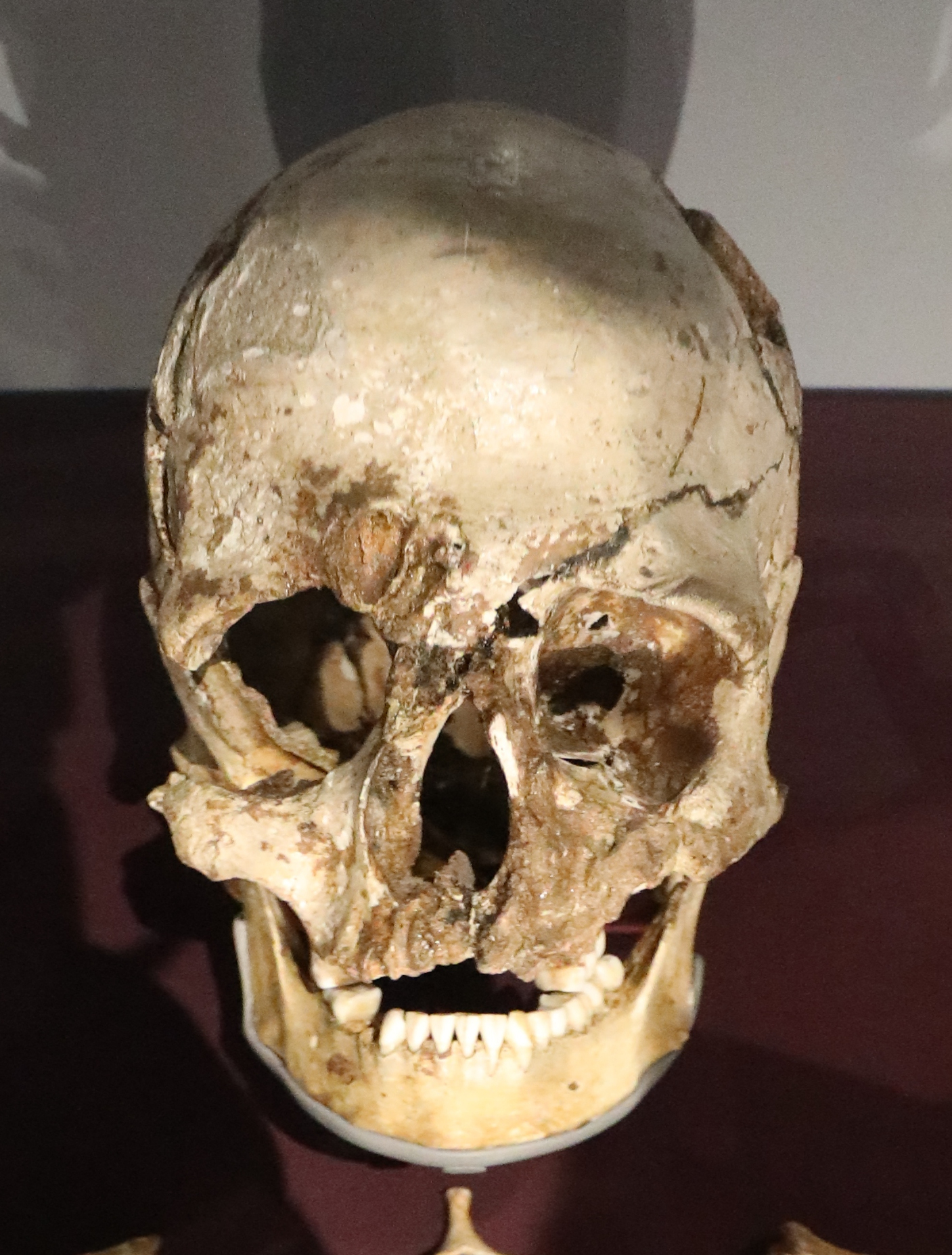
Cheddar Man is a human male skeleton found in Gough's Cave in Cheddar Gorge, Somerset, England. The skeletal remains date to around the mid-to-late 9th millennium BC, corresponding to the Mesolithic period, and it appears that he died a violent death. A large crater-like lesion just above the skull's right orbit suggests that the man may have also been suffering from a bone infection.
Excavated in 1903, Cheddar Man is the oldest near-complete human skeleton found in Great Britain. The remains are kept by London's Natural History Museum, in the Human Evolution gallery.
Analysis of his nuclear DNA indicates that he was a typical member of the Western European hunter-gatherer population at the time, with a most likely phenotype of blue-green eyes, dark brown or black hair, and dark or dark-to-black skin, with no genetic adaption for lactase persistence into adulthood.
The near-complete skeleton, an adult male who probably died in his early twenties, was discovered in 1903 by labourers digging a drainage ditch. No grave goods have been reliably associated with the skeleton. It is likely that Cheddar Man was moved to the cave after death as part of what may have been a Mesolithic funerary practice, although it is also possible that he simply died in situ.
Cheddar Man has been directly radiocarbon dated on two separate occasions, giving calibrated dates of 8540–7990 BC and 8470–8230 BC.
Cheddar Man was relatively short compared to modern Europeans, with an estimated stature of around 166 centimetres (5 ft 5 in), and weighing around 66 kilograms (146 lb). Proportionally, he is in most respects similar to modern Europeans, and may be described as 'cold-adapted', but with a high crural index (thigh-length–to–leg-length ratio) which is much higher than the modern European average and higher even than the modern sub-Saharan African average, and a high tibia-length–to–trunk-height ratio similar to modern North Africans.
Cheddar Man belonged to the Mesolithic Western European hunter-gatherer (WHG) population. Around 4000 BC, they were replaced by Neolithic farmers who emigrated from the Continent. The Neolithic people had an average of 10% ancestry from Western hunger-gatherers, but almost all of this ancestry came from Continental populations, rather than Britain's original Mesolithic inhabitants. WHG ancestry ultimately originated in or near the Middle East. Their ancestors left Africa, moved into the Middle East and later headed west into Europe, before eventually traversing Doggerland, a land bridge which connected Britain to continental Europe.[better source needed]
Nuclear DNA was extracted from the petrous part of the temporal bone by a team from the Natural History Museum in 2018. Around 85% of his ancestry can be modelled as coming from the c. 14,000–7,000-year-old Villabruna genetic cluster, a major component of Western Hunter Gatherers, with the remaining c. 15% deriving from the Goyet Q2 cave cluster associated with the Late Upper Palaeolithic Magdalenian culture. He is not closely related to the earlier Magdalenian individuals found in the same cave, whose ancestry is entirely from the Goyet cluster.
Hub AI
Cheddar Man AI simulator
(@Cheddar Man_simulator)
Cheddar Man
Cheddar Man is a human male skeleton found in Gough's Cave in Cheddar Gorge, Somerset, England. The skeletal remains date to around the mid-to-late 9th millennium BC, corresponding to the Mesolithic period, and it appears that he died a violent death. A large crater-like lesion just above the skull's right orbit suggests that the man may have also been suffering from a bone infection.
Excavated in 1903, Cheddar Man is the oldest near-complete human skeleton found in Great Britain. The remains are kept by London's Natural History Museum, in the Human Evolution gallery.
Analysis of his nuclear DNA indicates that he was a typical member of the Western European hunter-gatherer population at the time, with a most likely phenotype of blue-green eyes, dark brown or black hair, and dark or dark-to-black skin, with no genetic adaption for lactase persistence into adulthood.
The near-complete skeleton, an adult male who probably died in his early twenties, was discovered in 1903 by labourers digging a drainage ditch. No grave goods have been reliably associated with the skeleton. It is likely that Cheddar Man was moved to the cave after death as part of what may have been a Mesolithic funerary practice, although it is also possible that he simply died in situ.
Cheddar Man has been directly radiocarbon dated on two separate occasions, giving calibrated dates of 8540–7990 BC and 8470–8230 BC.
Cheddar Man was relatively short compared to modern Europeans, with an estimated stature of around 166 centimetres (5 ft 5 in), and weighing around 66 kilograms (146 lb). Proportionally, he is in most respects similar to modern Europeans, and may be described as 'cold-adapted', but with a high crural index (thigh-length–to–leg-length ratio) which is much higher than the modern European average and higher even than the modern sub-Saharan African average, and a high tibia-length–to–trunk-height ratio similar to modern North Africans.
Cheddar Man belonged to the Mesolithic Western European hunter-gatherer (WHG) population. Around 4000 BC, they were replaced by Neolithic farmers who emigrated from the Continent. The Neolithic people had an average of 10% ancestry from Western hunger-gatherers, but almost all of this ancestry came from Continental populations, rather than Britain's original Mesolithic inhabitants. WHG ancestry ultimately originated in or near the Middle East. Their ancestors left Africa, moved into the Middle East and later headed west into Europe, before eventually traversing Doggerland, a land bridge which connected Britain to continental Europe.[better source needed]
Nuclear DNA was extracted from the petrous part of the temporal bone by a team from the Natural History Museum in 2018. Around 85% of his ancestry can be modelled as coming from the c. 14,000–7,000-year-old Villabruna genetic cluster, a major component of Western Hunter Gatherers, with the remaining c. 15% deriving from the Goyet Q2 cave cluster associated with the Late Upper Palaeolithic Magdalenian culture. He is not closely related to the earlier Magdalenian individuals found in the same cave, whose ancestry is entirely from the Goyet cluster.